@stratdepth Thank you for your writings and observations on this event. I was not able to attend so this series of posts gave me a way to connect to what I missed. Much appreciated.
@PeterBell@vboykis I've experienced something similar. For me, any more than 3 agents and it becomes difficult to context switch and work-volume begins to saturate.
The Dream Stele. Two orientations of the same sphinx. State 1 and State 2. "Thus in the period of eleven thousand three hundred and forty years they said that there had arisen no god in human form; nor even before that time or afterwards among the remaining kings who arose in Egypt, did they report that anything of that kind had come to pass. In this time they said that the sun had moved four times from his accustomed place of rising, and where he now sets he had thence twice had his rising, and in the place from whence he now rises he had twice had his setting." - Herodotus
[1] https://t.co/wBC6A9rquz
[2] https://t.co/PJaDfKlGEh
[3] https://t.co/Qqz0Y2sOPY
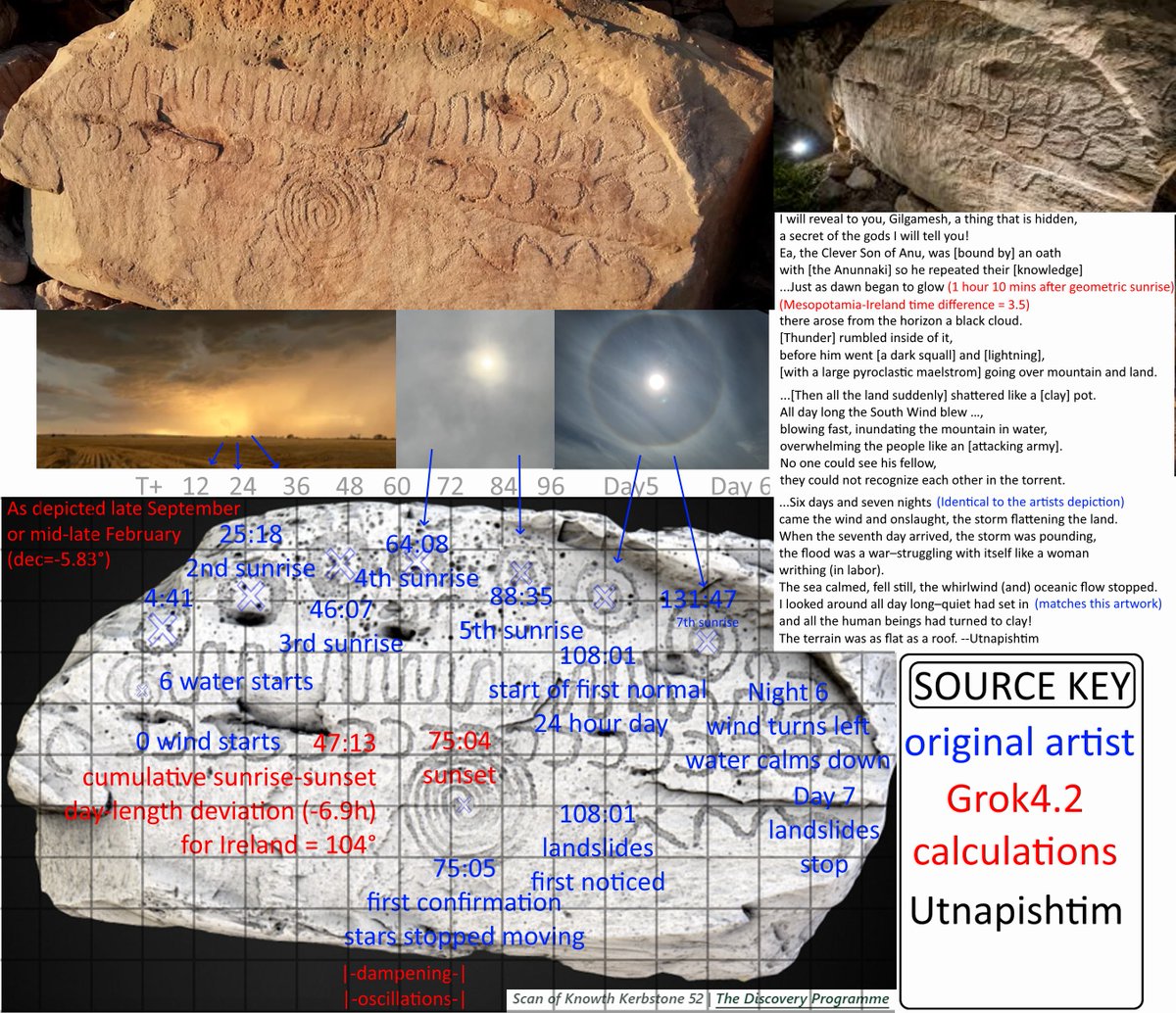
Kerbstone 52 Decoded!
Utnapishtim's story is corroborated.
The observed start and stop times are marked with spirals.
The documented event is calculated to last 47 hours and 13 minutes using only the blue text from this image. The exact times of sunrise combined with the location and approximate year are the primary enablers of this calculation.
The documented event was directly observed to last up to 75 hours and 4 minutes if you include dampening oscillations. It might be shorter; it was daytime in Ireland when the stars fully stopped changing so they couldn't tell.
The blue text was obtained by measuring pixels and obvious symbols.
The grey grid was obtained by knowing that a day must last 24 hours once all extra movement stops.
@EthicalSkeptic This perspective is at the foundation of my pedagogy as an instructor. I’ve been teaching this to my freshman engineering students in Introduction to Engineering for four semesters now. Many have expressed to me how valuable that lecture was to them.
As AI dissolves education’s dependence on trivia, memorization, formulaic procedures, rubric compliance, and procedural box-checking, the system faces a far more difficult challenge: determining who can actually think, reason, synthesize, and create - rather than simply who excels at executive administration and instruction-following.
This is why so many A-students fail to deliver their promised potential. They simply learned how to be good administrators, following the exacting rules of their extraction cronies, with no heart for their employees, industry, or social ethics. They are empty, devoid of resources for when the sh*t hits the fan.
Getting an 'A' by perfectly following procedural rules is rapidly becoming a low-signal achievement in an AI-saturated world, because machines are already better than most humans at compliance, formatting, memorization, fact assimilation, and finishing speed.
What becomes scarce (and therefore more valuable) is independent judgment: the ability to perceive contradictions, ask non-obvious questions, reason through ambiguity, challenge assumptions, create original frameworks, and arrive at conclusions that were not pre-scripted by institutional incentives.
https://t.co/53ljXUPCBD
How far have we had to fall as a society where we had this in 1985 and now we just have same colored block cars from every manufacturer that has a bad ipad as the main feature






![nobulart's tweet photo. The Dream Stele. Two orientations of the same sphinx. State 1 and State 2. "Thus in the period of eleven thousand three hundred and forty years they said that there had arisen no god in human form; nor even before that time or afterwards among the remaining kings who arose in Egypt, did they report that anything of that kind had come to pass. In this time they said that the sun had moved four times from his accustomed place of rising, and where he now sets he had thence twice had his rising, and in the place from whence he now rises he had twice had his setting." - Herodotus
[1] https://t.co/wBC6A9rquz
[2] https://t.co/PJaDfKlGEh
[3] https://t.co/Qqz0Y2sOPY](https://pbs.twimg.com/media/HItHPI6XAAEWAxn.jpg)