I am so proud of you, Bukayo. 🥹
Bukayo Saka. 2026 Socrates Award winner.
🏥 Funded 120 life-changing surgeries for children in Nigeria
🌍 Sponsored 100 pediatric surgeries across Kenya, Rwanda & Tanzania
🇹🇷 Housed 26 displaced families after the Turkey earthquake
🇲🇦 Built a village shelter for 255 people in Morocco
🎒 Donated 1,000+ school uniforms to families in West London
🎓 Funded academic scholarships for 20 international students
A fly that died years ago is flying around a harbor that doesn't exist.
Here's what's going on. Scientists took one female fruit fly and sliced its brain into about 7,000 pieces, each roughly 2,000 times thinner than a human hair. They photographed those slices 21 million times under an electron microscope. Then hundreds of people spent years tracing every connection by hand until they had the whole thing, all 139,255 neurons and 54.5 million synapses. That map is called FlyWire. Odyssey hasn't said exactly which map it used, but FlyWire is the one most of these projects build on.
Earlier this year a startup called Eon ran that map as a simulation with zero training and got a virtual fly that walks and grooms on its own.
Now Odyssey has put the brain somewhere new. The harbor in this clip isn't sitting on a server as a 3D model or a game level. Odyssey-3 is a 14-billion-parameter AI that learned how water and light behave by watching a ton of video, and it invents each frame as the fly steers through it.
This is kind of a big deal for a nerdy reason. For as long as people have tried to build a mind, there have been two camps. One says copy a real brain. The other says train a giant model on tons of data. Those camps have mostly fought each other, and in this clip one is living inside the other.
And here's a fun bit of math. The fly has 54.5 million synapses. The AI dreaming up its world has 14 billion parameters. Line those up and the world is about 250 times bigger than the brain living in it.
That's what happens when one approach rides on GPUs and the other rides on grad students with microscopes. The trained side ballooned in a couple of years. The copied side took the better part of a decade to get one fly.
What really got me is how little it takes to fool a fly. A fruit fly sees through about 800 tiny lenses per eye, so its whole view of the world is around 1,600 pixels. Each of your eyes sends about a million nerve fibers to your brain. Keeping a fly convinced means the AI only has to look right across 1,600 pixels, which is a pretty low bar, and it's clearing it.
The fake world will look good enough for human eyes long before anybody can slice up a human brain and rebuild all 86 billion neurons.
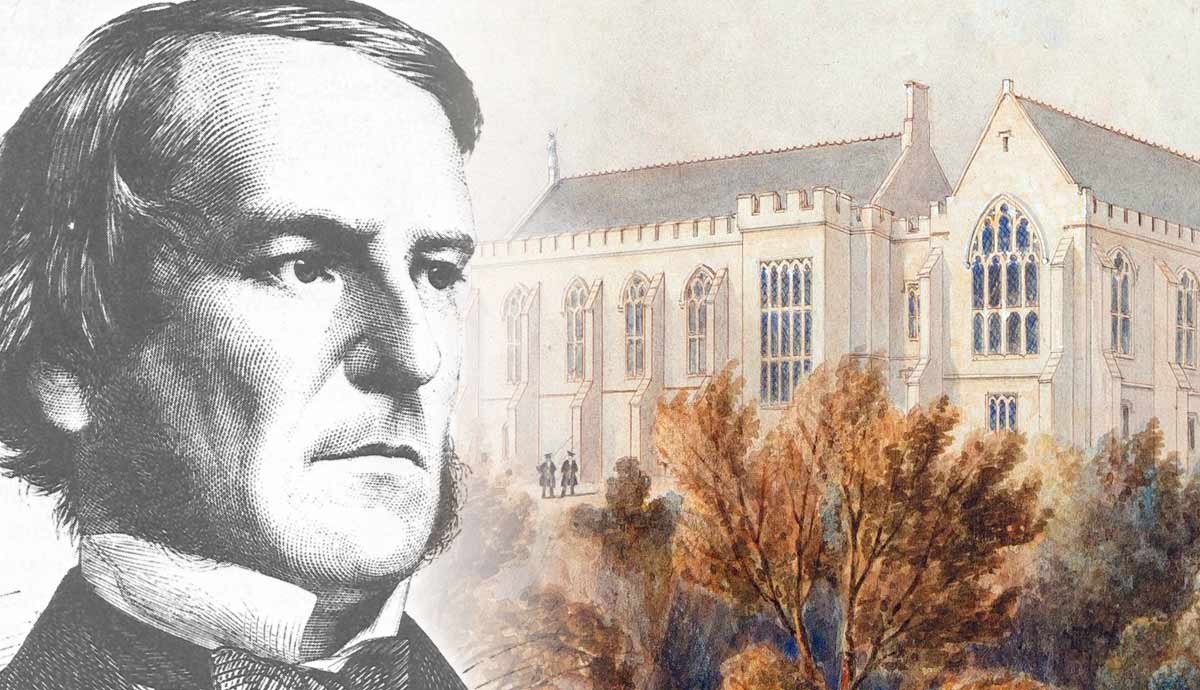
A shoemaker's son who left school at 16 wrote a book in 1854 that nobody knew what to do with, and 83 years later a 21-year-old at MIT opened it and found the blueprint for every computer chip on Earth.
I went down this rabbit hole at 1am and I still can't get over how thin the thread is.
His name was George Boole. The book is called The Laws of Thought.
Boole never went to university. Not for a single day.
His father fixed shoes in Lincoln, England, and spent his spare money on telescopes and math books instead of the shop. The shop failed. At 16, George started teaching just to feed the family.
So he taught himself everything else at night.
At 14 he translated an ancient Greek poem into English. A local paper printed it. A schoolmaster wrote in to say no boy that age could have done it.
By 1849, a university in Ireland made him its first professor of mathematics. A man with no degree, now handing them out.
Then he asked a strange question. What if thinking follows rules, the same way numbers do?
Every argument you've ever had is built from statements that are either true or false. "It's raining." "I have an umbrella." Boole wanted to do math on those, the way you do math on 2 and 3.
So he built an algebra with only two numbers.
- 1 means true
- 0 means false
- AND works like multiplying
- OR joins two ideas together
- NOT flips one into the other
The whole system rested on one odd little equation. x times x equals x.
Try it with any normal number and it breaks. 5 times 5 is not 5. It only works for two numbers in the entire universe. Zero and one.
"Let us conceive, then, of an Algebra in which the symbols x, y, z, &c. admit indifferently of the values 0 and 1, and of these values alone."
That's Boole, in 1854.
Mathematicians found it clever. Philosophers argued about it. Nobody built a single thing with it.
Boole died ten years later at 49, after walking two miles to a lecture in pouring rain. He never saw his idea do anything useful.
Jump to 1936.
A 20-year-old named Claude Shannon is working on a giant calculating machine at MIT. It's packed with relays, little electrical switches that click open and shut. Wiring them together is mostly guesswork.
But Shannon had taken a philosophy class back at the University of Michigan. It covered Boole.
He looked at the switches and saw the 1s and 0s.
- A closed switch lets current through. That's 1.
- An open switch blocks it. That's 0.
- Two switches in a row only pass current if both are closed. That's AND.
- Two switches side by side pass current if either one is closed. That's OR.
Boole's algebra of thought was also an algebra of electricity. Same rules. Same two numbers.
Shannon wrote it up as his master's thesis in 1937. The psychologist Howard Gardner later called it possibly the most important master's thesis of the century.
Shannon just shrugged.
"It just happened that no one else was familiar with both fields at the same time."
Sit with that for a second. The idea was sitting in a library for 83 years. It only needed one person who happened to be standing in two rooms at once.
The phone in your hand holds billions of those switches. Every photo, every text, every AI answer is them flipping between 1 and 0, following rules a self-taught teacher wrote down before the light bulb existed.
Boole thought he was writing down how the human mind works.
He ended up writing down how machines would think.
Exactly 37 years ago on October 3, 1989, a game was released that took the world by storm.
Prince of Persia (by Jordan Mechner) had such fluid and lifelike animations, that gamer-jaws were dropping left, right, and center. Rightfully so. But that alone wouldn’t have made the game such a massive hit and gaming-culture icon, I think.
Prince of Persia also popularized the “cinematic platformer” genre (Karateka, Mechner’s earlier game, introduced it, though on a much smaller scale), with its immersive atmosphere, deadly falls and traps, and a real sense of weight and physics in movement. Jumps and sword swings had to be timed precisely; mistiming felt punishing but realistic, and also far less cartoonish than typical platformers.
It wasn’t just a straight left-to-right platformer either. You had to go back and forth, open pathways through hidden mechanisms, and more. It always felt like it had some Indiana Jones moments with adventure and exploration elements.
The one-on-one duels were more tactical than button-mashy, again diverging from the arcade-style norm of other platformers. You had to read your opponent’s stance, parry, and strike at the right moment. Brains over brawn.
The sense of realism is ultimately what set it apart from the stereotypical platform genre of that era. Prince of Persia felt more “human,” had greater story depth, and made you think, not just react. You could argue that it paved the way for Another World, Flashback and other greats of the 90s.
Mechner is one of the very few true pioneers of gaming history.
Extraordinary scene in the Atacama desert of South America.
Historically one of the world's driest locations has been completely transformed by heavy El Nino rain, leading to the proliferation of stunning flowers from long-dormant seeds.