Open enrollment is far from a wrecking ball. It is a policy that helps schools and families, serving as a release valve for students stuck in public schools that are not the right fit, allowing them to choose other public schools that better meet their needs.
https://t.co/FUWszYVUkb
K–12 open enrollment empowers families to match their children with schools that best fit their goals and needs. In Iowa, families attributed their transfers to differences in academic and extracurricular offerings, safety, and convenience, with many also prioritizing welcoming, diverse schools.
https://t.co/Z2NY5GhFXy
As public school choice expands across the country, new data show a clear pattern: families are using open enrollment to move their children to higher-performing districts, writes @JudeSchwalbach.
https://t.co/vsgWPOfZEh
The Kill Switch was pitched to Congress as a way to stop drunk driving—but its real-world implications are far more troubling.
No government should have the authority to remotely control a vehicle you paid for, or turn it into a tool for surveillance.
Stop the overreach. Kill the Kill Switch.
“With forecasts of fewer students in the years to come, school districts can’t keep doing the same things they’ve been doing if they want to successfully compete in a more robust education marketplace.” — @JudeSchwalbach
https://t.co/sLxldRJW7q
Since 2007, the number of births in the U.S. has dropped by 18%. This means that nearly 718,000 fewer children were born in 2025 than in 2007.
Fewer kids means fewer students in classrooms, which leads to less funding for public schools since budgets are largely based on enrollment.
https://t.co/ARhfoK8IbN
At least 80,000 students with disabilities across the country already benefit from K-12 open enrollment programs. New Hampshire’s students should, too. https://t.co/6NOqlTxQAd
@JudeSchwalbach writes:
"This data shows that many students with disabilities benefit from open enrollment, attending schools that are the right fit for them."
"Yet it doesn’t mean policymakers, taxpayers, and families shouldn’t monitor the situation, as worrying data from Nebraska and Wisconsin show that transfer applicants who are also SWDs experience higher denial rates than other students."
https://t.co/KyJXxnwrYj
Open enrollment serves at least 1.8 million students nationwide, including more than 80,000 with disabilities. The bill New Hampshire is considering would help these students choose public schools that better serve their needs.
https://t.co/QWAX04mAEd
Most school apps spy on kids.
Researchers found 96% of apps used in US schools share student data with third parties, and 78% send it to advertisers or data brokers.
Kids today are learning under surveillance.
🧵👇
Overall, of the five studies reviewing the effects of K-12 open enrollment on student achievement, four of them find that participants experienced statistically significant positive results or no effect. https://t.co/aoqhpuvm8g
“Open enrollment is a step toward a boundaryless education system, giving students more flexible education options when extra seats are available.” 👏👏👏@JudeSchwalbach@reasonfdn
https://t.co/LVRorPabHR
The Annual Highway Report ranks the quality and cost-effectiveness of every state's roads and bridges.
Best: Virginia, Georgia, South Carolina, North Carolina, Ohio
Worst: Alaska, California, Washington, New York, Louisiana
How does your state rank?
https://t.co/mC8S61cEVc
Funding shouldn't be a barrier to adopting strong K-12 open enrollment laws.
For most states, it's simple: let dollars follow the child across district boundaries via the state's funding formula.
State aid is more than sufficient to cover marginal costs.
For states with funding quirks, like hold harmless provisions, there's an easy fix.
Studies from states like Florida, Colorado, Texas, California, and Wisconsin show that students who use open enrollment to choose their public schools tend to transfer to higher-performing school districts.
https://t.co/BWiFgOpzO7
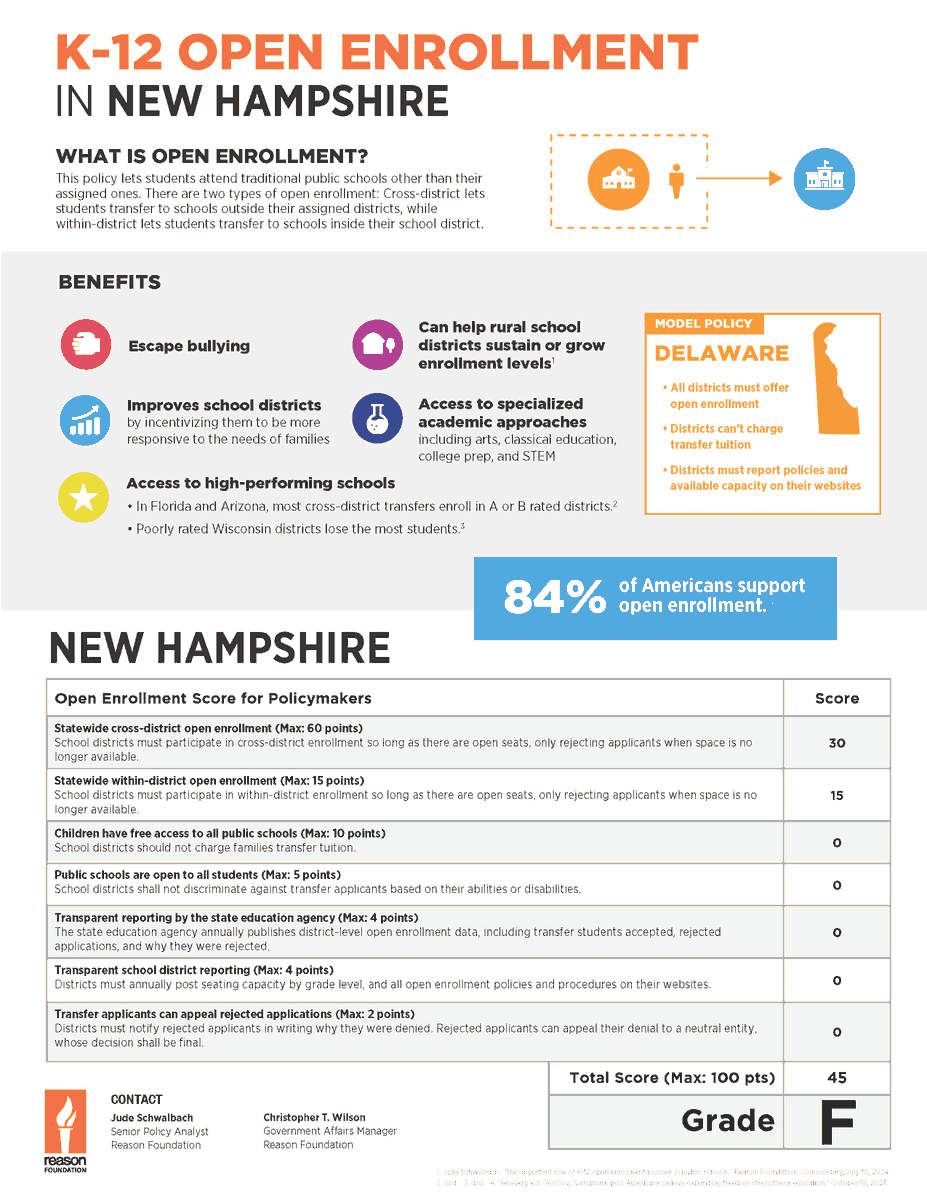
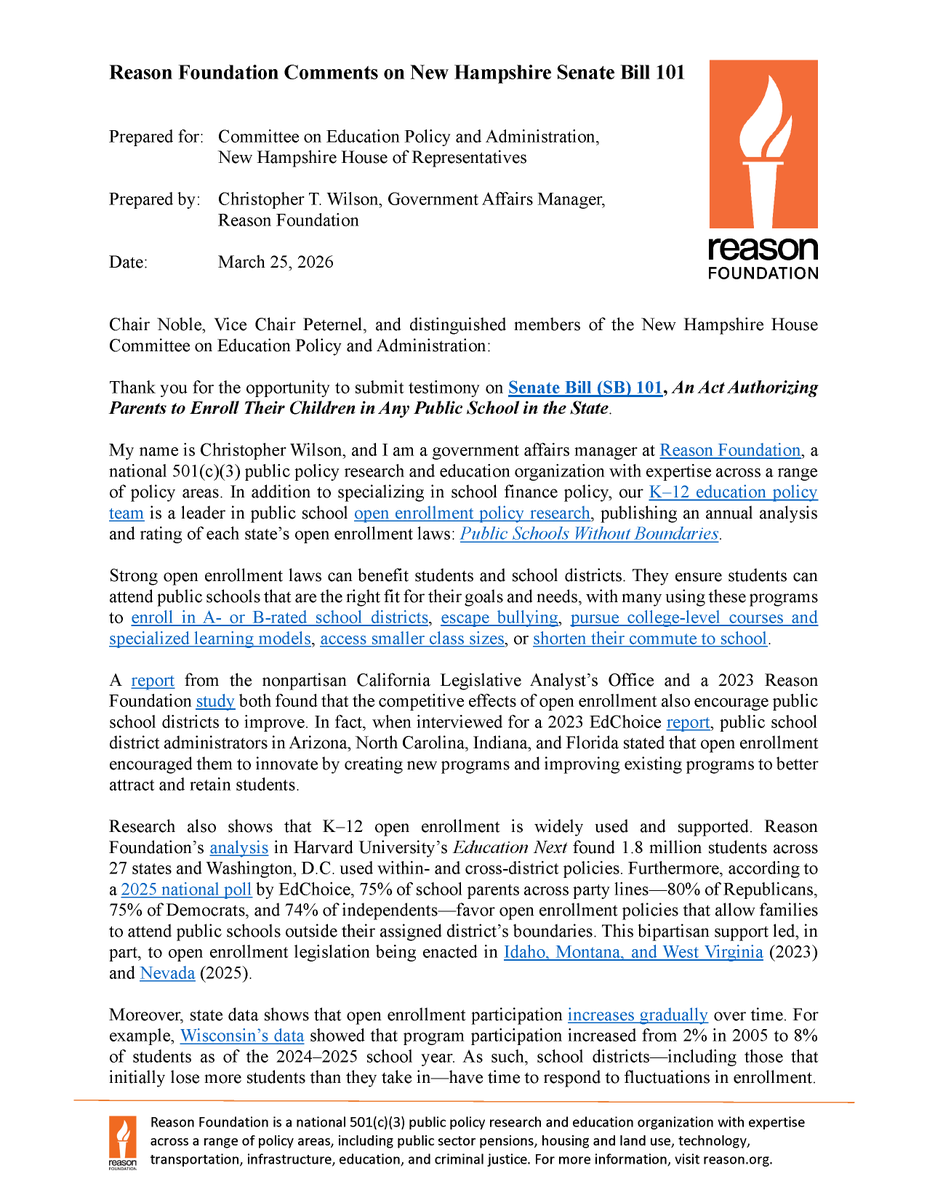
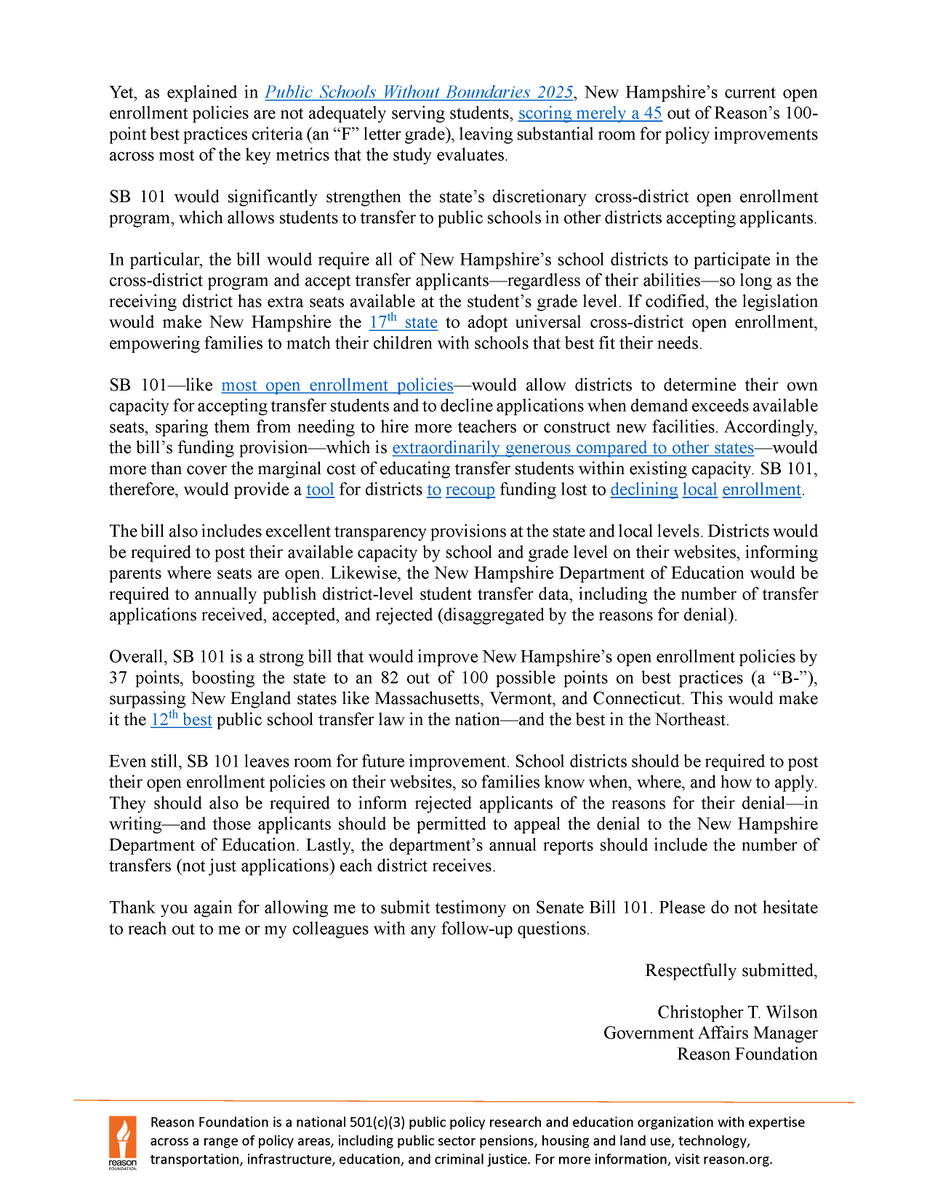
Yesterday, I testified on New Hampshire Senate Bill 101, which would improve the state's open enrollment policies by 37 points on @ReasonFdn's Public Schools Without Boundaries 100-point best practices criteria, boosting the state's score to an 82 (a “B-”).
This would make NH's public school transfer law the 12th best in the nation—and the best in the Northeast.
Check out my testimony to the New Hampshire House Committee on Education Policy and Administration here: https://t.co/iJC0aw574y
If a New Hampshire cross-district open enrollment program were to mirror the inaugural participation rates of Wisconsin, Kansas, and West Virginia, the number of students transferring across school districts during the program’s first year would amount to between three and five such transfers per school district, on average (or roughly one to two per school).
Inaugural participation at the 0.41% mean rate, however, would total just 589 transfers statewide, an average of only four transfer students per district and one per school.
https://t.co/FUWszYVmuD
Some New Hampshire school districts worry that statewide cross-district open enrollment will drain their students and funding, suddenly and unpredictably. Somersworth Superintendent John Shea, for example, claimed the legislation would be “a wrecking ball of chaos” for public-school budgets.
But data from other states tell a different story, with two clear takeaways: open enrollment participation typically starts small and tends to scale up incrementally over time. As such, neither HB 751 nor SB 101 is likely to cause the budgetary disruption that some New Hampshire school districts fear.
https://t.co/FUWszYVmuD