"We are all dull and are served well when language claps its hands and wakes us up to pay attention." John Piper, Seeing Beauty and Saying Beautifully, 31.
@nick_elder Works on media ecology would be helpful; it sounds like the focus would be more on engaging specific examples rather than a deep dive into the philosophical underpinnings, so perhaps the classic by Postman, Amusing Ourselves to Death? Or perhaps a more recent intro to the field.
“If writers whom we judge to be competent regularly violate some alleged rule and most careful readers never notice, then the rule has no force. In those cases, it is not writers who should change their usage, but grammarians who should change their rules.” (Williams/Colomb, 18)
“Some of us take a private pleasure in writing a shapely sentence, even if no one will notice."
Williams and Colomb, Style: Lessons in Clarity and Grace, 8.
Augustine: And I said to all these things in my external environment: 'Tell me of my God who you are not, tell me something about him.' And with a great voice they cried out: 'He made us' (Ps 99:3) My question was the attention I gave to them, and their response was their beauty.
@AJWTheology Check out Bray's ITC commentary on the Pastorals, pp. 50-51. "One feature of the style of the Pastoral Epistles that most commentators seem to miss is that they are replete with triadic formulae which the apostle uses to make different points." (1Tim-15; 2Tim-8; Titus-10) Etc.!
@AnthonyEsolen Anthony, what are one or two helpful works that discuss English grammar as the logical structure of our language? Could you recommend one work that is an English textbook and one that is not?
"There's a reason that thinking online is so perilous. The internet is an epistemological habitat that makes genuine wisdom difficult and unappealing." Samuel James, Digital Liturgies, 99.
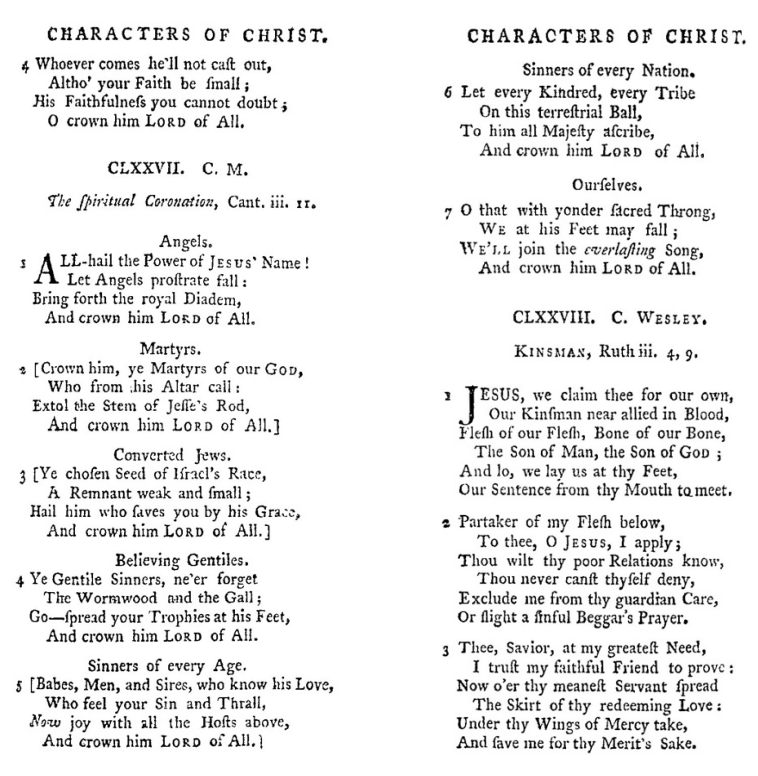
As each stanza of All Hail the Power of Jesus' Name in turn adds a different group to those who are to "crown Him Lord of all," we are led to a fuller picture of the "all" Christ is Lord over.
The last stanza of "Guide Me, O Thou Great Jehovah" becomes more understandable when we realize that “Death of Death, and Hell’s Destruction” (originally capitalized) refer to and address Jehovah.
@megbasham Note as well Paul's distinction between unbelievers and believers (5:9-11), then (as to level of "eating") later in 10:27 says it's fine to go to a meal with an unbeliever. Suggests meals generally are in view in 5:11's "eat with such a one."
@megbasham Not eating with the person has in view at least the Lord's Table, and probably table fellowship more generally. Aim is to maintain the testimony of the church (though expulsion is main avenue there) and to "put him to shame" (2Th 3:14) aimed toward his repentance.
@megbasham Note the same Greek word is used in another church discipline passage: 2 Thess 3:14: "If anyone does not obey our instruction in this letter, take special note of that person SO AS NOT TO ASSOCIATE with him, so that he will be put to shame." (NASB for similar translation of word)
@megbasham How significant the break? Paul clarifies he means those calling themselves brothers, but if he had meant “don’t ‘associate’ with the immoral of the world” the Corinthians would have had to “go out of the world” (5:9-10). So, very significant; don’t eat with such a one (5:11)./3
@megbasham What is the church to do with such a person? Four equivalent ways of saying remove from the church: remove the offender from among you (5:2); deliver to Satan (5:5); cleanse out the old leaven (5:7); purge the evil person from among you (5:13)./2
@megbasham Who is in view? Note list progression in 5:9, 10, 11, 6:9-10 from sexually immoral alone to add eight more by the end. All characterized as “unrighteous [who] will not inherit the kingdom of God” (6:9). But they call themselves brothers (5:11)./1