Exchange OS is a game-changer for builders on @XLayerOfficial.
At ShieldSuite, we’re excited to use it to deploy dedicated Outcome Venues for Premier League and other European leagues predictions, powered by Pitchside AI’s real-time scouting.
We’ll also launch Perps markets on player stats and team performance, plus specialized compliant player share venues that feel professional and seamless.
This is how we turn AI speculation into the most exciting sports trading experience onchain.
Can’t wait to ship!
.. @bayc7276@lararaxyz
@ShieldSuite_@encrypt_wizard@XLayerOfficial@aave I don't know if it's intentional, but the first wallet of 35$ volume on the leaderboard disappeared . Bought shares not is not reflecting so tge wallet cn be ranked
Rally only works because it can coordinate decisions that are not purely mechanical. At its core, Rally needs to evaluate context, intent, and outcomes that cannot always be reduced to simple yes or no rules. That kind of judgment is exactly where traditional deterministic blockchains fall short.
This is why @GenLayer matters so much for @RallyOnChain. GenLayer introduces AI-native validation and non deterministic consensus, which allows the network to reason about subjective inputs and still reach a verifiable outcome. Instead of forcing everything into rigid smart contracts, it enables validators to interpret information, compare perspectives, and converge on a result in a decentralized way.
Without that capability, Rally would either be centralized or severely limited in what it could support. GenLayer provides the infrastructure that lets Rally coordinate at scale while keeping decision-making on chain and decentralized.
I’ve been keeping an eye on what Nirvana has been building, and the launch of Samsara really stands out as a big step forward. With this release, @nirvana_fi has introduced a new platform that lets teams launch decentralized DATs (Digital Asset Treasuries) similar in spirit to MicroStrategy’s treasury approach, but designed from the ground up for Solana and fully on-chain.
What I find most interesting is how Samsara shifts the conversation around token design. Instead of relying purely on hype or short-term liquidity, DATs focus on treasury-backed value, protocol-owned assets, and mechanisms like a defined floor. On a fast and low-cost network like Solana, this model becomes practical and scalable, which is why the $SOL and $ANA combination here is worth paying attention to.
Samsara being live means teams can start experimenting with these treasury models right now, not just talking about them. You can explore the platform here: https://t.co/veT04Xb4eE. I’m genuinely curious to see how different projects use DATs and how the floor mechanism holds up across different market conditions.
If you’ve already looked into Samsara, I’d love to hear your thoughts especially around how you think the floor mechanism works in practice and of course, the more comments and likes you give to @nirvana_fi’s content, the better the rewards.
Scenium’s Sovereign L1 Why True Sovereignty Matters
For years, shared rollups on Ethereum promised much of what builders needed: lower fees and better throughput than mainnet. But as real-world use cases begin to ship, platforms like @sceniumapp are making it clear that shared blockspace alone isn’t enough when you’re solving financial inclusion and scale problems at production level. EcoCity, the live environment where sovereign L1s are deploying in production, reveals how these architectural decisions actually play out on chain not just as theory but as live products.
What Scenium Is Building
Scenium is a fintech platform focused on bringing tokenized real-world financial assets equities, real estate, private funds on chain with broad accessibility. Rather than keeping these functions on an existing rollup or Ethereum itself, the team launched a dedicated Layer-1 blockchain on Tanssi’s infrastructure. The goal isn’t just crypto trading, it’s 24/7 global access to an asset catalog with no minimums and predictable settlement, targeting underserved regions like LATAM and beyond.
Why Shared Rollup Blockspace Was Insufficient
Shared rollups whether optimistic or zk-rollup based still inherit several constraints from their parent chains:
•Unpredictable fee markets: Activity from other applications directly affects transaction costs. For financial products with low margins and regulatory expectations of predictability, this is a structural issue.
•Performance volatility: Shared execution environments mean your transactions can be delayed or reprioritized based on network load elsewhere. For trading and settlement infrastructure, that unpredictability is unacceptable.
•Limited governance control: On shared rollups, protocol parameters are subject to the rollup’s governance which is not aligned with product-specific economics or compliance needs.
These constraints make it difficult to build stable, regulated financial rails with predictable economics on top of shared infrastructure exactly the core of Scenium’s mission.
What Dedicated Blockspace Enables Instead
Launching a sovereign L1 gives Scenium ownership over its execution environment:
1.Stable and predictable fees: As the chain controls its gas market, Scenium can tailor costs to users and products instead of reacting to congestion from unrelated protocols.
2.Execution guarantees: Dedicated blockspace means transactions settle reliably under load, which is vital for asset trading and compliance requirements.
3.Custom governance and runtime logic: The protocol can evolve with market needs for example adjusting tokenomics, settlement rules, or compliance parameters without relying on shared rollup governance timelines.
4.Scalability aligned with product demand: Instead of competing for resources on shared infrastructure, Scenium’s chain grows with its own usage patterns.
5.Focused security model: Through orchestration infrastructure like @TanssiNetwork, Scenium inherits decentralized block production and economic security without building these systems from scratch, lowering operational overhead.
Conclusion
Scenium’s decision to launch a sovereign L1 in EcoCity is not ideology it’s a practical product choice. When you’re dealing with financial markets and real-world assets, execution certainty, predictable fees, and governance alignment are not optional. Shared rollups helped us scale past bottlenecks on mainnet, but teams like Scenium are showing that the L1 renaissance is real when blockspace control aligns with product demands, and orchestration infrastructure like Tanssi makes that possible without months of engineering work.
Always In Sync with @OpenGradient
The ecosystem is growing fast , from personal AI memory to an open market for DeFi intelligence.
Here’s everything new across the product suite.
https://t.co/BnXwZCJRX7
Each Twin is an AI agent modeled on a real person’s public ideas, writing, and logic.
https://t.co/BnXwZCJRX7 deployed on BNB Chain, letting people collect Keys, chat with digital minds, earn points, and explore a new social economy built on L1 + inference infrastructure.
Powered by MemSync’s continuous memory layer, Twins now remember your context, preferences, and ideas, and carry that intelligence into every new chat on https://t.co/sk6ICgX29n instead of resetting every session.
CZ - A Twin modeled on the Binance co-founder, letting users explore structured perspectives on exchanges, markets, and execution.
Yi He - A Twin shaped by one of crypto’s strongest operators, focused on brand, leadership, and long-term company building.
Waleswoosh - A narrative-driven Twin capturing his signature style of explaining market cycles and NFT meta.
Zeneca - A Twin shaped by years of Web3 education from poker to NFTs to ZenAcademy and The 333 Club.
https://t.co/BnXwZCJRX7 crossed $500k+ in volume, marking the emergence of digital minds and Keys as a new asset class, powered by OpenGradient’s L1 + inference stack.
Now, no codes needed. Anyone can now join, collect Keys, and explore every mind in the ecosystem.
BitQuant
AI-powered quantitative research & trading intelligence.
Over the past two months, BitQuant has deepened its role as OpenGradient’s DeFi agent, connecting model intelligence directly to on-chain action.
Live feed of trending tokens + risk reads on SUI, giving users real-time insight into what’s moving and how to position around it.
The goal has not changed
Yap @OpenGradient on @KaitoAI Now!!
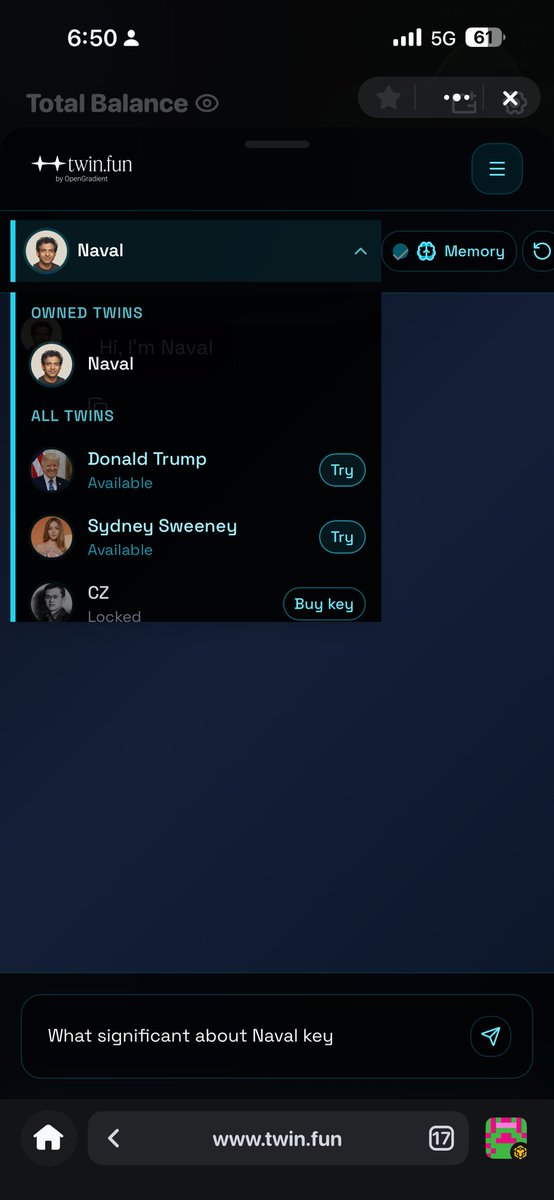
Happy weekend guys, today i was able to bag some asset on the https://t.co/sk6ICgXzYV , I was able to interact with the platform and i could see and notice more things about what @opengradient is building.
I spoke with the Naval key and also the Donald Trump key after bagging them,
I could understand its intelligence, personality, and reasoning in fact now i understand how @memsync_ai memory works.
From my screenshot you could see the response of Naval key to my question ,
You can see how they both develops personal reasoning and i could see that the key i don't own doesn't give me dipper reasoning like the one i own.
Why twin really matters
1. It helps our daily interactions and makes it feel better
2. it gives creators a version of itself
3. It gives us the community ownership of interaction
4. It's real and makes you own it.
Guys pivot to @OpenGradient now and understand more about how https://t.co/sk6ICgXzYV works, how @BitQuantAI works and also how memsync works and thank me later.
Have a good week ahead guys
https://t.co/WEOjn5tm70