Waiter: "To begin, half a dozen oysters, raw. Then the steak tartare with a raw egg yolk. And the cheese course to finish."
Diner: "What's on the board tonight?"
Waiter: "Brie de Meaux, Comté and Roquefort, madam. All unpasteurised. Under French law they must be, or they lose the name."
Diner: "Wonderful. I'll have a glass of milk with the cheese. Unpasteurised as well, if you have it."
Waiter: "I'm afraid we can't serve raw milk, madam."
Diner: "You've run out?"
Waiter: "We're not permitted. A restaurant isn't allowed to sell it."
Diner: "On what grounds?"
Waiter: "Safety, I believe."
Diner: "You've just sold me six raw shellfish."
Waiter: "Very fresh, madam. In this morning."
Diner: "And a plate of raw minced beef with a raw egg on it."
Waiter: "Chef's signature."
Diner: "And three cheeses made from raw milk, one of which has been sitting in a cave since the summer before last."
Waiter: "Twenty-four months, the Comté. It's exceptional."
Diner: "So the milk is safe to serve after two years in a cave."
Waiter: "It matures, madam."
Diner: "But not this morning, when the cow had only just finished with it."
Waiter: "I'm afraid not."
Diner: "Could I buy it anywhere?"
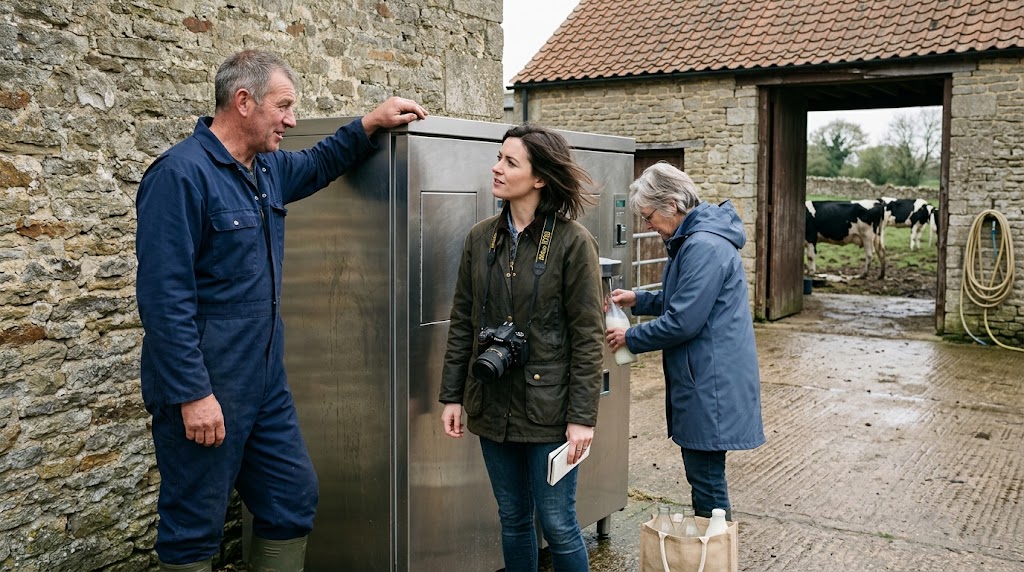
Waiter: "From the farmer himself, I understand. At the farm. I'm told the bottle carries a health warning."
Diner: "Does the tartare carry one?"
Waiter: "There's a small asterisk on the menu."
Diner: "And the oysters?"
Waiter: "The same asterisk, madam."
Diner: "So the shellfish gets a footnote and the milk gets a law."
Waiter: "I could bring you a glass of the ordinary. Pasteurised."
Diner: "Is that from the same farm as the cheese?"
Waiter: "From several hundred farms, madam. It's blended."
Diner: "I'll have the wine."
Waiter: "Very good. That's also unpasteurised."
@BriggsonBeer@TheIanHalstead I suspect the 3.5 pence difference in duty between 4.2% and 4.5% might have something to do with it. Taylor’s is a Yorkshire company after all and though 3p doesn’t sound a lot it all adds up.
Pears are not native to NZ but the cultivated form Pyrus communis was brought over by English settlers and sadly those for perry making have been lost. However some still survive. Jon Colyer has been hunting them down. This is an excellent read. https://t.co/0wERe8BFL1
Journalist: "You're selling raw milk at the farm gate. Unpasteurised. That's a public health hazard."
Dairyman: "What's pasteurising for?"
Journalist: "Killing dangerous bacteria."
Dairyman: "From where?"
Journalist: "The milk."
Dairyman: "The muck, the bucket and the cow. It came in when town milk was from sick cows in sheds behind the pub, carted warm for a day and topped up at the pump. They couldn't clean the dairy, so they cooked the milk."
Journalist: "And you think you're above all that."
Dairyman: "I think I'm inspected. The herd's TB tested. A man comes twice a year and goes through the parlour with a torch. The milk goes to a lab 4 times a year. One bad result and I'm shut that afternoon."
Journalist: "People have been made ill by raw milk."
Dairyman: "By dirty milk, same as dirty anything. 2 summers ago near 300 people in this country went down with E. coli. It was lettuce, out of a sandwich. How's the campaign against salad going?"
Journalist: "Salad doesn't carry the same risk."
Dairyman: "Salad doesn't carry a label. Every bottle I sell has a warning on it by law. Find me that on an energy drink, a vape or a bag of rocket."
Journalist: "So you accept it's risky."
Dairyman: "I accept I'm the only thing in your fridge that's been made to say so. My customers drive 40 minutes past 3 supermarkets, read the warning and buy 6 litres. Best-informed shoppers in Britain."
Journalist: "The experts advise against it."
Dairyman: "The experts advised margarine. People round here have drunk this for a few thousand years. I'll give the experts time to settle down."
THE DROUGHT DIDN'T create fragility in British dairy. It’s exposed it
This morning I spoke to BBC Scotland about why our collaboration of four small organic farms in Scotland are suddenly sending tens of thousands of litres of milk south.
We’ve already sent around 56,000 litres down to help with shortages, with four independent organic farms here in Scotland working together to keep supply moving.
For me though, the bigger story isn’t that Scotland has organic milk and England doesn’t - it’s that we’ve spent decades losing dairy farms and concentrating production into fewer and fewer places.
Then you get a year like this one; drought, poor grass growth, heat stress and suddenly you see how little resilience is left in the system.
We had earmarked this milk for new products to launch later this year, but when we say others in need of milk to sustain their own businesses - we couldn't say no.
I believe that small farms and dairies working together, spread across different parts of the country have a much bigger role to play in food security than our modern world give them credit for.
Anyway - one interview down. BBC Wales next and maybe some TV later
-Bryce
@NigelSommelier First broadcast 2004! I thought they all looked rather young! Pre social media too! Interesting to see how much -and also how little has changed in 20 years. It’s a historical programme itself now.
Que c’est énervant ! 😳😞 Nous recevons des centaines de messages de gens qui nous disent chercher désespérément des produits solidaires en rayon. Dans cette période dramatique pour les producteurs, les aider doit être plus simple et la transparence plus grande dans les rayons !
Regardez simplement votre liste de courses : combien de produits solidaires pouvez-vous aujourd’hui ramener chez vous, poser sur la table familiale, en étant absolument certain que votre argent permet aussi à ceux qui nous nourrissent de vivre dignement de leur travail ?
Le drame absolu pour les producteurs, c’est le manque de transparence sur leur rémunération.
À l’échelle du nombre de produits présents dans les rayons, cette offre solidaire représente probablement moins de 1 % de ce qui nous est proposé. Ce n’est pas normal.
Car cela révèle l’immense impasse dans laquelle nous nous sommes collectivement enfermés depuis des années, avec pour premières victimes les agriculteurs. Au nom des prix toujours plus bas, nous avons presque totalement éteint la possibilité, pour ceux qui le peuvent, de choisir facilement des produits qui soutiennent réellement les producteurs. Et beaucoup de magasins (près d’un sur deux !) ne proposent même pas une offre minimale de produits solidaires.
Je répète : en France, près d’un magasin sur deux ne permet pas aujourd’hui à ceux qui le souhaitent et qui le peuvent d’acheter facilement des produits garantissant aux producteurs une rémunération leur permettant de vivre dignement de leur travail.
Cette offre solidaire doit prendre beaucoup plus de place dans les rayons. Son succès montre qu’elle répond à une véritable attente.
Les magasins sont dépositaires d’une offre alimentaire qui doit répondre aux choix de tous les consommateurs et ils se doivent de proposer à ceux qui le peuvent des produits qui rémunèrent les producteurs au juste prix.
Est-ce que ça marche ? CQLP est la marque la plus vendue en France parmi les marques créées en France au cours des dix dernières années.
Magasins, élargissez votre offre de produits solidaires dans vos rayons ! Les producteurs en France ont besoin d’aide maintenant et la solidarité ne doit pas être un parcours du combattant dans les rayons. Elle doit devenir un choix évident, visible et accessible à tous. Bonne soirée à tous #SoutienAuxProducteurs #LePatronCestLeConso
@FSProducteurs@C_qui_le_Patron #SouverainetéAlimentaire #Mercosur #AgriculteursEnColère #Solidarité
"Public ownership of water industry could save £22billion, MPs are told."
Oh look, you were lied to, nationalising the water industry isn't going to cost you billions, it could in fact save you £22 billion.
Who'd have guessed it.
https://t.co/Xyd9CCfnIk
It’s easy to forget how rare really species rich native grassland is now
Loads of British flora and fauna needs this kind of space and management
Our restoration has been a mix of adding trees with every cage, sleeve and box available and then carefully planned grazing
I am so proud of this hillside… a bunch of good people have all done the right thing together.
Recreating grazed wood pasture and wet rush pasture.
We are the conservation grazers of it.
Not sure you could create anything much better - just will take a little time.
SICK OF HEARING ABOUT EPR YET?
Because we’re sick of paying for it.
The news covered a wee Scottish dairy who stopped using reusable glass bottles.
Government says reusable packaging is encouraged.
But glass is heavier, so it costs more when it first goes into circulation.
And while they’ve spent more than a year saying this needs fixed, Mossgiel has already been hit with nearly five figures in EPR charges.
So what’s actually being fixed?
We collect our bottles. Wash them. Refill them. Reuse them again and again.
Yet the system still makes single-use plastic financially more attractive.
EPR was supposed to reduce packaging waste.
Right now, it risks becoming:
EPR = DEATH BY A THOUSAND CUTS FOR REUSABLE GLASS.
If the greener option is the harder and more expensive one, something has gone badly wrong.
"Just to make clear how dramatic these [E. coli] readings were, the level considered unsafe for bathing is 1,000 colony-forming units per 100ml. The group’s highest reading showed 370,000."
Christchurch Harbour everyone, Christchurch Harbour.
https://t.co/CH7nvPaAVr
@BriggsonBeer You can certainly see from this the person they are aiming at. I’m not so sure about their ‘Golden Best’ update though: an older gingery bloke looking somewhere in the distance with some giant barley over his shoulder. Who’s that intended for?
@RobinHoodGav@BriggsonBeer@yorkshirepost Interesting that when I see the word ‘press’ I make an assumption that it’s a newspaper source. But the title also makes it easily confused with @yorkshirepost which to my mind is a credible up to date information source. You have to be so careful these days.