Hey #TeamMassSpec@ScoHoDigDaSnow and I are proud to share our @PCCP perspective on what ions do inside a DMS/FAIMS cell. But don't panic, because this hitchhiker's guide to DMS translates the field into a language understandable by all academic levels.
https://t.co/HVXGZIUSnp
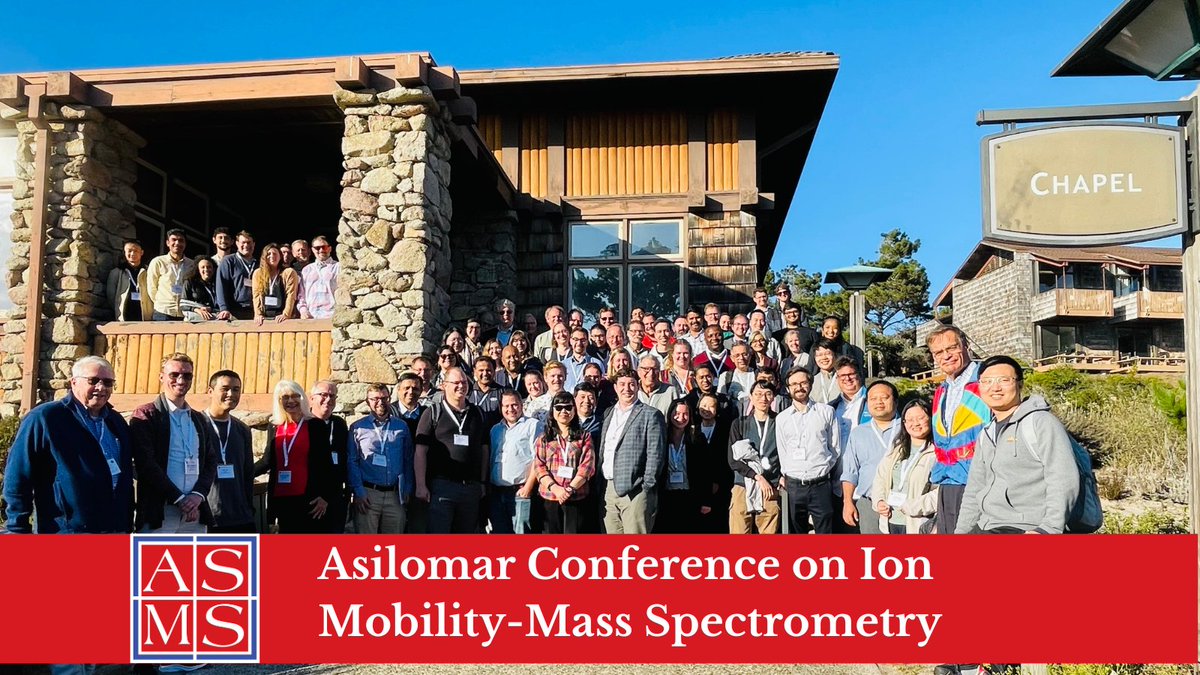
Enjoying the beautiful science AND weather at @asmsnews Asilomar Conference on Ion Mobility-Mass Spectrometry.
Download group pic here: https://t.co/nUcbqXzaRv
@J_ASMS#TeamMassSpec
📢More exciting news for ion mobility enthusiasts!
The MobCal-MPI manual has been updated with instructions of how to compile the source code on most platforms!
We can't wait to all the exciting things #TeamMassSpec can do with MobCal-MPI 🙂
https://t.co/U7oAV4Lxei
Hey #TeamMassSpec,
Have you heard? The MobCal-MPI 2.0 manual covers Fortran code installation! We promise it's less scary than deciphering my cat's plan for world domination. Plus, there's a tutorial on calculating CCSs from scratch - it's your time to be a CCS superstar💫
📢Exciting news for ion mobility enthusiasts!
💻MobCal-MPI v2.0 is out, offering accurate ion mobility and CCS calculations at any field strength with a user-friendly manual.
Get it here: https://t.co/U7oAV4Lxei. Analyst publication (DOI:D3AN00545C)
@cieritano@AHaack91
📢Exciting news for ion mobility enthusiasts!
💻MobCal-MPI v2.0 is out, offering accurate ion mobility and CCS calculations at any field strength with a user-friendly manual.
Get it here: https://t.co/U7oAV4Lxei. Analyst publication (DOI:D3AN00545C)
@cieritano@AHaack91
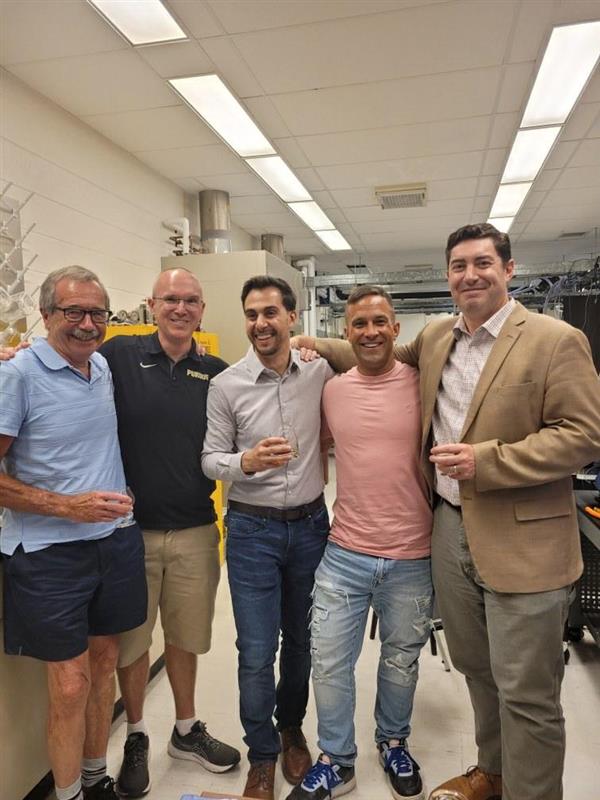
Congratulations to Dr. Ieritano, who successfully defended his PhD thesis in early August!
We are looking forward to your continued contributions to the group and wish you the best of luck in your new permanent position on campus (more exciting announcements to come soon)!👨🔬
Looking for an alternative to those pen-and-paper exams for chemistry labs?🧑🔬
Carlee and Julie of @UWaterloo have cooked up a practical examination for undergrad synthesis labs - check out their work in @ACSDivCHED#ChemTwitter#AcademicTwitter
https://t.co/YuYqs3GrAs
And that's a wrap on thesis writing - just in time to celebrate at #ASMS2023! Thank you to all the #TeamMassSpec members and @UWaterloo friends who have made my PhD journey especially memorable.
Hey #TeamMassSpec, want to learn about competing solvent modifiers for DMS/FAIMS? Check out this work in #JASMS, which explores this phenomenon and its applications for ion mobility!
Congrats @justinebissonn on your first first-author publication! 🥳
https://t.co/YByAuZorHq
@inigo_iribarren The NEB method in ORCA is exactly what you are looking for :)
https://t.co/OyPr9mKQJK
If you want more detailed info (ie. other possible intermediates), then its not really an interpolation, but more of a PES mapping. In that case, I'd recommend CREST
https://t.co/nTtEATl3n8
@VRAdoesMS@StacyMalaker Very interesting. Do you happen the know the charge on some of these larger glycoproteins? Even with the extra "heating" that multiply charged ions will get during a FAIMS separation, I'm amazed that something so big still fragments!
(apologies for all the questions)
@chrashwood @StacyMalaker The CV in which an analyte will transmit the DMS/FAIMS cell usually follows a Gaussian distribution with a FWHM of 2-5V, although it can be larger. Is it not more reasonable to say the analyte is being transmitted within the 45 - 55V CV window, and not transmitted at CV = 60V?
@chrashwood @StacyMalaker Dependence of survival yield on CV is rather strange - the CV offsets the "zero-point" of the FAIMS waveform. I can't find the SV used by the authors, but even at "lower" settings of say 2kV, CV increments of 10V won't cause the drastic changes shown in this figure.