The uncomfortable truth: most of my agent time wasn’t spent building. It was spent rebuilding things that were already built.
Then I found kache.
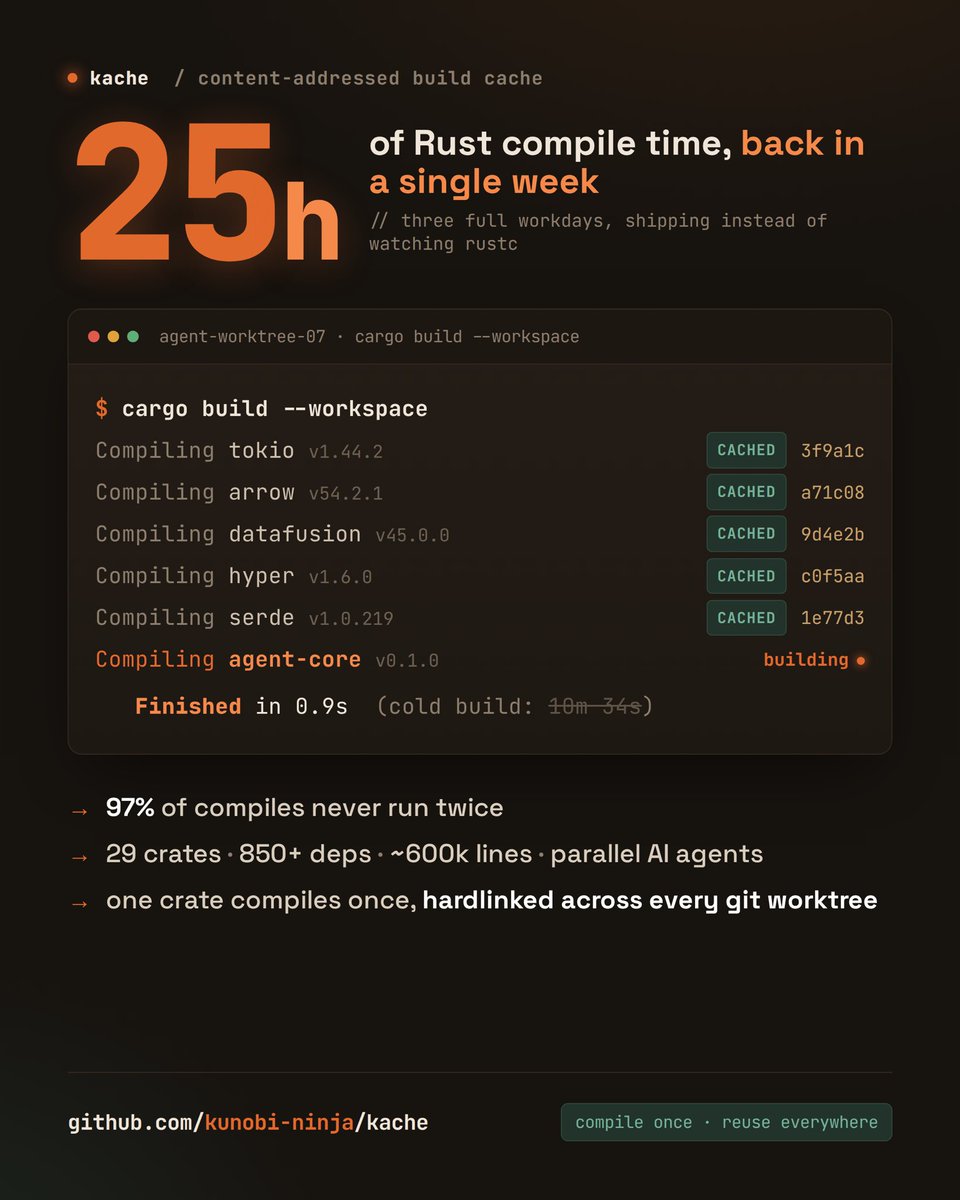
A content-addressed build cache that hardlinks compiled artifacts across worktrees. A crate compiles once, then gets reused everywhere.
What it did for me:
→ 97% of compiles never run twice
→ ~25 hours of build time back in a single week
→ three full workdays spent shipping instead of watching rustc
And it’s no side project. 2,531 commits in ~3.5 months, moving fast.
I handed Claude Code an entire feature on Friday. I reviewed the finished work over the weekend. I touched it zero times in between.
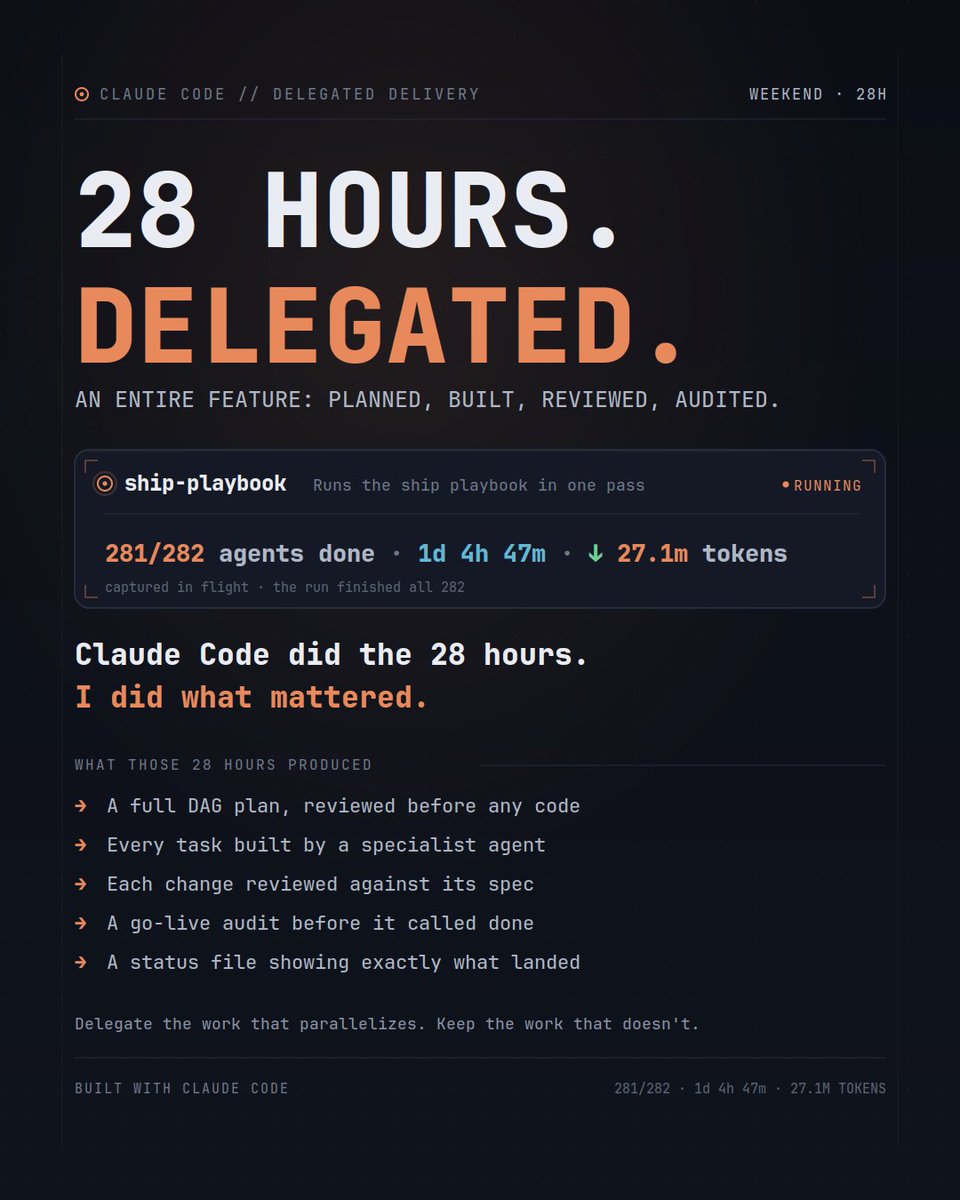
Not a snippet. Not a function. The whole delivery: planned, built task by task, reviewed, and audited. 28 hours. 282 agents. One pass.
◯ ship-playbook Runs the ship playbook in one pass
281/282 agents done · 1d 4h 47m · ↓ 27.1m tokens
(caught in flight, it finished all 282)
Here is what those 28 hours produced while I was away from the keyboard:
→ a full DAG plan of the feature, reviewed before a line was written
→ every task built by a specialist agent, on its own branch, merged in dependency order
→ each change reviewed against its acceptance criteria
→ a go-live audit at the end
→ a durable status file I could open later to see exactly what landed
That is the part most people miss about agents. The headline is not "AI writes code." The headline is delegation: handing off a multi-day unit of work and getting back something you can actually ship, without it ever sitting on your calendar.
The uncomfortable truth for anyone senior: most of us still use these tools like a faster autocomplete. Pair-programming. Babysitting. Watching the cursor move. That is not leverage. That is the same job with a better keyboard.
Real delegation looks different. You build the harness once: named phases, gates that fail closed, a DAG so nothing builds on a broken base, a durable status file so the run survives a stop or a token cap. Then you hand it the work and you walk away.
And while it ran, I did the things only I can do. Strategy. People. The two decisions that actually moved the week. The work that does not parallelize across 282 agents.
That is the trade nobody frames correctly. Claude Code did not save me an afternoon of typing. It gave me back a weekend of attention and let me point it at what mattered.
The agents are ready to be delegated to. The real question is whether you have built something worth delegating to, and whether you can stop hovering once you have.
Build the harness. Hand off the work. Go do the important things.
How to get it:
npx skills add https://t.co/ZX2q4cl32f --skill ship-playbook
@seanmrnda@kimmonismus maybe we’re old fashioned, and believe that’s good to have specialists on mission critical things.
Customer trust is earned over years and lost overnight.
Everyone’s optimizing prompts. Almost nobody’s optimizing the wire.
I let two proxies sit in front of my coding agents for 24 hours.
They clawed back 49.9M tokens. ~15% of everything that hit the model.
Here’s what nobody’s talking about:
Token efficiency isn’t one knob. It’s layers.
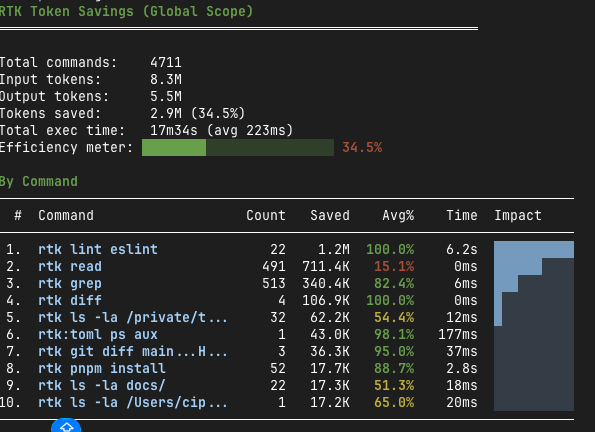
→ RTK trims what the agent reads. It swaps read/grep/diff/ls/lint for token-lean equivalents. 809.3K saved across 1,627 commands. diff and lint hit 100%.
→ Headroom trims what actually ships. It compresses context before it ever leaves the machine. 49.1M saved across 6.5k requests. ~$229, before provider caching even kicks in.
Same workload. 351.3M tokens in. 302.3M out.
The uncomfortable truth?
Most teams are paying full price for context the model never needed to see. Not because they can’t fix it, but because they’re tuning the prompt and ignoring the pipe.
Two tools. One day. The percentages compound.
What’s your token bill actually paying for?