New, and nobody writes about you yet? Start with the listings you control: fill in every field on your directory and comparison-site profiles. Half-empty listings get summarized as half-empty.
@phuclh93 Nice. One check worth building in: when a keyword drops, open that query in GSC's Pages tab and see if the ranking URL changed. A lot of "drops" are Google swapping in a different page from the same site, and the fix is internal links or merging pages, not new content.
@lilyraynyc One check we'd add if you already built a page just for LLMs: put it next to the pages humans see. Same prices, same claims, same limits?
Anything that only lives in the bot version, move it to a real page or cut it. One source, one place to keep current.
I’m working on an enterprise brand’s website, and something interesting stood out in its Google Search Console Gen AI report:
The most cited page on the company’s website in AI Overviews & AI Mode, with 5x more impressions than the homepage, is its “About” page.
It’s a comprehensive, detailed page about the company’s history, background, and evolution over time.
It’s not a “special page” created for LLMs or AI agents. It’s written for humans, visually appealing, and contains detailed information about the brand in a format that both humans and LLMs can easily understand.
So what’s the big “GEO” takeaway here?
Create comprehensive “About” pages with detailed, accurate information about your company’s history.
In other words, the same recommendation many of us in SEO have been making for years, especially since E-A-T became a bigger part of the conversation in 2017 (and long before that, in many cases).
Why do I think this is a more sustainable approach than creating separate pages specifically for LLMs?
Because those pages create an easily gameable surface.
Notably, Google, OpenAI, and Anthropic haven’t explicitly asked website owners to create separate, LLM-specific versions of their content, use Markdown, etc. I would change my perspective if they did (they won’t.)
The problem: it’s inevitable that bad actors (and plenty of brands) will use these pages to inject prompts, exaggerate claims, or give AI agents promotional information that doesn’t match what real users see, with the goal of manipulating what AI says about their brand.
My prediction is that as this behavior becomes more widespread (it’s already spreading thru the GEO world like wildfire), the AI companies will increasingly develop ways to ignore, discount, or otherwise treat these pages as untrustworthy.
And depending on how these systems evolve, the consequences might extend beyond the individual pages themselves.
The unfortunate part is that even well-intentioned companies simply trying to “help” LLMs understand their content better could become collateral damage. Even if their LLM-specific pages contain exactly the same accurate information as their human-facing website, they could still get caught up in broader efforts to crack down on this type of content, or flag the sites using “manipulative” approaches.
This is why I’m extremely cautious about employing tactics like this in the first place.
Meanwhile, there’s a much simpler way to work on this:
Take all that time and effort you’re spending creating special content for LLMs and use it to improve the information available to actual humans on your website.
Make your company’s history, expertise, people, products, and reputation easy to find, understand, and verify.
You’re still giving LLMs the information they need; you’re just doing it in a way that’s actually useful to your human readers, too.
And unlike tactics designed to exploit how AI systems currently work, this is an investment that’s unlikely to become a liability when those systems inevitably start cracking down.
Renamed your product? Add one plain line like "Formerly called X" to your homepage and docs. Without it, old reviews and new pages read like two different companies.
If you only fix one thing in your schema this week, make it sameAs: point your Organization markup at your real X, LinkedIn and GitHub profiles. That's the line that ties them to one company.
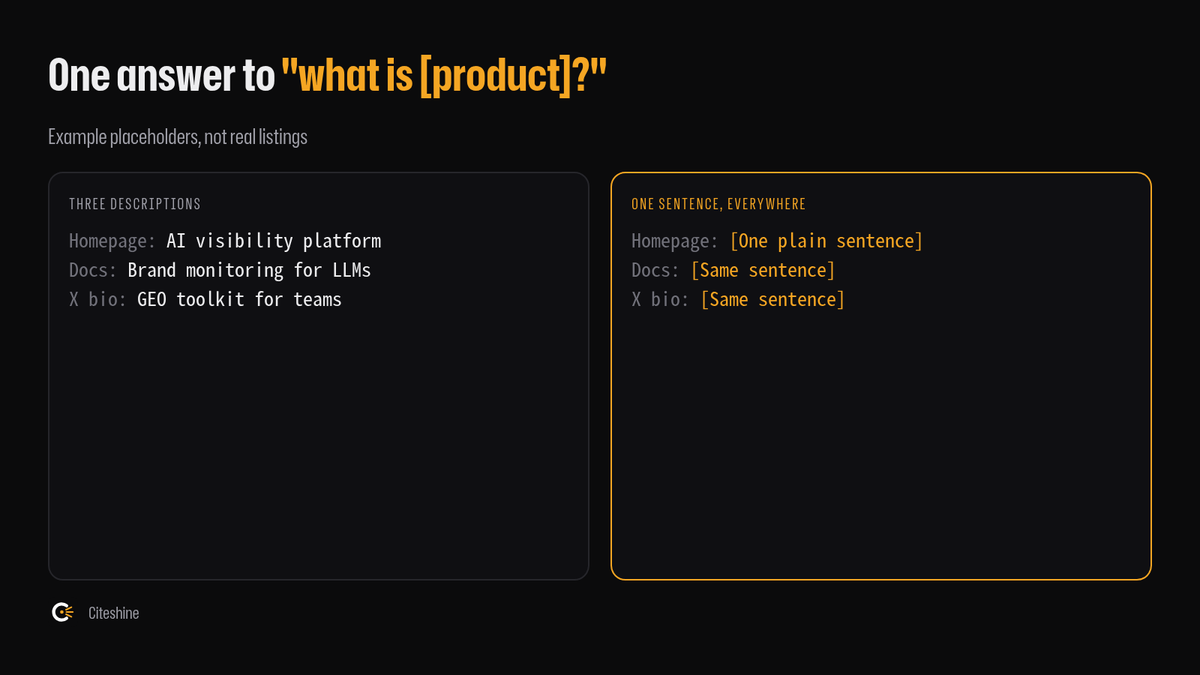
Write one plain sentence that answers "what is [product]?" Then use that exact sentence on your homepage, docs, and every profile bio. When your own pages disagree, assistants pick one at random.
ChatGPT Search and Google AI Mode don't lean on the same kinds of sources, and they cite a different number of pages per answer. So check each one separately, and look at which pages get cited, not just whether you're named.
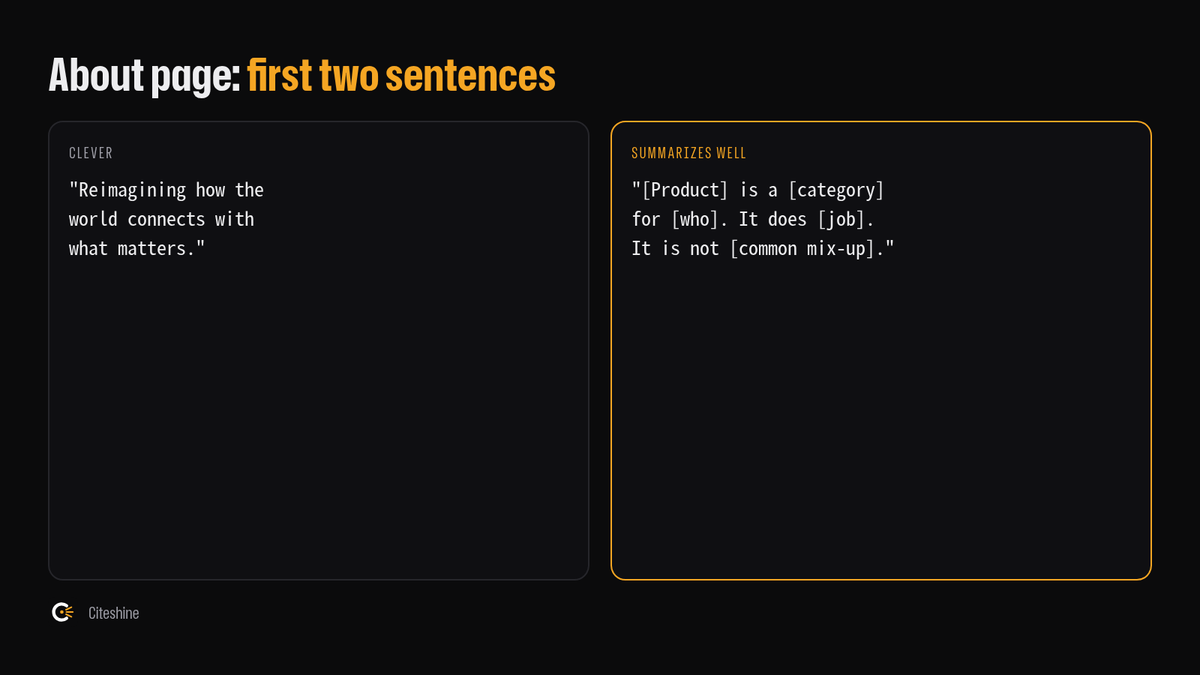
Your About page now has two readers: a buyer skimming it, and a model summarizing it. Say what you do, who it's for, and what you're not, in the first two sentences. Clever taglines don't summarize well.
Question for founders: when an AI assistant gets your product wrong, what do you fix first? Your own site, or the third-party page it's probably quoting? We lean toward the second. Curious what others do.