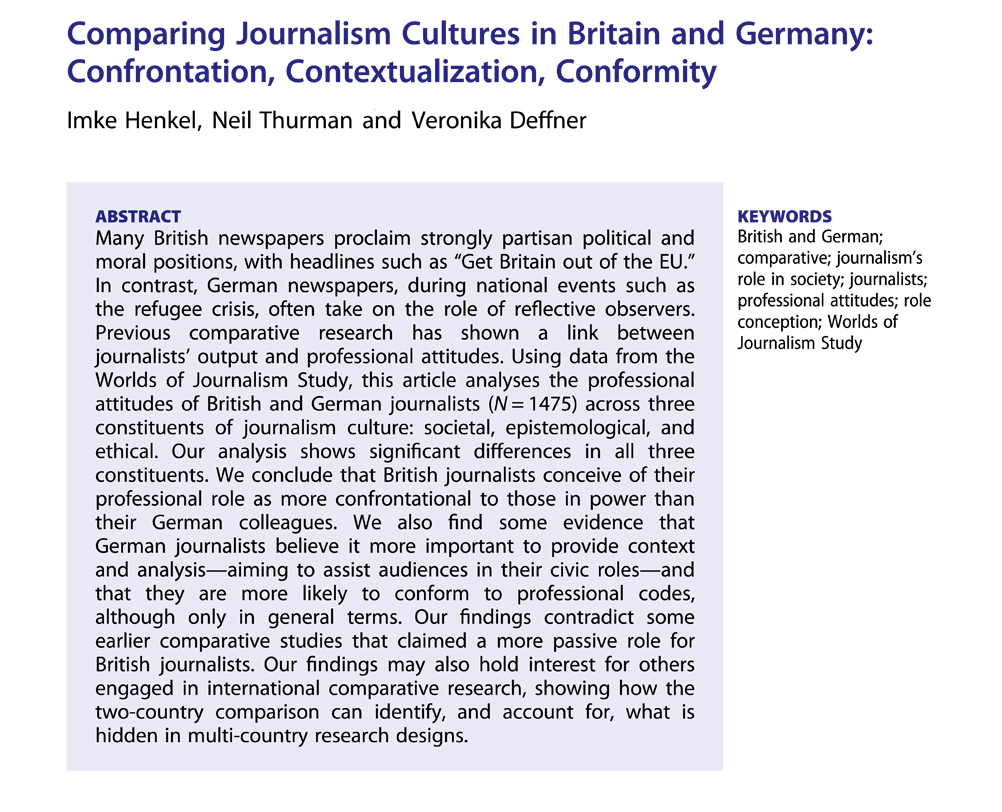
Our new study shows British journalists think it more important to confront those in power than German journalists. We also find German journalists believe it more important to provide context & analysis & are more conformist
https://t.co/sZWkFHZvNf
@ImkeHenkel@Routledge_MandC
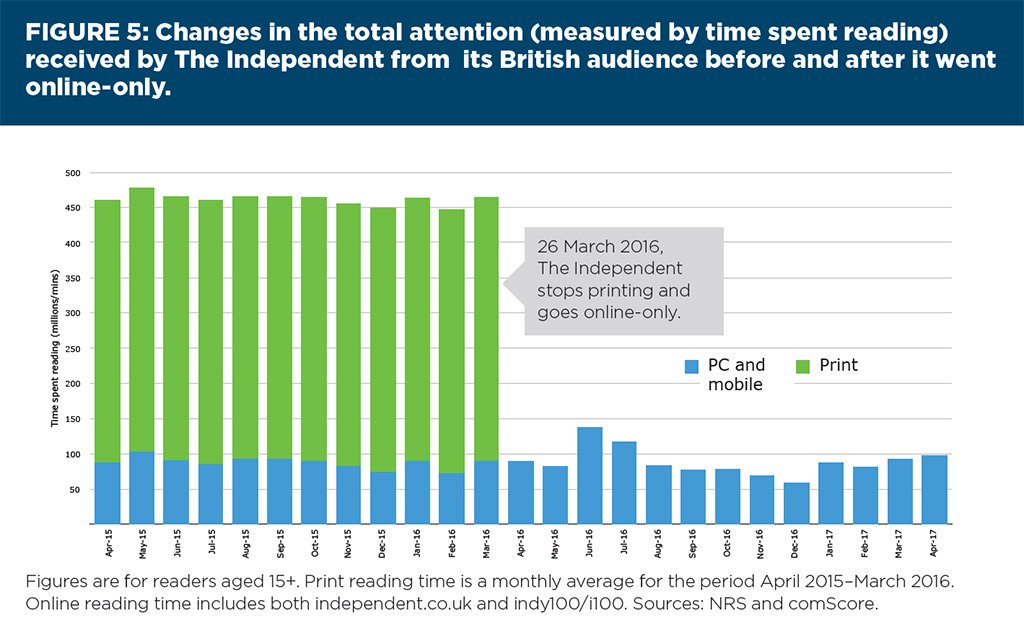
This is the scary chart at the center of it: When The Independent went online-only, its (comparatively tiny) print audience was still responsible for ~80% of all attention paid to Indy content.
When the paper killed print, those people just evaporated.
https://t.co/wydzhLDg4O
What will happen when newspapers kill print and go online-only?
Most of that print audience will just…disappear.
(new piece by me, reviewing new research by @neilthurman and @dragz)
https://t.co/wydzhLDg4O
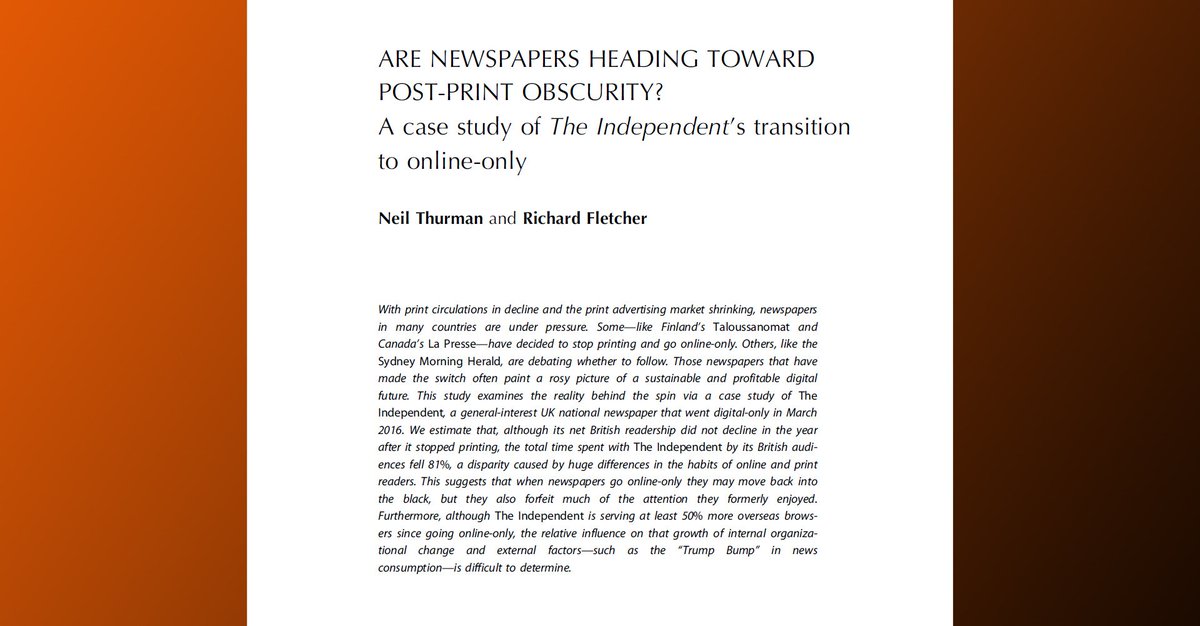
2/7. @Independent's British readership has declined by 1% since it dropped its print editions. The 12 other UK national #newspaper titles that continue to publish print editions have increased their readerships by an average of 25% over the same period:
https://t.co/KhCRlUxqT8
New @PAMCo_Ltd data shows that, on a daily basis, 5 UK national newspapers (@thetimes, @theipaper, @Daily_Star, @EveningStandard, & @MetroUK) reach more 15-34 year olds in print than via phone & tablet & PC combined.
https://t.co/5EvTBzxtbq
New @PAMCo_Ltd data shows that, on average, UK national & regional newspapers reach 56% more women than men via phones & 21% more men than women via print.
https://t.co/5EvTBzxtbq
My 3rd main finding in the @PAMCo_Ltd data released today:
NEWSPAPERS' AUDIENCES REMAIN IN PLATFORM SILOS
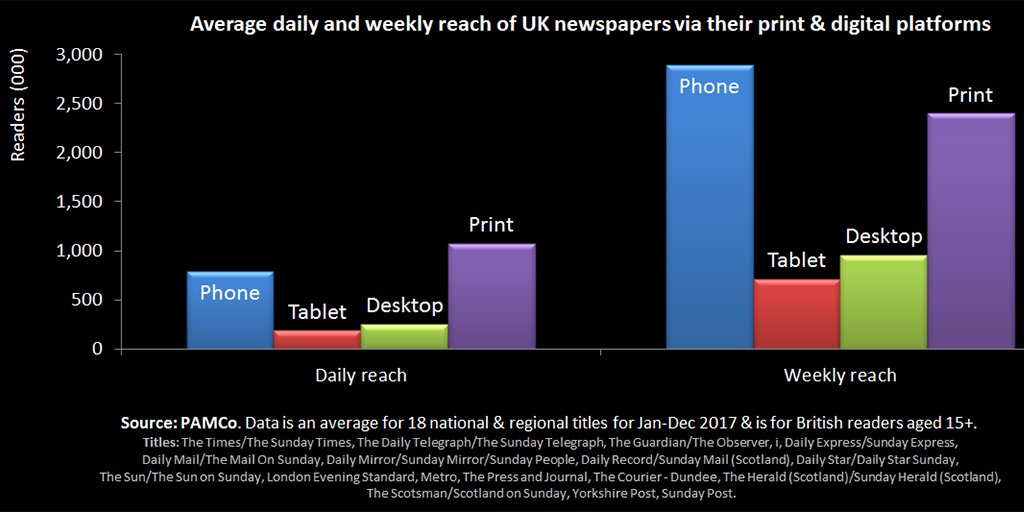
On a daily basis, an average of 98% of newspapers’ readers are consuming any given title via a single platform: print, phone, desktop or tablet.
https://t.co/5EvTBzxtbq
My 1st main finding in the new @PAMCo_Ltd data released today:
On a daily basis, more than 75% of the UK’s national & regional newspapers reach more Britons via their print editions than via phones or tablets or PCs.
4/6…
https://t.co/5EvTBzfRMQ
I've been crunching the new @PAMCo_Ltd data. Here are my top 3 findings:
1. Day-to-day, print is newspapers’ most important single platform
2. Tablets aren’t "saving newspapers"
3. Newspapers' Audiences remain in Platform Silos
3/6…
https://t.co/5EvTBzfRMQ
Research led by Dr @neilthurman into robo-journalism has been named in a @NiemanLab list highlighting "10 of the most important pieces of new research into digital and social media published in 2017" https://t.co/BSsyaLiA93
Newspapers' decline still hasn't bottomed out, but the courses followed by individual outlets won't necessarily correspond to this general trajectory. Differences in distribution strategies can have major effects, as can the public's interest in politics.
https://t.co/7BrYQ04eqH
Although digital distribution has allowed newspapers to reach out to younger audiences, the fleeting attention paid by those accessing newspaper content via PCs and mobile devices has diluted digital distribution’s rejuvenating effects.
https://t.co/7BrYQ04eqH
43% of time spent with newspapers brands came from older audiences at the turn of the millennium. Now it’s 62%:
https://t.co/7BrYQ04eqH
From my new study, co-authored with @dragz
Newspaper brands are now even more reliant on older audiences for the attention they receive than they were at turn of millennium:
https://t.co/7BrYQ04eqH
From my new study, co-authored with @dragz
New study from @neilthurman and @dragz shows that the total time spent with newspaper brands by #British audiences has fallen by 40% since 1999/2000. The biggest drop in attention is from #younger users, despite growth in reach. https://t.co/SWCFaCFtAe
Who says the young prefer reading newspaper brands online? 18–34s spend more time with newspapers in print than online:
https://t.co/V6f2aOmcaO
My new study, published today, co-authored with @dragz. #journalism#newspapers
Changes in the attention attracted by newspapers since they started to go online. @guardian and @EveningStandard buck the downward trend:
https://t.co/V6f2aOmcaO
From my new study, published today, co-authored with @dragz#newspapers#journalism