Civil Defence - Be alert today for a better tomorrow.
-
R/T is not always an endorsement. It can be to share valuable info, or to highlight relevant issues.
The key word here is "integrated."
Building a credible Integrated Air and Missile Defence (IAMD) network for Australia requires far more than simply acquiring advanced platforms.
It demands a fundamental transformation in how sensors, shooters, and battle management systems are integrated into a resilient, networked force capable of operating seamlessly across the land, maritime, air, space, and cyber domains.
This modernisation rests on several interconnected pillars:
The Digital Backbone – Project AIR 6500: Acting as the joint "system-of-systems" architecture, AIR 6500 will connect sensors, effectors, and command-and-control networks across the Australian Defence Force. By fusing data from every operational domain, it will enable faster decision-making, improve situational awareness, and coordinate responses at machine speed. The true value of AIR 6500 lies not in any single platform, but in its ability to transform disparate capabilities into a single, integrated combat network.
Layered Effectors: Given Australia's vast geography and the dispersed nature of its population centres, military bases, and critical infrastructure, its IAMD architecture must rely on multiple, mutually supporting layers of defence.
Long-range air dominance should be enhanced through advanced air-to-air weapons such as the AIM-260 JATM and AIM-174B, paired with sufficient aircraft positioned where they are operationally required. Fleet air defence must also be expanded, with force structure accounting for maintenance and refit cycles to ensure persistent coverage.
On the ground, LAND 19 Phase 7B (NASAMS), together with specialised counter-uncrewed aircraft systems (C-UAS) and counter-rocket, artillery and mortar (C-RAM) capabilities, electronic warfare elements, and directed energy weapons, should provide protection against threats ranging from small drones to cruise missiles and other high-speed aerial threats. These capabilities must not only be acquired in sufficient numbers, but also fully integrated into the wider IAMD architecture. Medium-range ground-based air defence is only one—albeit essential and currently lacking—component of a much broader, layered kill chain.
That kill chain must be seamless, resilient, cyber-secure, scalable, and built with redundancy at every level. Every sensor should be capable of cueing every appropriate shooter through a common
command-and-control architecture, ensuring there are no single points of failure and that the network can continue to function even when individual nodes are degraded or destroyed.
Perhaps the most intriguing element of Australia's long-term IAMD planning is the decision outlined in the National Defence Strategy to begin planning for the eventual replacement of the E-7A Wedgetail fleet, even as several key allies are only now introducing the aircraft into service.
This suggests Australia recognises that the future of airborne command and control is likely to evolve beyond a small number of high-value airborne platforms towards a far more distributed and resilient architecture, where space-based sensors, uncrewed systems, fighters, surface combatants, ground-based radars, and terrestrial command networks collectively perform the functions traditionally associated with dedicated airborne early warning and control aircraft.
Ultimately, the effectiveness of Australia's future IAMD capability will not be determined by the performance of any individual missile, radar, aircraft, or ship. It will be determined by how effectively every component is integrated into a single, survivable, and resilient, and adaptive system capable of detecting, deciding, and defeating threats across every domain.
That's a big job, but because it is, there is no time to waste. Threats are rapidly evolving. If ADF is serious about IAMD it will require huge decades long investment, a complete rethink on force posture, flawless systems integration, and effectively the ability to see the future.
Civil Defence extends beyond Earth. National resilience now depends not only on protecting people and infrastructure on the ground but also on safeguarding the space-based systems that modern civilian life relies upon.
https://t.co/oRSesXTpaD
Could your family stay in touch if the phone network went down?
Walkie-talkies are a simple, reliable way for families to communicate during power outages, severe weather, camping trips, or other emergencies when mobile coverage is limited or unavailable.
Consider keeping a pair of charged walkie-talkies in your family's emergency kit and make sure everyone knows:
• Which channel to use.
• When to check in.
• Basic radio etiquette, such as keeping messages short and clear.
Being prepared isn't about expecting an emergency—it's about making communication easier if one happens.
A small investment today could make a big difference when it matters most.
#BePrepared #FamilySafety #EmergencyPreparedness #WalkieTalkies #CivilDefence #ReadyTogether
When major telecommunications networks go down, the impact extends beyond losing internet access. You may also be unable to make phone calls, use digital payment methods, or receive real-time emergency alerts. Widespread outages highlight how dependent we are on digital infrastructure and underscore the importance of being prepared for these "blackout" moments.
To help you stay informed and safe during future outages:
- Diversify your sources of information. Avoid relying on a single device or network. Keep a battery-powered or hand-crank radio as part of your emergency kit. During widespread telecommunications outages, local ABC and commercial radio stations are often the most reliable sources of emergency information and official updates.
- Prepare for offline access. Download essential maps, emergency contact lists, and first aid guides to your devices so they remain available without an internet connection. Also keep a printed list of important contacts—including emergency services, your local council, and close family members—as a simple, dependable backup that does not rely on technology.
@Telstra@nemagovau
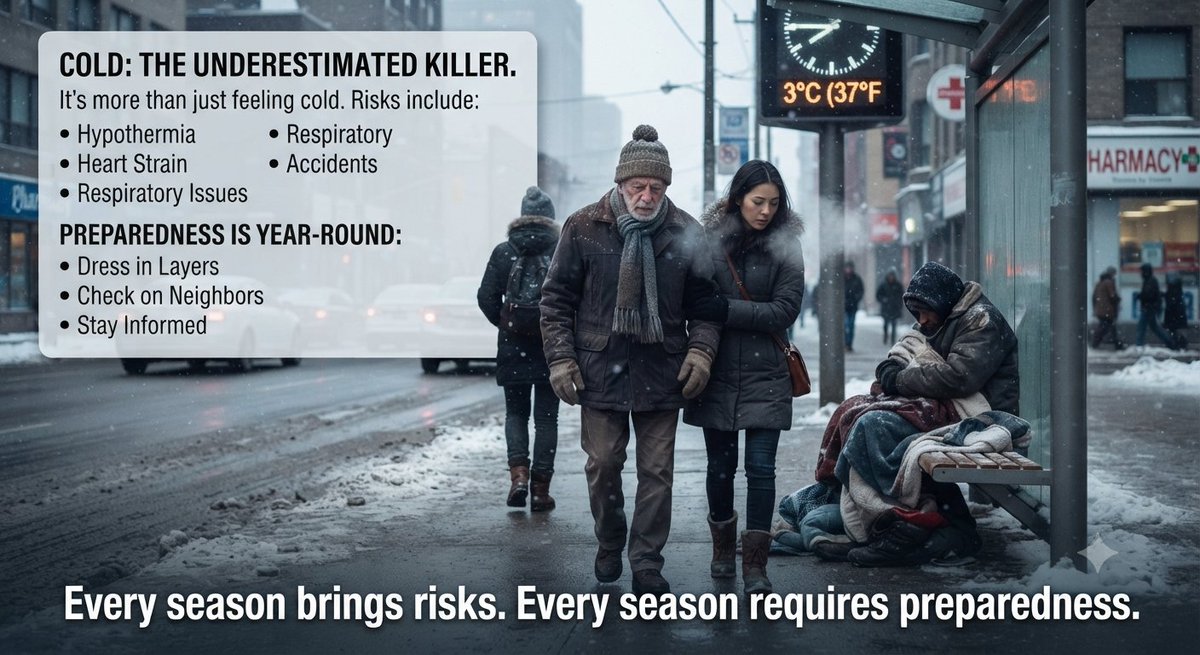
Cold is one of the deadliest natural hazards—but it's often underestimated.
When people think of climate-related risks, they usually picture heatwaves, floods, or bushfires.
Yet cold weather continues to claim lives every year, particularly among older adults, infants, people experiencing homelessness, and those with underlying health conditions.
In fact, many studies have found that cold-related deaths currently exceed heat-related deaths globally. While heatwaves often receive more attention because of their sudden and dramatic impacts, cold weather remains a significant and persistent public health risk.
Cold doesn't have to be extreme to be dangerous. It can increase the risk of hypothermia, worsen heart and respiratory conditions, reduce dexterity and decision-making, and contribute to accidents on the road and at home.
Climate change is about more than rising temperatures. It is changing weather patterns, increasing variability, and influencing the frequency, intensity, and duration of many types of extreme weather events. Depending on the region, this can include severe cold outbreaks alongside more frequent and intense heat events.
Every season brings risks. Every season requires preparedness.
The reality of modern conflict has fundamentally changed. Sabotage of civilian infrastructure is now a well-documented feature of hybrid warfare. We must move beyond the assumption that only military installations are potential targets.
National defence is no longer defined solely by border security. In today's security environment, it also depends on the resilience of the critical infrastructure that underpins everyday life.
This means investing in redundancy across our energy, communications, water, and other essential utility systems. The objective is not only to reduce the likelihood of disruption, but to ensure essential services can withstand attacks, maintain continuity, and recover rapidly when incidents occur.
Resilience is now a core component of deterrence. The stronger and more adaptable our critical infrastructure, the fewer opportunities there are to achieve strategic effects through disruption, undermine public confidence, or shape the information environment through sabotage to civilian infrastructure.
https://t.co/Hs3aeyBM9j
The Paradox of Global Logistics: Why Local Manufacturing Is the New Frontier of Resilience
In today's volatile global economy, we are living through a striking paradox.
A modern supertanker—capable of transporting millions of barrels of oil across oceans—can cost in the order of $130 million to build. Yet in many cities, a single cup of coffee costs $5–8.
🤔 Here's a thought: Around 18 million Australians drink coffee every day (or almost every day). If each bought just one $8 coffee today, together they'd spend around $144 million—enough to buy a modern supertanker, with money left over.
The comparison isn't meant to suggest these products should be similarly priced. Rather, it illustrates a defining feature of the modern economy: we've become extraordinarily efficient at moving goods across the globe. In many cases, it's cheaper to transport products thousands of kilometres than it is to manufacture them close to where they're consumed.
That should make us question what we've actually optimised. We have rightly invested heavily in making global logistics faster, cheaper, and more efficient, yet we've overlooked the resilience of the system itself. If tech can optimise almost every process, why are we still optimising for price alone instead of resilience, total system cost, adaptability, transparency, and local value creation?
Why do we continue to view cost solely through a financial lens, while ignoring the broader system costs that don't appear on a balance sheet? Cheapest option is not always the lowest-cost option.
For decades, globalisation rewarded businesses for optimising supply chains around cost and efficiency. Components crossed multiple borders before becoming finished products, supported by low shipping costs and just-in-time inventory systems. This model delivered lower prices and increased productivity—but it also created hidden risk.
When supply chains stretch across continents, every additional link introduces risk. Political tensions, natural disasters, pandemics, technological disruption, cyberattacks, trade restrictions, labour shortages, and logistics bottlenecks can all disrupt the flow of essential goods. Every additional intermediary—whether a distributor, broker, or offshore supplier—can also add cost, complexity, delays, and reduced visibility. The true cost of global supply chains is therefore measured not only in freight rates, but in their exposure to disruption.
Local Supply Chains Matter More Than Ever
Economic resilience is no longer a competitive advantage—it is a strategic imperative.
Building stronger local and regional manufacturing capability reduces dependence on distant suppliers, shortens recovery times after disruptions, and enables manufacturers to work more directly with customers and suppliers. By reducing unnecessary intermediaries, organisations can improve transparency, make faster decisions, lower transaction costs, and retain more value within local economies.
Regional supply chains also strengthen sovereign capability. They support skilled employment, foster innovation through closer collaboration, reduce transport emissions, and provide greater certainty for critical industries such as healthcare, energy, food production, defence, and advanced manufacturing.
This does not mean abandoning global trade. Rather, it means balancing efficiency with resilience. Nations and businesses that combine international competitiveness with robust domestic manufacturing capability and streamlined supply networks will be better positioned to absorb future shocks while maintaining economic stability.
The next frontier of resilience is not simply producing goods more cheaply. It is producing critical goods at scale, closer to where they are needed, through shorter, smarter, and more transparent supply chains that are efficient, adaptable, secure, and resilient.
Because in an increasingly uncertain world, the shortest supply chain may prove to be the strongest.
Beyond the Fuel Pump: The Philosophical Shift Australia Needs After the 2026 Crisis
1/2
Australia got through the 2026 fuel crisis by the skin of its teeth, but it's not over yet. While the queues at the bowsers have dissipated and emergency rationing has eased, the vulnerability exposed remains raw. The hard work of building a resilient nation happens not during a crisis, but for the years before and after.
Yet, as politicians and commentators bicker over strategic reserve days, domestic refining capacity, and EV transition timelines, they are missing the forest for the trees. The true structural change Australia needs is not a practical one, it is a philosophical one.
We do not just have a fuel deficit; we have a worldview deficit. To truly survive the next century, Australia must undergo a profound cultural pivot: from a philosophy of hyper-efficient lowest-cost, to a philosophy of deliberate resilience.
The Cult of "Just-in-Time"
For decades, Australia’s economic model has worshipped at the altar of the "just-in-time" supply chain. We optimized our systems to be as lean, cheap, and fast as possible. In a peaceful, highly globalized world, this worked beautifully. It kept corporate overheads low, maximized short-term profits, and delivered cheap goods to consumers.
But the 2026 fuel crisis exposed the fatal flaw of hyper-efficiency: it leaves zero margin for error. When a system has no slack, a single snapped link in a global supply chain causes total domestic paralysis. By treating "redundancy" as an economic sin, we systematically stripped away our nation's shock absorbers. We traded our national security for a slight discount on the balance sheet.
To build a resilient nation, we must stop treating buffer capacity like a dirty word and start viewing it as a prerequisite for survival.
Three Pillars of a Resilient Philosophy
Shifting our national mindset requires reframing how we value our resources, our infrastructure, and our sovereignty.
1. From "Just-in-Time" to "Just-in-Case"
The efficiency mindset asks: What is the absolute minimum amount of inventory we can hold to keep costs low today?
The resilience mindset asks: What is the maximum amount of disruption we can withstand tomorrow?
This requires an acceptance that "idle" capacity is not wasted capital; it is fully funded insurance. Holding excess inventory, maintaining mothballed equipment, and over-engineering critical infrastructure are the essential costs of living on an isolated continent. We must be willing to pay a premium today to ensure we have a tomorrow.
2. Pricing Risk into Sovereign Capability
For a generation, Australian policy has assumed that if it is cheaper to outsource refining, manufacturing, or shipping overseas, we should. But economic spreadsheets are famously blind to geopolitical volatility and maritime chokepoints. They forget that the tyranny of distance cannot be negotiated with during a crisis. When the sea lanes close, an unrefined barrel of oil or critical components a thousand kms away might as well be on Mars.
The philosophical pivot requires us to price risk directly into the ledger. A nation cannot claim to be truly sovereign if its vital functions rely on foreign supply lines remaining perfectly uninterrupted. Domestic capability—even if it costs more to produce—is a non-negotiable pillar of national defence.
3. Embracing the Strength of Decentralization
Efficiency loves centralization. Huge, monolithic refineries, massive synchronized energy grids, and concentrated distribution hubs scale beautifully. They maximize profits right up until they become catastrophic single points of failure.
A resilient philosophy champions decentralization and modularity. If our energy production, food distribution, and water infrastructure are hyper-local, a failure in one node remains contained. The network suffers a scratch, not a death blow.
2/2
The Road Ahead
Infrastructure, fuel reserves, and electric vehicle grids are merely the tools. If we do not change the underlying philosophy that governs how we build our society, we will simply use those new tools to construct another fragile, hyper-optimized system that will break during the next storm.
We got lucky in 2026. The system bent, groaned, and nearly snapped, but it ultimately held. But luck is an incredibly poor strategy for statecraft!
The real work ahead of us is not engineering; it is cultural. It is the difficult, slow work of convincing a nation accustomed to cheap, fragile convenience to invest in expensive, robust endurance. Australia must decide whether it wants to be a nation perfectly optimized for a world that no longer exists, or a nation built to withstand whatever comes next.
During the next crisis, we may not be so lucky.