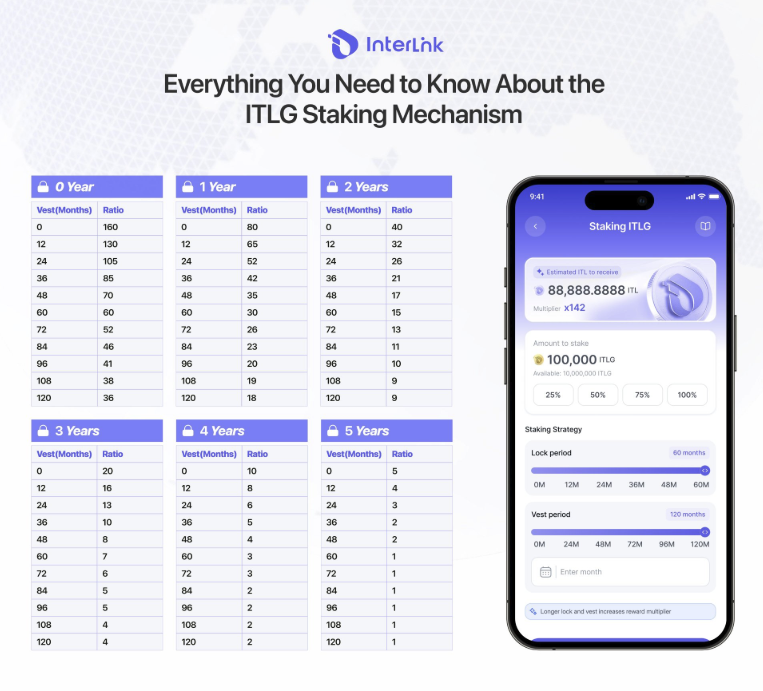
InterLink’s New Website is Coming Soon. 🌐
As @inter_link evolves from a free mining app into a sustainable blockchain ecosystem, our new website will better showcase the InterLink Network, its ecosystem, technology, and long-term vision.
A clearer vision. A stronger ecosystem.
Coming Soon. 🚀
#InterLink #ITLG #ITL
Interlink labs $ITL price update
Price of $ITL live on ATV website
How many of you are excited to see the price of $ITL at $13.69
Will you sell or hold ?
Revenue Models and the Economic Sustainability of dApps
Decentralized applications are commonly evaluated through scalability, security, and transaction performance. However, their long-term survival depends on a more fundamental question: Can a dApp generate recurring revenue without continuously relying on token emissions?
Revenue Models
DApps typically generate income through:
- Transaction and service fees
- Subscriptions and premium access
- Marketplace commissions
- Lending interest spreads
- Performance and asset-management fees
- APIs, data services, and enterprise integrations
Diversified revenue sources can improve resilience during periods of lower market demand. However, the most suitable model depends on the dApp’s core utility. A DEX may rely on trading fees, while a lending protocol can generate income from interest spreads and liquidation fees.
Revenue vs. Token Incentives
Airdrops, liquidity mining, and token rewards can accelerate user acquisition, but they are expenses, not operating revenue.
A protocol may report high transaction volume while spending more on incentives than it retains. Therefore, analysis should distinguish between:
- Total fees paid by users
- Revenue retained by the protocol
- Rewards distributed to service providers
- Token incentives
- Value captured by token holders
This reveals whether growth comes from genuine demand or temporary subsidies. If user activity declines immediately after rewards are reduced, the protocol may have attracted incentive-driven participants rather than loyal users.
Measuring Sustainability
Relevant indicators include:
- Protocol revenue growth
- Revenue per active user
- User retention
- Customer-acquisition cost
- Incentive-to-revenue ratio
- Treasury runway
- Token-emission rate
A simple measurement is:
> Economic sustainability = Protocol revenue ÷ (Operating costs + Token incentive costs)
When a dApp consistently spends more than it earns, it must depend on treasury reserves, external capital, or further token issuance, potentially causing long-term dilution.
Early-stage dApps do not necessarily need to be profitable immediately. The key question is whether incentives eventually create recurring usage and whether the protocol has a realistic path toward reducing subsidies.
The Role of InterLink
A sustainable revenue model also requires dependable infrastructure. Downtime, difficult integration, and high development costs can prevent a promising dApp from achieving commercial viability.
@itl_fdn supports developers through:
- Reliable and scalable infrastructure
- Developer-friendly SDKs and APIs
- Faster, simpler integration
- Accessible technical resources
- Continuous ecosystem assistance
- 24/7 developer support
Reliable infrastructure reduces operational risk, while easier integration lowers development costs and shortens time to market. These advantages allow teams to focus more resources on product utility, user retention, and revenue generation.
Sustainable dApps align four essential elements: infrastructure, real utility, recurring revenue, and fair value distribution. Token incentives may attract early users, but long-term growth begins when users stay because the product delivers genuine value.
> Sustainable dApps convert real demand into recurring revenue and lasting ecosystem value.
#InterLink #ITLG #ITL
💰 $ITL OTC Market Price Snapshot
Based on the latest community-reported OTC activity, the estimated trading ranges for $ITL are:
🇰🇷 South Korea: $1.90 – $7.90
🇻🇳 Vietnam: $1.90 – $3.10
🇮🇩 Indonesia: $1.60 – $2.00
🇮🇳 India: $1.90 – $3.90
🇵🇰 Pakistan: $1.85 – $2.60
🇪🇹 Ethiopia: $1.60 – $2.90
⚠️ Disclaimer
The prices above are based on community-reported OTC trades and are shared for informational purposes only. They do not represent an official market price or guaranteed valuation of $ITL.
OTC prices can vary depending on:
• Mutual agreement between buyers and sellers
• Regional demand and available supply
• Liquidity and trade size
• Payment methods and local market conditions
Always verify the other party's identity and use trusted, secure channels when conducting OTC transactions.
🌐 7 Dapps - The Beginning of the Entire Interlink Economy
With the launch of the first 7 applications on the Interlink chain, we can understand that $ITL will have more use value than just hoarding.
While the initial deployment of dapps allows users to spend their $ITL, it also presents an opportunity for businesses to see how participating in the ecosystem can boost their own revenue.
With more ways for users to utilize $ITL, it will become scarcer, leading to a higher value increase.
A new era for Interlink has begun, and the deployment of 7 dapps is just the beginning of thousands of connected dapps in the future.
Ultimately, due to the deflationary design tied to the circulating supply of $ITL, most of the growth value will be passed on to users through the amount of $ITL they hold.
The road ahead is long, and with each stage, some will leave and new ones will arrive.
I hope you will be my last companion on this journey – success always belongs to the most patient.
🔥 IMPORTANT UPDATE 🔥
Make sure you've updated your InterLink App to the latest version because something exciting is about to happen!
The first six dApps in the InterLink Ecosystem are on the way:
🔹 LinkersMap🔹 ATV🔹 BitFlip🔹 InterPredict🔹 ITL Vault🔹 InterLink Name Service (INS)
This marks another major milestone in building a real blockchain ecosystem where every dApp strengthens the utility of $ITL and expands the InterLink Network.
The future is getting closer with every update. Don't miss what's coming next!
🚀 Update your app. Stay ready. Stay tuned.
🔐 ITL Vault is almost here!
Soon, $ITL holders will be able to lock their tokens as collateral and access USDT liquidity without selling their assets.
This means you can keep your $ITL, unlock liquidity when needed, and benefit from a secure, transparent on-chain financial system.
A major step forward in expanding the real utility of $ITL.
#InterLink #ITL #ITLG #ITLX
📢 Important Clarification from the InterLink Core Team
To ensure everyone has accurate information:
❌ The claim that the second migration batch will take place one year after the first batch is false. No such timeline has been announced.
✅ The Core Team has already considered concerns about potential ITL inflation after token distribution. InterLink's utility and demand mechanisms are being designed to balance token circulation, aiming for near-zero net inflation or even a deflationary ITL economy.
🔒 Additionally, the InterLink Core Team will not hold or own the token supply at this stage, and strict internal policies prohibit company employees from trading ITL.
⚠️ Always rely on official InterLink announcements and avoid spreading unverified information.
#InterLink #ITL #Blockchain #Crypto #Tokenomics #Web3 #DeFi #InterLinkChain
The Pi ecosystem is no longer just a vision—it's becoming reality. 🔥
From screens to stores, $PI is making real-world payments possible. This is what true crypto adoption looks like.
The Pi Economy has arrived. 🚀💜
❤️ Like if you're still holding.
🔄 Repost if you believe Pi's best days are ahead.
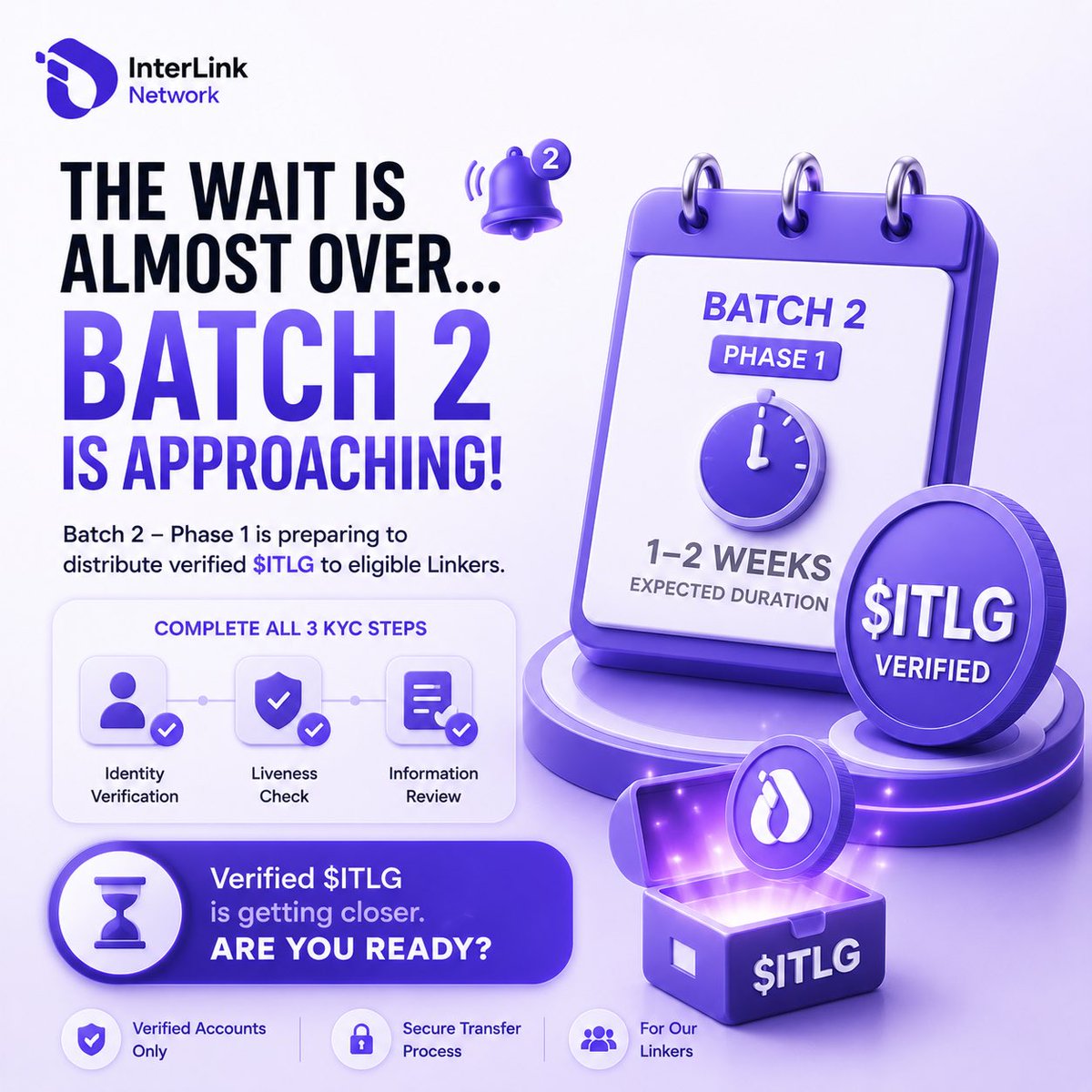
🚨 The Wait Is Almost Over… Batch 2 Is Approaching!
The next major milestone for the InterLink community is getting closer.
Batch 2 – Phase 1 is preparing to distribute verified $ITLG to Linkers who have successfully completed all 3 KYC verification steps.
Once enough verified accounts are confirmed, the transfer process will begin and is expected to take around 1–2 weeks.
If you’ve completed your KYC, this is the update you’ve been waiting for.
⏳ Verified $ITLG is getting closer. Are you ready?
#InterLink #ITLG #ITL
Batch 2 - Phase 1 is getting closer.
InterLink is preparing to distribute verified $ITLG to Linkers who have completed all 3 KYC steps.
Once enough valid KYC accounts are compiled and confirmed, the Batch 2 transfer process will begin, which is expected to take around 1–2 weeks.
This could be one of the most anticipated updates in the community right now.
If you’ve completed KYC, get ready.
Verified $ITLG is getting closer.
#InterLink #ITLG #ITL
Please help us report fake accounts like these that are harming the project and misleading the community.
At this time, only the following accounts are official InterLink Core Team accounts:
@reina_itl@kv_interlink@miratang16@scott_itlg@KTimmering
Any other accounts claiming to represent the InterLink Core Team are not official.
🚨 INTERLINK UPDATE 🚨
The wait is almost over! ⏳🔥
Starting Tuesday, users who requested the conversion of their verified $vITLG to $ITL will begin receiving their coins directly in their wallets.
This marks another major milestone for the Interlink ecosystem, with the community eagerly watching the next phase unfold.
Stay patient. Stay ready.
🚀 Something BIG could be just around the corner.
How many $ITL are you holding?
Comment below! 👇
#Interlink #ITL #ITLG #ANetwork #ANet #wANet #Crypto #Blockchain
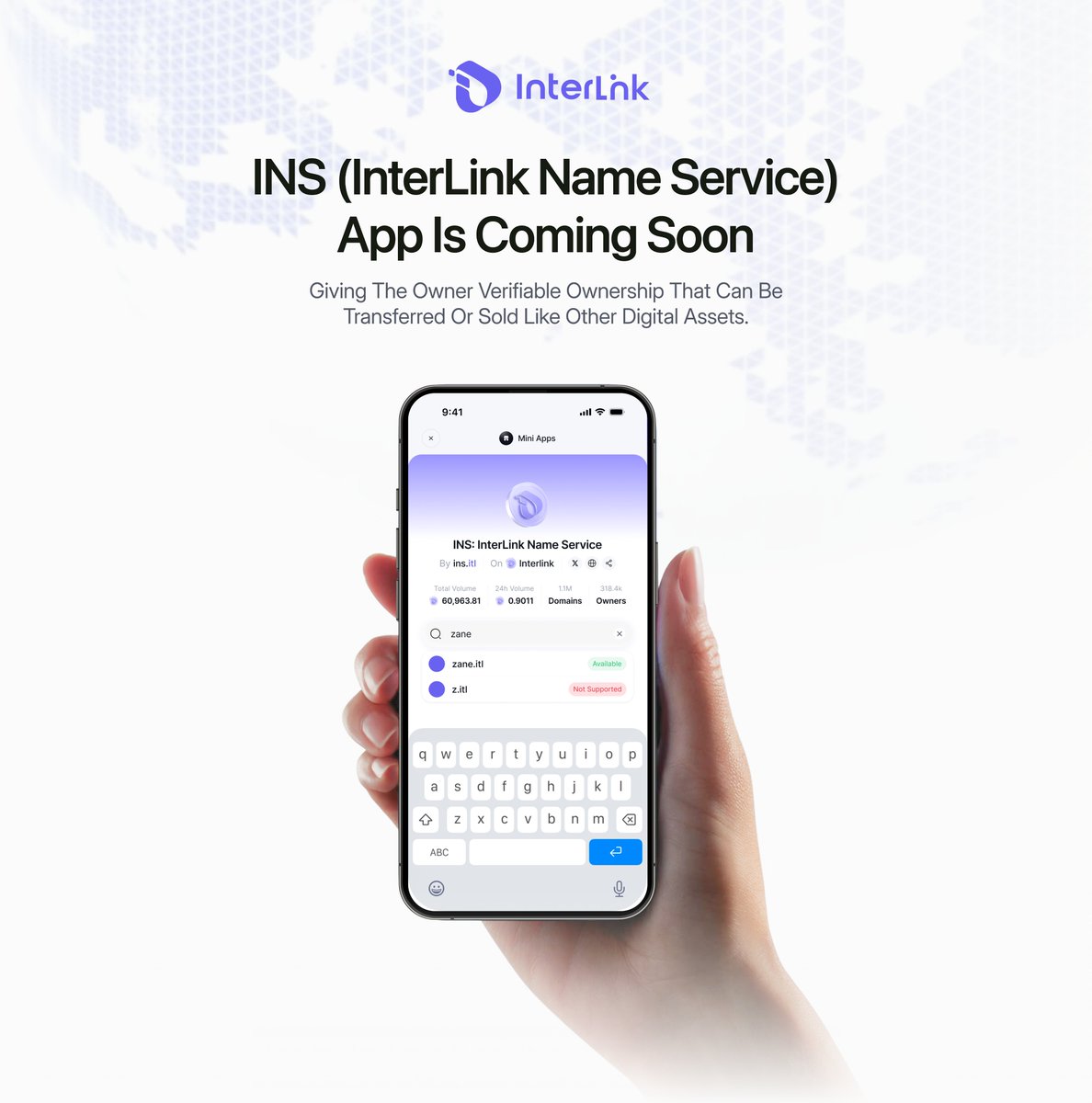
INS (InterLink Name Service) App is coming soon
What Is InterLink Name Service?
INS is a decentralized naming protocol built on InterLink Chain that lets users register human-readable names ending in ".itl." Each INS name is an IRC-721 non-fungible token (NFT), giving the owner verifiable ownership that can be transferred or sold like other digital assets.
Beyond wallet addresses, INS names can link to cryptocurrency addresses on other blockchains, content hashes pointing to websites or files on decentralized storage networks, and personal metadata such as social media handles or email addresses.
Once live, INS will grow into a community-governed protocol managed through InterLink DAO, which will oversee the INS root and make key protocol decisions.
NameWrapper and IRC-1155 names
The INS NameWrapper contract will allow INS names to be wrapped and represented as IRC-1155 tokens rather than plain IRC-721 tokens. Wrapped names support "fuses," permission settings that control what actions can be taken on a name, such as preventing subdomain creation or preventing the name from being unwrapped. This enables more advanced use cases, including emancipated subdomains that cannot be revoked by the parent name owner.
How Does INS Work?
- Architecture
INS uses a hierarchical structure. At the top are top-level domains (TLDs) like ".itl," each managed by smart contracts called registrars that define registration rules. The INS registry is a central smart contract that records domain ownership, resolver assignments, and cache settings. Resolvers are contracts responsible for translating INS names into addresses or other data.
- Forward and reverse resolution
Forward resolution converts an INS name (such as "alice.itl") into one or more addresses or linked data. Reverse resolution works in the opposite direction, linking an address back to its primary INS name. This allows wallets and applications to display human-readable names instead of full hex addresses.
- Domains and subdomains
Owners of INS domains can create effectively unlimited subdomains that they fully control. For example, owning "alice.itl" allows creation of "mail.alice.itl" or "shop.alice.itl," each pointing to different resources or managed independently. With the NameWrapper, subdomains can be issued with specific permissions baked in.
What Can You Do With INS?
INS simplifies sending and receiving cryptocurrency by replacing complex addresses with readable names, reducing the risk of errors during transactions. A single INS name can link to multiple blockchain addresses, making cross-chain interactions easier to manage.
INS names can also store information such as website links, email addresses, and social media handles, making them useful as decentralized identifiers for personal or organizational branding. Subdomain creation and delegation enable communities and applications to build naming systems on top of an INS domain they control.
Registering and Managing INS Domains
- Registration
Registering an INS domain will require a compatible crypto wallet and ITL to cover the registration fee. The process involves searching for an available name on the INS app and registering it directly. Most names will be available on a first-come, first-served basis without auctions.
- Pricing and renewal
Registration fees will be set in dollar terms but paid in ITL. On-chain price oracles will convert the dollar price into the current ITL amount at the time of payment, keeping the actual cost stable in dollar terms regardless of ITL's market price. Names with five or more characters are expected to cost around a few dollars per year, while shorter names (three to four characters) will carry higher fees due to their scarcity. INS domains will require periodic renewal, with a grace period after expiration that allows owners to renew before a name re-enters the public pool.
#InterLink #ITLG #ITL
The @itlx_defi Perpetuals market is now live with permissionless listings, including:
$GLW — Corning
$AAOI — Applied Optoelectronics
$SYN — Synapse
$EIGEN — EigenLayer
$GRAM — Gram
This is exactly how permissionless markets should work. @itlx_defi is liquidity infrastructure—not a gatekeeper. Markets can be listed permissionlessly, liquidity providers supply the liquidity, and users simply trade.
Today, users can access perpetual markets for major U.S. equities, crypto tokens, and other assets directly on blockchain infrastructure.
This is just the beginning.
#ITLX #ITLG #ITL