Happy 250th Independence Day!
There's a lot to say today, but it comes down to this: God bless the U.S.A. It took us in and gave us safety, opportunity, and care when our own country turned away. Grateful doesn't quite cover it.
Thank you
Aquí el anuncio entero de Nike para el Mundial. Es una absoluta locura. Seguramente el mejor comercial de futbol de todos los tiempos. Vale cada segundo.
Apple is about to make Siri unrecognizable. iOS 27, previewed ahead of WWDC on June 8, will turn Siri into a standalone conversational app with persistent chat history — think ChatGPT, but built into every iPhone. The Camera app gets a dedicated AI mode powered by Visual Intelligence, and the Photos app gains three new generative editing tools.
Apple is using its next software cycle to close the AI gap with Google and OpenAI in one move.
Google Cloud abruptly suspended Railway com without any warning, cutting off a company spending over $10 million a year on its infrastructure. The cutoff triggered a major outage, with customers hitting "no healthy upstream" errors and unable to access their dashboards.
Railway described the suspension as coming completely out of the blue, with resources appearing simply deleted. It echoes Google Cloud's 2024 wipe of Australian pension fund UniSuper and reignites a serious debate about the risks of depending entirely on a single hyperscaler.
Google just ended 25 years of search as we know it. At Google I/O, the company announced it's replacing its ten blue links with AI agents, generative interfaces, and personalized mini apps built on Gemini, rolling out free to all users this summer.
The change affects every internet user on the planet. Publishers already battered by AI Overviews now face a search engine that sends less traffic than ever: users can deploy "information agents" that monitor the web around the clock on their behalf.
The credential that was supposed to make you stand out is everywhere now. The Wall Street Journal reports that a master's degree is no longer the employment guarantee it once was, as graduate program enrollment has surged and employers have shifted focus toward demonstrable skills over academic credentials.
Tech, finance, and consulting, the traditional landing zones for graduate degree holders, are pulling back on entry-level hiring. Add AI automation into the mix, and the ROI calculus for a $60,000 master's degree has never been harder to justify.
OpenAI just brought Codex into the ChatGPT mobile app for iPhone and Android. Developers can now monitor AI coding tasks, approve commands, review diffs, and start new work from their phone — while Codex runs on a laptop or remote machine.
OpenAI calls it more than remote control: live state updates, cross-thread management, and real-time screenshots from wherever you are. Windows support is coming soon.
Meta launched an incognito mode for conversations with Meta AI inside WhatsApp. Chats are processed in a secure environment and disappear by default when the app is closed or the phone is locked.
The feature is powered by Meta's Muse Spark model and rolling out to WhatsApp and the standalone Meta AI app over the coming months — a privacy pitch directed at 2 billion users at once.
State-sponsored hackers targeted Google's artificial intelligence systems in what U.S. officials describe as one of the most sophisticated espionage campaigns ever directed at the company. Attackers sought access to proprietary AI research and infrastructure.
The breach signals a new front in geopolitical competition — not over weapons or secrets, but over the AI systems that could define technological dominance for decades. Federal intelligence agencies are investigating, and Google has not disclosed the full scope of the intrusion.
OpenAI just released three new realtime voice models built on GPT-4o that can reason, translate, and transcribe as you speak, without converting audio to text first. The company says they will unlock a new class of voice apps that are faster, more natural, and multilingual from the ground up.
For developers, this opens the door to real-time translation tools, AI-powered call centers, and voice interfaces that can think in conversation. OpenAI is moving voice AI well ahead of competitors with this launch.
The Canvas login page greeted millions of students this morning with a ransom note instead of their coursework. ShinyHunters breached Instructure and threatened to leak data on 275 million students and faculty from nearly 9,000 schools unless a ransom is paid by May 12.
The timing couldn't be worse. Hundreds of schools are mid-finals and Canvas is now completely offline. Stolen data reportedly includes billions of private messages between students and teachers, plus names, phone numbers, and email addresses.
The Trump administration is considering a formal government review process for new AI models before public release — a striking reversal from its earlier push for deregulation and unfettered AI development. Officials briefed OpenAI, Anthropic, and Google last week on the proposals.
The apparent trigger is Anthropic's unreleased Mythos model, which the company says can identify software vulnerabilities at a scale that could cause a national cybersecurity crisis. When an AI lab's own unreleased model prompts a White House policy reversal, something has fundamentally shifted.
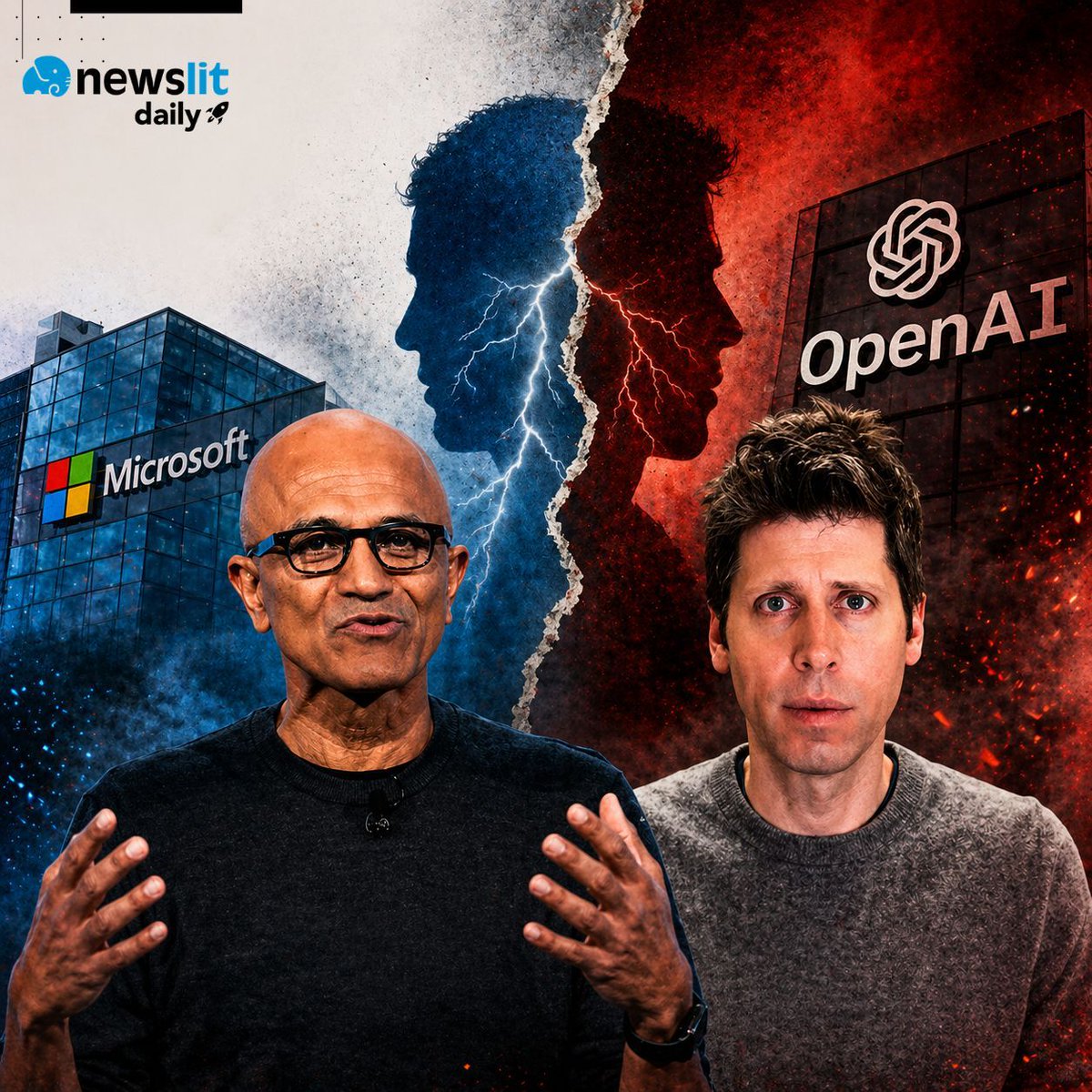
The OpenAI-Microsoft exclusivity deal is over. Azure no longer holds a monopoly on powering ChatGPT.
Microsoft drops its exclusive right to sell OpenAI models, opening the door to Amazon and Google. In exchange, revenue sharing on resold products ends. OpenAI products still ship first on Azure, but that is now Microsoft's call to make, not a contractual obligation.
This is not a clean break. It is a renegotiation. But the terms have fundamentally shifted, and OpenAI now has room to move that it did not have before.
The Musk v. Altman trial has a jury. Nine people will now decide whether OpenAI betrayed its founding mission as a nonprofit.
Opening arguments start Tuesday. At stake is whether a for-profit company can walk away from public commitments made as a nonprofit, and what that precedent means for the rest of the AI industry.
Elon Musk filed this lawsuit more than a year ago. It was easy to dismiss as noise. It is now in federal court with a full jury seated.
Microsoft had a shot at Cursor. They passed.
SpaceX did not. Elon Musk's rocket company has secured an option to buy the AI coding startup for $60 billion, with an alternative deal for a $10 billion collaboration. This is the same Cursor that Microsoft evaluated and walked away from.
For a company that has been betting heavily on AI developer tools, it is a costly pass.
X just handed your timeline to an AI.
Starting this week, Premium subscribers can access Grok-curated feeds across more than 75 topics, from Politics to Tech to Sports. Unlike keyword filters, Grok reads and labels every post on the platform before surfacing content. Your feed, shaped by AI.
Meanwhile, X is shutting down Communities on May 6. Apparently AI curation is in. Human-built spaces are out.
OpenAI shipped a new trick for Codex on Mac called Chronicle.
Instead of you pasting context into every prompt, the coding agent looks at your recent screen activity and figures out what "this error" or "that document" means. Over time it learns your workflows, tools, and recurring projects. Screenshots and memories stay local on the Mac. You can inspect, edit, or turn it off from the menu bar.
The catch: OpenAI says it burns through rate limits fast, and it is Pro-only for now.