To speak the final words of Gunner Lee Thornton at @PoppyLegion Festival of Rememberance 2026 has to be one of greatest honours of my life. God bless you Lee….for your unbelievable service, bravery and sacrifice. I hope I did you proud mate? ❤️ #RemembranceDay2026
Allan Massie was hugely important to me. One of my very first readers and champions. He was also an underappreciated novelist, a sharp but humane literary critic, a gentleman.
I gave it everything….
Congratulations @McIlroyRory on winning the @TheMasters and completing the Grand Slam.. very cool sharing the green with you in that moment…
Thank you Team🌹 as always for all the support during the week… We go again 👊🏻
A 17-gun salute was fired in honour of former Chief of the General Staff General Sir Mike Jackson GCB CBE DSO, who died recently.
@Airbornegunners fired as General Jackson, a @TheParachuteReg officer who served in Northern Ireland and the Balkans, was laid to rest.
From Major General Ollie Kingsbury OBE, Colonel Commandant PARA:
“Being appointed by the Colonel in Chief as your new Colonel Commandant is the honour of my life. I could not be more proud of our Regiment: always a safe haven to return to, and constant source of inspiration. Taking over from Lieutenant General Harrison on the DZ at Arnhem was perfect, surrounded by so much history, and so many friends. I am extremely grateful to Andy for all he has done for us as Colonel Commandant, and for setting me up so well: look for his memorable Ginkel Heath farewell speech online if you need a reminder of what this Regiment means to us all.
The Parachute Regiment is in a good place. There remains the same powerful golden thread of logic from our battle honours, through our ethos, selection and training, to our current roles. Montgomery’s words are as true as ever: “…infectious optimism… offensive eagerness… highest standards in all things… every man an Emperor.” This shared sense of purpose continues to drive our soldiers to reaching excellence in training, on courses, in their sport, and on operations; just as importantly, in their achievements when they leave the army.
But there is no room for complacency. The past shows us what right looks like, but it does not guarantee success in the future. Remaining healthy requires continuous attention.
Five areas matter most. First, our twin roles in 16 Air Assault Brigade and in the special operations force are secure, but we must continuously help and inform as future plans develop. Second, recruiting and inflow from training are improving but require constant effort, as does retention. Third, the RAF’s Air Mobility Force – our key capability dependency – continues its complex transition to the immensely capable A400M. I know they share our ambitions, and we need to be patient and supportive. Fourth, credibility at readiness and on operations remains strong. Reputation brings scrutiny however; we should expect and welcome it, as a chance to demonstrate our professionalism. Fifth, we are inherently resilient, with the diversity we get from welcoming all those who meet high entry standards. We should be proud of that, and humble in acknowledging the opportunities it brings us.
Serving you as your Colonel Commandant, I am the temporary guardian of our history and our heritage, and of our spirit. I will work to tell our story, to look after our people, and to support the chain of command in getting the most from our amazing soldiers, and our extraordinary Regiment. I will need your help, and I look forward to working with you over the next few years.”
Ready for anything 🇬🇧🆎
@BritishArmy@16AirAssltBCT@Army_Leadership@DefenceHQ@ArmyInfantryHQ
#ParaReg
#Paras
#Paratrooper
It is with great sadness that I share the news of the passing of Warrant Officer John Thompson, who died aged 82 on Saturday evening after a period of ill health.
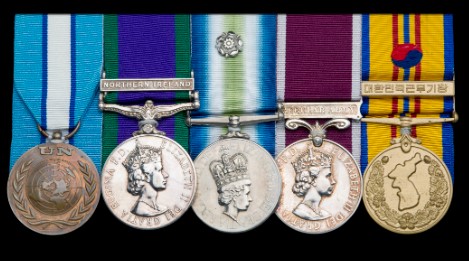
John Vincent Thompson enlisted into the Royal Electrical Mechanical Engineers Junior Leaders in 1959, aged 17, taking up his man service the following year. He completed his parachute training, and, staying with the R.E.M.E. joined the Parachute Brigade in 1962, being posted to Cyprus on New Year's Day 1964. He was amongst the first British Paras to remove their red berets and exchange them for the light blue beret of the United Nations, when the U.N. took over responsibility for peacekeeping operations in Cyprus on 27 March 1964.
Thompson transferred to the Royal Army Ordnance Corps, Parachute Brigade in 1969 and five years later in 1974, together with his Brigadier, gained the rare distinction of being presented at a parade with the Republic of Korea Service Medal on the completion of a one-year posting in Korea on a Commonwealth Liaison Mission.
In 1978 he successfully applied for and completed his S.A.S. selection and was posted to Boat Troop, ‘A’ Squadron.
Operation Nimrod
On the morning of 30 April 1980, six gunmen took 26 people hostage at the Iranian Embassy in South Kensington. As a result, a coded message was sent to S.A.S. H.Q. in Hereford requesting immediate assistance and ‘B’ Squadron, whose turn it was to act as the Counter-Terrorism Team were soon rushed to the scene. Thompson’s involvement in the Siege happened quite by chance three days later when ‘B’ Squadron requested additional support. Thompson and three of his ‘A’ Squadron colleagues happened to be leaving camp on their way to watch Liverpool play Arsenal in a third replay of the F.A. Cup semi-final when an M.O.D. policeman stopped them and told them that they were to attach themselves to “B’ Squadron for the duration of the siege with immediate effect. They were taken to London by a Chinook helicopter and at the time were not at all impressed at missing the football match.
Two days later, on 5 May 1980 at 19:24hrs, following the shooting by the terrorists of one of the hostages, the fifty-five men of the S.A.S. began their rescue mission. Thompson and his three ‘A’ Squadron colleagues were split into two pairs and assigned the important role of assaulting the front and rear of the building from the ground level. Thompson and his partner were given the front of the building where they successfully fired numerous gas canisters through the four first-floor windows. He and his partner had to be alert and ready at all times for the terrorists in case they tried to shoot their way out of the building, and in the actual event had to deal with various guns and hand grenades that were thrown out of the windows by the terrorists as well as deal with the hostage reception. The raid lasted 17 minutes in total and by the end of it, five of the six terrorists were dead. One hostage was killed by the terrorists in the raid and two others were wounded.
The following year Thompson transferred from Boat Troop, ‘A’ Squadron to Boat Troop, ‘G’ Squadron, a somewhat fortuitous move as it turned out for an elite soldier seeking action, as the following year his old squadron was destined not to take part in the Falklands Conflict being kept back in the essential role of homeland security.
The Falklands
During the Falklands War, Thompson and the rest of ‘G’ Squadron were inserted by helicopter at night in four-man patrols three weeks before the invasion. Thompson’s Patrol Commander was awarded an M.M. for this action and his citation which was published in the London Gazette gives detail of their mission:
‘Inserted by helicopter from the Naval Task Force at a distance of 120 miles from the islands, he maintained observations of the enemy movement and dispositions in the Bluff Cove, West Stanley areas for 28 days. In a hostile environment, with the only protection from ground and air search provided by the skill and stealth of his patrol, the reporting was both accurate and timely.
To obtain the detail of the enemy disposition he was required to move his observation position to close and often obvious positions to gain the intelligence required. This he did with great courage and skill knowing that if compromised his patrol could not have been extracted from any predicament caused by enemy action. In addition, he communicated his information in an environment where the enemy was known to possess a Direction Finding capability.’
Following the success of this mission Thompson was employed in fighting patrols for the duration of the conflict. As well as the M.M. to his Patrol Commander, one other member of his four-man patrol received an M.I.D.
Warrant Officer I John Vincent Thompson left the Special Air Service on 13 January 1983, aged 40 on completion of 23 years and 77 days of service. He immediately took up a job in the Royal Oman Police Special Task Force and the Sultan’s Special Force Oman, with whom he served as a Major between 1983 and 1988.
On returning to the UK he was active in the security industry, involved in the close protection of several well-known personalities, until retiring at 65. During the last 5 years, he has remained reasonably fit by becoming a 1st Dan Black Belt in Martial Arts, a National Swimming Lifeguard and running several marathons, including the London and Snowdonia. As well as running these for military charities, he also walked up to Everest Base Camp earning a reasonable amount for Help for Heroes.
#SAS #BritishArmy at its best, rest in peace John.
The 2nd Battalion of The Parachute Regiment entered Port Stanley in the Falklands Islands, closely followed by the 3rd Battalion The Parachute Regiment.Ending an occupation of hostile forces from the Argentinian Army.
14th June 1982, end of a war.Everyman an Emperor 🪂🪂