@cjoye So historically does a housing correction cause a negative wealth effect (and at what decline does it do that) and does it cause a recession or are they intertwined?
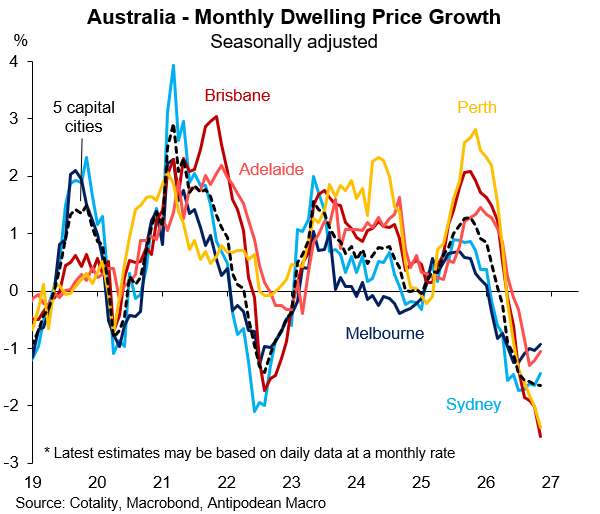
Australia’s housing correction is now the worst decline on record, as Coolabah projected. Cotality’s five-capital city index has fallen 8.8% from its March 2026 peak, eclipsing the 8.6% decline of 2017-19, previously the deepest nominal drop since the series began in 1980. The daily index passed that mark on 9 November.
What sets this episode apart is its speed. The 2017-19 downturn needed 19 months to reach its trough. This one went further in under eight. The other major corrections, in 1982-83, 2022-23, 2008-09 and 1989-91, bottomed between 6.4% and 8.5%.
The second chart asks whether the falls are slowing. They are not. Measured over rolling 30-day windows, the five-capital index has been declining at an annualised pace of 16% to 19% since late July. It sits at 17.2% today, barely below the 18.6% reached in early August. That is a plateau, not a deceleration.
Beneath the aggregate, the cities are moving in sequence. Melbourne, the first market to turn, is the only one that has clearly eased, with its pace halving from 17.8% in July to 9.2%. Sydney has moderated from 21.1% to 17.5% and has held near that rate since September. The later-peaking markets have taken over. Brisbane is falling at 23.9% annualised, its steepest rate of the cycle and the quickest of any capital. Perth is running at 19.9%, only modestly off its September high.
Relief in Melbourne has therefore been offset elsewhere, leaving the national rate of decline essentially unchanged for more than three months.
While you can blame higher interest rates, the real driver is Australia’s globally elevated inflation, which is in turn being propelled by reckless public spending and some of the developed world’s worst productivity growth. This dismal performance is itself a function of Aussie governments suffocating Main Street (aka private enterprise)...
Strategy has acquired 1,036 $BTC and repurchased $188M of $STRC. As of 11/8/26, we hold 850,364 BTC and $4.9B of USD Assets. $MSTR https://t.co/Pxqso5aVRU
JUST IN: Center for AI Safety warns AI is rapidly approaching the ability to automate all remote work, as Claude Fable 5.2 successfully completes 41.3% of real freelance projects — up from 2.5% a year ago.
Daily Cotality data - subject to revision - suggest the decline in Brissie & Perth dwelling values is really getting up a head of steam so far this month.
What goes up and all that....
Real wages in Australia have fallen to levels last seen in 2011.
And they are not expected to recover until 2034.
If you are feeling worse off under this Labor Government, that is because you are worse off.
🇺🇸 LATEST: Deutsche Bank now expects three consecutive 25-basis-point Fed rate hikes in December, January and March, bringing the target range to 4.50%–4.75% following hotter-than-expected October inflation data.
Masayoshi Son’s SoftBank reserved enough gas turbines to generate the power of six Hoover Dams. It cost the company billions of dollars in losses. https://t.co/9f3cqYRrNj
I’m absolutely fed up with this fucking globalist liar.
Cut Canada off of dollars tomorrow. Cut visa free travel to US. Get his kids and wife out of the U.S. and seize his property.
Sen. Elizabeth Warren (D-MA), the incoming Banking chair, could not name a positive impact of crypto on the financial system.
“I’m still waiting for crypto to make that case,” she told me.
Warren on what she wants Dems to do now —>
https://t.co/MYV9Gq7rKF
@KatieMiller I remember that time when Masa, instead of putting $12B into Tesla for a 1/4 of the company to help me take Tesla private, instead invested the money in WeWork.
That was dumb.