@bewakoof
Your customer support is pathetic and unethical. First the email of my bewakoof account was changed (_gk was added to it) and then they started refusing the refund.
Now they are saying to wait and its been days since I last got this mail.
I'm regretting shopping here.
Everyone’s a gangsta until they have an interview with principal swe at amazon working on bedrock🫠.
We discussed harness engineering for an hour, started with what is a model and ended with in depth brainstorming how would I optimize codex/claude code etc for a specific use niche.
Some of the nit-bits:
how would i fundamentally enforce guardrails robustly,
why current sub agents architecture is very unoptimised (build your own system from scratch),
how does tool calling works, etc.
Need to lock in hard.
And yea sorry to disappoint but no leetcode.
PS: Will post the complete experience once I have some time.
One of the core operations behind Uber's driver matching is a spatial join. Let me explain...
Your phone sends a location (a point). Uber needs to know which nearby drivers (also points) fall within a certain radius, and which pricing zone (a polygon) you are standing in.
Neither of these is a simple key match like `user_id = driver_id`. It is a question involving geometry, a simple variant being - does this point fall inside that shape, or how close is it to another point?
That is what a spatial join is. Instead of joining two datasets on a column, you join them on a spatial relationship: intersects, contains, or within a distance. Here are a few more examples -
- DoorDash and Instacart use it to check if a delivery address falls inside a store's delivery zone, and to assign the nearest available driver.
- Swiggy and Zomato use it to decide if your address falls inside a restaurant's serviceable radius before they even show it in your feed.
- Strava uses it to match your GPS trace against known running or cycling segments, so it can tell you if you just set a personal record.
By the way, this is how you identify if you need a spatial join or not - one side is usually points (a person, an order, a sensor reading) and the other side is polygons or radius (a zone, a district, a delivery range).
The join answers a question that a normal SQL join cannot: not 'do these IDs match', but 'do these shapes overlap in space'.
The easiest way to prototype spatial joins and other geo capabilities is through an OSS library called geopandas. This is what I also used in the past while I was building a similar system.
Hope this helps.
yoo channels like jordan has no life and byte byte go are definitely the best sources to learn system design or just know how anything runs under the hood
I also feel that more of other channels should be given some light too .. like watching from different POVs ... I binge watch these channels while traveling or when I am just feeling not to do anything
most of them are run by senior engineers so its good to see some experienced talking on stuffs you know earlier
MIT DEDICATED A FULL LECTURE TO GIT'S INTERNALS -- BECAUSE THEY FOUND MOST DEVS MEMORIZE THE COMMANDS AND HAVE NO IDEA WHAT THE TOOL ACTUALLY DOES
A whole 85 minutes MIT session that refuses to teach git as a list of commands to copy, and instead shows you the data model underneath -- the thing that makes every command finally make sense.
-> The moment it clicks, git stops being scary magic. You stop memorizing "The incantation that fixed it last time" and start actually knowing what's happening.
Most people learn just enough git to not get fired. Four commands, blind faith, and a prayer before every merge.
In 2026 that's not enough anymore -> git is the literacy test for being in the room, and "I'll just reclone it" is the fastest way to look junior.
An AI agent will branch, commit and rebase faster than you can read. When it tangles the history, untangling it runs on understanding the model MIT teaches in this one hour.
Anyone can run git push. The person who understands the graph underneath is the one who saves the repo when it breaks.
Bookmark & Watch it ↓
Don't overcomplicate it.
- Build a Bank Account System to learn OOP, inheritance, and polymorphism done properly
- Build a Library Management System to practice CRUD, collections, and file persistence
- Build a TCP Chat App to understand sockets, threads, and blocking I/O streams
- Build a Task Scheduler to master executors, thread pools, and Java concurrency
- Build a Simple HTTP Server to work with raw sockets, request parsing, and response logic
- Build a Student Grade Tracker to use Java Streams, sorting, and functional-style pipelines
- Build an Inventory System with JDBC to learn database integration from first principles
- Build a Dependency Injection Container to go deep on reflection, generics, and annotations
The best way to learn Java? Projects. Not tutorials.
As an AI Engineer. Please learn:
Harness engineering, not just prompt engineering
Context engineering, not just long prompts
Prompt caching vs. semantic caching tradeoffs
KV cache management, eviction, reuse, and memory pressure at scale
Prefill vs. decode latency and why they optimize differently
Continuous batching, paged attention, and throughput optimization
Speculative decoding vs. quantization vs. distillation tradeoffs
INT8, INT4, FP8, AWQ, GPTQ, and when quantization hurts quality
Structured output failures, schema validation, repair loops, and fallback chains
Function calling reliability, tool contracts, argument validation, and idempotency
Agent guardrails, loop budgets, tool budgets, and termination conditions
Model routing, graceful fallback logic, and degraded-mode UX
RAG architecture: chunking, embeddings, hybrid search, reranking, and freshness
Retrieval evals: recall, precision, grounding, attribution, and citation quality
Evals: golden sets, regression tests, adversarial tests, LLM-as-judge, and human evals
LLM observability as a first-class discipline: traces, spans, tokens, latency, errors, and drift
Cost attribution per feature, workflow, tenant, and user journey not just per model
Safety engineering: prompt injection defense, data leakage prevention, and permission boundaries
Multi-tenant isolation, cache safety, and cross-user context contamination prevention
Fine-tuning vs. in-context learning vs. RAG vs. distillation and when each is the wrong tool
Latency, quality, cost, and reliability tradeoffs across the full inference stack
Production failure modes: hallucinated tool calls, malformed JSON, stale retrieval, runaway agents, and silent eval regressions
Shipping LLM systems as reliable infrastructure, not demos wrapped around prompts
https://t.co/OhK9MK04ld
Want to get into backend development?
- Build your own DNS
- Build your own BitTorrent
- Build your own Decentralized file system
- Build your own Interpreter
- Build your own kafka
- Build your won web scraper
- Build your own Redis
- Build your own Database Engine
- Build your own Distributed Job Queue
- Build your own Search Engine
- Build your own web server
- Build your own Reverse Proxy
- Build your own API gateway
- Build your own Load Balancer
- Build your own URL Shortener
- Build your own CDN
- Build your own Pub/Sub System
- Build your own Task Scheduler
- Build your own Email Service
- Build your own File Storage Service
- Build your own Logging System
- Build your own Metrics/Monitoring System
- Build your own Feature Flag System
- Build your own Payment Gateway Mock
- Build your own Rate Limiter
- Build your own Notification System
- Build your own WebSocket Server
- Build your own OAuth Server
- Build your own CI/CD Pipeline System
for anyone asking where to learn this stuff:
• RAG → https://t.co/4bzbUIwV5g
• Agentic RAG → https://t.co/IotOiGmV1Y
• AI Agents → https://t.co/nEeMnVJQbk
• Multi-Agent Systems → https://t.co/pavDPVJEFj
• LangGraph → https://t.co/3miEqqFzF0
• LangGraph (code) → https://t.co/v7kxHZXqba
• MCP → https://t.co/lKawRb4etX
• Memory Systems → https://t.co/LSaT2UaPAS
• Evals → https://t.co/vxChxa1kqQ
• Context Engineering → search "Context Engineering Survey" on arXiv
and please skip the "build an ai agent in 10 minutes" videos
build something, watch it fail, then figure out why.
again saying there's never been a better time to work on multi-agent systems.
learn rag, orchestration, evals, memory, routing, tool calling, validation loops, fix loops, split learning, context engineering. all of it.
getting an llm to answer questions is becoming the easy part
getting multiple agents, tools, and workflows to work together reliably in production without breaking every other day is where the real challenge is.
we're entering a phase where building the model matters less than building everything around it.
idk about others but the last two interviews I gave ... the questions were simple related to ai + infra
> my opinions on long horizon eval like how will i evaluate a agent that is running 20+ steps to complete a task
> agent architecture on prod level ... like a prod ready agent architecture and how do I stop a infinite loops
if you ever want to understand a complex system:
1. use claude code, cursor or whatever IDE you have, create a flow diagram of the codebase with function names, services etc
2. next, go through the names. dont go for complete explanations yet. just understand how A connects to B, then B to C. what updates does A send to B? what comes back?
3.then read a 1 liner summary of each component and try to connect the dots in your mind
only after that start reading code, if needed.
by that point, you already have the architecture mapped in your head and every file starts making a lot more sense
way better than opening random files and spending hours trying to figure out whats even going on
Yesterday, I was building a small Agentic PR reviewer for myself, and I realised how critical topological sort was in its entire application.
Essentially, every AI workflow is fundamentally a dependency problem. We do not just chain the prompts together, but also have situations where we may need to do things in an order that respects the dependencies.
This is where the classic DAG and topological sort come in handy.
I just wrote an essay on why DAGs and topological sorting are the core primitives required to design, debug, and scale AI workflows.
In this article, I break down how the dependency problem breaks linear pipelines, how to unlock "free" parallelism and cycle detection at definition time, and how this mental model scales seamlessly to multi-agent orchestration.
If you are building AI workflows (which I am sure you are), RAG pipelines, or multi-agent systems, this essay will give you a solid first-principles framework.
Give it a read.
I very much relate to this .... started implementing papers in late 2024 and still I implement few
there is a lot of learning in those papers ... the constraints and solution to those .... soo for anyone starting with papers you can checkout these papers ...
[1] https://t.co/Vec37dATFc
[2] https://t.co/lBcqoEBFGg
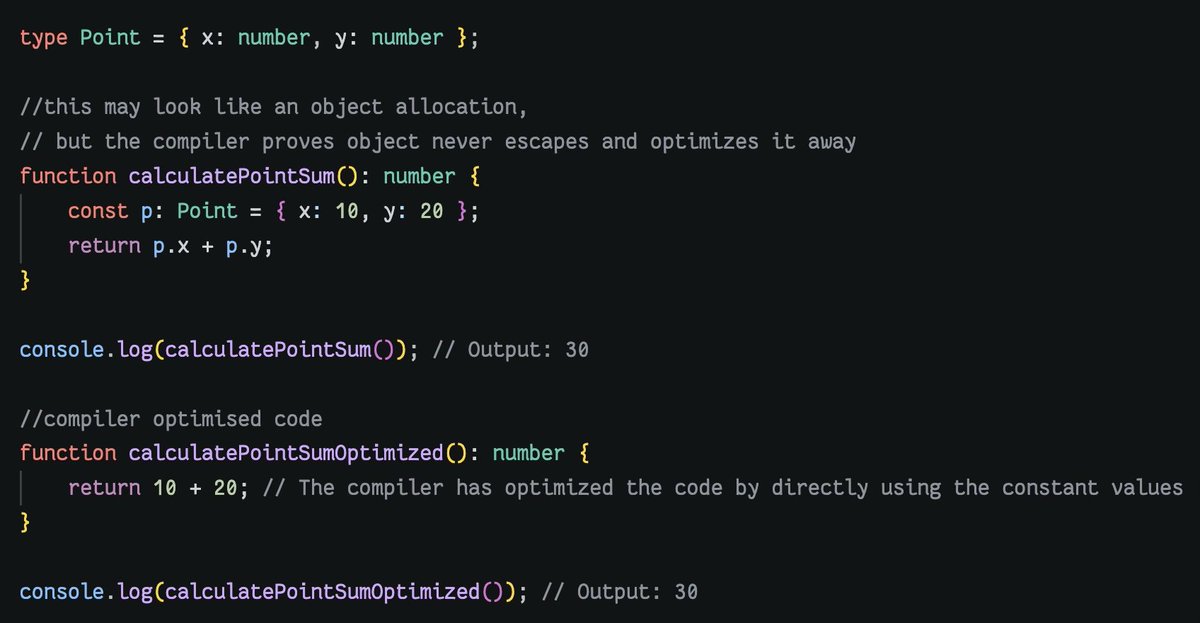
One of the coolest compiler optimisation is when an object never exists at runtime.
The code (img) look like a heap allocation. Most devs think memory being allocated & later claimed by the GC.
But the compiler asks:
"Can this reference escape?"
This is called Escape Analysis.


![Hi_Mrinal's tweet photo. I very much relate to this .... started implementing papers in late 2024 and still I implement few
there is a lot of learning in those papers ... the constraints and solution to those .... soo for anyone starting with papers you can checkout these papers ...
[1] https://t.co/Vec37dATFc
[2] https://t.co/lBcqoEBFGg](https://pbs.twimg.com/media/HJunPACa8AEp4cH.png)


![Hi_Mrinal's tweet photo. I very much relate to this .... started implementing papers in late 2024 and still I implement few
there is a lot of learning in those papers ... the constraints and solution to those .... soo for anyone starting with papers you can checkout these papers ...
[1] https://t.co/Vec37dATFc
[2] https://t.co/lBcqoEBFGg](https://pbs.twimg.com/media/HJunPAvacAAZPuB.png)