Here’s a true-to-scale size comparison of the Galaxy Z Fold 8 Ultra, Galaxy Z Fold 8, and Galaxy S26 Ultra side by side.
Based on the character of each device, I picked three different animal wallpapers that I think suit them perfectly. A fun little touch, isn't it?
Which one would you choose as your primary phone?
Samsung Display has officially started mass production of OLED panels for Apple's foldable iPhone, including both the inner and outer displays.
There is little doubt that this is likely the most advanced foldable display solution currently available on Earth. It combines Samsung's latest M16 emissive materials, higher brightness, longer lifespan, and what is arguably the industry's best crease reduction technology.
When most people hear "Samsung Display," their first thought is still Galaxy. But perhaps it's time to adopt a new perspective:
Today, Samsung Display's most important customer is not Galaxy. It's Apple.
In terms of revenue and profit contribution, Apple is the backbone of Samsung Display's business. Hundreds of millions of OLED panel orders every year provide the company with its most stable and lucrative source of income. Galaxy is certainly important, but within Samsung Display's overall business, it plays a much smaller role than many people realize.
In a sense, Samsung Display's future is deeply tied to Apple. The better iPhones sell, the more money Samsung Display makes. Without Apple as its largest customer, Samsung Display's financial performance would look very different.
So the next time you see the name "Samsung Display" in the news, your first association may not need to be Galaxy. It might be iPhone. After all, many of Samsung Display's most advanced and most profitable display technologies are supported by Apple's enormous order volumes.
Let me tell you why Apple is so eager to raise prices, and why it may not even want to wait until the iPhone 18 Pro launches.
Just look at the memory pricing data.
For LPDDR5X 96Gb (12GB) memory:
Q1 price: $77.1
Q2 forecast: $145.9
Increase: $68.8
Growth rate: 89%, nearly doubling in a single quarter
Translated into smartphone costs, that means the memory bill for a single 12GB RAM phone has increased by roughly $68.8.
And then comes the bigger question:
What about Q3 and Q4?
Will prices keep rising?
If memory prices continue climbing at anything close to this pace, even a company as powerful as Apple will struggle to absorb the cost pressure indefinitely.
Many people focus on the rising cost of advanced chips, but memory may be the real story here. When a core component nearly doubles in price within one quarter, maintaining the same retail price becomes increasingly difficult. At some point, passing part of that cost on to consumers becomes the only realistic option.
For the first time, I feel like we are not watching robots perform.🙄
We are watching robots go to work.
From June 23 to 28, AGIBOT will livestream multiple humanoid robots inside a real factory, working on an actual tablet production line and handling real QC tasks alongside human staff.
This is interesting because factory work leaves very little room for storytelling. You either stay stable, follow the workflow, coordinate with others, and keep repeating the task correctly, or the factory will expose the problem very quickly.
AGIBOT says it has already produced 10,000+ robots. Now they are showing something people rarely get to see: what humanoid robots look like during daily operation in a real industrial environment.
It starts tomorrow. I think this one is worth opening and watching for a while. @AGIBOTofficial
#AGIBOT #HumanoidRobots #EmbodiedAI #Robotics #Manufacturing #Automation
Samsung's foldable lineup for the second half of the year.
Galaxy Z Flip 8, Galaxy Z Fold 8, and Galaxy Z Fold 8 Ultra side by side.
Take a look at their relative sizes and get a feel for how they compare.
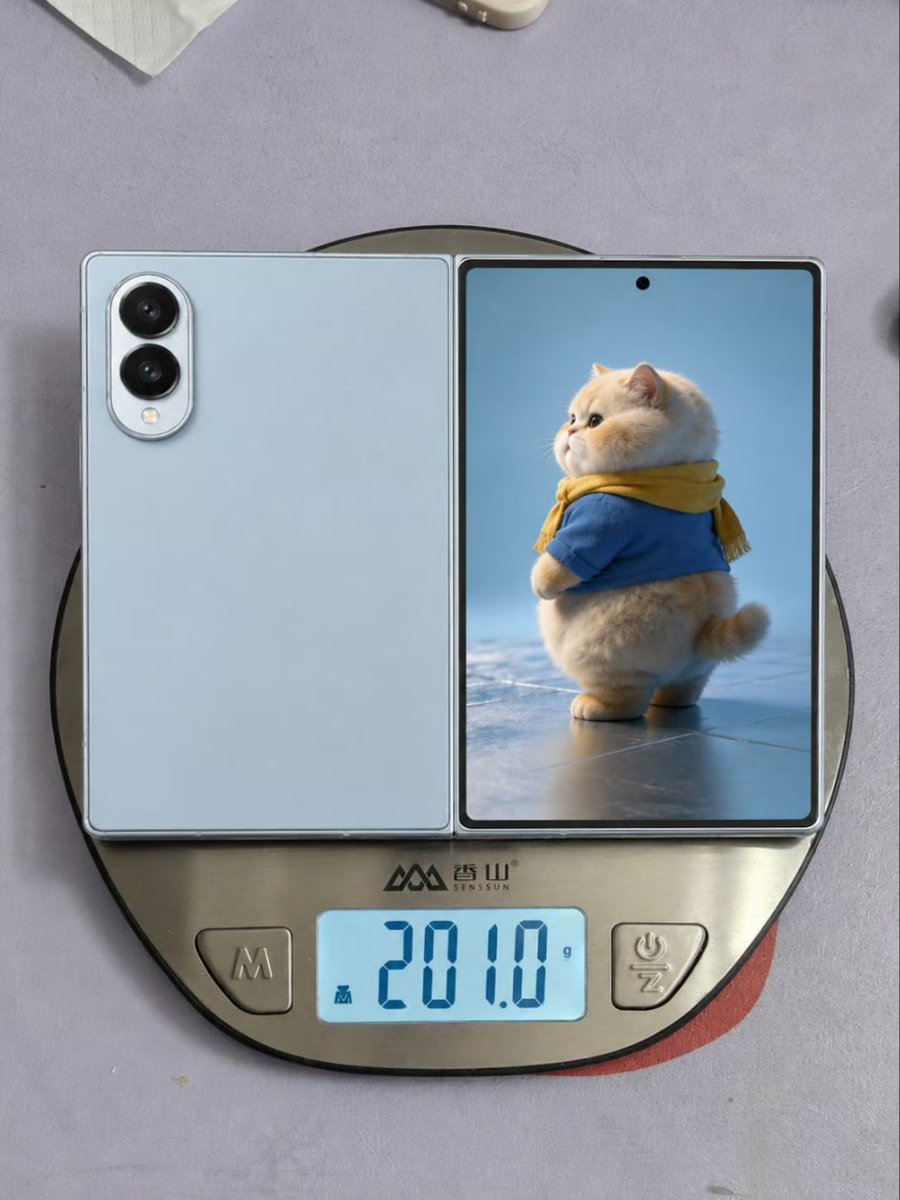
The Xiaomi MIX Flip 2 weighs 203g.
The Samsung Galaxy Z Fold8 Wide weighs just 201g.
One is a clamshell foldable. The other is a large foldable with a spacious 4:3 inner display.
What makes the Galaxy Z Fold8 Wide so remarkable isn't simply that it weighs 201g. It's that Samsung has managed to give a large foldable the weight of a compact foldable.
Weight doesn't exist in isolation. What really affects how a device feels in the hand is its weight relative to its size.
When just 201g is distributed across such a large chassis and tablet-sized display area, the weight per unit area becomes exceptionally low.
As a result, it doesn't merely feel light. It feels unusually light, almost as if the weight has been diluted across the device. In hand, there's even a subtle sense of weightlessness.
The screen area of a large foldable. The weight of a compact foldable.
That's what makes the Galaxy Z Fold8 Wide feel almost unreal.
The low-quality dummy model of the Samsung Galaxy Z Fold 8 Wide has already appeared online.
Its build quality is far from the real device, so it should only be used as a rough reference.
From what I know, Samsung’s internal testers are actually very fond of this device.
Maybe it’s because the form factor feels fresh and different.