@Goddie_Ke A 33 percent single day move on Nvidia would add over a trillion dollars in market cap overnight. Might want to double check the timeframe on those numbers.
@_mohansolo Merging separate model buckets into one shared pool is huge for workflow. Nobody wants to babysit three different rate meters while shipping code.
@kale_abe If quantum breaks SHA256 tomorrow, global banking and every password on earth go down long before Bitcoin does. Stocks are winning right now because AI prints actual cash flow and narrative, not because Wall Street is hedging against Shor's algorithm.
@denzelayeah If AI compute really drives over half the revenue with 90 day exit options, that is massive top line and way more cyclical than people assume.
Most people are running AI agents on their main machines with full file system access and just trusting what the agent says it did.
That is basically running with scissors.
If you actually deploy agents near real work or company data, three things matter way more than which model you picked.
1. Isolate the environment.
Put the agent on a separate node that only holds the exact data it needs for that task and nothing else. It shrinks the blast radius instantly.
2. Log everything outside the model.
System level file access logs paired with outbound network logs let you correlate what file was read right before a request went out to a third party endpoint.
3. Automate the sandbox once.
Use Docker, Podman, or Ansible so the whole team gets a repeatable baseline instead of everyone winging it locally.
Setting up proper isolation feels like too much work right until you have to explain to your employer how an agent leaked internal data to the internet.
Scientists right now are quietly working on things that sounded like pure sci-fi twenty years ago:
• Reversing cellular aging and extending human healthspan
• Building artificial suns through nuclear fusion for limitless clean energy
• Pushing particle physics further with next-gen hadron colliders
• Scaling artificial intelligence into general-purpose reasoning systems
Which one of these changes the world fastest?
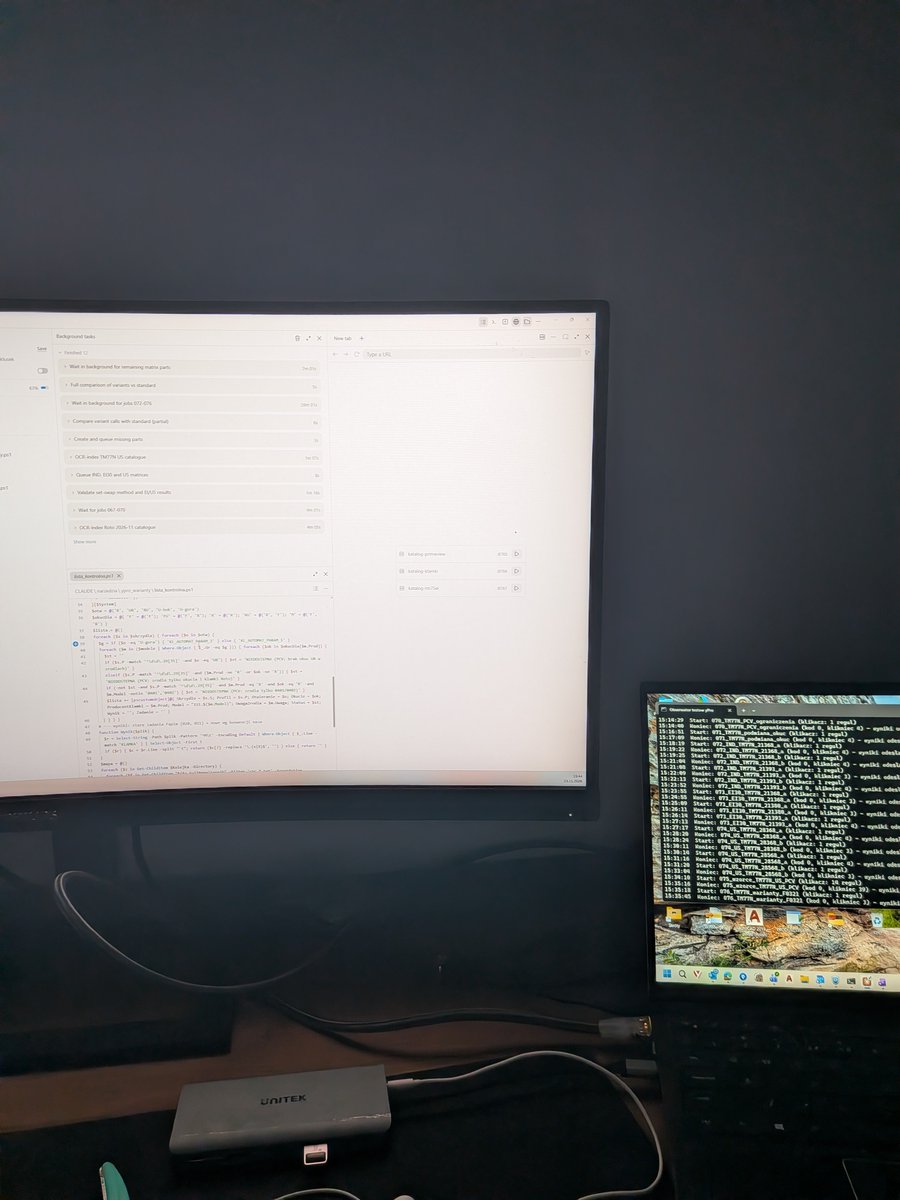
A few years ago I tried to tackle this project for the first time and hit a wall within days.
It's a massive window manufacturing system originally written in Delphi back in 2002. No modern docs, thousands of rules, complex dependencies between profiles, hardware, and variants layered on top of each other for over two decades. Back then, without AI, just untangling what connects to what would have taken months, so I had to shelve it.
I came back to it recently with AI in my workflow, and suddenly the wall started moving. Models make it way faster to parse old scripts, extract logic from catalogs, and automate the parts that used to trap you for weeks.
The wildest part is realizing that even with today's tools, in real manufacturing it's still easier and safer to extend an old battle-tested program than to rewrite everything from scratch. That 2002 codebase has already survived every weird factory-floor edge case a new system would spend the next five years learning.
ELON MUSK OFFICIALLY DECLARED THAT SUPERINTELLIGENCE IS ALREADY HERE.
11 hours later, Meta's AI chief admitted we probably can't control it.
In the video below, two posts and 13 million views in less than a day.
On Sunday morning Musk wrote a single line:
"Unequivocal super intelligence has arrived. Welcome to the Singularity."
The trigger was the Riemann Hypothesis. On Friday, Anthropic mathematician Levent Alpoge claimed that he and Claude had solved a problem humans had fought for 167 years. The proof is 17 million lines of code. A machine has verified it, and people still don't even understand why it's true.
Later that day Alexandr Wang published an essay. He runs the Meta lab building superintelligence for Zuckerberg. Here is his key line:
"It is hard to imagine a world where humanity can maintain control over fully unconstrained recursive self-improvement."
According to Wang, models will soon get better on their own faster than we can keep track. And what we do over the next year will decide what world we end up in.
Musk says the singularity is already here. Have you noticed it yet?
When YouTube launched in 2005, it was actually built as a video dating site. Almost nobody uploaded dating profiles, so the founders opened it up to any video and accidentally created the biggest media platform on earth.
@Polymarket Seeing how fast Claude and Anthropic scale shows what happens when strong models meet real execution, and that kind of momentum only compounds from here.
Fun fact: the guy who built the Perceptron in 1958, the ancestor of modern neural networks, wasn't even a computer scientist. Frank Rosenblatt was a psychologist trying to model how human brains process what we see.
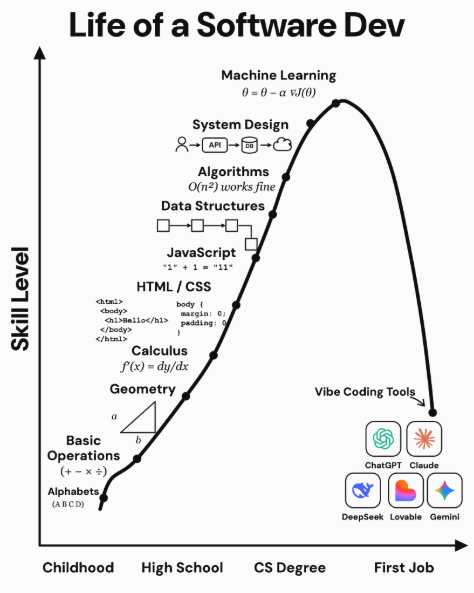
Better tools don't fix bad taste, they just help you ship questionable ideas way faster.
A few examples:
- Giving an AI agent a half-baked idea and waking up to 4,000 lines of overengineered code nobody asked for.
- Using a fast deploy pipeline to push broken copy and messy UI to prod ten times before lunchtime.
- Prompting a model to overcomplicate a simple CRUD flow into microservices and event queues.