Remaining BTC Supply Projection
April 2026 Remaining: 984,370 coins (Block reward per block: 3.125 BTC)
April 2027 Remaining: 820,310 coins (Block reward per block: 3.125 BTC)
April 2028 Remaining: 656,250 coins (Block reward per block: 1.5625 BTC)
April 2029 Remaining: 574,210 coins (Block reward per block: 1.5625 BTC)
April 2030 Remaining: 492,180 coins (Block reward per block: 1.5625 BTC)
April 2031 Remaining: 410,150 coins (Block reward per block: 1.5625 BTC)
April 2032 Remaining: 328,120 coins (Block reward per block: 0.78125 BTC)
April 2033 Remaining: 287,100 coins (Block reward per block: 0.78125 BTC)
April 2034 Remaining: 246,090 coins (Block reward per block: 0.78125 BTC)
April 2035 Remaining: 205,070 coins (Block reward per block: 0.78125 BTC)
April 2036 Remaining: 164,060 coins (Block reward per block: 0.390625 BTC)
April 2037 Remaining: 143,550 coins (Block reward per block: 0.390625 BTC)
April 2038 Remaining: 123,040 coins (Block reward per block: 0.390625 BTC)
April 2039 Remaining: 102,530 coins (Block reward per block: 0.390625 BTC)
April 2040 Remaining: 82,030 coins (Block reward per block: 0.1953125 BTC)
By the completion of the 7th halving (projected April 2036):
Total Bitcoin minted: 20,835,937.5 coins
Total Bitcoin left unmined: 164,062.5 coins
This means that by April 2036, 99.22% of Bitcoin’s total supply will have been fully mined.
The gradual depletion of block rewards is hardcoded into Bitcoin’s protocol and can be calculated with absolute precision, yet most people fail to grasp this reality, refuse to believe it, or simply deny this inevitable outcome.
Let us break down a critical question: Can Bitcoin sustain steady operation all the way to the 7th halving in April 2036 relying solely on its current block reward model?
A simple cost analysis lays bare the issue. The current mining cost per Bitcoin stands at roughly $75,000. After three more halvings, mining costs will surge eightfold, pushing the cost per coin to $600,000. At that price point, Bitcoin’s overall total market capitalization would need to top $12 trillion.
By contrast, the total hardware value of all Bitcoin mining rigs across the globe is only around $7 billion.
How can a $12 trillion market be supported by merely $7 billion worth of mining hardware? This is utterly illogical and devoid of basic market sense. Are all institutional investors and capitalists in this space ignorant or irrational?
This scenario completely defies commercial logic and fundamental capital principles.
Scaling up network hash rate will only drive mining costs higher, amplify operational losses, and accelerate the onset of a death spiral.
This is an unsolvable dead end under the existing rules—there is only one fix: expand block reward supply.
The solution: #NAT
#NAT is a native asset built directly on the Bitcoin mainchain. It shares identical hash power, blockchain, block generation cycle and wallet address system with Bitcoin, minting synchronously every ten minutes within each block. It functions as the secondary native asset minted in parallel within every Bitcoin block, Bitcoin’s twin asset sharing the same foundational blockchain infrastructure.
Two of the world’s top 4 mining pools, SpiderPool and F2Pool, have already begun distributing #NAT to miners.
The entities with the most to lose are the major Bitcoin holders ranked below:
1. Coinbase (Exchange + ETF custody): 976,000 BTC
2. Strategy (formerly MicroStrategy, public listed firm): 845,300 BTC (Latest financial filing update, June 8)
3. BlackRock IBIT (iShares Bitcoin Spot ETF): 817,100 BTC
4. Binance (User exchange reserves): 631,000 BTC
5. BTC seized by the U.S. government: 328,400 BTC
6. Fidelity FBTC ETF: 190,000 – 200,000 BTC
7. Grayscale GBTC: 144,000 BTC (Sustained net redemptions and drawdowns)
8. Bitfinex Exchange: Approximately 195,000 BTC
After the #BTC halving, a new security budget mechanism is required to sustain network hashrate — #NAT is a non-arbitrary token generated from the bits field of #BTC blocks in accordance with the Digital Matter Theory.
Serving as the secondary block subsidy, it shares the identical hashrate, public blockchain, block structure and address system with #BTC, minted synchronously in every block every ten minutes.
As the only genesis-aligned companion mining token native to the #BTC chain with fully open-source code, it upholds the core tenets of decentralization, pioneers an entirely new category of digital assets, and infuses brand-new vitality into the #BTC ecosystem!
https://t.co/nXdDiCorRL
🆕 DMT-NAT token & Tacit Protocol Now Supported on UniScan
• Full ticker recognition and search support for DMT-NAT token and Tacit assets
• Asset Details pages with token information, holder data, and transaction history
• Clear decoding of Tacit asset activities within transaction inputs and outputs
• Full Tacit asset list, sortable by deployment time and recent activity
• Initial mint distribution data for Tacit T_Petch assets
UniSat infra is doubling down on on-chain data accessibility, making ecosystem activity easier to discover and explore. We will take a more active approach to expanding protocol coverage and supporting the Bitcoin ecosystem.
Supporting a protocol ≠ endorsing its assets. We're here to surface data, not pick winners.
Find links in the first reply below 👇
1/2
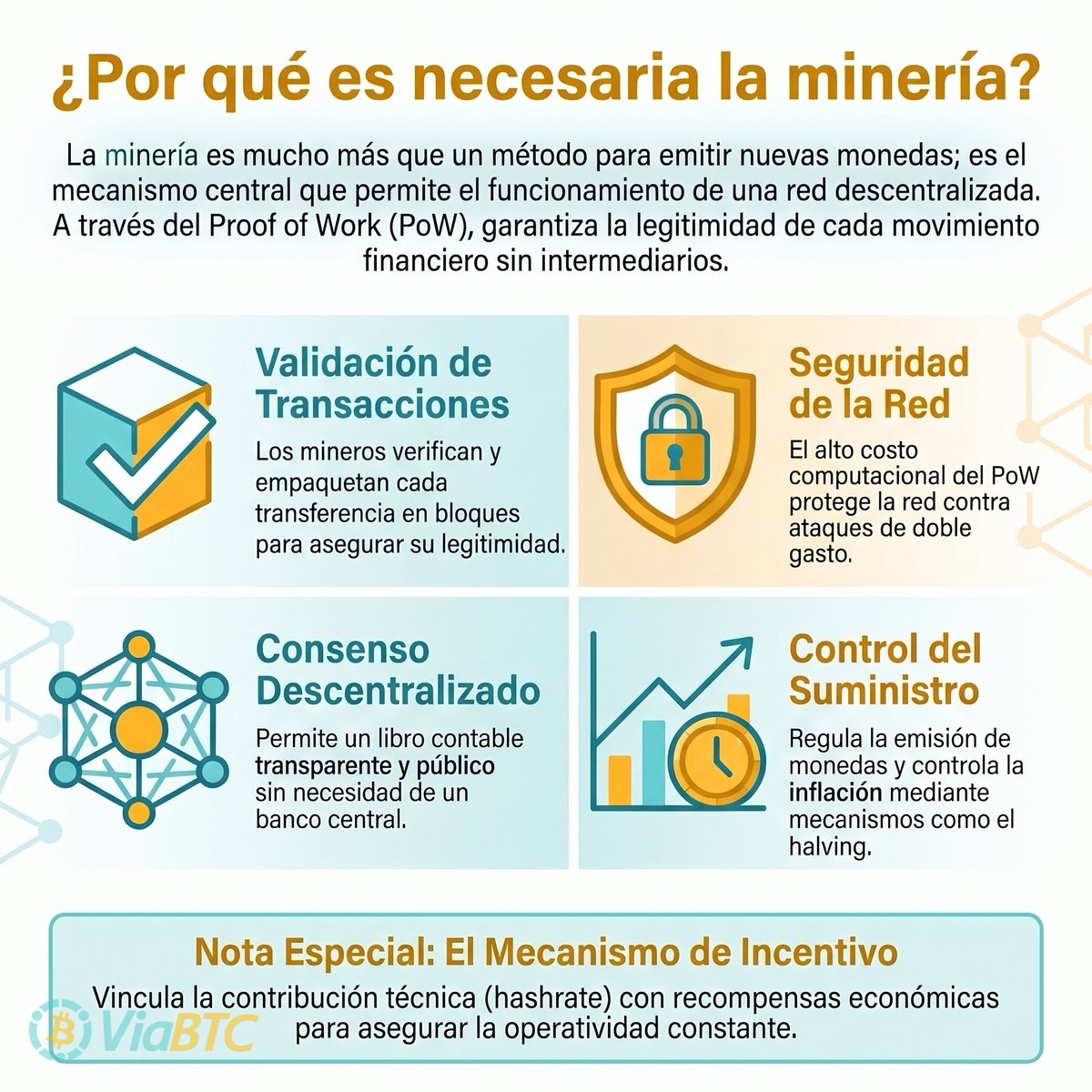
¿Para qué sirve realmente la minería? 🛠️
Mucho más que emitir monedas, es el núcleo que sostiene la red.
Los 4 pilares fundamentales:
✅ Valida transacciones y empaqueta bloques.
🛡️ Asegura la red contra ataques mediante PoW.
🌐 Consenso descentralizado sin autoridad central.
📊 Controla la inflación regulando el suministro.
¡Domina la industria con la guía "Minería de criptomonedas 101" de @ViaBTC! 📘✨
$NAT is a Bitcoin mining companion coin:
$NAT benefits miners, mining pools, and mining rigs.
Other coins only benefit project teams.
The focus of $NAT will last throughout Bitcoin's entire lifecycle.
$NAT 🔥🔥🔥
https://t.co/8uXX6Rppxy