Seeing Martin Scorsese using FLUX for storyboarding and scene exploration was absolutely insane. Experiencing how one of the absolute masters of cinema & filmmaking uses the technology that we developed, his curiosity and creativity, and the way he prompted our models, was humbling.
I am grateful to call Martin Scorsese an advisor to BFL, and to explore the next, multimodal and interactive phases of visual AI with him.
In 2025, European startups raised around €66bn–$85bn in VC funding, while the U.S. reached $339bn.
The AI gap is even more brutal:
U.S. AI companies attracted $194bn in 2025 — about 75% of global AI VC funding. EU27 firms attracted only $15.8bn, around 6%.
In Q1 2026 alone, U.S. VC investment reached $267bn. Europe raised $25.7bn.
One reason is structural: European pension funds allocate only around 0.1% of assets to venture capital, while U.S. institutional investors have built far deeper exposure to private equity and venture.
Europe needs to build a real venture industry: deeper capital markets, stronger pension fund participation, larger late-stage rounds and more competitive IPO markets.
A real Capital Markets Union is not optional. It is the infrastructure Europe needs so startups can raise capital at continental scale — instead of being trapped inside fragmented national markets.
@SebJohnsonUK@DadaJudith@VisionariesVC This is one of the most important messages that everyone in Europe needs to understand. No government body is coming to save us. The people must do it themselves. So if our future is our own responsibility, then we have to do all we can to enable our builders to build our future.
@FredrikHjelm4 The headline writer using Techbros still shows how comically out of touch the press still is with this topic. I’d also note that Sweden has something that much of the rest of Europe lacks: capital via a citizens’ investment culture and former founder reinvesting. Bravo!
Extremely impressed with @cohere Co-founder @aidangomez at @handelsblatt#tech2026 event. It’s rare to hear a founder speak so eloquently about how we have sleepwalked into tech and capital dependency. Making me optimistic.
Europe’s startup & scaleup ecosystem is on the rise: EU-27 performance is up 13.5 percentage points since 2020, according to the first-ever Startup & Scaleup Scoreboard. However, we’re still behind the US & China in ecosystem valuation & unicorns’ growth. https://t.co/5picdNwaFp
The version of Star Wars returning to theaters on February 19, 2027 is the one George Lucas spent nearly thirty years insisting could never be shown again.
This is the genuine 1977 theatrical cut, newly restored. Han shoots first. There is no CGI Jabba slithering around Mos Eisley. None of the Special Edition additions Lucas folded in starting in 1997 are present. It is the first proper theatrical run of the original film in over forty years, confirmed on the official Star Wars site.
What makes that remarkable is how hard Lucas worked to bury it. After the 1997 Special Editions, he said repeatedly that the altered versions were the only ones he recognized. He compared his right to keep changing the film to Michelangelo deciding to repaint part of the Sistine Chapel.
His stated reason it could never come back was technical. He said the original camera negative had been physically cut apart to assemble the Special Edition, which made a true restoration of the 1977 version impossible.
So for almost three decades, every official release carried Special Edition material. The one time the original cut appeared on DVD, in 2006, it was a low-resolution transfer pulled from an old laserdisc master, slipped out as a bonus disc with no restoration at all.
The best way to watch the real 1977 Star Wars became a fan project. One team tracked down an actual 35mm theatrical print through a seller in Spain and scanned it frame by frame, cleaning every speck of dirt by hand over several years, because the studio that owned the film would not.
The 2027 restoration quietly proves it was always possible with the technology that existed the whole time. What had been standing in the way was ownership. Lucas controlled the film and did not want this version seen, and that only changed when he sold Lucasfilm to Disney in 2012 for four billion dollars.
The 50th anniversary celebration everyone is sharing is, underneath the nostalgia, a studio releasing the exact version the film's creator spent his life trying to paint over, now that he is no longer the one holding the brush.
Love this roundup and thread. Europe is a string of pearls. I‘d give Warsaw and Prague more love and not sleep on Athens or Valencia either. Everyone playing to their strengths and rising together; what an awesome time to call this old world home.
Current view on European tech hubs — this is based on vibes only, after having taken 50 flights this year across the best continent in the world. 🫶🇪🇺
Tell me where I’m brutally wrong!
🔥🔥🔥
🇸🇪 Stockholm — unmatched energy, community, and ambition. THE applied AI capital. Lovable, Legora, Neko, Pit, plus so many more. This is insanely strong.
🇬🇧 London — highest volume, most mature, most diverse: everything from AI Apps to Infra to Fintech to DeepTech. If Europe had a tech capital, it would still be London.
🔥🔥
🇨🇭 Zurich — true DeepTech / Robotics hub, ETH is doing an amazing job at training and inspiring young founders.
🇪🇸 Barcelona — great energy, highly commercial, becoming an expat hub for European founders, highly (!) underrated.
🇫🇷 Paris — continues to build great companies, seems a bit more Fintech and consumer focused vs other hubs, plus Mistral as the clear European AI lighthouse.
🔥
🇩🇪 Berlin — too much self loathing / inner-German Berlin hate. Quiet builders, more B2B than ever, definitely underrated. Needs more momentum and confidence.
🇩🇪 Munich — CDTM is the best thing that happened to this city. Fantastic technical founders. Waiting for more of the second gen of founders out of Celonis, Lilium, Isar, Helsing, Quantum etc to emerge though.
🇩🇰 Copenhagen — underrated, quiet and reliable producer of great companies. Light, Flatpay, Corti are amazing next gen leaders. Naturally a bit lower volume.
[honorable mentions]
🇱🇹 Vilnius — Punches above its weight, great energy among young founders, NordVPN and Vinted are underrated beasts, too often forgotten among the European greats.
🇳🇴 Norway — quietly emerging as a DeepTech hub, need to sort out some of their policies though
🇵🇱 Warsaw — the most dynamic economy in Europe, needs even more true tech entrepreneurs
🇮🇹 Milan — emerging expat hub, better energy than ever, still too low in volume for what it could be, one to watch
🇮🇪 Dublin — big tech talent is finally starting to leave and build companies, this would be a game changer
🇳🇱 Amsterdam — good volume, good energy, needs a bit more momentum and confidence, Framer and Mews are underrated
🇺🇦 Kyiv — Defense capital of Europe, incredibly technical, iterative, scrappy, pragmatic, resilient. So much love and respect for these guys 🫶
🇪🇪 Tallinn — still the most entrepreneurial per capita, feel it needs a lot more momentum though, Pactum and Starship are some of too few AI leaders
🇫🇮 Helsinki — FR8 / Founders House / Slush are re-igniting much needed momentum. Very DeepTech overall with IQM, Varjo etc
🇨🇿 Prague — getting there. Duvo, Aisle are ones to watch. Still low volume
I’ve been in European Tech for over eleven years now. This is the best it’s ever been, by far. Let’s continue that momentum, no matter what the Euro haters on this platform say. 🇪🇺🔥🫶
the pope and anthropic's co-founder just stood together at the vatican to release "magnifica humanitas," the first ever catholic teaching on AI
yes, you read that right. the full ceremony was 2 hours.
here's the most interesting things for you to know:
1. this is the biggest religious response to AI in history. popes only put out a handful of these huge official letters in their entire time as pope. the fact that one of them is about AI tells you how seriously the church is taking what's coming.
2. small detail with massive meaning: this pope picked the name "leo XIV" on purpose. the last pope named leo was leo XIII back in 1891, and his most famous act was writing the church's response to the industrial revolution. picking the same name is a deliberate signal. this pope sees AI as the new industrial revolution.
3. the catholic church does this every time a major technology reshapes humanity. they wrote "rerum novarum" in 1891 to respond to the industrial revolution. when nuclear weapons threatened the world in the 1960s, they wrote "pacem in terris." climate change and runaway tech got "laudato si" in 2015. now AI gets "magnifica humanitas." they don't issue these often.
4. the pope's main line: "AI needs to be disarmed." he literally compared AI to nuclear weapons. he said the church spent decades pushing for nuclear disarmament because the technology was too dangerous to leave in the hands of a few. he says AI is now in that same category.
5. anthropic co-founder christopher olah told the pope, on stage at the vatican, that anthropic's own research team keeps finding things inside their AI models that "mirror joy, satisfaction, fear, grief, and unease."
6. olah's reframe of what AI actually is: these things are grown. they're trained on a structure roughly modeled after the human brain and fed everything humans have ever written. in his own words: "they are made from us, from our words." he said even the people building them don't fully understand what's happening inside.
7. olah publicly admitted that every AI lab, including his own, faces pressure that can conflict with doing the right thing. commercial pressure to keep shipping, competitive pressure from other labs, plus the older pressures of pride and ambition. his solution: we desperately need outside critics with no skin in the game who will tell the labs when they're failing.
8. olah says there are 3 giant questions the AI labs cannot answer alone and the world needs religion and philosophy to step in on:
> how do we make sure poor countries actually benefit from AI?
> what does human flourishing even look like in this new world?
> and what are these things we're actually building?
9. one of the sharpest lines in the whole encyclical: "the promise of automatic general prosperity often proves illusory." translation: the idea that AI will just make everyone rich on its own is a fantasy. someone has to actually design the system so the benefits get shared.
10. the pope also pulled out a 100-year-old quote: "contemporary man has not been trained to use power well." said by a theologian back in the 1920s. the whole encyclical is basically a long argument that we need to learn how to use this kind of power before it uses us.
11. the pope kept stressing that he doesn't have the technical answers. but he says the church has thousands of years of wisdom on what it means to be human, and that wisdom is exactly what's missing from how we're building AI right now. his closing line: this technology should serve "human flourishing and human dignity, not control consciences."
@mikebutcher@DAaronovitch I find it hard to listen to such talks today because they either parrot Big Tech talking points or focus too much on regulation as the silver bullet. Europe has to generate more demand for its own tech stack; that will enable more investment in supply.
@SebJohnsonUK Network nodes / voices like yours are what make ecosystems thrive. Congrats; here's to an awesome run ahead. The rise and rise of European tech is the great unreported story of the decade. Keep plugging away and someday it will all retroactively be declared as inevitable.
Really important analysis of what’s at stake right now. Ironically, German politicians kept pinning their hopes on the phrase Industrie 4.0 a decade ago, and yet the country wasted the decade and is utterly losing any relevance in that race.
I'm German.
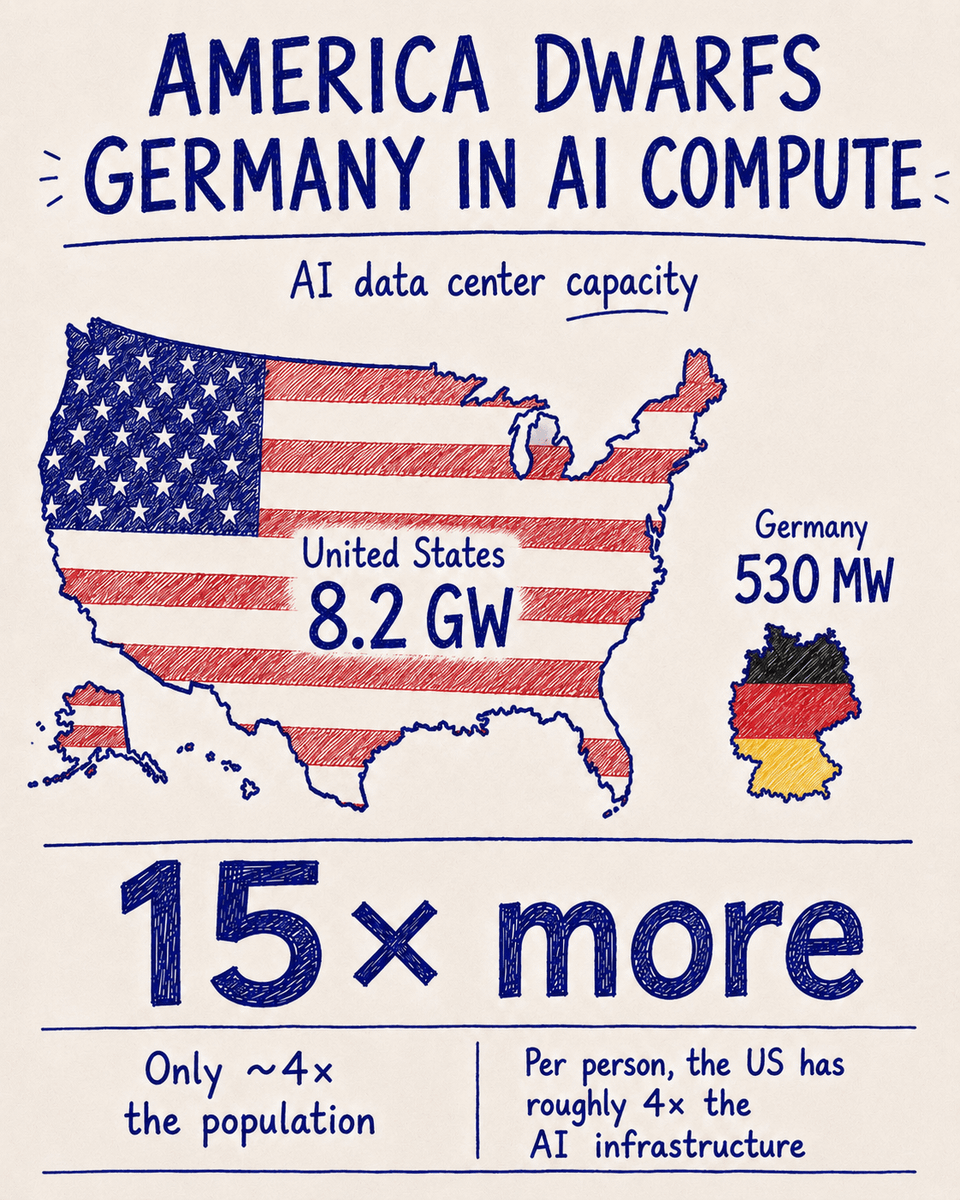
Germany's ENTIRE AI data center capacity is less than 1/2 of just one site being built in Texas.
We have 530 megawatts of AI data center capacity in the entire country.
The US has 8.2 gigawatts. That's 15x more compute on a country with only 4x the people.
Per German, the US has roughly 4x the AI infrastructure.
One university computer at MIT is 4x faster than Germany's most important commercial AI facility.
The obvious reaction here is "so what, German companies can just rent compute from AWS."
But that's the same logic Germany applied to Russian gas for two decades.
Roughly 70% of German enterprise AI today runs on American cloud providers like AWS, Microsoft, and Google. Which means it runs under American law.
Every AI tool running in German hospitals, courts, ministries, banks, and factories sits on a foreign platform.
Here's why this can actually become problematic. Imagine these scenarios:
> The next GPU generation launches and American companies get access first because they own the data centers. German firms wait 12 months and pay 2-3x more for what's left.
> A frontier AI model gets released and US export controls block it from being deployed in Germany. SAP and Siemens watch American competitors integrate it for a year before they can.
> And in the worst case, a US president decides to use AI access as leverage in a trade dispute. German companies get cut off from the models their American competitors are still running.
All of them are compounding problems that will negatively impact the German economy (and everyone's standard of living/jobs etc).
None of this is hypothetical.
> The US pulled Starlink as leverage with Ukraine in March 2025
> Chip exports to China have been throttled for three years
> And the CLOUD Act lets the US demand any data stored by American cloud providers (even when the customer is a German company and the servers are physically in Germany).
Germany doesn't have an answer for any of those scenarios today because the infrastructure that would make those answers possible isn't built yet.
Now look at why this is actually happening on the ground.
In the last 3 months Germany rejected 3 AI data center projects in a row:
> Groß-Gerau, February: Vantage Data Centers, €2.5 billion, 174 MW. Voted down 18-14 by the local council
> Maintal: EdgeConnex, €1 billion, 170 MW. Blocked over a backup gas generator the developer needed because grid connections in Germany take 7-10 years and a data center is built in 2
> Freyenstein, Brandenburg, April: 700 MW AI campus. Killed by protests before construction
€3.5 billion in AI infrastructure turned away in one quarter.
And the situation is more urgent than it looks because compute is getting harder to access, not easier.
NVIDIA's Blackwell GPUs are already allocated through the second half of 2027. The American hyperscalers locked in the bulk of new production with forward orders placed in 2025. TSMC's advanced packaging lines (the actual bottleneck) are sold out through 2026.
Germany has no hyperscaler of its own. That means German industry sits at the back of the queue, and the gap compounds every quarter that goes by.
Where Germany is falling short right now comes down to three things:
> Public backlash, because the case for what AI data centers actually do for a country has never been made to the people voting on them
> Industrial electricity at €0.16-0.18 per kWh vs about $0.08 in Texas. For a 1 GW campus that's $700-900 million extra per year just for power
> Grid connections taking 7-10 years for large facilities when the data center itself is built in 2. No serious operator runs on math where the wait is longer than the build
And the first one is the biggest. Electricity policy and grid timelines are fixable. Public consent isn't, until someone makes the case that this infrastructure isn't nice-to-have. It's the foundation everything else runs on.
The average person only feels the downside (noise, rising electricity cost, terror attack vector)
We have a big messaging and marketing problem around data centers and why they are critical for everyone's future.
Germany still has the foundation to win this if it moves now.
Germany adopted its first national data center strategy in March 2026. 28 concrete measures, annual progress reports, doubling overall capacity and quadrupling AI capacity by 2030. The plan exists.
The Industriestrompreis launched on January 1st of this year. It targets 5 cents per kWh for half of an industrial user's annual consumption. If data centers get cleanly pulled into that framework, the electricity cost gap with Texas gets significantly closer.
Deutsche Telekom turned on 10,000 NVIDIA Blackwell GPUs in Munich in Q1. One facility increased Germany's available AI compute by roughly 50% overnight.
And the demand is already domestic. SAP, Siemens, BMW, BASF. The German industrial anchors that benefit most from AI are German companies. The customers are at home, the infrastructure should be at home too.
And this is the thing that most people forget.
Germany won the second industrial revolution. By 1900 German chemical output had passed Britain's, Siemens was wiring the world, and BASF and Bayer were inventing industries that didn't exist before they built them.
The companies that came out of those decisions are still the largest employers in Germany 130 years later.
Germany sat out the third industrial revolution, the software one, and that was survivable because software didn't run factories.
But AI runs factories. It runs hospitals, logistics, courts, and financial markets. This one is infrastructure in the same category as railways and chemical plants.
The plan is written and the money is ready.
The only question left is whether the country will let it get built.
There's a lot of work left to do, but I'm staying optimistic.
I remember that rainy night during Slush a few years ago when you presented the EU Inc idea in that newly reclaimed tumbledown house. Amazing how far you, EU Inc and FR8 have come. LFG Europe.
FR8 is a 12,000 m² palace, filled with geniuses researching or building startups, it charges 0% equity and even pays for your food, living, and flights. One of their founders drank actual poison on stage to demo their tech.
Welcome to FR8.
Nothing about FR8 makes sense because it’s so over the top in their ambition, but they might eventually become the biggest thing for young founders globally. And it’s happening right here in Europe.
They are neither a hackerhouse, nor a startup accelerator, nor a classic research lab.
Instead they think of themselves as a university-like institution for the post AGI world that pushes you towards building companies, ambition, obsession, and bias-to-action.
Think YCombinator, Stanford and Bell Labs all wrapped into one thing for the most ambitious 20-somethings in the world to work, run by 20-somethings.
They just came out of stealth. Until recently people didn’t even know where their latest cohort is based. Because additionally on top FR8 is absurdly secretive. Their target group knows them and that’s about all they care for.
We visited last week to join them behind-the-scenes as they prepare for their first demo day in their new building - a 5 floor university building in the middle of Helsinki.
We knew them for quite some time so we were allowed to film them as the first team worldwide. But even we couldn’t film multiple floors and rooms of their building. This video gives you an insight into the ambitious craziness that FR8 is – but trust me there’s more to come in the near future.
The biggest new thing in startups – isn’t in SF – it’s in the north of Europe and attracts young geniuses worldwide. Welcome to FR8!
FR8 is a 12,000 m² palace, filled with geniuses researching or building startups, it charges 0% equity and even pays for your food, living, and flights. One of their founders drank actual poison on stage to demo their tech.
Welcome to FR8.
Nothing about FR8 makes sense because it’s so over the top in their ambition, but they might eventually become the biggest thing for young founders globally. And it’s happening right here in Europe.
They are neither a hackerhouse, nor a startup accelerator, nor a classic research lab.
Instead they think of themselves as a university-like institution for the post AGI world that pushes you towards building companies, ambition, obsession, and bias-to-action.
Think YCombinator, Stanford and Bell Labs all wrapped into one thing for the most ambitious 20-somethings in the world to work, run by 20-somethings.
They just came out of stealth. Until recently people didn’t even know where their latest cohort is based. Because additionally on top FR8 is absurdly secretive. Their target group knows them and that’s about all they care for.
We visited last week to join them behind-the-scenes as they prepare for their first demo day in their new building - a 5 floor university building in the middle of Helsinki.
We knew them for quite some time so we were allowed to film them as the first team worldwide. But even we couldn’t film multiple floors and rooms of their building. This video gives you an insight into the ambitious craziness that FR8 is – but trust me there’s more to come in the near future.
The biggest new thing in startups – isn’t in SF – it’s in the north of Europe and attracts young geniuses worldwide. Welcome to FR8!









![andyhelbig's tweet photo. Current view on European tech hubs — this is based on vibes only, after having taken 50 flights this year across the best continent in the world. 🫶🇪🇺
Tell me where I’m brutally wrong!
🔥🔥🔥
🇸🇪 Stockholm — unmatched energy, community, and ambition. THE applied AI capital. Lovable, Legora, Neko, Pit, plus so many more. This is insanely strong.
🇬🇧 London — highest volume, most mature, most diverse: everything from AI Apps to Infra to Fintech to DeepTech. If Europe had a tech capital, it would still be London.
🔥🔥
🇨🇭 Zurich — true DeepTech / Robotics hub, ETH is doing an amazing job at training and inspiring young founders.
🇪🇸 Barcelona — great energy, highly commercial, becoming an expat hub for European founders, highly (!) underrated.
🇫🇷 Paris — continues to build great companies, seems a bit more Fintech and consumer focused vs other hubs, plus Mistral as the clear European AI lighthouse.
🔥
🇩🇪 Berlin — too much self loathing / inner-German Berlin hate. Quiet builders, more B2B than ever, definitely underrated. Needs more momentum and confidence.
🇩🇪 Munich — CDTM is the best thing that happened to this city. Fantastic technical founders. Waiting for more of the second gen of founders out of Celonis, Lilium, Isar, Helsing, Quantum etc to emerge though.
🇩🇰 Copenhagen — underrated, quiet and reliable producer of great companies. Light, Flatpay, Corti are amazing next gen leaders. Naturally a bit lower volume.
[honorable mentions]
🇱🇹 Vilnius — Punches above its weight, great energy among young founders, NordVPN and Vinted are underrated beasts, too often forgotten among the European greats.
🇳🇴 Norway — quietly emerging as a DeepTech hub, need to sort out some of their policies though
🇵🇱 Warsaw — the most dynamic economy in Europe, needs even more true tech entrepreneurs
🇮🇹 Milan — emerging expat hub, better energy than ever, still too low in volume for what it could be, one to watch
🇮🇪 Dublin — big tech talent is finally starting to leave and build companies, this would be a game changer
🇳🇱 Amsterdam — good volume, good energy, needs a bit more momentum and confidence, Framer and Mews are underrated
🇺🇦 Kyiv — Defense capital of Europe, incredibly technical, iterative, scrappy, pragmatic, resilient. So much love and respect for these guys 🫶
🇪🇪 Tallinn — still the most entrepreneurial per capita, feel it needs a lot more momentum though, Pactum and Starship are some of too few AI leaders
🇫🇮 Helsinki — FR8 / Founders House / Slush are re-igniting much needed momentum. Very DeepTech overall with IQM, Varjo etc
🇨🇿 Prague — getting there. Duvo, Aisle are ones to watch. Still low volume
I’ve been in European Tech for over eleven years now. This is the best it’s ever been, by far. Let’s continue that momentum, no matter what the Euro haters on this platform say. 🇪🇺🔥🫶](https://pbs.twimg.com/media/HJZE_5ZXAAUh3Sl.jpg)