In 800, the Roman Empire faced a challenge that was not simply military or diplomatic, but ideological: a form of geopolitical identity theft. When Pope Leo III crowned the Frankish King Charlemagne as “Emperor of the Romans,” he was not reviving a vacant western imperial office abolished long ago in 480, but inventing a rival claim to Roman universality, even though the Roman Empire still fully existed in Constantinople (Charlemagne was crowned as the one and only Roman Emperor). There had been earlier Roman usurpations and breakaway imperial regimes (the Gallic Empire under Postumus and Palmyra under Zenobia) but these emerged from within the Roman imperial world. The Frankish case was different: an external Kingdom, legitimized by the Papacy rather than by the Roman army, Senate, or Constantinopolitan court, claimed the name and dignity of an existing state and people. Constantinople’s refusal during the 812 peace talks to recognize Charlemagne as “Emperor of the Romans” captures the distinction. From the Roman perspective, this was not merely another usurpation; it was the creation of a competing faux Roman identity in the West - a revolutionary act whose consequences would shape medieval Europe for centuries.
In long-term retrospect, the most damaging role was played by the Papacy, which had been the driving engine of the whole affair, setting the stage for the fracturing of Christianity into imperial and ersatz imperial camps over the next 250 years, a division that continues to persist to this day. Papal power to crown a Roman Emperor, and the idea of the Papacy as the source of imperial power, were completely invented in 800 and were without any precedent (it was later justified by the so-called Donation of Constantine or Donatio Constantini, a forged Roman imperial decree by which the 4th-century emperor Constantine the Great supposedly transferred authority over Rome and the western part of the Roman Empire to the Pope; composed in the 8th century shortly before the act of 800, it was used, especially in the 13th century, in support of claims of political authority by the Papacy - Lorenzo Valla, an Italian Catholic priest, exposed the forgery in 1439–1440). For the Roman imperial authorities in Constantinople, the papal coronation of Charlemagne as the Roman Emperor in 800 was a deeply unsettling act of betrayal, since the Christian Church had effectively become a department of state in 380 through the Edict of Thessalonica (Cunctos populos), and the Popes themselves were, in essence, imperial officials. Needless to say, this whole setup and the Church rift that followed it also created the conditions that would lead to the Crusader sack of Constantinople in 1204, an event that many historians consider the real fall of the Roman Empire, since the state and society never fully recovered from it, making them far easier prey for the final Ottoman conquest.
Nonetheless, the events of 800 have another meaning and importance: they are the actual birth of the modern West as we know it. The Pope’s crowning of Charlemagne in 800 as the Roman Emperor is actually the point of divergence from all things Roman - in retrospect, the exact opposite of what it was proclaimed to be: a moment when Western Europe and Roman history parted ways and were set on very different paths. The Roman Empire continued to exist for centuries to come, ruled from Constantinople, but not as a historical part of the West as we understand it (which is also the ultimate reason why we mislabel it with an invented name, too).
Historiographically and ideologically, we are still unable to give the medieval Roman Empire its due, despite the fact that academia is essentially free of the constraints of the past.
Illustration: Napoleon before the Throne of Charlemagne (Henri-Paul Motte, 1898).
Today we remember the Fall Of Constantinople!
It was no ordinary city - it was New Rome, the city of Constantine, the Queen of Cities. It was the center of an ancient civilization, the capital, and the beacon of the Roman world!
On May 29, 1453 it fell, conquered by the Turks!
Unlike the medieval Latin West, the east Romans did not need to rediscover Roman law because they had never stopped living under it.
Justinian’s jurists codified Roman law in the 6th century, but while the Latin Digest and Codex later had to be “reawakened” in the West, Greek versions and commentaries kept the legal tradition alive in the East.
Roman law in the east Roman empire was not a foreign classical inheritance. It had always been the law of the Roman state. Bernard Stolte explains this in “Legal Thought,” in The Cambridge Intellectual History of Byzantium:
“The Latin text of Digest and Codex went to sleep, only to be reawakened in northern Italy in the eleventh century, to embark upon a new career as the source of the continental civil-law tradition, whereas the various Greek versions and commentaries gave birth to an independent tradition of Byzantine law in the eastern Mediterranean.”
In the medieval Latin West:
“Roman law became prominent only after customs and statutes had shaped various legal systems, into which the ‘new’ law had to be integrated. In the hierarchical order, the local law always came first.”
That was the western situation. Roman law was prestigious, but it had to be fitted into legal worlds that already existed.
“Obviously, all this was different in Byzantium. There, Roman law was not a (relative) newcomer. To the contrary, it had always been the law of the land and its prestige was indisputable. It was imperial law and the emperor held the monopoly of legislation.”
The east Romans were not medieval people looking back at Rome from the outside, because Roman law was their own living law as the continuation of the Roman state.
“There could be no question of local custom or statutes having precedence except by permission of the emperor. Even a theoretical debate on this matter was impossible. (Practice could be, and was, different.)”
That is why Stolte describes the difference through the image of inheritance:
“Elsewhere I have described the difference between Byzantium and the western world in this respect as the difference between an heir and a legatee.”
The medieval Latin West received Roman law like a legacy, something useful that could be accepted, adapted, or dismissed according to local needs, but east Rome was different:
“The [east Roman empire] was the heres necessarius of Roman law. Constantinople was the new Rome and was simply unable to escape the consequences of that position. It received Roman law with all its activa and passiva, its assets and debts.”
Constantinople was new Rome, and new Rome inherited Roman law not as a museum piece, but as the law of the land.
“But in the various cities and regions of the Latin west, where it often had never been entirely absent, Roman law was received with greater or lesser enthusiasm, a legatum unburdened by liabilities, to be used or dismissed as irrelevant according to local political and cultural conditions.”
So the medieval Latin West did not simply lack all Roman law. Stolte says it had often “never been entirely absent.” The difference is that the West could use it selectively, while east Rome could not treat it as optional. Roman law came with the whole burden of being Rome.
This did not mean east Roman law was frozen or effortless to apply. Stolte adds that even though Roman law had no real rival, practical needs still forced jurists to find workable solutions:
“This unchallenged position does not mean that this state of affairs met with universal satisfaction. Roman law did not yield to the pressure of an alternative, but was not up to playing the role of omniscient counselor, either. For practical needs, different strategies were being devised.”
Stolte points to the major collections that dominated East Roman legal history:
“So far we have looked in some detail at the two major collections that dominate the history of Byzantine law: Justinian’s legislation (in western tradition called the Corpus iuris civilis) and the Basilika, its definitive Byzantine transformation.”
Across the centuries, east Roman jurists and emperors kept Roman law usable through major legal works, from Justinian’s legislation in 529–534 to Greek works like the Ecloga of 741, the Procheiron, the Basilika around 900, and the Hexabiblos of 1345. These were not rediscoveries of Roman law from the outside, but ways of selecting, translating, summarizing, adapting, and applying the law of the Roman state itself.
This Greek legal tradition was not a sudden change under Herakleios either. Even Justinian was already issuing later laws in Greek almost a century earlier, since, as Stolte notes, Justinian “could not entirely disregard the fact that the majority of his subjects were Greek-speaking,” so “His subsequent legislation was therefore in Greek and the intellectual digestion of the legal tradition took place in Greek as well.”
Because Roman imperial law had no equal rival inside the empire, east Roman legal development followed a different path from the medieval Latin West:
“the greatest obstacle to building a new legal system (as was being done in the late medieval west) was the absence from the Byzantine world of a legal system that had an equally valid claim as imperial Roman law.”
In other words, the medieval Latin West could receive and reshape Justinianic law as a revived learned tradition, but east Rome carried Roman law as the living law of the Roman state itself.
Source: Bernard Stolte, “Legal Thought,” in The Cambridge Intellectual History of Byzantium.
La distinción entre imperio generador y depredador del materialismo filosófico quizá sea la que más éxito ha tenido, sin embargo casi siempre se entiende mal. No es una distinción moral entre imperios buenos y malos. Es una distinción filosófica de gran calado que merece un hilo:
Thrilled to announce the publication of my research on the Great Palace of Constantinople. We’re taking a fresh look at the heart of Byzantium. I hope you find it an engaging and insightful read.
Free for two weeks on Cambridge Core: https://t.co/yJLa5Nusnq
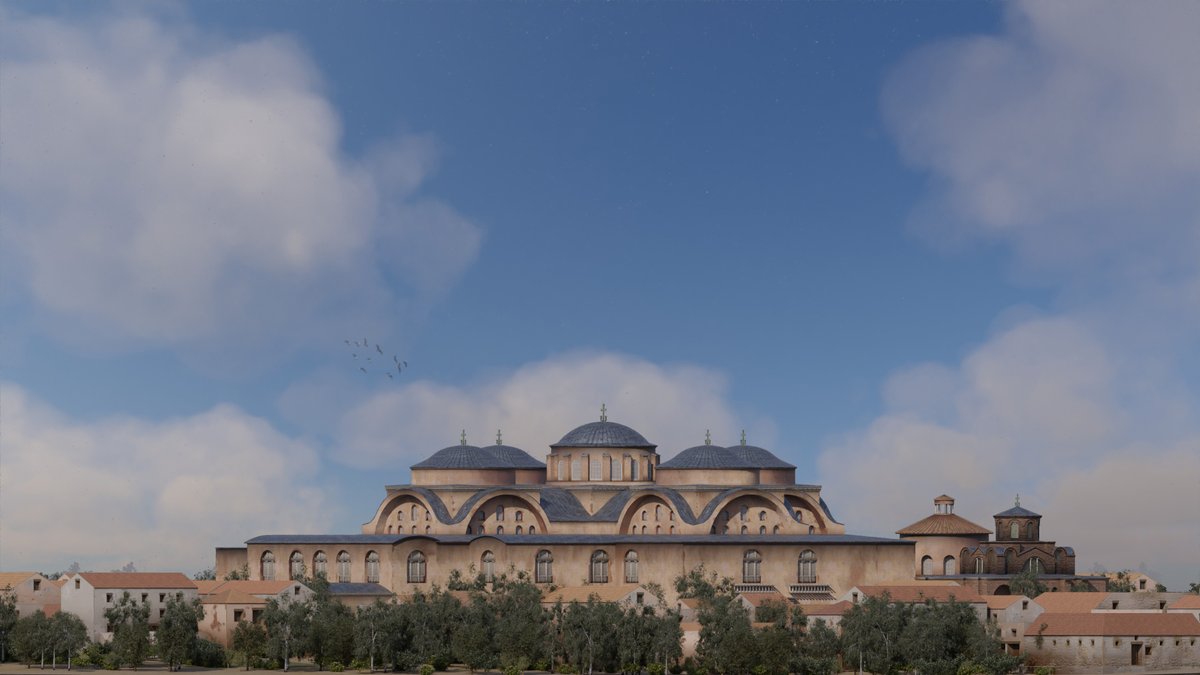
Located on the highest hill in #Constantinople, the Church of the Holy Apostles was one of the largest and most important religious buildings in the city during the #Byzantine period, second only to Hagia Sophia.
Let's explore this architectural marvel with a #3Dreconstruction.
Gemini 3 has a capability most people don't even know exists.
it's not the 1M tokens.
it's not the multimodal processing.
it's something else entirely.
And it's the reason I built 3,000+ prompts specifically for Gemini 3.
Everyone talks about Gemini's specs:
→ 1 million token context
→ Native multimodal inputs
→ Deep Think mode
→ Agentic workflows
But they're missing what happens when you combine these features.
The secret is persistent systems thinking.
Gemini 3 doesn't just process large contexts.
It maintains coherent reasoning ACROSS those contexts while simultaneously:
- Analyzing images
- Reading documents
- Planning multi-step workflows
- Adapting based on previous outputs
This creates emergent capabilities that don't exist in other models.
I built 3,000+ prompts that exploit this.
Each prompt is built around this core insight:
Gemini 3's real power isn't WHAT it can process.
It's HOW it connects everything together.
The library includes:
✓ 3,000+ production-ready prompts
✓ Organized by difficulty (beginner → advanced)
✓ Real use cases for each prompt
Like, RT + reply "GEMINI" and I'll DM you the guide.
(Must be following so I can DM)
Skip this and keep wondering why your Gemini results feel the same as ChatGPT.
Or grab the library and start using the capability everyone's missing.
Bienvenidos a ITINER-E, un proyecto (en construcción, y abierto) de las universidades de Aarhus y UAB, que muestra 300.000 km de CALZADAS DEL IMPERIO ROMANO.
Con todos sus datos arqueológicos asociados: itinerarios, miliarios, antiguos mapas, imágenes🛰️...
https://t.co/g7pOh1zOEK
If one thing sums up the 21st century it's got to be all these default profile pictures.
You've seen them literally thousands of times, but they're completely generic and interchangeable.
Future historians will use them to symbolise our current era, and here's why...
A place to be? Urbs Aeterna, Rome, 5–17 July 663: the very last visit of a Roman Emperor (Constans II) to the old imperial capital. Constans II, who was on a tour of his western provinces at the time, decided to visit Rome, marking the first occasion of a Roman Emperor being physically present in the city since 476, a gap of 187 years.
The Emperor was treated with a full ancient adventus, the formal ceremony marking the arrival of an Emperor into the city of Rome. The ritual, rooted in military processions of the Roman Republic, involved a procession to the city's boundary (the pomerium in the imperial period, and later the Aurelian Wall), where the Emperor was formally welcomed by the city's inhabitants. Constans II arrived on a Wednesday, 5 July 663, and was received by the Pope, clergy, and local state officials outside the city walls, at the sixth milestone on a uia exiting Rome. After the official greetings, Constans II proceeded to St. Peter’s Basilica (erected by Emperor Constantine in the fourth century in the place at the outskirts of Rome where Christians worshipped St. Peter’s tomb). Constans II travelled there on foot, had a prayer, and presented a gift to the basilica.
On Thursday, 6 July, the Emperor visited St. Paul's Basilica (also erected by Emperor Constantine at the burial site of the Saint), and presented a gift to the Basilica. It was state business and meetings with local officials on Friday, 7 July, and on Saturday, 8 July, Constans II presented a gift at St. Mary’s (Santa Maria Maggiore, the first church in Rome dedicated to the Virgin Mary in the aftermath of the Council of Ephesus in 431). On Sunday, 9 July, there was a military parade in the city in the Emperor's honor, followed by his second visit to Saint Peter's Basilica. Here, the Emperor gifted a golden pallium (an altar-frontal made of gold).
The Emperor continued to conduct state affairs from Rome over the next few days (10–14 July). During his stay in Rome, Constans II stayed the whole time in the Palatine palace, the old imperial residence (which was ready to receive the Emperor, since it was fully maintained at the time - and continued to be afterwards; we also have a record of an official in charge of the Palatine palace from 687).
On Saturday, 15 July, Constans II visited the Pope in the Lateran, including participating in the ceremonies at the Basilica of Vigilius. On the last day of his visit, Sunday, 16 July, Constans II participated in a statio ceremony at St. Peter's Basilica, after which the Pope bid the Emperor farewell, putting an end to the official acts of the visit. One final ceremony followed, profectio, a farewell with joy between Rome's city elites and local state officials and Constans II, as the final order of business before the Emperor's departure.
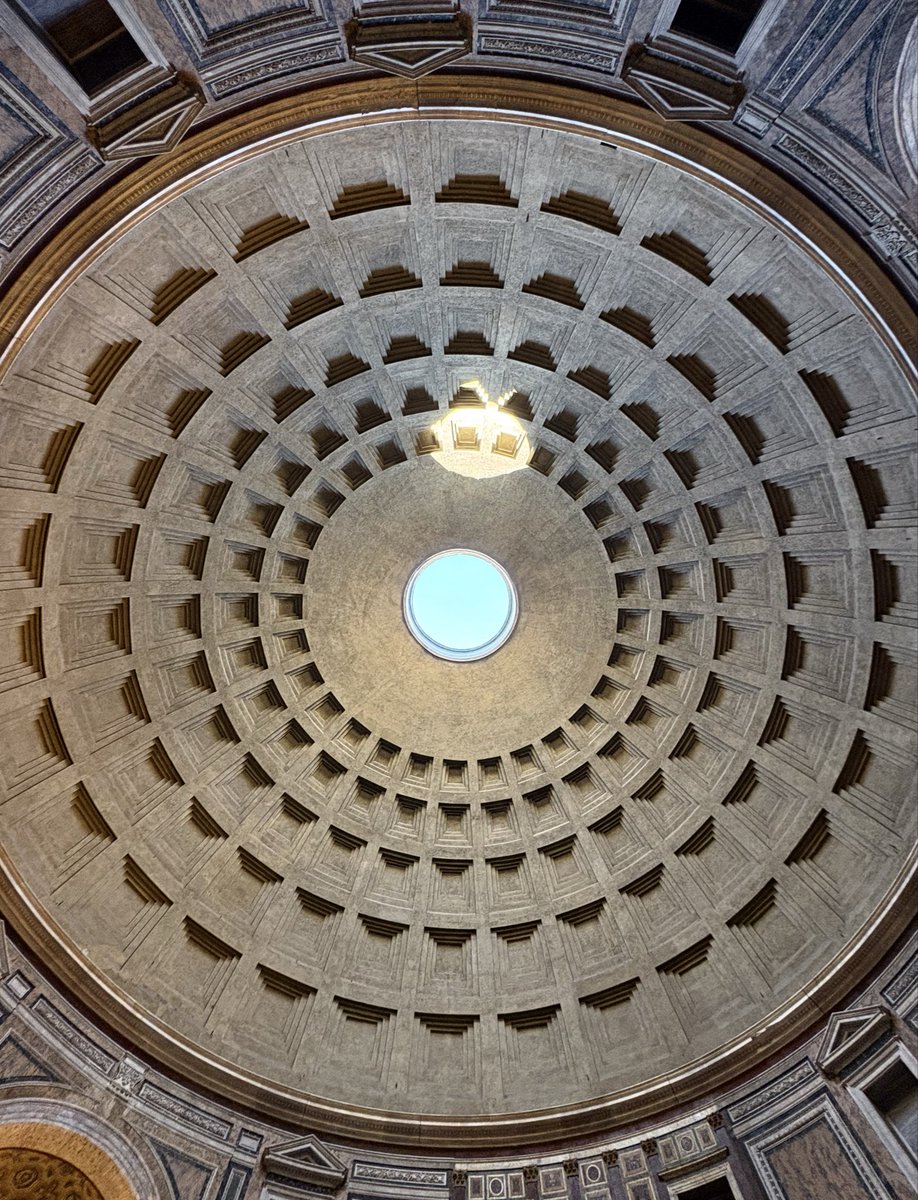
And then, we are treated with anti-imperial smear, which unfortunately still finds its way into modern-day historiography and online encyclopedic sources. Instead of simply moving on, and after repeatedly showering Rome's various basilicas with generous gifts of gold, Constans II inexplicably decides to strip bronze tiles off the roof of St. Mary ad Martyres (the ancient Pantheon) and take that material with him to Constantinople (?) on Monday, 17 July.
That extra day, and the untoward deed, come from two papal sources (the Liber Pontificalis and Paul the Deacon’s Historia Langobardorum), and fit a Petrine narrative portraying the Constantinopolitan Emperors in a shady and malign light. A literary anti-imperial discourse of Constans II's visit is first fleshed out in the Liber Pontificalis (or Book of the Popes). The source contains a general Petrine stance in defending Roman ecclesiastical prerogatives against Constantinopolitan claims for state supremacy (it goes on until 870), and the same is true of the other belated source, Historia Langobardorum of Paul the Deacon (cca 720–799), a Benedictine monk of Monte Cassino writing after the collapse of the Lombard Kingdom due to Charlemagne’s invasion. Paul’s animosity against seventh-century Roman Emperors is apparent throughout the source, and there is a clear contextual link between this work and the Liber Pontificalis.
Moral of the story? Constans II's spectacular visit to Rome gave the citizens of Rome once more a chance to bask in full Roman imperial glory (the actual, real deal), twelve days in 663 to feel like a million solidi once more before the descent into the Middle Ages took full hold (...and, to add the second moral of this story - always look for a wider context of your historical sources, and take them with a generous grain of salt).
Kudos to Dr. Oriol Febrer of the Universitat Leiden for his spectacular research on Constans II.
Image: Gold Semissis of Constans II (Latin inscription, Obverse: CΟΝS Ν- ΙΝ SΡΡ V), Syracuse mint, 648 (via Dumbarton Oaks).
Because the Eastern Romans maintained a secular administration in their government, it required an educational institution to train them!
This is what is known as the “University of Constantinople” - but was it truly a university and was it really a continuous institution?
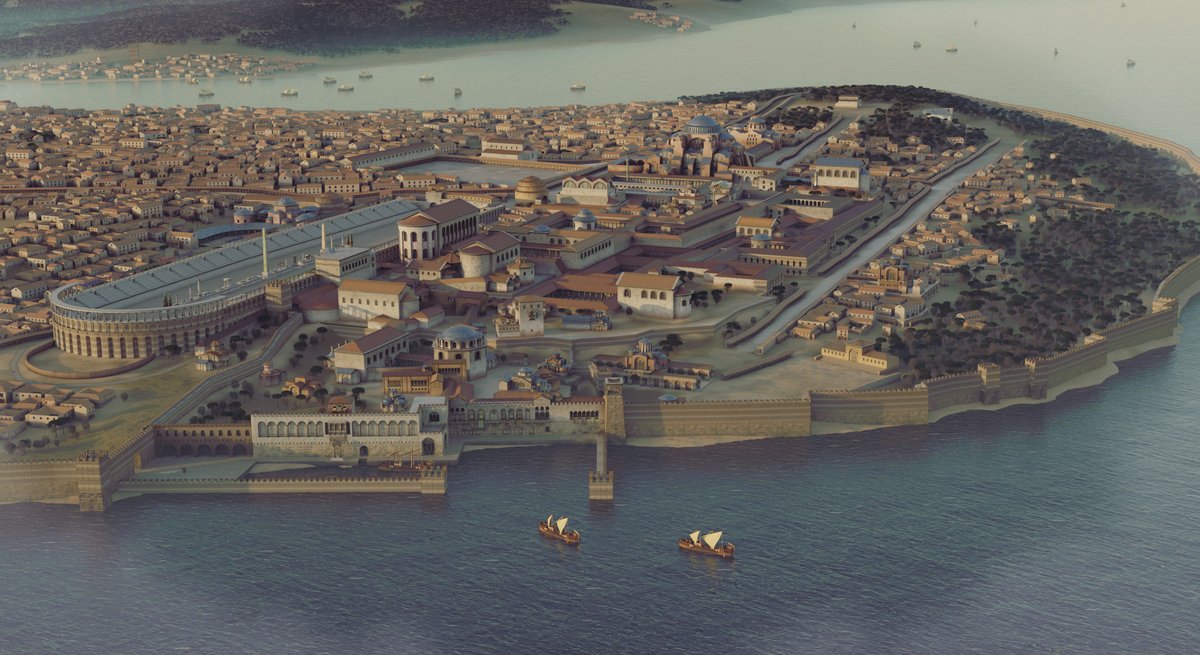
The Great Palace was the traditional Roman palace complex in Constantinople
In the 11th century Alexios Komnenos built a new palace in Blachernae. In the 12th century Manuel Komnenos would bring Blachernae to grandeur as well as restoring and adding to the Great Palace!
🧵🧵




![HeraldOfRome's tweet photo. Unlike the medieval Latin West, the east Romans did not need to rediscover Roman law because they had never stopped living under it.
Justinian’s jurists codified Roman law in the 6th century, but while the Latin Digest and Codex later had to be “reawakened” in the West, Greek versions and commentaries kept the legal tradition alive in the East.
Roman law in the east Roman empire was not a foreign classical inheritance. It had always been the law of the Roman state. Bernard Stolte explains this in “Legal Thought,” in The Cambridge Intellectual History of Byzantium:
“The Latin text of Digest and Codex went to sleep, only to be reawakened in northern Italy in the eleventh century, to embark upon a new career as the source of the continental civil-law tradition, whereas the various Greek versions and commentaries gave birth to an independent tradition of Byzantine law in the eastern Mediterranean.”
In the medieval Latin West:
“Roman law became prominent only after customs and statutes had shaped various legal systems, into which the ‘new’ law had to be integrated. In the hierarchical order, the local law always came first.”
That was the western situation. Roman law was prestigious, but it had to be fitted into legal worlds that already existed.
“Obviously, all this was different in Byzantium. There, Roman law was not a (relative) newcomer. To the contrary, it had always been the law of the land and its prestige was indisputable. It was imperial law and the emperor held the monopoly of legislation.”
The east Romans were not medieval people looking back at Rome from the outside, because Roman law was their own living law as the continuation of the Roman state.
“There could be no question of local custom or statutes having precedence except by permission of the emperor. Even a theoretical debate on this matter was impossible. (Practice could be, and was, different.)”
That is why Stolte describes the difference through the image of inheritance:
“Elsewhere I have described the difference between Byzantium and the western world in this respect as the difference between an heir and a legatee.”
The medieval Latin West received Roman law like a legacy, something useful that could be accepted, adapted, or dismissed according to local needs, but east Rome was different:
“The [east Roman empire] was the heres necessarius of Roman law. Constantinople was the new Rome and was simply unable to escape the consequences of that position. It received Roman law with all its activa and passiva, its assets and debts.”
Constantinople was new Rome, and new Rome inherited Roman law not as a museum piece, but as the law of the land.
“But in the various cities and regions of the Latin west, where it often had never been entirely absent, Roman law was received with greater or lesser enthusiasm, a legatum unburdened by liabilities, to be used or dismissed as irrelevant according to local political and cultural conditions.”
So the medieval Latin West did not simply lack all Roman law. Stolte says it had often “never been entirely absent.” The difference is that the West could use it selectively, while east Rome could not treat it as optional. Roman law came with the whole burden of being Rome.
This did not mean east Roman law was frozen or effortless to apply. Stolte adds that even though Roman law had no real rival, practical needs still forced jurists to find workable solutions:
“This unchallenged position does not mean that this state of affairs met with universal satisfaction. Roman law did not yield to the pressure of an alternative, but was not up to playing the role of omniscient counselor, either. For practical needs, different strategies were being devised.”
Stolte points to the major collections that dominated East Roman legal history:
“So far we have looked in some detail at the two major collections that dominate the history of Byzantine law: Justinian’s legislation (in western tradition called the Corpus iuris civilis) and the Basilika, its definitive Byzantine transformation.”
Across the centuries, east Roman jurists and emperors kept Roman law usable through major legal works, from Justinian’s legislation in 529–534 to Greek works like the Ecloga of 741, the Procheiron, the Basilika around 900, and the Hexabiblos of 1345. These were not rediscoveries of Roman law from the outside, but ways of selecting, translating, summarizing, adapting, and applying the law of the Roman state itself.
This Greek legal tradition was not a sudden change under Herakleios either. Even Justinian was already issuing later laws in Greek almost a century earlier, since, as Stolte notes, Justinian “could not entirely disregard the fact that the majority of his subjects were Greek-speaking,” so “His subsequent legislation was therefore in Greek and the intellectual digestion of the legal tradition took place in Greek as well.”
Because Roman imperial law had no equal rival inside the empire, east Roman legal development followed a different path from the medieval Latin West:
“the greatest obstacle to building a new legal system (as was being done in the late medieval west) was the absence from the Byzantine world of a legal system that had an equally valid claim as imperial Roman law.”
In other words, the medieval Latin West could receive and reshape Justinianic law as a revived learned tradition, but east Rome carried Roman law as the living law of the Roman state itself.
Source: Bernard Stolte, “Legal Thought,” in The Cambridge Intellectual History of Byzantium.](https://pbs.twimg.com/media/HH2vCl6XUAYwflc.jpg)
![HeraldOfRome's tweet photo. Most people think that the Roman Republic ended with Augustus.
But the Romans in the empire still saw themselves as a republic!
[Thread]🧵 https://t.co/O2gSNXSw7U](https://pbs.twimg.com/media/GyJFWxHWkAE7ovq.jpg)