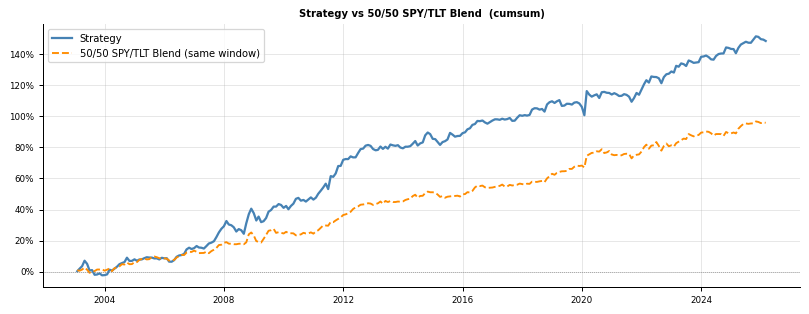
So when the CTA's sell at high prices, who is buying? I dont know, but it does look a bit ponzi-like. An uncoordinated pump and dump.
@choffstein@ScottPh77711570 Would love your thoughts
Is trend still your friend? https://t.co/YlsWRQGLz3
The authors talk about the price impact loop of trend-followers. Price up -> TF's buy -> price higher... They say an important part of trend PnL is precisely this price-impact loop.
Smoothing usually decreases cov(a,r), as it weights past (less relevant) data more. But, it will also decrease σ_a (noise in your alpha). As long as the σ_a decreases more than cov(a,r), your smoother will boost ic.
TLDR: Smooth alphas to boost ic, let optimizer handle turnover
As far as I understand. Smoothing alphas can:
1) Reduce turnover
2) Increase ic
For 1, as ceph points out, an optimizer can do this (and probably should). But an optimizer cannot do 2.
why?
a=alpha, r=return
ic(a, r) = cov(a,r) / (σ_a * σ_r)
@macrocephalopod @NewRiverInvest @robertmartin88@witchqueendot @stevehouf @Mtrl_Scientist 👋
Say you've got some volatile alpha that explains step ahead returns.
And you wanna smooth it cos real world.
And you observe decay in IC for increasing half life of smoothing. But you also prefer the more autocorrelated alpha.
How do you think about the tradeoff?
@SystemicStratHL To push back on the macro view a bit if you look at S&P's forward PE, its ~21x today, which isn't cheap, but not particularly high either.
@stalequant How does credora calculate p(default)? If its a function of APY then that would explain the good r^2 but not necessarily mean its correctly priced.