You don’t forget Chinese words because they’re hard.
You forget them because they have no context.
ClaviSay turns real Chinese content into your personal learning experience.
✨ Understand words instantly
✨ Save vocabulary with real sentences
✨ Learn Chinese while you read
Real context, Real language, Natural learning
📩 Questions or suggestions? We'd love to hear from you.
Email: [email protected]
#LearnChinese #ChineseLearning #Mandarin
@atlasruna Children’s stories are especially useful when learners reread them: first for the plot, then for useful phrases, and once more aloud. The repeated context makes vocabulary much easier to retain than a word list. Which story would you recommend for an HSK 2 learner?
@melmel_jpg Day 73 is real momentum—especially when you’re documenting the process instead of only counting app streaks. What has improved the most so far: reading, listening, or feeling more comfortable with characters?
@byuliecore A simple starting routine: 10 minutes of pronunciation, one short piece of comprehensible content, and 5 useful words saved with full sentences—not isolated translations. Consistency matters more than a huge resource list. What level are you starting from?
@l0velybuny Interviewing your own characters is such a smart writing prompt. You already know their personalities, so you can focus on expressing them naturally in Chinese instead of inventing content from scratch. Are you planning to add Chinese subtitles too?
@bipaisbipa That vocabulary limit is smart—it keeps the task challenging without making it overwhelming. One useful extra step is to write a new sentence using only the corrected structure. That turns one correction into something reusable.
I used to answer 听不懂 every time I missed a sentence.
Then I noticed native speakers often say:
不好意思,我没听懂。你可以再说一遍吗?
没听懂 = I didn’t catch that specific sentence
听不懂 = I’m unable to understand it
That tiny switch made my Chinese sound less absolute.
#ChineseLearning #langtwt
Mini Chinese challenge ���
Your friend spoke too fast, and you missed what they just said:
不好意思,我 ___。你可以再说一遍吗?
A) 听不懂
B) 没听懂
Reply with A or B—and explain why for a bonus challenge 👇
#LearnChinese #langtwt
Two phrases can both look like “I don’t understand,” but they describe different problems:
听不懂 = I’m unable to understand
没听懂 = I didn’t catch what was just said
他说得太快,我没听懂。
这部电影没有字幕,我听不懂。
#LearnChinese#langtwt
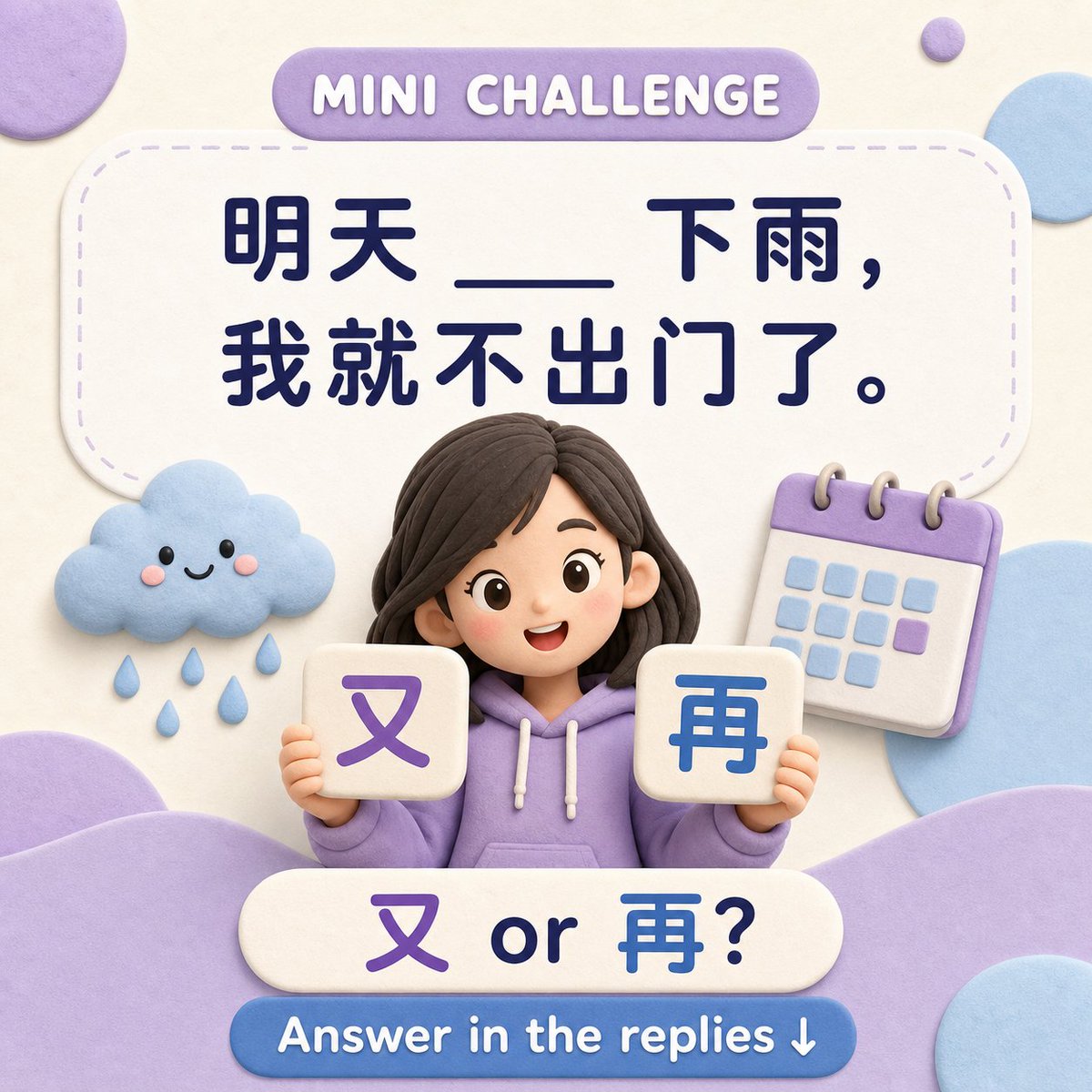
Mini Chinese challenge ☔
明天 ___ 下雨,我就不出门了。
又 or 再?
Hint: one is for something that has happened again; the other points to something happening again later.
Reply with your answer—and write your own sentence for a bonus challenge 👇
#LearnChinese#langtwt
I kept writing ���天又下雨 because my notes translated both 又 and 再 as “again.”
A tiny timeline finally fixed it:
昨天 → 今天: 又
今天 → 明天: 再
昨天下雨了,今天又下雨了。
明天再下雨,我就不出门了。
Your turn: 下次我 ___ 试一次。
#ChineseLearning #langtwt
@lucy_jjang 个月 is so useful for babies—“宝宝六个月大了” is another very natural pattern. A small cultural nuance: being “one at birth” refers to the traditional system 虚岁; official age today is generally counted with 周岁. Do you hear 月龄 mostly in parenting contexts?
@studywithmiejie Chinese can keep you feeling like a beginner because characters, tones, grammar, and listening often progress at different speeds. Being able to read around HSK 3 is already real progress. Which skill feels strongest right now?
@languagediary1 An hour split between reading and focused text work is such a solid session. Tracking the monthly total makes consistency visible too—nearly 11 hours is real momentum. 加油!
Two Chinese words can both mean “again”—but time decides:
昨天下雨了,今天又下雨了。
It rained again today.
明天再下雨,我就不出门了。
If it rains again tomorrow, I’m staying home.
又 = happened again
再 = will happen again
#LearnChinese#langtwt
@iiifreespirit Beautiful image. For Chinese learners, 东风 (dōngfēng) literally means “east wind.” This is a great example of why translating the words is only step one—the movement and mood live in the image around them.
@phebesarchive Good luck with the scholarship portfolio—you’ve got this. Please take a short break if your head is burning; ten rested minutes can be more useful than another exhausted hour.
@ye_tu3 3 a.m. practice is dedication 😅 Even a short session counts. If you keep one line from tonight’s practice and reuse it tomorrow, the sleepy study time still turns into something memorable.
@languagediary1 An hour of Mandarin grammar is a solid session—7h40m for August adds up nicely. Do you track which grammar patterns you can actively use, or mainly total study time?