Want to make an extra $249,342 this year?
I’d bet my shirt you can do it with land investing.
But before you get started, here’s a MEGA THREAD to make sure you don’t lose MONEY on your next land flip:
👇👇👇
Today is day 70 of our 100-day challenge to make over half a million dollars buying and selling rural recreational land.
The number keeps moving.
Three years ago that would have been a lie.
Vacation meant phone going off every 20 min. Three deals waiting on my approval. Laptop at dinner. Coming back to a week of backlog.
A one-week trip was a two-week trip plus a recovery week.
Here's the 5-step prep that changed it. Run this before your next trip:
1. Document every decision you make in a normal week.
Every approval. Every call. Every "ping me when X."
Each one becomes a delegation, a rule, or an SOP before you leave.
2. Name the backup chain in writing.
Who covers transactions. Who covers sales. Who covers ops. Who covers each of them.
No one is guessing while you're gone.
3. Set the escalation rule.
Two questions before anyone reaches for the phone:
"Can this wait 10 days?" "Is this a $25K+ decision?"
If both answers aren't yes, it doesn't reach you.
4. Pre-decide everything close to a decision.
Anything on your desk that could break, you decide before you leave.
Nothing sits waiting for you.
5. Tell the team the trip is real.
"I'll check in once a day" guarantees you check in 14 times.
"Phone is off, escalation rules are written down" guarantees you actually leave.
If your business stops when you stop, it's a job.
If it keeps moving, it's a business.
The prep is the difference. One week of focused work before you go. That's the trade.
Here's our exact acquisition process. Nothing held back.
Pull data from LandPortal.
Skip trace the first 3 numbers.
Load into Smarter Contact.
Text campaign goes out.
Leads respond.
Lead manager qualifies on price and motivation.
Qualified leads pushed to CRM.
AM calls within 5 minutes.
Everything tracked. Everything recorded.
That's it.
We're not doing anything magic. We built a system and we run it consistently.
Speed to lead is the difference. Five minutes or less on every qualified call — that's not a goal, that's the standard we hold ourselves to.
Comment DUE DILIGENCE and I'll send you the full acquisition workflow we use to buy land at scale.
Today is day 69 of our 100-day challenge to make over half a million dollars buying and selling rural recreational land.
Pure value today.
Five deals at 80% beats one deal at 100%. Every single time. Here's the math.
Option A — Full retail 100% of market 180 days to sell $100K profit per deal 1 deal per year = $100K annual return
Option B — Velocity 90% of market 60 days to sell $80K profit per deal 5 deals per year = $400K annual return
Same capital. Same year. 4x the profit.
Most operators kill more deals than they close. Not by being too aggressive. By being too patient.
List at $50K. Get a $42K offer. Reject it. 90 days later take $40K.
They think they lost $2K. They actually lost $20K when you count what their capital could have done.
Velocity isn't about being aggressive.
It's about respecting what your capital can do when it's not sitting in inventory.
When an offer is within 10% of your listing and the buyer is real — take it. Your next deal is more important than this one.
Today is day 68 of our 100-day challenge to make over half a million dollars buying and selling rural recreational land.
An operator just sent me 4 deals to fund:
Marion MS: $4K → $17K (~$13K spread)
Warren PA: $5K → $17K (~$12K spread)
Campbell VA: $6K → $20K (~$14K spread)
Taylor FL: $20K → $37K (~$17K spread)
Combined projected spread: $45-70K.
The biggest one is a $20K buy.
Most operators in this space pretend they only work on $100K+ subdivides. That's not real.
A $4K buy and a $17K sell is a $13K spread that closes in 45 days. That's a great first deal for someone. Four of them stacked is a real week for a funder.
Here's the trap most newer operators fall into.
They believe they need a "big" deal to be taken seriously, to find a funder, to feel like the business is real.
They pass on $13K spreads because they look small. They wait for a $100K spread that never comes.
The math is the test. The size is not the test.
We fund small. We fund big.
If you've got a deal under contract and the numbers work, comment FUND. 50/50 split. You stay on the deal.
I've watched a lot of land investors work their tail off and still not get the results they deserve.
It's never laziness. It's always one thing quietly holding them back.
We're building a free workshop around YOUR biggest struggle.
What's the one thing stopping you from closing more deals right now? Drop it below!
I've coached 100+ land investors. Every level: Beginners, operators, people doing $500K/year.
The same 5 problems show up over and over.
Which one is killing your business right now?
Comment your number below. I'm building a live workshop around whichever one shows up most.
Today is day 67 of our 100-day challenge to make over half a million dollars buying and selling rural recreational land.
Two deals locked last week. Neither by me. Both by my land manager.
One of them is in a dead woman's name.
Deal 1: Crider Pond, SC Buy $15K, sell $55K. $40K spread.
Deal 2: parcel Buy $27K, sell ~$55K. ~$28K spread.
Combined projected spread: ~$68K.
The catch on Deal 2.
The parcel is in the seller's late mother's name. Three brothers as the heirs.
To get this to a title company, we need probate or the will. Most operators walk when they hear that. We don't.
The probate playbook:
Get the death certificate
Find the will. If no will, identify all heirs
Pick path: small-estate affidavit vs formal probate
Get every heir to sign the contract
Offer to pay for probate (~$3K) if it unlocks the close
Probate isn't a deal-killer.
It's a 30-60 day delay and a few thousand dollars.
On a $28K spread, you can absorb the cost and the timeline. Walk-rates on probate deals are 90%+ in this industry. That's why deals like this are still on the table for us.
When you're solo: 1-2 quality deals a week is the ceiling.
When the team is running: double that. Same hours from you.
You don't scale by working harder. You scale by giving a deal to someone else and trusting them.
I've been doing land investing for a long time now and one thing I keep seeing is good people working hard and still staying stuck.
It's never about effort. It's always about that one thing nobody told you how to fix.
Cold calling. Direct mail. Due diligence. Funding. Consistency.
Something in that list just made you nod your head
We're building a workshop for land investors and we want to make sure we solve the RIGHT problems.
So tell me honestly what's the one thing in your land business that's giving you the most trouble right now?
Drop it in the comments. Every answer counts.
Tag a land investor who needs this!
.
.
.
#LandInvesting #LandInvestor #LandFlipping #RawLand #LandDeals #WholesalingLand #RealEstateInvesting #LandBusiness #LandWorkshop #FinancialFreedom
Today is day 66 of our 100-day challenge to make over half a million dollars buying and selling rural recreational land. $403,912 of $500,000 booked. 35 days remaining.
Last Tuesday, my land manager locked a deal. Solo. End to end. I reviewed it after it was already under contract.
Before anything else, thank you to everyone who served and to the families of those who didn't come home. The reason any of us get to run businesses on a Monday in May is because of them.
The deal: 5 acres in South Carolina. Buy $15K. Projected sell $55K. $40K of projected spread on a deal I never touched.
What made it work. Comps in the immediate area are trading at $13,000 to $15,000 per acre PPA.Our projected exit at $55K on 5 acres is $11,000 per acre, well below the comp ceiling.
Mobile-home-friendly zoning is the demand-side kicker.
This areas Rural Residential zoning allows up to two mobile homes on the parcel, which widens the buyer pool from just owner-occupants to mobile-home buyers, small builders, and investors looking for rental setups. Utilities are already at the road: fiber optic, electricity, county water. Buyer only has to put in septic.
One yellow flag I want to be honest about. The parcel has limited road frontage. My land manager priced the exit with that discount already factored in. The comp blend still supports $55K, even with the frontage haircut. We will mulch in a road to get access to to parcel.
Why this matters more than the dollar amount.
For most land investors, I talk with, the first deal your team locks without you is the hardest one to celebrate.
There is a part of every founder that wishes they had been the one to find it. By the tenth deal, that feeling is gone. By the fiftieth, you stop counting whose deal was whose, and you start counting whether the machine is running.
If you are still the only person sourcing deals in your business, the next twelve months of your life look exactly like the last twelve.
Find a great AM, pay them well and let them run!
Today's machine: 4,000 outbound messages, 5 callers, 5 offers submitted. None of it touched my calendar.
Day 65. Crossed $400K.
$403,912 of $500,000. 35 days left. $150K of net profit on the week!
Six closes:
• Pauline, SC — 36 acres, dev deal, ~$400K projected
•Hancock County, MS — JV sell-side, 47-day cycle
•Indiana — buy-side funded, new market
•Bassett, VA — Sell-side, e-notary
•Thompson's Station, TN — closed Friday
Two of these were deals I almost walked from.
The walks are the filter. The reversals are the judgment call. Both matter.
80% through. $96K to go in 35 days.
Two patterns I auto-walk from. Not because they're bad deals. Because I've personally lost money on them three times and that's enough data.
Closed five deals on my side last week. Numbers tomorrow. Today the deals I don't do.
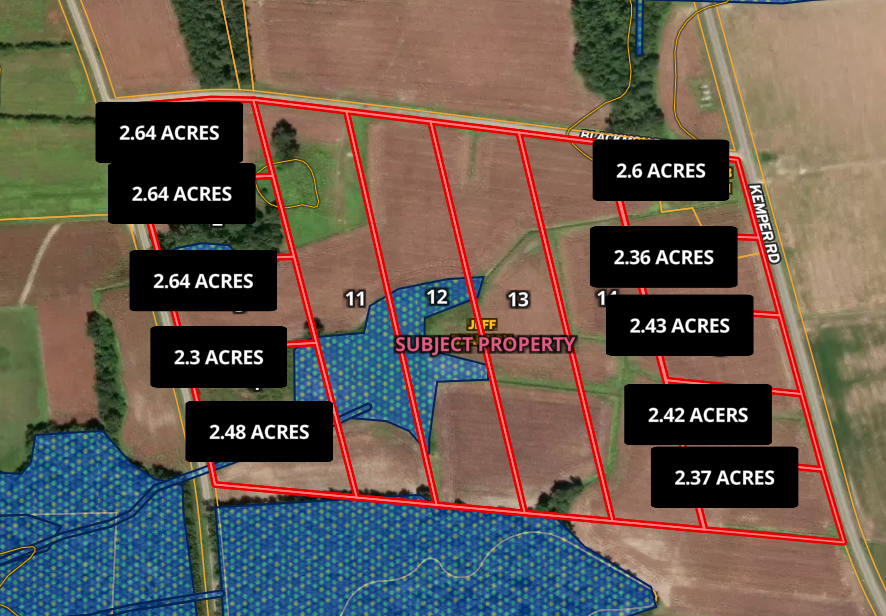
Someone brought me a six-parcel small-town deal recently. ~7 acres total. Seller wanted $80K. Comps at $10K-$30K per lot. On paper there was margin.
I told him I personally wouldn't touch it.
Every operator with reps has a list of patterns where they have personally lost money. The list is short, usually two or three categories. The list is sacred. It is what protects the capital that compounds.
Pattern one. Small towns with no regional homebuilder presence within 30 miles. The demand side of a land flip is homebuilders, secondary developers, or owner-occupant builders with financing access. When no regional builder operates within an easy commute of your parcel, the demand side is structurally broken. You list, you get tire-kickers, you hold for 12-24 months, you sell under cost.
Pattern two. Bad absorption rate markets. Absorption rate is the velocity at which finished lots change hands. If average days-on-market is 180+ days, your subdivide doesn't exit on the timeline you underwrote. You become an inventory holder, not a flipper. Flipping land is built on cycle time. When cycle time doubles, the IRR collapses.
These aren't opinions. They are my track record. I tried each three times. Lost three times. After three losses on the same pattern, the right adjustment is not to find a better version of the same deal. The right adjustment is to stop.
Cost asymmetry. One deal you shouldn't have done roughly equals the profit of three you should have. Time on a bad deal is time not spent on good ones. Capital in inventory is capital not running through the machine. Operational attention on the wrong deal is attention not available for the right one.
Saying no is a skill most operators don't develop because saying yes feels like progress. Saying yes produces visible action. Saying no produces the absence of a future loss. That absence is what compounds.
Build your list. Two or three patterns where you've personally lost. Treat it as inviolable. When the math looks fine but the pattern is on your list, the math isn't the question. Your track record is.
Reply DEVELOPMENT for the pass criteria.
Subdivides where the only diligence was an AI tool. That's the fastest way to lose $20,000 in this business right now.
Someone brought me a New York subdivide deal recently. He wanted to split a parcel into two 3.5-acre lots. I asked him: did you verify with the county that the subdivide is permitted?
His answer: "I ChatGPT'd it. Should be more than fine."
That was the most expensive sentence in the conversation.
AI tools are extraordinary for first-pass research. Synthesizing public information rapidly. Directionally reasonable answers most of the time. Underwriting, comp pulls, ICP analysis. I use them every day.
Subdivision rules are the category where they fail systematically, and the failure is structural.
Local zoning ordinances often aren't in any public training corpus. Even when they are, the AI doesn't know which version is current. The rules change quarterly through planning commission votes that don't get indexed online for months. Even with the current version, the AI doesn't know about the unwritten interpretations the planning department applies in practice.
The result is AI tools confidently producing subdivision opinions that are wrong roughly half the time, often in ways that look correct to someone who hasn't spent years in that specific market.
The rule. Get the county's answer in writing. Email. Anything with a documentary record of what was said, when, and which staff member said it.
Phone calls don't count. The planning department says one thing Tuesday morning, the officer who answered is on vacation by Friday, and your deal moves into diligence with no record.
The written record matters most when the deal goes wrong, not when it goes right. If the county confirmed in writing and a later officer rules differently, you have a legal claim. If your only record is a ChatGPT screenshot, you have nothing.
One email. Two paragraphs. Parcel ID, specific question, request for written confirmation. Fifteen minutes of work. The downside of skipping it is the entire deal.
Day 63 / 100. $253,912 of $500,000. 37 days remaining.
Reply DUE DILIGENCE for the template and dashboard.
"Smart, hungry, coachable."
That's the filter.
Missing one of those three? Don't hire them.
Missing two? You'll fire them in 90 days anyway.
Missing all three? Congrats — you just hired your future biggest distraction.
Subdivides where the only diligence was an AI tool. That's the fastest way to lose $20,000 in this business right now.
Someone brought me a New York subdivide deal recently. He wanted to split a parcel into two 3.5-acre lots. I asked him: did you verify with the county that the subdivide is permitted?
His answer: "I ChatGPT'd it. Should be more than fine."
That was the most expensive sentence in the conversation.
AI tools are extraordinary for first-pass research. Synthesizing public information rapidly. Directionally reasonable answers most of the time. Underwriting, comp pulls, ICP analysis. I use them every day.
Subdivision rules are the category where they fail systematically, and the failure is structural.
Local zoning ordinances often aren't in any public training corpus. Even when they are, the AI doesn't know which version is current. The rules change quarterly through planning commission votes that don't get indexed online for months. Even with the current version, the AI doesn't know about the unwritten interpretations the planning department applies in practice.
The result is AI tools confidently producing subdivision opinions that are wrong roughly half the time, often in ways that look correct to someone who hasn't spent years in that specific market.
The rule. Get the county's answer in writing. Email. Anything with a documentary record of what was said, when, and which staff member said it.
Phone calls don't count. The planning department says one thing Tuesday morning, the officer who answered is on vacation by Friday, and your deal moves into diligence with no record.
The written record matters most when the deal goes wrong, not when it goes right. If the county confirmed in writing and a later officer rules differently, you have a legal claim. If your only record is a ChatGPT screenshot, you have nothing.
One email. Two paragraphs. Parcel ID, specific question, request for written confirmation. Fifteen minutes of work. The downside of skipping it is the entire deal.
Day 63 / 100. $253,912 of $500,000. 37 days remaining.
Reply DUE DILIGENCE for the template and dashboard.
A texter on my team got pushback for "qualifying too hard."
Then she went on to push the highest closing rate we'd ever seen.
Hard qualification is the gift.
Soft qualification is the curse.
Five deals closed on my side last week. Friday I'll show the numbers.
Today I want to walk through one of the ones I told someone to walk away from.
Someone brought me a deal listed as eleven acres. When they pulled the satellite it looked closer to 5.6. The seller's explanation was that he inherited two adjacent lots from a family member and that he owned both. The deed paperwork had never been updated.
Most operators would have signed that contract. The story is plausible, the seller is motivated, the math works on paper.
The standard playbook is wrong on inherited property. Here is why.
Inherited property without an updated deed is not the seller's to sell. The property still belongs to the estate. The estate has to clear probate before title can legally transfer. The seller can sign a contract. The seller cannot deliver clean title until probate completes. Probate is one of the most variable, least controllable timelines in real estate.
Clean case, 30 to 90 days. State with a busy court calendar, six months. Contested will, 18 months or longer.
Contesting parties are the silent killer. A cousin shows up. A second marriage's stepchild shows up. They have a claim, and the seller often does not know they exist until probate flushes them out.
The other thing operators miss. Probate costs $3,000 to $15,000. The seller almost never expects to pay. They expect the buyer to advance the cost as part of closing. That is unmodeled expense layered onto a deal you underwrote without it.
Three things in your addendum before you sign.
One. Extended due diligence rights, ninety days minimum, with unconditional buyer extension rights.
Two. Seller pays for probate, in plain English.
Three. Your probate attorney reviews the case, not theirs.
Inherited property can be a great deal. Or the worst trap in land investing. The difference is whether the addendum protected you before you signed, or whether you learned the protections you needed afterward.
Day 62 / 100. $253,912 of $500,000. 38 days remaining.
Reply DUE DILIGENCE for the checklist and dashboard.
If your lead pipeline is broken, here's where to look:
— Data quality (filter, source, freshness)
— Texter qualification training
— Texts per record
— Speed to lead
— Lead manager handoff
— AM availability
Don't send more. Fix the leak.