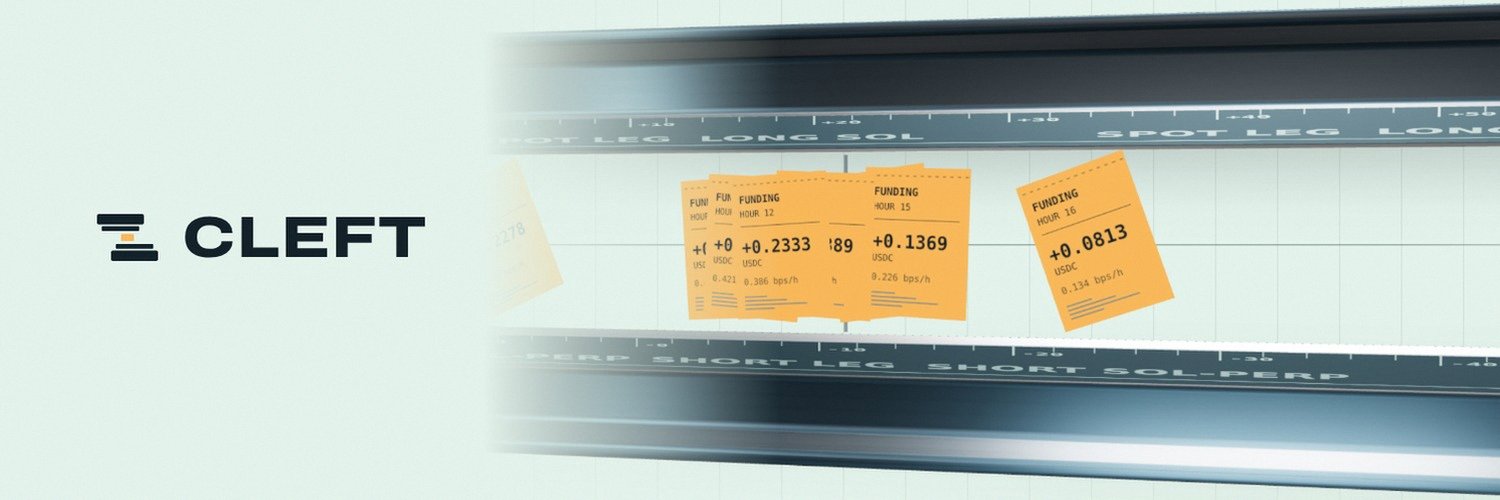
CLEFT is a USDC vault that holds spot SOL against an equal short on SOL-PERP.
When SOL moves, one leg gains what the other loses. What stays is funding: the hourly payment between leveraged longs and the shorts on the other side.
You deposit USDC and your request waits for the next daily strike. At the strike, shares mint at one NAV for everyone in the queue.
Every settled hour prints a receipt, received or paid. The paid hours sit on the same tape as the received ones, next to every cost line.
A keeper with limited rights keeps the two legs equal and cuts both when margin runs thin. You redeem at a strike, up to the gate, and the USDC comes back to your wallet.
$CLEFT is the fee side. Staked $CLEFT claims half of the vault fees CLEFT realizes in USDC, and a fifth of the fees CLEFT keeps buys $CLEFT for the burn ledger.
https://t.co/wb8mJQdwrK
The first strike on the mainnet vault is the next daily boundary.
Every deposit queued before it mints shares at one NAV per share, the same price for everyone in the queue. A deposit is already waiting for it, and the vault page counts down to it.
At the boundary, both legs are reconciled and the oracle is checked for age and confidence. If a check fails, the strike moves to the following boundary instead of reusing an old price.
https://t.co/Oh61pXqY7h
@SayNoToRUGSo@akuaja243 fair point. the first round just ran. spot and short opened at the strike and the first funding receipt is on the receipts page
@ThadiusQ no volume bot and there won't be one. the first hedge went live on mainnet at the strike and the first funding receipt is public. that's the push
Both legs are open on mainnet, and the first funding receipt is printed.
The vault bought spot SOL and opened the equal SOL-PERP short from its own USDC. The keeper recorded both fills, then the first hour settled into the cleft.
Every step has its transaction, starting with the first receipt:
https://t.co/x2MgPRj9PU
https://t.co/Oh61pXqY7h
Money leaving the perp venue has one destination: the vault program.
The program owns the venue sub-account, and the keeper is only a delegate. It can place and cancel orders, settle funding and reconcile, and it cannot send a withdrawal anywhere else.
Your wallet signs only your own deposits, redemptions, cancels and claims. The program and the strategy authority are listed in full on the receipts page.
https://t.co/G9qcnanRnj
@SayNoToRUGSo not slow at all. you deposit usdc and the vault holds sol against an equal short so price mostly cancels out. what's left is the funding longs pay
Depositing on CLEFT takes three steps, all inside the deposit ticket.
Connect a wallet. Enter an amount, from ten USDC. Read the review, which lists every step of the transaction and the network fee, then sign.
Your USDC waits in the vault until the next strike, and you can cancel it from Portfolio any time before then. At the strike, shares mint at that NAV.
Your wallet is the only signer, and nothing is sent until you sign.
https://t.co/Oh61pXqY7h
The receipts tape has six tabs, and each one answers a different question.
Vault lists deposits, cancels and redemptions with their epoch. Funding lists every settled hour, received or paid. Costs lists the route fee, slippage and taker fee of each fill.
Book flows lists money moving in or out of the four books. Creator fees lists each fee claim and where every part of it went. All puts the whole tape in one order.
Every line links its transaction on Solscan.
https://t.co/G9qcnanRnj
More than 5.9 million $CLEFT is burned and on the ledger.
A fifth of the creator and LP fees, after their claim cost, goes to market buys of $CLEFT. Rounds run as those fees build up, as often as once a minute.
A burn counts only after the token supply drops by exactly that amount. Every round lists its buy transaction and its burn transaction on their own page.
https://t.co/EtTdlH7rlD
@ThadiusQ early days. deposits just opened and the queue strikes at the next daily boundary. every deposit shows up on the receipts page the moment it lands
Every receipt has a fee side, and $CLEFT sits on it.
Depositors keep ninety percent of the new profit above their marks. Of what CLEFT realizes, half goes to staked $CLEFT in USDC, and a fifth of what CLEFT keeps goes to the burn ledger.
Staked depositors pay less through rebates. As the carry grows, the token's share of it grows with it.
https://t.co/wb8mJQdwrK
One pair of legs is where it starts.
SOL spot against SOL-PERP is the first carry CLEFT runs. The same rails can weigh funding across more markets once each one has its own record.
What happens when every wallet and treasury can hold the other side of leverage, and read the receipts for it?
https://t.co/wb8mJQdwrK
A fifth of the fees CLEFT keeps goes to the burn ledger.
Twenty percent of service revenue and twenty percent of creator and LP fees, after their claim cost, buy $CLEFT on the market. Every token bought is burned in the same round.
The buy and the burn are recorded as separate transactions, each tagged with the book that paid for it.
https://t.co/G9qcnanRnj
Your position, your mark, your fees, on one page.
Portfolio shows any wallet's shares, value at the last strike and open requests. Sign in as the owner and it adds your net contribution, profit, high-water mark and every fee you paid.
Cancel a queued deposit or claim a redemption from the same page.
https://t.co/zUzixkSgeQ
CLEFT starts with a capacity cap, on purpose.
The vault takes up to fifty thousand USDC across NAV and queued deposits. A carry is only as good as the depth of the venue it shorts on.
The cap rises when the venue's depth and the vault's record both say it should, and the vault page shows how much of it is used.
https://t.co/Oh61pXqY7h
The keeper's key signs a short list.
It can reconcile the venue, record fills, rehedge, reduce both legs and strike the epoch. Redemption payouts go from the vault program to the depositor's own wallet.
Every permission is written on the docs page, and every keeper action lands as a transaction you can open.
https://t.co/c9hXd8VwQV
Vault deposits are open.
Connect a wallet on https://t.co/Oh61pXqqhJ and deposit USDC, from 10 USDC up to a 50,000 USDC vault cap for now. Every request in the queue strikes together at 00:00 UTC at one NAV.
At the strike the keeper opens both legs: spot SOL and an equal short. From then on every funding hour prints a receipt, paid or received.
https://t.co/Oh61pXqqhJ