Pray with me
November 20, 2026
Father, I confess my sin to You. Have mercy on me according to Your steadfast love. Forgive me for what I have done and for the good I have left undone.
Thank You that the blood of Jesus cleanses me from all sin. Create in me a clean heart, O God, and renew a right spirit within me. Give me the humility to make things right with those I have hurt and the grace to forgive others as You have forgiven me.
In Jesus’ name, amen.
Psalm 51:1-12, James 4:17, 1 John 1:7-9, Ephesians 4:32
To all Active Duty Military and Veterans: please accept our invitation to get a FREE Original Double Steakburger, Beef Tallow Fries and a Patriot Shake on Wednesday, November 11.
Thank you for your service! 🇺🇸
It looks like a scene that no Hollywood director would dare put in a movie because audiences would never believe it was real.
Yet the official U.S. Navy photograph taken on the flight deck of the aircraft carrier USS Abraham Lincoln on July 6, 1991 proves every word of it.
At fifteen thousand feet over the Indian Ocean, Navy Lieutenant Mark Baden was flying a Grumman KA-6D Intruder, with bombardier-navigator Lieutenant Keith Gallagher sitting beside him in the right seat.
Without warning, a mechanical failure triggered the ejection seat under Gallagher while the glass cockpit canopy was still locked shut.
The seat rocket blasted twenty-six-year-old Gallagher straight through the thick acrylic glass roof, but stopped halfway up the rails.
His boots and legs remained jammed inside the cockpit while his head, shoulders, and chest stuck straight out the top of the airplane into a two-hundred-and-fifty-mile-per-hour hurricane of freezing air.
Worse still, his parachute pack popped open in the slipstream, wrapping white nylon shroud lines tightly around the Intruder's vertical tail fin like a giant net.
Hammered against the metal frame by wind forces strong enough to dislocate his shoulders and rip his helmet visor off, Gallagher blacked out.
Inside the shattered cockpit, Pilot Mark Baden looked to his right, saw only Gallagher's boots and limp legs, and assumed the blast had killed his friend.
Why did Baden not pull his own ejection handle and abandon the crippled airplane?
Because if Baden ejected, the firing rocket of his own seat and the pilotless crash into the ocean would kill Gallagher for certain, and a moment later Baden saw Gallagher's gloved hand move in the wind.
Dropping the nose toward the carrier USS Abraham Lincoln below, Baden slowed the jet to one hundred and forty knots so the wind would stop suffocating his friend.
With a shredded tail fin, an open canopy roaring like a tornado, and a human being sticking out the roof, Baden lined up on the pitching flight deck.
He slammed the Intruder onto the steel deck and snagged the number-three arresting wire while deck crewmen swarmed the fuselage to cut Gallagher out of his harness.
Gallagher survived with a dislocated shoulder and bruises, returning to active flight duty six months later because his pilot refused to leave him behind.
Welcome to my official X account as Governor-Elect of South Carolina!
I'm honored by the trust South Carolinians have placed in me. I'll use this account to share updates on our transition, priorities and the work ahead to put South Carolina families first. Let's get to work!
🚨 GEN X, WE HAVE A SERIOUS PROBLEM. 🚨
Somewhere between blasting Mötley Crüe in our bedrooms and getting excited about a new set of kitchen towels, something went terribly wrong.
WE HAVE BECOME OUR PARENTS.
And quite frankly, I would like to speak to whoever authorized this bullshit. 🤣
I’m serious.
We were the generation that swore we’d NEVER turn into those boring adults who complained about everything.
And now?
We’re standing in the kitchen at 9:00 at night, furious because somebody left a light on in a room nobody’s using.
“DO YOU THINK WE OWN THE ELECTRIC COMPANY?!”
Dear God.
That was my mother’s voice.
COMING OUT OF MY MOUTH.
We used to sneak out of the house after midnight.
Now we’re checking to make sure every door is locked by 8:15.
Twice.
We used to spend three hours getting ready to go out.
Now we spend three hours mentally preparing ourselves to go to Walmart.
And if we get there and they’ve rearranged the store?
THAT’S ENOUGH TO RUIN THE ENTIRE DAMN DAY.
We used to drive around for absolutely no reason, wasting gas, listening to Def Leppard, Bon Jovi, and AC/DC.
Now we combine six errands into one trip because we’re NOT wasting gas driving all over creation.
And don’t even get me started on the thermostat.
Remember when our parents acted like touching that thing was a federal offense?
Well, congratulations.
WE ARE NOW THE THERMOSTAT POLICE.
“WHO TURNED THE AIR DOWN TO 68?!”
Suddenly we’re giving a 20-minute lecture about utility bills to people who just wanted to stop sweating.
We used to laugh at our parents for watching the news and complaining about the government.
Now we have opinions about property taxes, interest rates, and the price of a dozen eggs.
STRONG OPINIONS.
We used to spend our money on concert tickets, beer, and questionable fashion choices.
Now we’re walking into a store and saying things like:
“Well, that’s a pretty good price for paper towels.”
And actually MEANING IT.
We have favorite grocery stores.
Favorite laundry detergents.
Favorite parking spaces.
Some of us have a favorite burner on the stove.
AND DON’T YOU DARE USE MY GOOD SCISSORS TO CUT CARDBOARD.
We used to make fun of our parents for saving butter containers.
Now we’ve got a cabinet full of Cool Whip bowls, Country Crock tubs, and enough plastic grocery bags stuffed inside one plastic grocery bag to survive the apocalypse.
And why?
BECAUSE THEY’RE PERFECTLY GOOD CONTAINERS.
We used to think our parents were crazy for getting up at 5:30 in the morning.
Now we’re awake at 5:17 for absolutely no reason, drinking coffee in the dark, enjoying the silence like it’s an all-inclusive vacation.
We used to listen to music so loud the neighbors complained.
Now we’re standing at the window saying:
“WHO THE HELL IS PLAYING MUSIC THIS LOUD?!”
Then we recognize the song.
And suddenly we’re singing every word to Pour Some Sugar on Me while complaining about the noise.
We used to go to the mall to see who was there.
Now we order online because we don’t want to see ANYBODY.
We used to think a Friday night at home was punishment.
Now somebody invites us somewhere on Friday night and we’re immediately trying to figure out how to get out of it without hurting their feelings.
“That sounds like SO much fun!”
It does not.
It sounds like putting on real pants, driving after dark, and being expected to socialize.
ABSOLUTELY NOT.
And let’s talk about the noises we make.
Getting out of a chair now requires a sound effect.
Standing up? GRUNT.
Bending over? GROAN.
Getting off the floor?
THAT’S A WHOLE DAMN PRODUCTION.
We don’t even fall asleep anymore.
We just sit down on the couch after dinner, blink twice, and wake up three hours later with the television asking if we’re still watching.
YES, NETFLIX.
I’M STILL WATCHING.
I JUST NEEDED TO REST MY EYES.
And the phrases?
Good Lord, the phrases.
“Close the door! Were you born in a barn?”
“Money doesn’t grow on trees!”
“Because I said so!”
In 1991 eight people were sealed inside three acres of glass in the Arizona desert to prove that a carefully designed farm could feed humans without the outside world, and the design had almost no room in it for animals. Two years later the only thing inside that had reliably fed them was a handful of goats.
Biosphere 2 cost a hundred and fifty million dollars. A rainforest, an ocean, a savannah and a farm under one roof, with the door welded shut for two years and nothing allowed in or out. The farm was the heart of it, and the farm was built on the modern idea: crops first, grown intensively, with livestock as an afterthought at the edges. A few African pygmy goats for milk, a flock of chickens, and four small feral pigs chosen because they could live on scraps.
The pigs did not last the year. In a sealed box short of calories a pig is a competitor, and the crew killed and ate them. The chickens barely laid, because the glass cut the light and there was nothing to feed them that would make an egg. That left the goats, and for two years the goats were the only source of fat in a world designed around vegetables.
The accounts the crew wrote afterwards return to them again and again. The half glass of milk a day was the thing people lived for. When a kid was born it was eaten and the meal was written up like a feast. The men lost nearly a fifth of their body weight, the women a tenth, and the food they dreamed of was never the sweet potatoes they had in abundance. It was the animal they had been given too few of.
The plants were also taking the air. To make the crops grow the soil had been enriched with compost, and the microbes in that soil breathed oxygen faster than anyone had calculated. The level fell from twenty-one per cent to fourteen, the air of a high mountain, until the crew could not climb a staircase without resting and oxygen had to be trucked in from outside. The design that put plants first had removed the thing everyone needed most.
Nobody has ever run the experiment the other way, with a herd at the centre and the crops at the edge. It would not have needed a doctor to explain the results.
They were given three acres and told to feed themselves on plants. They ate the pigs, worshipped the goats, and suffocated.
NASA's first job, before it put a man in space, was to find the meal that leaves the least behind. The answer was steak and eggs, and it has been the launch breakfast for 65 years.
The problem was the suit. A Mercury astronaut was sealed into a pressure suit, bolted into a capsule the size of a phone box, and left on top of a rocket for hours. He could not take anything off. There was no toilet, and no plan for one.
So in July 1960 the Air Force handed the question to a nutritionist called Beatrice Finkelstein. She had to feed the man so he stayed strong, clear-headed and full, for as long as it took, on the least possible waste.
She wrote a menu for the last 3 to 4 days before flight. High protein, low residue. Meat, eggs, very little else. Residue is the polite word for whatever the body cannot use and has to send back out. On her figures, beef and eggs produced almost none. The body took nearly all of it.
On the morning of 5 May 1961, Alan Shepard sat down to steak and eggs, went out to the pad, and became the first American in space.
It worked so well that nobody dared change it. John Glenn ate it. The crew of Apollo 11 ate it on the morning they left for the Moon. Shuttle crews ate it. Astronauts are superstitious, and this is the one ritual with a medical file behind it.
Look at what that file says. The best funded engineers on earth needed a food that was nearly all nutrition and next to no waste, to fuel a man through the most demanding day of his life, and they did not pick porridge.
Down here the same breakfast comes with a warning, and we are advised to swap it for the bran.
NASA ran the test in 1960. The bran is the residue.
In 1999 climbers found George Mallory's body high on Everest, 75 years after he vanished, and the clothes he died in were still on him. They were wool, silk and cotton. In 2006 somebody put on an exact copy and climbed the mountain in it.
For decades the story had been that Mallory and Irvine were doomed by their kit. Tweed jackets and woolly jumpers at 28,000 feet. Brave amateurs, dressed for a grouse moor.
The body told a different story. Mallory was wearing 8 thin layers. Silk next to the skin, then fine wool, then more silk, more wool, a flannel shirt, and a windproof cotton outer woven so tightly it turned the snow.
Four British universities took fragments from the body and rebuilt the whole outfit, thread for thread. A mountaineer called Graham Hoyland wore it on Everest.
He reported that it was warm. It was also lighter than the modern down suit his companions were wearing. The silk layers slid over the wool, so he could move his arms freely, which a man in a padded plastic suit cannot. The wool held its warmth when damp with sweat. He said he would have been comfortable going for the summit in it.
The researchers concluded the clothing was fully up to the job.
So the gear of 1924 was not the weak point. A sheep and a silkworm had solved the problem of the coldest place on earth, at less weight, before anyone had invented nylon.
Then we spent a century replacing it with petroleum and told ourselves the men who came before were underdressed.
He was sixty years old.
His town was destroyed. His wife had been swept away by the wave.
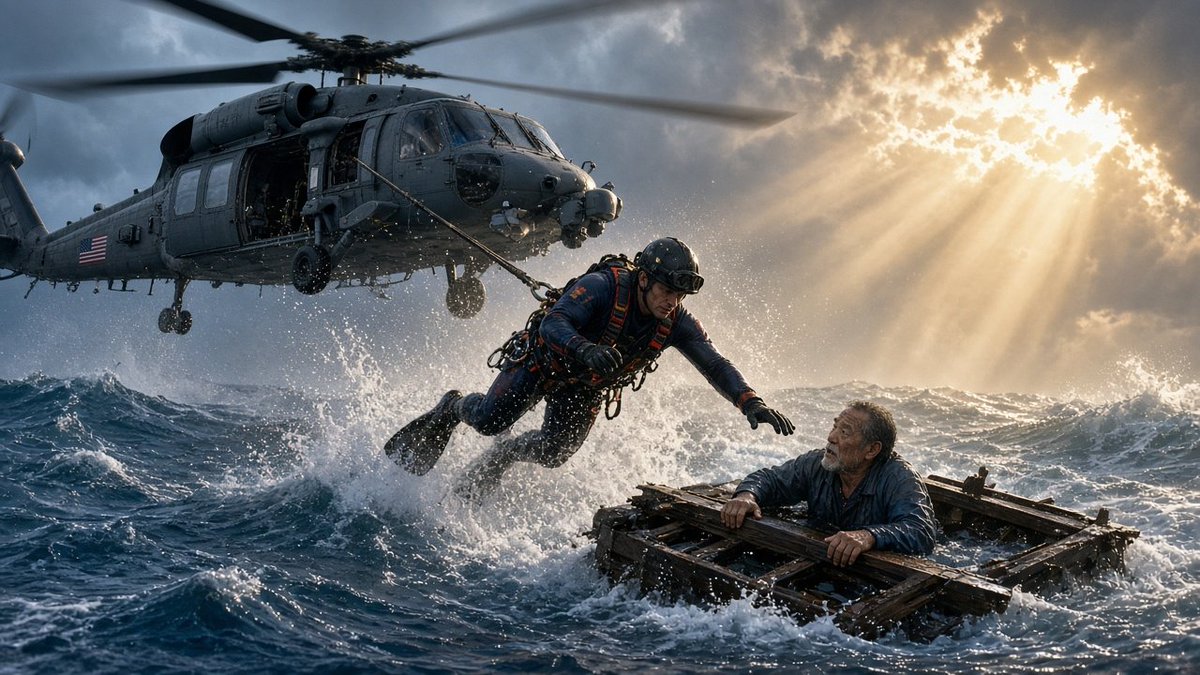
And for two straight days, Hiromitsu Shinkawa was drifting alone in the freezing Pacific Ocean—ten miles offshore—clinging to the red tin roof of his floating house.
Around him was nothing but miles of gray, frigid swells and floating debris.
No water. Hypothermia setting in.
He waved a red cloth at passing distant ships. Nobody saw him.
He laid down on the wood and closed his eyes to die.
Then he heard the whip-cracking roar of helicopter blades.
An SH-60 Seahawk from the USS McCampbell had spotted the tiny red speck on the ocean horizon.
The pilot didn't hesitate.
In rough seas with 8-foot waves tossing the fragile roof, Navy rescue swimmer explosive diver pushed off the skid.
He dropped into the deadly freezing ocean.
Swallowing salt water and diesel scum, the American swimmer fought through the swell, climbed onto the rocking roof, and wrapped his arms around the freezing, weeping Japanese survivor.
“I got you,” the sailor said. “You’re coming home.”
When Shinkawa was hoisted into the cabin, wrapped in US Navy blankets, he clutched the American crew's hands and sobbed:
“I thought today was the last day of my life.”
The United States Navy didn’t have to search that far out into the open sea.
There was no strategic objective. There was no media camera.
Just a lone, forgotten old man on a floating shingle.
AND AMERICA REFUSED TO LET HIM DIE ALONE IN THE DARK.
This is why we love you, America.
This is who you are. 🇺🇸🤝🇯🇵
Stop waiting for the building.
Years ago, I had 40 boys coming for an overnight summer camp and lost the space we were supposed to use. The hotel plan didn’t work either.
My grandmother said, “Bring them here.”
So we did. Forty boys stayed at my grandmother’s house that summer.
And you know what? Their parents didn’t care that we didn’t have some beautiful facility. They trusted me with their sons because they knew my heart was in the right place and knew those boys were going to be poured into.
Sometimes your heart has to speak for you before your resources can.
Some of y’all have been sitting on a vision waiting for the building, the funding, the staff, and the perfect circumstances.
Meanwhile, somebody needs what you have right now.
Start where you are. Start with what you have.
The building can come later. The work can start now.
“The evidence for Noah’s Ark is getting a little overwhelming.”
This independent researcher just blew Joe Rogan’s mind.
Tyler Engle broke down bombshell new radar scans from Mount Ararat.
“The Noah’s Ark location.”
Bookmark this.
“How much more evidence do we need?”
“They got a new little drone … using the same technology that they used to find the Hawara Labyrinth in Egypt.”
“Mount Ararat is almost 17,000 feet high.”
“Straddled by two of the saltiest lakes on Earth.”
“How did it get there?”
“Most people confuse the flood with the Younger Dryas event.”
“That is way too far back in history.”
“The nearby town of Shuruppak was buried in 50 feet of mud.”
“That mud was dated very close to the mud that is covering this structure.”
“Shuruppak … is where Noah was from.”
“The ancient Sumerians called Noah Ziusudra, the last king on the Sumerian King’s List before the flood.”
“These guys were a megalithic culture.”
“They could work really big, really hard rocks.”
“And right by the site of this ark … are called drogue stones.”
“Anchor stones.”
“They would … suspend them off of the boat to keep it stable in rocky water or anchored.”
“Noah’s Ark … was the largest ship ever built.”
“And meant only to survive this one event.”
“Those dimensions are exceptionally close to what we see in the ground.”
Rogan: “It does seem like there was … probably multiple events throughout history.”
Engle: “That one’s well documented.”
Rogan: “The flood?”
Engle: “The one in Turkey was 3,000 BC or so … there was multiple.”
“That whole region … has flood evidence.”
Rogan: “So most likely, it was probably a semi-local event, like contained to Turkey.”
“And it’s wiped out.”
“The question is, was it a real event?”
“And if it was … how the hell did this Noah guy know it was coming?”
@joerogan@Bassforge_us
Just interviewed a young woman diagnosed with high grade brain tumor shortly after her 2nd child was born
Grade 4 highly aggressive astrocytoma-had surgical resection, followed by chemo therapy and radiation- after 8 months of chemotherapy it unfortunately came back and was inoperable!
She elected to not undergo any further chemotherapy and instead gave up sugar, went carnivore and put her faith in God.
The tumor continued to double in size every scan for the next 8 months reaching about 4cm in size and she was told her survival rate was less than 1% -at month 9 of carnivore the tumor began to shrink, her oncologist could not explain it-6 months later it was completely gone! Today she celebrated 1 year of her tumor recurrence being completely gone! This interview will be found on my podcast channel where I have done hundreds more like it
https://t.co/Deeknd53ey
🚨Unbelievable—Spartanburg, South Carolina proposed $3 Billion Valara Data Center project just went from an estimated 459,000 gallons of water a day to 1.2 MILLION—with peak usage potentially hitting 1.6 MILLION GALLONS DAILY!
That’s more than 2.6× the original estimate. 😬
Maybe we should ask a few more questions before handing over our water supply to data centers. https://t.co/1bybHADa1E