The board says it all.
Yesterday, South Carolina’s OTC ivermectin bill was sent back to committee, stopping it in its tracks.
Every green “Y” is a vote to send it back.
South Carolinians deserve representatives who trust citizens with their own healthcare decisions.
Remember the names.
What the Europeans fail to realize about US soccer fans is that even if only 20% of the country follows the sport, that’s roughly 70 million people, or more than the entire population of France or the UK
I'm close to having score results to begin sharing for this year's AP Exams. Here's a quick overview of how this will unfold.
The scoring of AP essays and free-response questions by ~30,000 professors and teachers - this year's AP Readers - runs throughout the first three weeks of June, with some make-up exam scoring continuing thereafter.
Once scoring is complete, the psychometric work begins. These annual processes ensure that this year's students are neither disadvantaged by tougher questions or stricter grading, nor advantaged by easier questions or easier grading.
Statistical analysis identifies the precise difficulty and scoring stringency of each question in comparison to prior years. If a given exam version proves to be easier, a higher number of points is required to earn scores of 5, 4, 3, or 2 on that version; if harder, a lower number is required. This work is led for the AP Program by the current president of the National Council on Measurement in Education.
After Readers have finished scoring and psychometricians have set the specific "cut scores" (points required) for each exam version, I'll be able to start sharing key findings as we collectively wait for this work to be completed across all 40+ AP subjects so that scores can be sent to colleges, students, and educators in early July.
Here's what I'll be covering as results come in:
• The focus areas of the free-response questions. (This year's exam questions were crafted by educators from virtually every state and DC; each question is worked on by a minimum of 15 professors and teachers before appearing on the test. I'll use this opportunity to pay tribute to their superb work.)
• Any statistically significant increases or decreases in the difficulty of this year's questions or scoring rigor.
• Particular content areas within the multiple-choice section where students scored especially well, or particularly struggled.
• Specific components of the free-response questions where students scored especially well, or particularly struggled.
All of this is very much an attempt to share in real time the data I'm receiving, to tide us all over until scores are released in a few weeks.
A few reminders:
• I'll report each subject as it's completed, and that timing will depend on how long it takes to score this year’s questions, so I can’t publish a schedule for sharing these updates. But I will have this info for all subjects no later than June 30.
• Because these score distributions include all students worldwide, individual classrooms will often have score distributions that are either higher or lower than this aggregation.
• AP Exams aren't scored on a curve. Rather, as many students as earn the points necessary for college credit receive a score of 3 or higher.
• If you're an AP student, here's information about how to make sure you're able to view your AP scores starting July 6: https://t.co/u2bTSrgujK
• You have until June 20 to indicate which college should receive your free score send: https://t.co/XL9cPGLw7f
• If you're an AP educator, here's information about how to view your students' AP scores starting July 6: https://t.co/oO5ufXWaVe
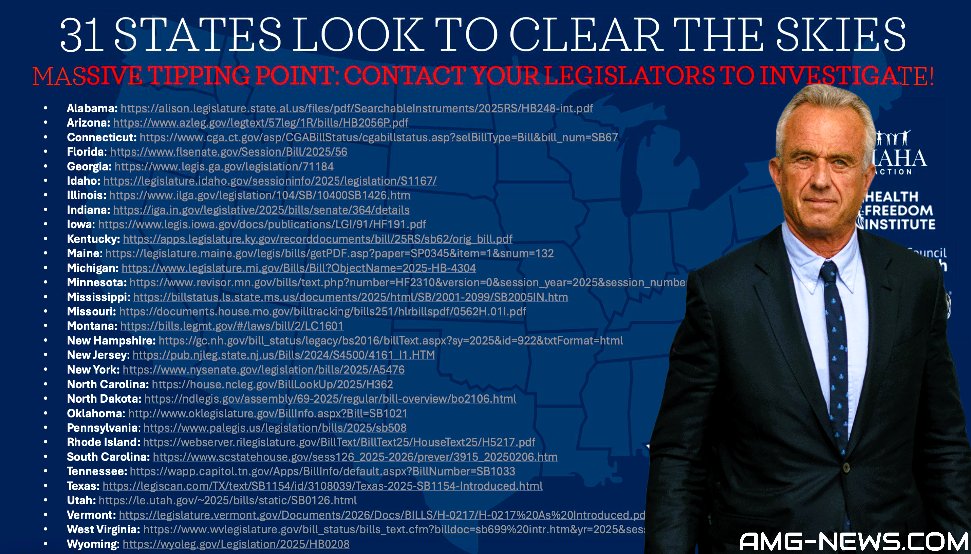
🚨 BOMBSHELL REPORT: 31 STATES DEFY THE SKIES — AMERICA, LED BY RFK JR., MOVES TO BAN GEOENGINEERING!
🚨31 U.S. states have introduced legislation to ban geoengineering and toxic weather modification programs. Backed by the Trump administration and a newly vocal HHS under Robert F. Kennedy Jr., this is not just a political shift — it’s an environmental reckoning.
This long-form investigative piece exposes the science, the cover-up, the public health fallout, and the constitutional violations behind decades of atmospheric experimentation.
America is reclaiming its skies.
Read it. Share it. Demand answers.
🚨31 STATES DEFY THE SKIES: AMERICA MOVES TO BAN GEOENGINEERING
👉 FULL STORY: https://t.co/MejqbqOxfA
📢 Join Telegram: https://t.co/FWCa4CamU4
🌐 Real stories. True journalism: https://t.co/F2U5vWBg3k
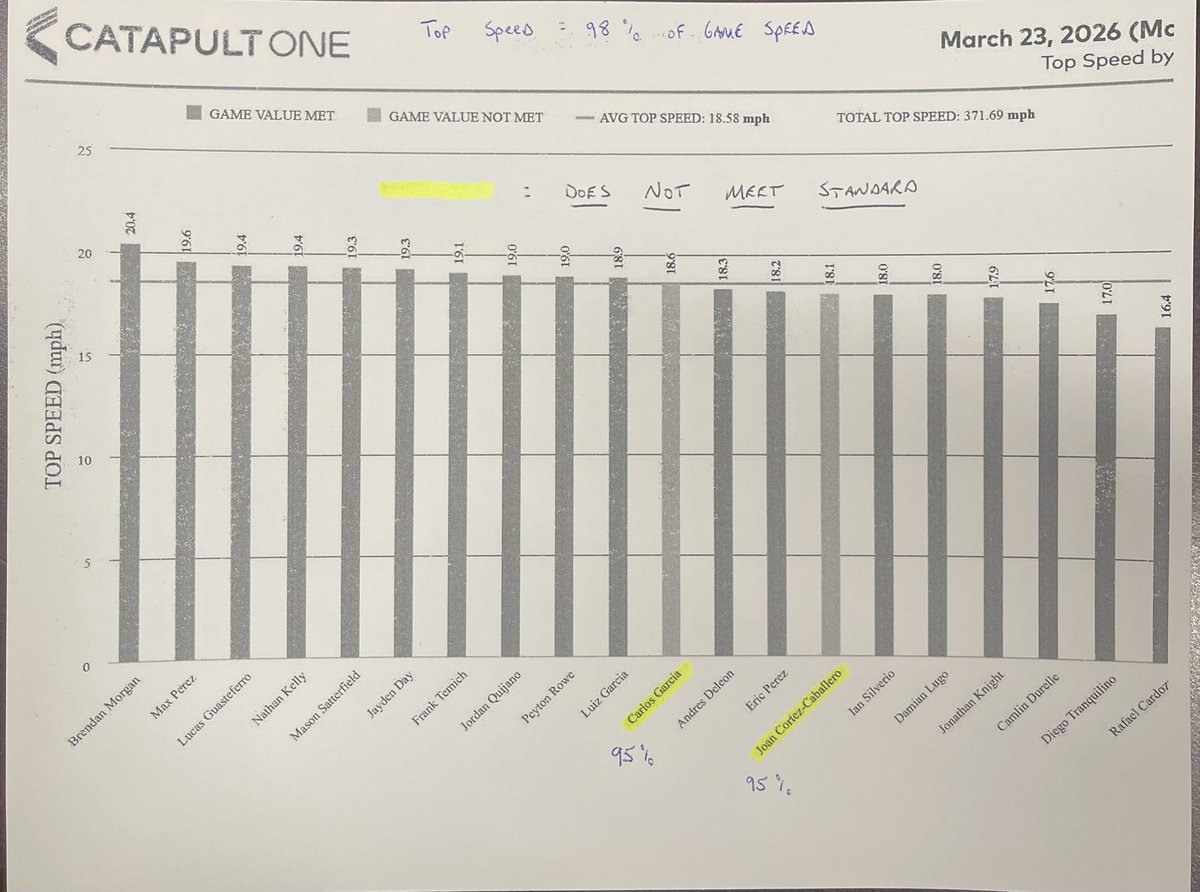
Dynamic Prep must be the most intense period of practice. Trains the brain to start fast, builds sprint capacity (power plays - 3 step burst out of prep skill), and 2 sprints stresses the muscle, conditioning it to withstand game demands - while helping athlete to get faster.
🚨 WOW! Clemson is being praised nationwide for the team personally THANKING Veterans in the stands as Lee Greenwood's "God Bless the USA" blasts on the loudspeakers
"They do this every home game now!"
Major standing ovation. PURE PATRIOTISM! 🇺🇸🇺🇸
This player is the hottest prospect in the Palmetto State and we're about to tell you why with of course the latest on his recruitment. Info on another 4-star OL headed to #Clemson's campus. And our Tuesday intel on two offered defensive end targets.
https://t.co/A8HIJySFWp
@MidwesternDoc has now received over a thousand reports attesting DMSO is incredible for a wide variety of conditions (especially chronic pain). These reports match what we're now seeing in our practice and can be read here. Please share your stories too!
https://t.co/JA1Nj73oa3
Newly published research helps to answer the "if masks work" work, why don't they "work"? It has been known for quite a long time that the vast majority of the aerosols we exhale are under 1 micron, with an avg around 0.28 microns.
Despite this, like OJ looking for the real killers, the vast majority of mechanistic mask studies evaluate particles over 1 micron, and many over 5 microns, where not only are there virtually no particles, and those that there are, do not carry infectious virus.
The research looks at the efficacy of masks at filtering aerosols (as source control) between 0.25 and 0.5 microns. Not surpringly, it found that surgical masks are roughly 20% effective, KN95s ~40% effective, and N95s 70% effective.
Note, this % decrease is not equivalent to the decrease in risk of infection. This is because people can become infected by COVID (and other viral respiratory diseases) with very few viral particles--around 100. But recent reserach has shown patients exhaling up to 10 million viral particles per hour---enough to make 100,000 people sick.
To put this in perspective, imaging you are in 20 x 20 room. There are 100,000 invisible "doses" floating around. Does a reduction of 20% to 80,000 have any impact on your likelihood of coming into contact with a dose? of course not.
In our minds, we tend to view exposure to viruses as an exposure modality, similar to cancer. Reduce the exposure to smoke, and you're less likely to get cancer. But it's really more like your ability to SMELL smoke. It's almost binary. It doesn't matter if there are 5 people smoking across the room, or 1, (80% reduction), you'll still be able to smell the smoke.
Links to the pre-print, and the peer-reviewed study are in the link below, as well as sources for everything I mentioned above. The s*bs**ck also has a much more detailed discussion of the paper, including more of the key figures.
The research was supported by @Rstorechildhood
https://t.co/E1q0ayddrq
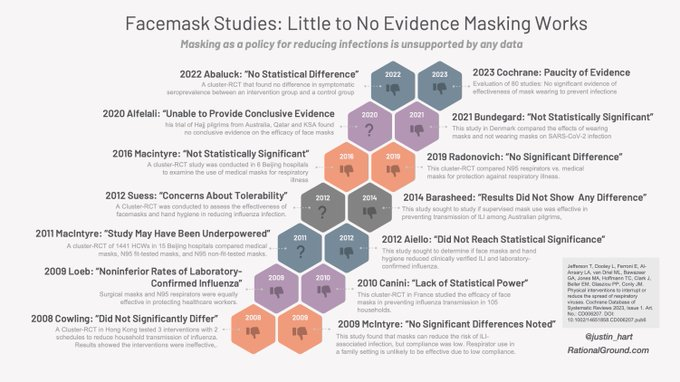
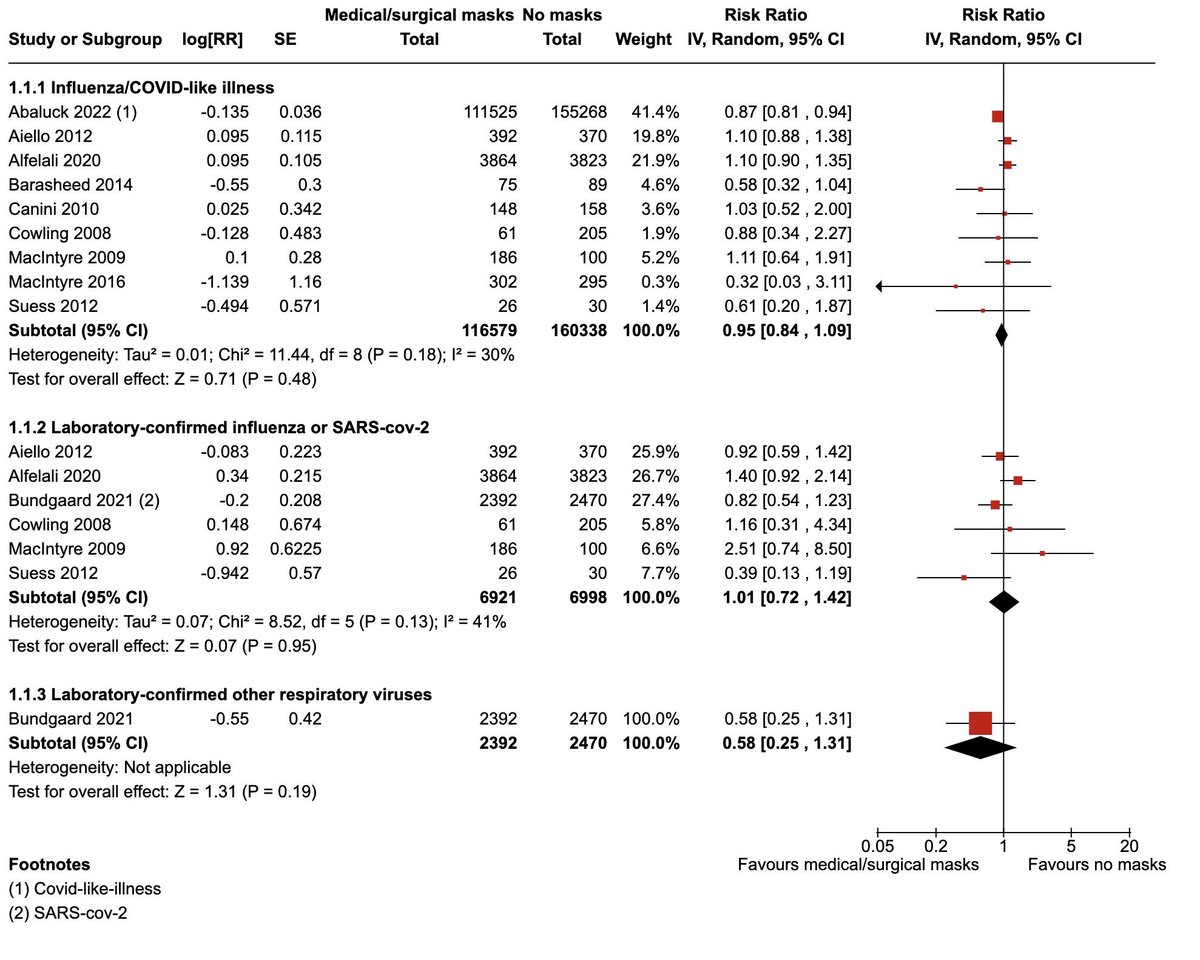
😷The Cochrane Review poured over 78 mask studies and concluded there was little to no evidence that facemasks provide any efficacy against viral transmission.
The confidence intervals on a range of endpoints and measures show "a relative paucity given the importance of the question of masking and its relative effectiveness." tr;dr -> no evidence that masks work. (links follow)