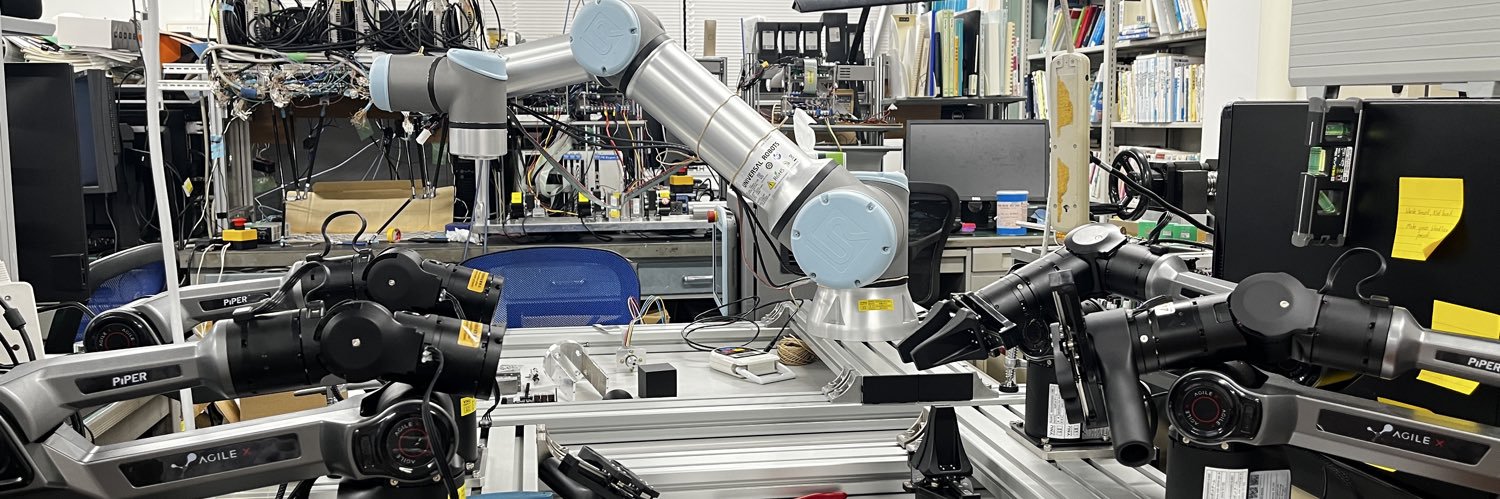
I had the privilege of presenting our joint research at AIM 2024, a truly enriching experience both socially and technically. The conference in Boston was incredible, closing with stunning views from the 52nd floor of the Prudential Center. #USA#AIM#Robotics#MIT#Harvard
The bottleneck for mass-producing humanoids is not just AI.
It's the actuator and the supply base that sits underneath it.
Study these companies for each of the components.
- Japan dominates precision mechanical (reducers, bearings).
- Germany and Switzerland own high-end motion.
- China owns volume motors, reducers, and the upstream magnet supply.
Who am I missing?
Japan Airlines will trial humanoid robots for baggage handling and aircraft cleaning at Tokyo's Haneda Airport starting in May, citing workforce shortages and rising tourist numbers
Open-source magnetic tactile sensor for $5! 🧲
Researchers introduced a magnetic tactile sensor that's low-cost, and easy to fabricate, democratizing tactile sensing for robotics.
Operating in unstructured environments like homes and offices requires robots to sense forces during physical interaction. Yet the lack of a versatile, accessible tactile sensor has led to fragmented solutions and often force-unaware, sensorless approaches.
Building an eFlesh sensor requires four components: a hobbyist 3D printer, off-the-shelf magnets (less than $5), a CAD model, and a magnetometer circuit board.
The sensor is 3D printed with magnets embedded in the middle layer. Based on chosen mechanical properties, magnets displace in response to contact forces, measured by a magnetometer underneath.
An open-source design tool converts simple OBJ/STL files into 3D-printable STLs. This enables application-specific sensors for robot hands, grippers, quadruped feet, and more.
Slip detection generalizes to unseen objects with 95% accuracy. Visual-tactile control policies improve manipulation by 40% over vision-only baselines, achieving 90% success on precise tasks like plug insertion and credit card swiping.
All design files, code, trained models, and conversion tools are openly available.
Project page: https://t.co/gTHpcnja5B
~~
♻️ Join the weekly robotics newsletter, and never miss any news → https://t.co/GoA3ZuwoPB
We are working to restore mobility that was lost due to disease or spinal cord injury by allowing participants to control robotic arms with their thoughts.
See how this is possible.
An MIT professor cracked the code on "How to Speak and gave a legendary 1-hour lecture on it.
It'll teach you more about speaking, writing, and selling ideas than most people learn in a lifetime.
Bookmark this. Give it 1 hour this weekend.
Clutching leg design…
No energy cost, no control needed.
Most humanoid robots simplify feet, but this design shows how effective foot design can improve mechanical control.
I recorded this podcast with Alexander & Monica 3 yrs ago, fascinating discussion on foot mechanics!
What's Hot in Antennas and Propagation?
In this new #WHAP, the authors Y. Guo, L. Zhao, G. Xu, W. Lin, Z. Fan, F. Liu, J. Guo, and Z. Huang present a systematic design method for multiple monopole antenna systems (MMASs) by exploiting the existing parasitic resonances.
Here are two videos of ASIMO falling over. You can see why high gear ratios don't work well for robot locomotion. With a super high gear ratio in the actuators there is ZERO tolerance for disturbance or loss of balance. ASIMO always needed a perfectly flat floor and controlled environment to walk properly.