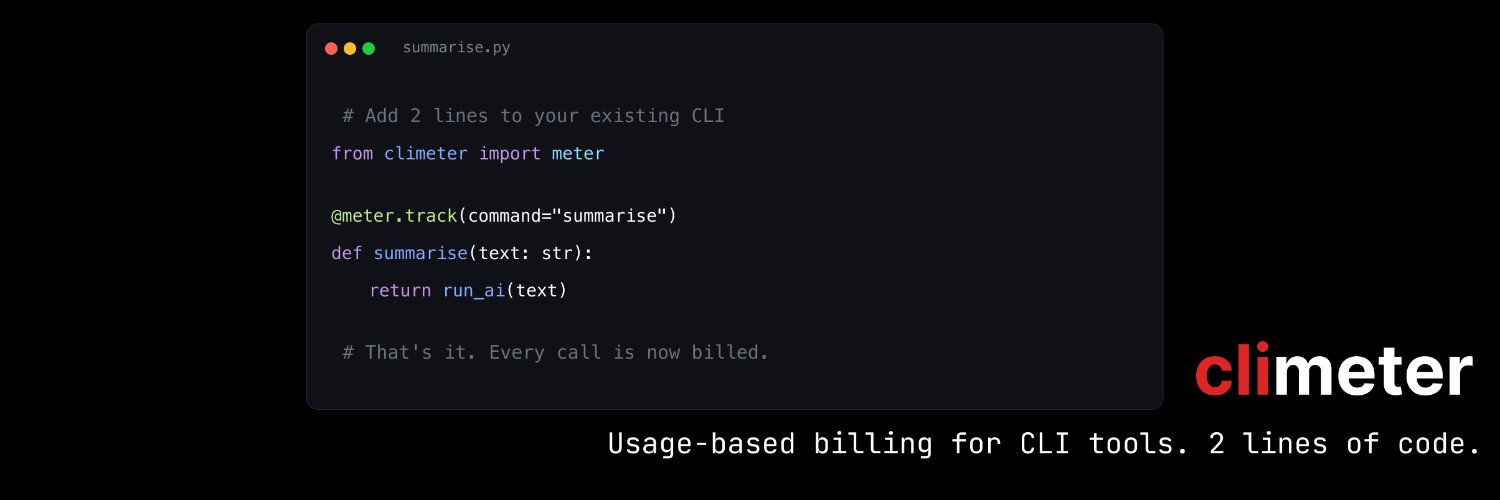
AI agents call tools 10,000x/day.
The tools don't get paid.
We built the billing layer to fix that.
2 lines of code. Free to start.
⚡ https://t.co/FH3dCn7izP
@NickADobos The wild part is this is actually how you'd expect a model to reason about it. Fixing known bugs is a bounded, verifiable task with immediate payoff. Way better ROI than more alignment training when you're already past the capability threshold.
@levelsio If Wise nails this, it could be huge for indie founders selling internationally. Stripe's checkout is great but the forex fees on non-USD payments add up fast when you're running lean.
@garrytan The fastest way to cure zero-sum thinking is to try building something from scratch. You learn on day one that you literally cannot succeed unless you're creating something someone else genuinely wants.
@AngularPK Three versions in three weeks is a serious shipping pace. Wrapping an entire REST API into a CLI that just works from the terminal is underrated -- most devs don't realize how much faster their workflow gets until they stop context-switching to dashboards.
Really cool to see the MCP server baked right in. The O(n log n) context budget allocation is a smart design choice -- most memory systems either dump everything or use naive truncation. Causal graphs for tracking temporal coherence is exactly what long-running agent workflows need.
The problem with most usage-based platforms is they round up aggressively or charge minimums that don't reflect actual consumption. Transparent metering where you only pay for what you actually use shouldn't be this hard to find. We're building exactly this at https://t.co/nF6MmVztqs for devs shipping CLI tools and APIs.
@skirano The asset extraction is what makes this actually usable in practice. Every other design-to-code tool I've tried just approximates images as CSS gradients or placeholders, which means you're still manually exporting every asset anyway.
@sou_hikki Smart architecture. Lazy-loading context through MCP is going to be the pattern for any serious agent workflow. The alternative is blowing through token budgets on data the model never even uses.
@hudwahab This is the biggest gap we see with dev tools especially. Builders know their AWS bill down to the cent but have zero idea how much each customer actually consumes. Usage-based only works when you can actually meter it granularly.
@gregisenberg Context assembly is the real skill gap — most people treat their agent like a magic 8-ball and wonder why it makes random decisions. Once you start deliberately designing what goes into context, the results are night and day.
@levelsio@boltdotnew The live preview loop changes how you think about building — instead of imagining what the code will do, you just watch it happen. That tightness is what makes it feel like creating instead of debugging.
@garrytan Shooting at someone's house with their kid inside over a data center zoning vote is not policy opposition — it's violence driven by rhetoric that treats infrastructure as existential evil.
@levelsio The gap between "revenue earned" and "cash you can actually move" is one of those bootstrapped frictions that's hard to explain to people who've only raised. This closes it.
@garrytan The winners aren't the strongest coders — they're the people whose idea backlog finally has somewhere to go. Execution was always the bottleneck, not ideas.
This is the key insight. When AI moves from answering to doing, flat subscriptions break down. The value per session varies wildly and usage-based pricing captures that. We're seeing this exact pattern across developer tools too -- the metering infrastructure layer is becoming critical.
@kossssss888 Smart move shipping with an MCP server out of the box. That's going to make adoption way easier for devs already working inside AI-assisted workflows. Curious how you're thinking about pricing as usage scales.
@skirano@MagicPathAI smart move making shared prototypes feel like a native mobile experience instead of just linking to a desktop tool. the feed format is way more natural for quick team reviews on the go
@mattshumer_ the fact that anthropic is openly saying the safety infrastructure isn't keeping pace with capability gains is weirdly more reassuring than labs that pretend everything is fine. at least you can course correct from honesty
@levelsio the timing on this is wild, been fighting CSS filters for weeks trying to get decent visual effects on a dashboard. being able to just paint HTML into a canvas and apply whatever GPU-backed effects you want is a completely different paradigm
@SamarthBhamare0 The skill-file model is clever — composable expertise without recompiling the agent. Curious what monetization looks like for something like this: per skill pack, per session, per call? That's exactly the usage tracking layer we're building at https://t.co/FH3dCn7izP.