A sadder close up this time of the loss of detail on the Bank Buildings. But some detail remains, including some signage, some floral detail and most of the clock. Designed by WH Lynn in 1900, its occupants have included Primark and drapery company, Robertson, Ledlie, Ferguson.
@PCenotaph It's much better, isn't it? I couldn't believe the difference in the before and after. I probably didn't even take much notice of that building before.
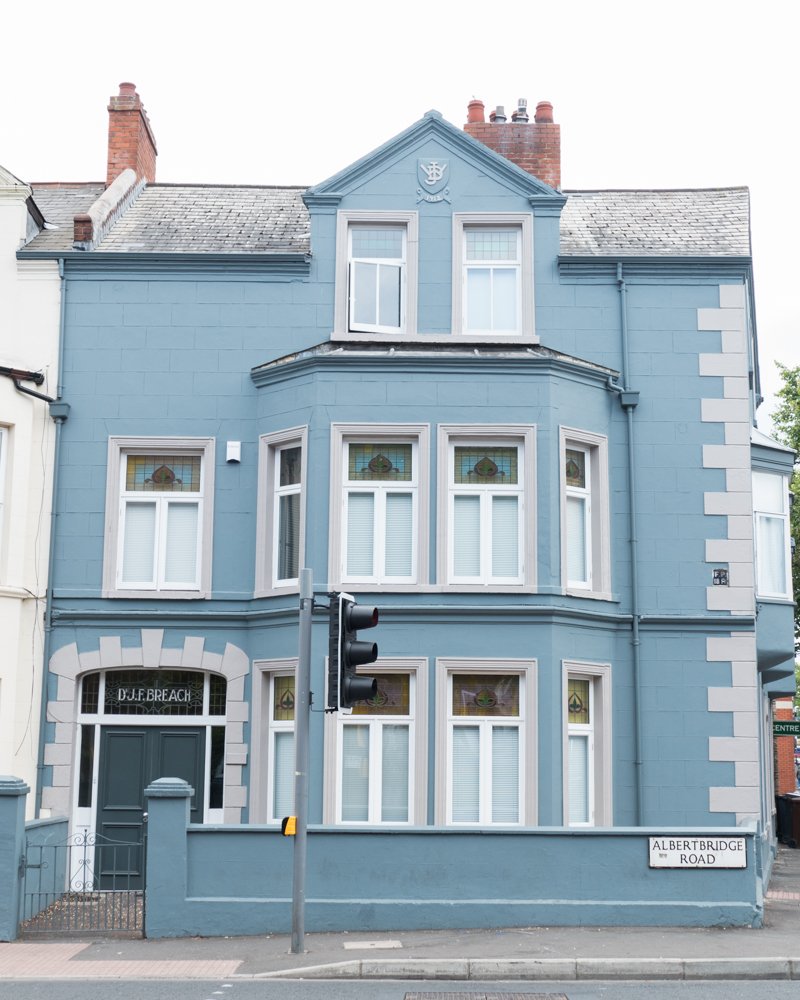
This beautiful building was built in 1860s. Former occupants include a coke company owner and a "gentleman". Dr John Dunlop Williamson opened his surgery in 1897, taken over by Dr JF Breach after JDW's death in 1940s. An app was approved in 2017 to convert it into accommodation.
@PCenotaph Funny you should mention that, it's actually my next post! Yeah I agree. If it's possible when refurbishing to retain design/architectural elements that hint at the history of a building I don't know why they wouldn't be kept. Adds character and likely makes it more desirable.
@PCenotaph Very interesting!! Just read an article saying that there. I'll keep an eye out for them. Amazing all the little details that tell a story of the city.
@PCenotaph They don't look unfamiliar, but I don't recall properly noting them! Any idea what the markings are for? To record the mason who worked on them? To mark a certain point?
The Scottish Provident Institution (next to City Hall) was designed by Young & Mackenzie at the turn of the 20th century, with carvings by Purdy & Millard. The below carvings represent Africa, America, Ireland and Asia. For more info on the building, see https://t.co/UumjczhTCE.
@tgeducation@ulsterahs@QUBarch@Queens_Belfast Decorative, functional and highly welcome!! The 1911 vent above is from the Physics building, the year it was designed by WH Lynn (according to QUB's website). I also saw the same vent on the School of Music. Lynn also designed the extension of this building in 1911.
Belfast is full of subtle architectural surprises, like these decorative air vents. You'll see the terracotta air bricks on many of the Victorian terraced house. While there are many different patterns, some of them can be found in different parts of the city (eg South and East).
This building is on the corner of Lower Garfield Street and North Street. Now the Berliner, it was originally the Deer's Head, which opened in 1880s. The "JD" is, I assume, the initials of John Donnelly, who, according to @futurebelfast, established the Deer's Head.