US Market Commentary | 7.21.2026
1. Nvidia delivered the answer in the physical.
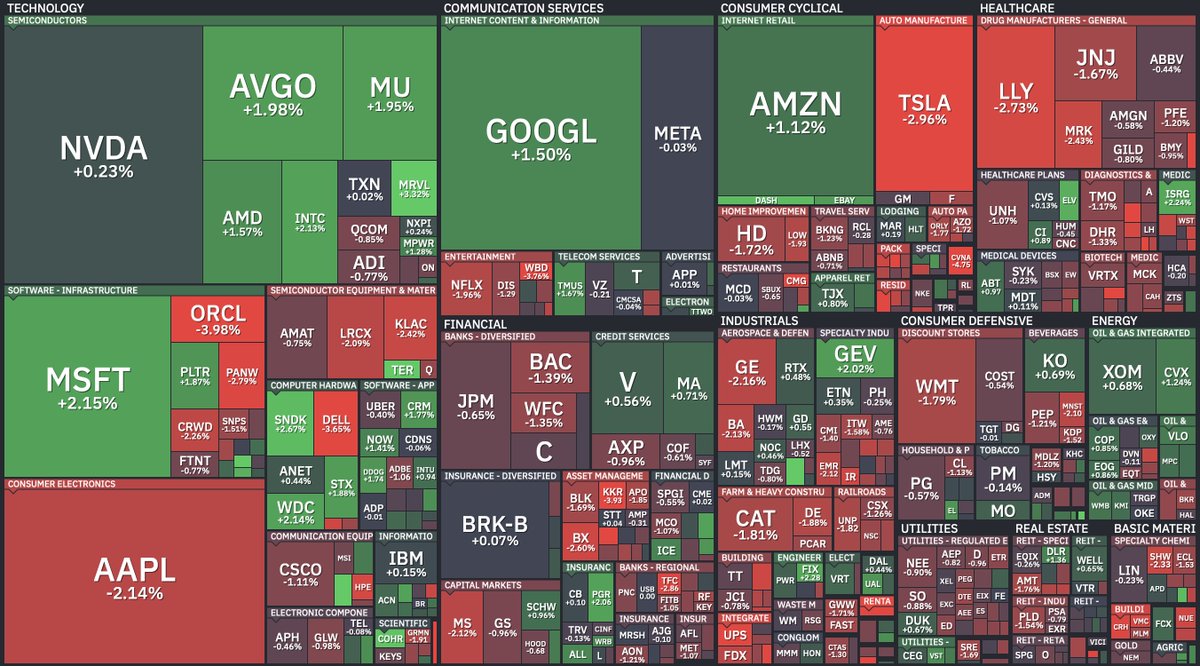
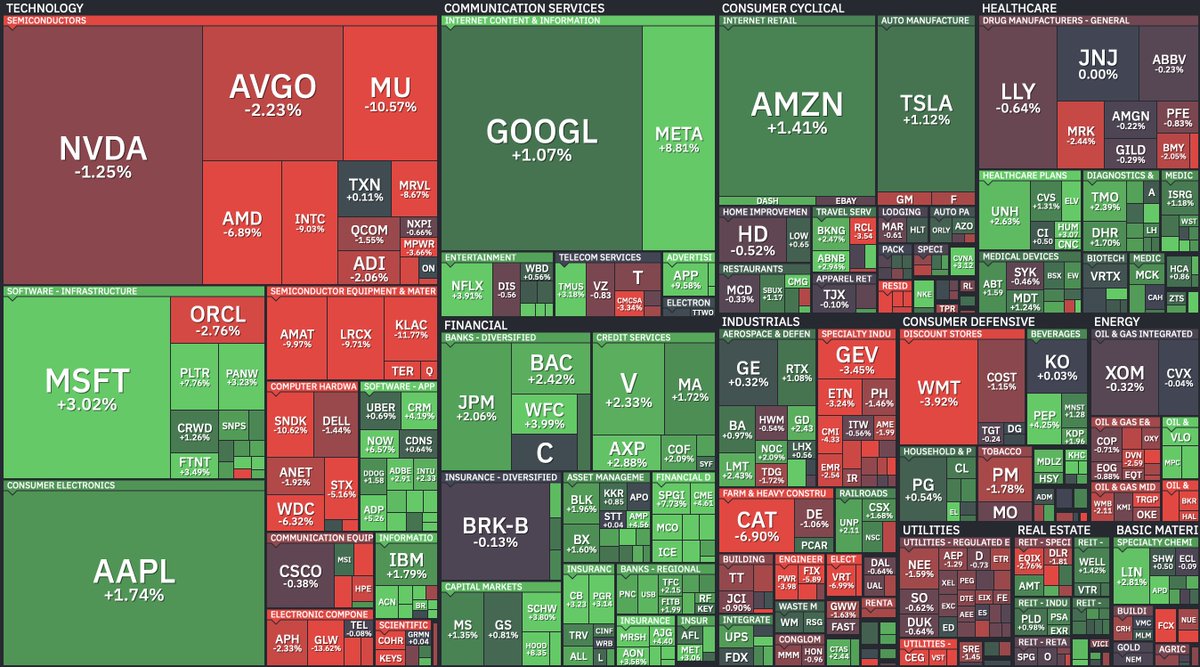
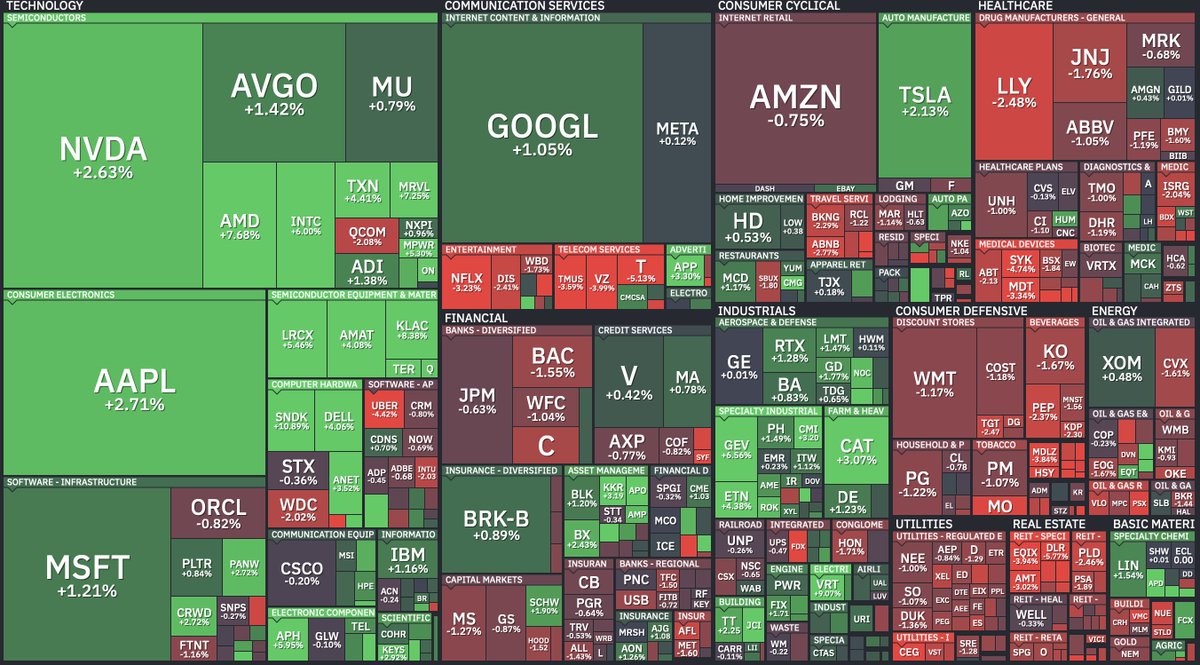
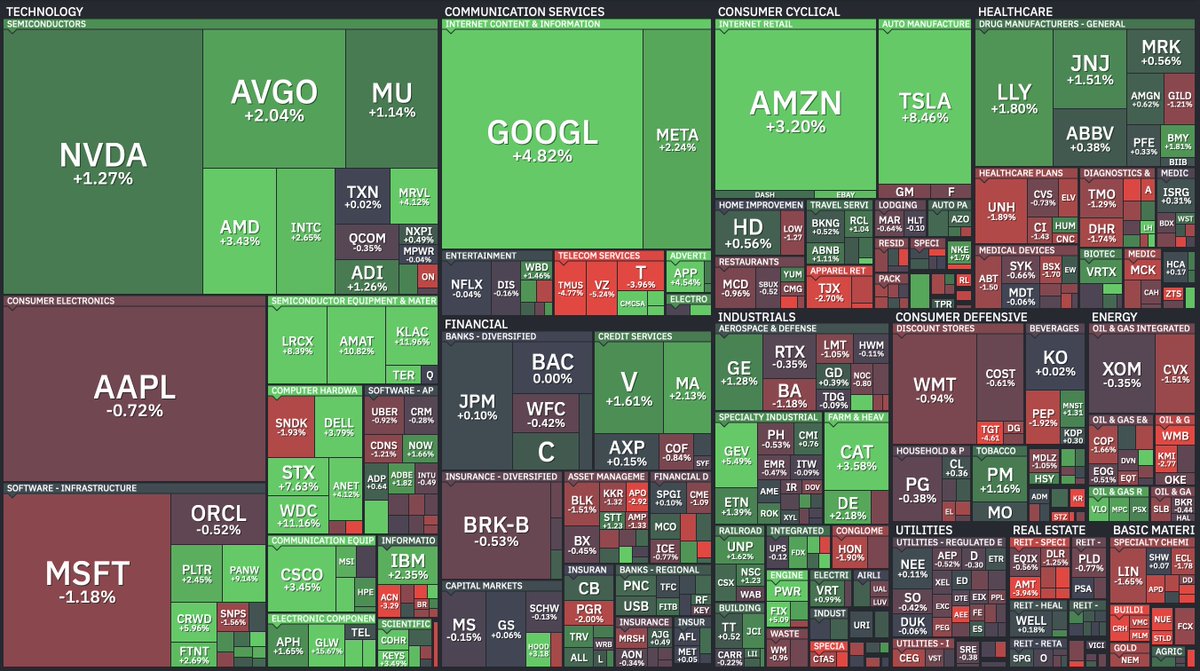
The question that drove semiconductors into a bear market last Friday was whether all those chips are really needed. On Tuesday $NVDA said its next-generation system, Vera Rubin, had entered full production and begun shipping to @OpenAI , $CRWV , Google Cloud, Azure, $META and Dell. The new NVL72 processes ten times more tokens than the prior generation. To a question that doubted demand, the answer came as a product already selling. The Philadelphia Semiconductor Index rose for a second day and the Nasdaq 100 jumped 1.93%.
2. This rebound carried a technical fuel alongside it.
Per UBS prime brokerage, hedge funds cut their long positions in momentum and semiconductor names by an amount equal to about 5% of assets, one of the largest reductions on record. Once the sellers have all sold, the power to fall further disappears, and the market snaps back like a compressed spring on even small good news. Last week's plunge pressed that spring to the floor, and Vera Rubin pulled the trigger. 248 Ventures' Bell said investors who had cut their weight were rebuying semiconductors for fear of missing the move.
3. But a spring is fuel, not direction.
A price snapping back because positioning is empty is a reversal, not fresh conviction buying. Indeed the S&P 500 rose 0.89%, yet advancing and declining stocks were nearly even. What lifted the index was a handful of semiconductor and tech names; the rest of the market stood still. The broad participation that set records last week narrowed again on this day. Whether this snap-back is a one-off short-covering or turns into a real re-rating is now decided by a different judge.
4. That judge arrives on Wednesday.
@Tesla and @Google open the big-tech earnings. What the market watches is not the growth rate but whether the money poured into data centers is coming back as profit, and in particular whether Alphabet's capital-spending plan justifies that spending. eToro's Kenwell said the bar companies must clear with results has itself changed. With expectations raised, merely meeting them is not enough; a company must lift its outlook too for the stock to hold. A rebound that rebuys empty positioning continues only when these earnings hand the baton to conviction buying.
5. And a second judge that could drop that baton sits outside.
Oil rose to a five-week high. As the Houthis threatened to blockade shipping through the Red Sea, two tankers carrying Saudi crude to Asia turned back, and WTI jumped to 84.54 dollars. The futures that were calm last week have begun to react to an actual event, the turning-back of cargo. Trump warned of an immediate response to any real blockade, and Britain approved US use of its bases for operations against Iran. The gap I flagged last week, between a calm surface and a tightening physical market, widened a little more on this day.
6. Higher oil led straight to higher rates.
The 10-year Treasury yield rose to 4.626% and the 2-year to 4.261%. The risk appetite that lifted semiconductors and the rate pressure that oil pushed coexisted on the same day. Gold stands out. Yesterday it fell, pressed by rising rates; today it rebounded to 4,082 dollars on bargain-buying amid Middle East tension. The headwind of rates and the tailwind of geopolitics contest each other day by day, which shows why gold is a hedge and not a core holding. It is insurance that pays only when the tail actually comes alive.
7. Meanwhile, beneath all this news, the bottleneck is shifting one notch.
As the demand question eased, the next question becomes what will power all those chips. The Trump administration prepared a 200-million-dollar nuclear program joined by Oklo and X-energy, with Microsoft and Nvidia also on the list. The Energy Department sees a need for 300 gigawatts of new nuclear by 2050. It follows growing concern that data centers, as they multiply, are pushing up electricity bills. Where the question of whether chips are needed has quieted, the question of where to find the power to run them is moving in.
8. In the end, Tuesday sent two opposite signals at once.
Inside, Vera Rubin and emptied positioning pushed semiconductors up; outside, oil and rates pressed the whole market down. The narrowed breadth and the widened oil gap say this rebound is still a rebound on trial.
■ How I read the market
I now regard the demand-collapse scenario for semiconductors as over. Vera Rubin has entered full production and is selling to major customers, and TSMC has signaled a 2027 price hike, so demand is confirmed in the physical. My read last week, that the worst for semiconductors had passed, was proven by a two-day surge. But this day's gain is not broad conviction; it is a narrow rebound of record-empty positioning snapping back. So I agree with the direction of the rebound but withhold judgment on its quality. The decisive variables are Wednesday's Alphabet and Tesla earnings and oil at a five-week high. If earnings clear the raised bar and lift guidance, the short-covering turns into conviction; if they miss or oil runs toward a blockade, the narrow rebound reverses. I lean bullish, but carry only half the weight until the twin judges of earnings and oil confirm it.
■ Positioning
Continue the staged re-add into the rack-scale winners I began last week. The Vera Rubin ecosystem, meaning Nvidia and the customers adopting it, HBM and networking, and now power, is the center. But do not chase the narrow, fast rebound that empty positioning created; add in tranches, leaving Wednesday's earnings gate ahead. With oil at a five-week high, keep energy exposure and a cash buffer intact, and hold gold thin as a hedge only. As the bottleneck moves from chips to power, add nuclear and electricity infrastructure as new structural beneficiaries to the watch list. As for scenarios, if Alphabet and Tesla prove the spending converts to profit, quicken the re-add; if earnings fall short of the raised bar or the Houthis force a blockade, step back into defense and cash.
■ What to watch
- Wednesday's Alphabet and Tesla earnings: whether data-center spending returns as profit, and whether Alphabet's capex plan justifies it. It is the only baton that turns short-covering into conviction.
- Oil and the Red Sea: whether the Houthi blockade threat hardens into an actual cutoff, and whether WTI at 84 heads toward triple digits.
- Market breadth: whether the leadership that narrowed back to semiconductors widens again, or the index rides on a handful of names.
- Rates: whether higher oil pushes the 10-year past the mid-4.6% area and reverses risk appetite.
- The power bottleneck: whether the Energy Department's AI energy summit and the nuclear program open a new investment axis after chips.
US Market Commentary | 7.20.2026
1. Nine straight days of strikes, and oil managed only a small gain.
Even as the US hit Iran for a ninth day, Yemen's Houthis declared a blockade of Saudi shipping, and Trump warned Iran would pay for the strike on the Jordan base that killed two US soldiers and left one missing, WTI rose only into the low 80s. Oil shrugged off half of all that bad news because, before the open, Iran's foreign ministry hinted at a diplomatic solution and mediators delivered a 10-day ceasefire proposal. Between the two scenarios, escalation and diplomacy, the market bet on diplomacy.
2. That bet is one fork of the path I split out last week.
Last week I divided it in two: one rung higher and the oil premium turns into a real supply shock; Iran turning to talks and oil calms instead. Monday was the day those two forces collided within a single session. Trump's threat of retaliation and the Houthi blockade pulled up, Iran's diplomatic signal and the 10-day ceasefire pulled down, and oil finished with a small gain in the middle of that tug of war.
3. But the market's bet on diplomacy was not free.
The moment oil rose even a little, bonds sold off. On fear that energy costs could stir inflation again, the 10-year Treasury yield jumped to 4.594% and the 2-year to 4.211%, and the dollar index rose to 100.977. The S&P 500 gave back all its early gains and fell 0.19%. And while the futures price was held down by hopes for diplomacy, the physical market was already tightening: shipping traffic through Hormuz fell sharply and US gasoline crossed 4 dollars again. That gap, between a calm futures price and a physical market already stretched, is the weak link in the bet on diplomacy. Even though oil managed only a small gain, that small gain pushed up rates and pressed the index down. The channel I traced last week, from oil to prices and from prices to rates, worked exactly as drawn.
4. What stands out is that gold fell instead.
Even with the war escalating, gold slipped to 4,011.8. The usual reflex, in which geopolitical fear lifts gold as a haven, was this time overwhelmed by higher rates and a stronger dollar. When real rates rise, the opportunity cost of holding gold, which pays no interest, grows. That adds a footnote to my call last week to layer gold on as a war hedge: in a rising-rate regime gold's geopolitical premium is often offset, so use it as a hedge but do not lean on it too hard.
5. Meanwhile the semiconductors that fell into a bear market last week rebounded.
The Philadelphia Semiconductor Index rose 0.6% and Micron jumped nearly 2%. The very logic by which the weekend's @SemiAnalysis_ rebuttal and Chey's demand outlook broke the base of the Kimi K3 fear was confirmed in prices. On top of that, $TSM reaffirmed years of strong AI demand and $MSFT agreed with $AMD to bring next-generation chips into Azure at scale, so the rebound was backed not by one stock's technical bounce but by a confluence of evidence that demand is alive. My read last week, that the worst case for semiconductors, a demand collapse, had passed, got its evidence within a day. The demand fear was overdone.
6. And yet inside those same semiconductors a new question opened.
Alphabet rose on reports that Google is developing its own server chip integrated with Gemini. Meant to lift AI efficiency and ease the compute shortage, it revives the old question of whether Nvidia's biggest customers, by making their own chips, could turn from customers into competitors. Apple abandoning Intel for its own silicon is the shadow behind it. But that analogy has a limit. Unlike Apple, the hyperscalers still need Nvidia for frontier-model training and for the merchant market, and their own chips are used mostly for internal inference. It gnaws at the moat but does not topple it.
7. All these questions come to a single test this week.
Alphabet and Tesla report second-quarter earnings on Wednesday, with Intel and IBM to follow. The market expects S&P 500 earnings to have grown 26% from a year ago. But the real focus is not the growth number; it is whether the enormous spending companies poured into AI infrastructure is coming back as actual profit. Edward Jones' Wymer read the recent tech pullback as profit-taking plus a reassessment of whether that spending can continue. Whether the tech sector, down 9% since June, can justify that spending with this week's earnings is the crux.
8. So the market's test this week grew from one to two.
If the question that dominated the index through last week was war alone, Monday laid a second test on top of it: earnings. War is decided between diplomacy and escalation, earnings between whether AI spending converts to profit. That the two tests fall in the same week is exactly the condition that magnifies volatility in a thin market, with summer volume running 20% below its 30-day average.
9. In short, Monday was not the day tail risk disappeared but the day it moved onto the negotiating table.
Oil rose only slightly, pressed down by diplomacy, and semiconductors rebounded past their demand fear. But as long as Trump's threat of retaliation and the Houthi blockade remain alive, the bet on diplomacy can be overturned at any time. The market simply bet on the good side; it did not end the problem.
■ How I read the market
Monday was the day both scenarios I split out last week flickered within a single session. Iran's diplomatic signal and the 10-day ceasefire pressed the oil tail down, so the "Iran turns to talks" side prevailed, and semiconductors rebounded as proof the demand fear was overdone. Both confirm last week's read: the worst for semiconductors has passed, and oil is the headwater variable for the index. Yet the index still fell, because even oil's small gain pushed up rates and pressed the market. So tail risk has not vanished; it is being managed on the negotiating table, and the market's test this week grew from war alone to war and earnings. The decisive variables are those two tests. If Iran's diplomacy hardens into a ceasefire and Alphabet and Tesla prove AI spending converts to profit, the semiconductor rebound sets into a rotation; if either fails, defense is right again.
■ Positioning
Ease last week's defensive stance a touch, but do not drop it. With the semiconductor rebound confirmed, begin re-adding in stages into the rack-scale winners SemiAnalysis named. This is the trigger of the "re-add if Iran turns to talks" scenario I set last week. But with Trump's retaliation threat and the Houthi blockade still alive, keep energy exposure and a cash buffer. Recognize that in a rising-rate, stronger-dollar regime gold's geopolitical hedge is limited, and do not lean on its weight. Do not rush the expensive spenders before earnings; instead, weight energy, where higher oil is itself the earnings, and quality that proves itself in results. As for scenarios, if the ceasefire hardens and earnings are strong, widen the re-add into the spenders and semiconductors; if Trump's retaliation spikes oil or earnings fail to justify the spending, step back into defense and cash.
■ What to watch
- Iran diplomacy versus Trump retaliation: whether the 10-day proposal hardens into an actual ceasefire, or retaliation for the Jordan base strike pushes oil back up.
- Alphabet and Tesla earnings (Wednesday): whether AI infrastructure spending is turning into real profit. The conversion matters more than the 26% growth number.
- Oil and rates: how far oil's small gain pushes the 10-year toward the mid-4.6% area, and whether bond weakness trips the index.
- The fallout from $GOOGL own chip: how much custom silicon gnaws at Nvidia's moat, and whether the semiconductor rebound holds.
- The thin summer market: whether volume 20% below its 30-day average magnifies volatility in a week when two tests overlap.
US Market Commentary | 7.17.2026
1. This weekend the market traded one worry that eased for one that is growing.
What drove semiconductors into a bear market on Friday was a demand doubt inside AI, and over two days that doubt largely resolved. But what filled its place is neither quieter nor smaller. The US-Iran war is climbing the escalation ladder rung by rung, and Brent crude crossed 90 dollars in Monday's Asian session. It was a weekend that swapped a resolved micro risk for an escalating macro one.
2. Take the resolved side first: Friday's fear stood on a weak base.
The Philadelphia Semiconductor Index fell 20% from its peak into bear territory on a single blow from China's @moonshot and its Kimi K3. Told that frontier-grade performance is possible with far less compute, the market recalled last year's DeepSeek and sold on the fear that chip demand may be smaller than assumed. The Nasdaq 100 fell 1.49% and the S&P 500 dropped 1.01% to 7,457.69.
3. The weekend answered that fear with an old counterexample.
It is Jevons's 1865 observation that as efficiency improves, consumption rises rather than falls. SemiAnalysis made exactly that case. Kimi K3, holding 2.8 trillion parameters, needs more than 1.5 terabytes of HBM just to store the weights, and to spread that across many chips it requires Nvidia's rack-scale systems and vast networking. The more efficient the model, the more widely AI is used, so demand for GPUs and HBM rises rather than falls. SK Chairman Chey Tae-won, too, warned of a shortage, seeing AI demand surge 60 to 100% next year. On the very weekend demand was doubted, the industry's front line feared the opposite.
4. The trouble is that the fire filling that space is far harder to handle.
In the US-Iran war two US soldiers were killed in Jordan, and the strikes spread beyond military sites to civilian infrastructure like Kuwaiti power plants and US assets in Qatar. That US blood was shed and civilian infrastructure became a target means this conflict has already climbed high on the escalation ladder. Each rung raises the odds of the next, so the current position is itself the measure of the risk.
5. The true detonator of this war is Hormuz.
If that narrow passage, through which a fifth of the world's seaborne oil moves, is closed, oil could leap not to 90 dollars but into triple digits. Today's 90 dollars is not yet a blockade but the price fear of one has set. What the market has priced is not the event but only a risk premium, and one more rung up the ladder turns that premium into a real supply shock. If the demand doubt on semiconductors was a matter of days, an oil supply shock is of a different force.
6. Worse, this shock collides head-on with a Fed already leaning hawkish.
Higher oil lifts prices, prices lend weight to hawks like Hammack and Logan, and that drives next week's July 29 meeting, the first FOMC of the Warsh era, toward a fight. A supply-driven price shock meeting a central bank that wants to tighten is the combination history fears most. When the 1973-74 embargo quadrupled oil, the Fed was trapped between inflation and recession and could save neither. Unlike then, today's US, with shale and lower oil intensity, takes far less of the same barrel shock. The real-economy hit would be shallower, but the Fed's dilemma, unable to cut rates in the face of oil-driven inflation, is unchanged.
7. And yet the market's surface is strangely calm.
The VIX, at 17.87, looks placid, but expected volatility in individual names has widened to a record gap. It means that while the index is quiet, inside it a historic rotation is under way, selling the leaders and buying the neglected. Michael Burry adding Nvidia puts, too, is a bet aimed not at demand but at five years of margin and valuation. The calm on the surface and the churn beneath, and the gap between them, reads closer to a signal that the market has not yet priced the geopolitical tail.
8. This is not to say the war means an imminent all-out conflict.
Room remains for Iran to return to the table, and oil could settle within a day. With 90% of reporting companies beating and consumer sentiment at a five-month high, the body of the economy is still sturdy. But that very sturdiness breeds complacency. Before a risk that is low in probability but large in loss, asymmetry always favors the cautious side.
9. So the center of gravity this week is not the direction of the index but the management of this tail risk.
The resolution of the semiconductor demand doubt is a welcome micro relief, but that relief does not offset the macro risk of oil and war. The pressure point has moved from inside AI to outside it, and the outside is larger and harder to price than the inside.
10. In the end this weekend took an easier question off the table and handed the market a harder one.
Whether the chips are needed has an answer; how far the war will climb has taken its place.
■ How I read the market
It is true that the worst case for semiconductors, a demand collapse, passed over the weekend, as SemiAnalysis's rebuttal and Chey's demand outlook broke the base of the Kimi K3 fear. But the risk that dominates the market this week is no longer AI; it is a US-Iran war climbing the ladder. US casualties and strikes on civilian infrastructure are already high rungs, and if Hormuz closes the 90-dollar oil premium turns into a real triple-digit supply shock. That supply-driven price shock collides with a July 29 FOMC already leaning hawkish, creating the stagflationary dilemma of a Fed unable to cut into oil inflation. That is the worst combination. The calm of a 17.87 VIX reads as relief that has not yet priced this tail. So I shift weight from last week's healthy rotation to the asymmetric downside of an underpriced geopolitical tail, and turn defensive. The decisive variable is whether the war climbs another rung. A Hormuz closure and regional escalation is the line between a contained premium and a real shock.
■ Positioning
Raise cash and defensives more decisively than last week. On top of energy exposure, add gold as both a safe haven and an inflation hedge, to cover war and oil at once. Cut high-beta, expensive exposure. Even with the demand fear off semiconductors, this week the macro tail outweighs the micro relief, so do not rush to add them. Keep quality and asset-light beneficiaries that prove themselves in earnings, but take gross exposure itself down a notch to shrink the blast radius. As for scenarios, if the war climbs another rung and Hormuz closes or US involvement deepens, oil jumps into triple digits and a broad flight from risk follows, so go defensive hard and hold cash high; if Iran turns to talks and oil calms, re-add in stages into the rack-scale winners SemiAnalysis named and into the market's broadening.
■ What to watch
- The Strait of Hormuz: whether it closes is the single biggest oil trigger. It is the line between 90 dollars and triple digits, and the headwater of prices and rates.
- The escalation ladder: the scale of further US casualties and retaliation, and whether strikes on civilian infrastructure spread across the Gulf.
- Oil: whether Brent's 90 dollars stays a fear premium or heads toward triple digits on real supply disruption.
- The July 29 FOMC: whether the oil shock forces the hawks' hand, or paralyzes the Fed between inflation and recession.
- The VIX and market breadth: whether the surface calm finally wakes and prices the tail, and whether the rotation underneath turns defensive.
US Market Commentary | 7.16.2026
1. On the very day the Nasdaq 100 fell 1.6%, the S&P 500 equal-weight index set a fresh record high.
That contradiction, the top collapsing and the base printing a record inside one market, is the whole of the day. $TSM grew net profit 77% and semiconductors fell anyway, and the money that left them flowed into the rest, lifting the broad market to an all-time high. The S&P 500 slipped 0.51% to 7,533.77, yet most of the stocks inside it rose.
2. The most symbolic scene was TSMC.
Quarterly net profit jumped 77%, and the stock was pressed down anyway. Perfection was already in the price of a group up 70% this year. The wall of expectations that sold Samsung last week even after a record result has now spread across the whole of semiconductors. That even a record is not enough means the problem lies not in the earnings but in the price put on them.
3. But the money that left semiconductors did not leave the market.
Of the S&P 500 companies that reported this week, 87% beat expectations, and riding that strength the money flowed into banks, health care and cyclicals. The equal-weight index setting a record says the rest of the market, minus a handful of AI generals, is healthier than ever. This is not a collapse of the market but a rotation emptying one crowded corner.
4. The picture of a narrowing top and a broadening base was nailed to a record today.
Even as a few names dragged the index down, weight each stock equally and the market rose. The wider that gap, the more the decline looks like the unwinding of one theme's overheating rather than a systemic crisis. The bull market is leaving its priciest seat to move to a wider one.
5. Yet today two new cracks were laid over that rotation.
The first is the counterattack of the Fed hawks. Governor Logan argued a further hike is needed, saying inflation does not look like it is returning to target, and President Schmid called inflation the biggest concern. The door Chair Warsh tried to close yesterday, saying he does not view AI costs as inflation, the governors threw back open. And what they pointed to was exactly the self-consuming loop: that AI, by lifting chip demand beyond supply, becomes inflation.
6. This counterattack hurts the spenders in particular.
If the hawks win, rates rise, and higher rates cut most from the valuation of semiconductors, whose payoff sits furthest in the future. If Warsh's dovish tone yesterday took one whip out of the hand aimed at the spenders, today the governors gripped it again. Which side wins this rift between chair and governors will set the timing of the spenders' rebound.
7. The second crack came from China.
@moonshot released Kimi K3, an open-weight model of 2.8 trillion parameters, raising the hope that frontier-grade performance is possible with far less compute. That is a question aimed at the base of the spenders, that chip demand itself may be smaller than assumed. But this fear has an old counterexample. In 1865 Jevons observed that as the steam engine grew more efficient, coal consumption rose rather than fell, because a cheaper resource is used far more widely. If running AI grows cheaper, the places that use AI could explode, so chip demand might rise rather than fall. Yet that counter holds only when efficiency widens the market faster than it cuts per-unit demand.
8. The wall of expectations is a problem that time, by digesting, resolves.
But the hawks' rates and the efficient model's demand question are of a different nature. One aims at the spenders' valuation, the other at the spenders' demand premise. That today's fall in semiconductors went beyond the simple froth-shaking of the past days is because these two questions landed together, for the first time, on the same day. A valuation can lower its bar with a few weeks of correction, but if the demand premise wobbles, the whole capex narrative that justified the price on the spenders must be rewritten. That is why the market is inclined to doubt semiconductors not for days but for longer.
9. Even so, the day's foundation did not give way.
Some 87% of earnings beat, the Philadelphia manufacturing index leapt to more than three times its forecast, and initial jobless claims fell. Consumption and labor showed no cracks. As the equal-weight record says, the body of the bull market is sturdy outside semiconductors. Today's fall happened not in that body but in the head that had run furthest ahead.
10. In the end, the market spoke in two directions at once.
The broad market signaled strength with a record, and semiconductors signaled a triple squeeze with a plunge.
■ How I read the market
The bull market is not breaking; it is broadening. On a day the equal-weight index set a record and 87% of earnings beat, the fall in the index is closer to a healthy rotation emptying one crowded corner of semiconductors. So I stay favorable on the index and the rest of the market. But the fall in semiconductors is not simple froth-shaking. On top of the expectations wall, two new headwinds landed on the spenders alone today: the rate pressure the Fed hawks revived, and the demand question China's Kimi K3 raised. The advance continues outside semiconductors, but I still read semiconductors as a falling knife. The decisive variable is the fallout from Kimi K3. Whether the efficient model truly cuts chip demand or instead widens it is what separates this decline into a rotation or a re-rating.
■ Positioning
Ride the broadening. Lean toward the rest of the market that proves itself in earnings, banks, health care and cyclicals, and toward the asset-light beneficiaries, and do not rush to buy the dip in the pure spenders (memory, semiconductors, equipment) despite the drop. Until the three headwinds of expectations, rates and demand doubt lift, approach only after confirming a rebound. Keep tracking the Kimi K3 aftershock; if efficiency proves to widen demand rather than shrink it, weight can return to the spenders. Oil eased slightly today despite the blockade, but keep a thin energy and cash buffer. As for scenarios, if the broad market holds its record and semiconductors stabilize, treat it as rotation and re-add the spenders in stages; if the hawks win and rates rise while the Kimi K3 fear compounds, cut risk and raise cash.
■ What to watch
- The Kimi K3 fallout: whether the efficient-model fear spreads or fades within a day. It is the trigger for a spender re-rating.
- The breadth of the equal-weight index: whether the record run of the rest of the market continues, the health check on the rotation.
- The Fed hawks versus Warsh: whether Logan and Schmid's case for a hike overrides the chair's dovish tone.
- Next week's big-tech earnings: whether the beneficiaries justify their premium, or the decline spreads from semiconductors to the whole AI complex.
- Oil and the Iran blockade: whether the disruption to transit pushes oil back up and stirs prices and rates.
US Market Commentary | 7.15.2026
1. Even as inflation cooled for a second straight day, the market did not rise in one direction.
The split between spenders and beneficiaries, telegraphed over the past several days, finally surfaced on the index itself. Semiconductors fell 2.1% and Micron dropped 8%, while Apple rose 4% to a fresh record high. The S&P 500 gained 0.38% to 7,572.40, yet the Nasdaq 100 fell 0.28% to 29,502.60. The market read the same news of cooling prices in opposite ways from one stock to the next.
2. Money moved from the side that spends on AI to the side that earns from it.
It drained out of memory and equipment, the spenders who bury capital in plant, and flowed into asset-light platforms like $AAPL , $AMZN , $GOOG and $MSFT that harvest profit atop that infrastructure. That the most rate-sensitive group, semiconductors, fell even as prices cooled and yields dropped (the two-year to 4.14%) says this move is not only about rates.
3. The axis of the split is not the size of the spending but the returns that come from it.
The spender pours capital out first and hopes to recoup later, so until the recoupment is proven, only the higher costs and the debt are visible. The beneficiary, by contrast, rents that infrastructure and shows results now, in revenue and margin. If IBM's 25% plunge yesterday was the invoice of the spending pile-up, Apple's record high today was the premium of the side that never receives that invoice.
4. The heaviest stamp on that premium came from Warren Buffett.
He said he personally led Berkshire's purchase of Alphabet. The man who has always bought low-capital toll businesses chose not the company building AI data centers but the one collecting the toll of search and advertising on top of them. In the gold rush, he bought the side that set up a tollgate on the road rather than the side selling picks. Yet the analogy has a limit. Google is itself a heavy AI spender, so Buffett's bet is not the crude spender-versus-beneficiary line but a finer one between the spender who earns enough to carry the spending and the spender who does not yet.
5. And yet today the market itself removed one leg from under this split.
Chair Kevin Warsh drew a line, saying the rise in AI infrastructure costs does not necessarily lead to broad inflation. Because supply can rise with demand, he said, he does not view these one-off price changes as inflation. That runs head-on into Governor Waller naming AI as a new source of inflation only the day before. Inside the Fed, the governor stands hawkish and the chair on the opposite side.
6. This reversal is not trivial.
One of the arguments that had weighed on the spenders was the self-consuming loop of AI spending to prices to rates to valuation, and the chair just denied its first link. If AI cost is not broad inflation, the rate whip aimed at the spenders weakens accordingly. That the split did not stop even so is because the spender's problem is not inflation alone but the not-yet-earning itself. That the divide survived the loss of one of its supports shows how structural it is.
7. On the same day, Larry Fink moved the bottleneck somewhere else entirely.
The real problem, he said, is not a bubble but a power grid that cannot keep up with explosive demand. Even 1 trillion dollars from six big tech firms is not enough, and a single 1-gigawatt data center costs 50 to 60 billion. Over the past weeks the bottleneck has wandered from demand to manufacturing to expectations, and today power took the seat. When electricity remade industry in the early 1900s, what was actually scarce was generation and transmission, and those who held that scarce infrastructure collected the rent. Unlike then, though, today's power bottleneck can be solved with a few years of building, so it is less a permanent moat than a temporary gate.
8. Fink's diagnosis dovetails oddly with Warsh's.
The same fact, that supply is short, Waller read as inflation and Fink read as strength. A shortage lifts prices, so it is inflation, and at the same time it is profit for the supplier who commands those prices. So memory's strength is at once the evidence of the shortage and the spenders' lifeline, yet even Fink said the price hikes could stabilize in three to four years. Memory falling today is the moment the market first put a question mark on the durability of that lifeline.
9. The floor under all this relief, meanwhile, is still oil.
What pulled prices down for two straight days was energy, and that oil climbed back to 80 dollars today, a one-month high, after President Trump warned he would intensify airstrikes until Iran opens Hormuz. If the very piece that cooled prices has already begun to turn the other way, this week's disinflation can be undone in next month's data. The foundation of the number the market celebrated is shaking.
10. In the end, the market spoke today not through direction but through the split inside it.
Prices cooled and the chair leaned dovish, but the warmth did not fall evenly on all.
■ How I read the market
For the index as a whole, this is a place where the advance can continue. Prices cooled two days running, Chair Warsh sheathed the hawkish blade by drawing a line under AI-driven inflation fears, and earnings are firm. But the main current of this advance is not the direction of the index; it is the change of leadership within it. Money is moving from the side that spends on AI to the side that earns enough to carry that spending, and Buffett's Google purchase stamped that shift. I read it as an advance, but a narrowing one in which the pure spenders are left behind. The decisive variable is oil. If oil climbs again, today's disinflation floor gives way and the split can spread into a decline.
■ Positioning
In principle, lean toward the asset-light beneficiaries that earn from AI, the platforms, software and big tech, and stay wary of the pure spenders that have not yet proven recoupment, memory, the neoclouds and equipment, on both weighting and duration. Widen the lens to the next bottleneck Fink named, power, the grid and utilities, because the resource that grows scarce gains the power to set prices. Keep a thin buffer of energy exposure or cash as oil climbs again. As for scenarios, if Thursday's retail sales and the TSMC and Netflix results come in strong, ride the broadening of beneficiary-led strength into cyclicals; if oil spikes again and reverses the price relief, raise defensives and cash.
■ What to watch
- The direction of oil: if WTI's 80 dollars climbs further, two days of disinflation are undone and today's relief flips.
- TSMC, Netflix and June retail sales: whether the beneficiaries confirm the split in earnings too.
- Memory prices: whether the spenders' lifeline holds, or the price drop that CoreWeave's put options point to becomes real.
- The Warsh-versus-Cook-and-Waller rift: whether the chair's dovish tone outweighs the board's hawks.
- The power and grid bottleneck: whether the next gate Fink named emerges as new leadership.
US Market Commentary | 7.14.2026
1. The market cheered that inflation had cooled. But it cooled for the wrong reason, oil, while the reason to worry, AI, went untouched.
And the biggest single move of the day, IBM down 25%, was caused by that very AI dynamic. As the market celebrated the easing of a symptom, the disease deepened in plain sight. The S&P 500 rose 0.38% to 7,543.59 and the Nasdaq 100 1.10% to 29,586.29.
2. On the surface the number was clearly good.
June consumer prices fell 0.4% from the prior month, the first negative in six years, and the annual rate came in at 3.5%, well below the 3.8% expected. Odds of a Fed hold in July jumped from 58% to 83%, and short-dated Treasuries rallied. JPMorgan, opening earnings season, rose 2.5% on a record profit, and Goldman Sachs gained 9%.
3. Yet unpack why prices cooled and the relief looks shallow.
The drop was led by energy, down 5.7%, and gasoline in particular, down 9.7%. Core prices were flat on the month. In other words, this is a backward-looking number made by oil. And oil fell only because President Trump withdrew his Hormuz toll, while the airstrikes and blockade continue and Brent still sits near 85 dollars. The market is leaning on the most volatile and most easily reversed piece of the index. Energy is the noisiest line in the price data, which is why the Fed always reads the trend through core, with energy stripped out. A headline made by a single plunge in oil does not change the direction. Just as oil surging two months ago pushed the headline up, this month's drop can flip the other way next month.
4. Chair Warsh named that shallowness precisely.
In his first congressional testimony he said today's CPI is only one data point and that he does not regard price stability as achieved. He warned in particular that the AI supply shock is arriving faster than expected. The Fed is looking, beneath the headline that oil pulled down, at the structural inflation that AI is pushing up.
5. The evidence of that structural inflation jumped out of $IBM that day.
Its chief executive blamed the weak results on customers pouring capital spending into securing servers, storage and memory ahead of price hikes and shortages, which pushed mainframe and software spending to the back of the line. The price pressure from AI that Waller had named in words the day before was seen, in numbers, on one company's income statement. What deserves attention is that this was not IBM being incompetent. In the same results Red Hat revenue rose 11% and distributed infrastructure grew 37%, which says this is not one firm's weakness but a wholesale change in where the money flows. The wave of AI capital spending is reallocating the budgets of an entire industry.
6. Two things overlap in IBM's single sentence.
One is that the shortage feeds inflation on its own: when customers stockpile ahead of price hikes, demand is pulled forward, the shortage worsens, and prices rise again. The other is crowding out: spending toward AI infrastructure has grown so large that it has begun to eat other IT budgets. IBM is the first casualty of that cannibalization. And this crowding out reaches beyond a single firm. If AI infrastructure absorbs the whole economy's capacity to invest, that may not be growth expanding in total but growth crowding into one place. Warsh's wish that growth spread beyond tech and AI into agriculture and housing is another expression of the same worry.
7. The invoice has arrived.
Only weeks ago the cost of AI was an abstraction about redistribution. Today IBM turned it into a single line on an income statement. The self-consuming loop that yesterday's commentary drew, in which AI spending presses on itself through prices and rates, did not stay theory. It printed as a 25% loss in a single day. Weeks ago Micron charged more and Apple passed the cost to consumers; this time IBM paid it in earnings. AI's invoice keeps being delivered, down the chain, to the next address. But the chain is not automatic. At each link, whether the cost is absorbed or passed on depends on that firm's pricing power, so the one who cannot pass it on, as IBM could not, is left holding the invoice. Where the invoice stops is what separates winners from losers.
8. The day's split reaffirmed the divide between the AI that spends and the AI that earns.
The asset-light banks soared on strong trading, while IBM, caught between old IT and the wave of AI capital spending, collapsed. The semiconductor spenders rose too, but on rate relief, a shallow and rate-sensitive bounce. The structural question, whether they are spending into an inflation they themselves stoke, remains unanswered. That the banks rose is no accident either. Market volatility swells trading revenue, and banks stand on the side that lends into the AI ecosystem without carrying the weight of its capital spending. The breadth of the beneficiaries is widening beyond semiconductors.
9. So today's relief is conditional.
It holds only while oil stays low and core prices stay quiet, and the first is shaken by Iran while the second is threatened by the AI shortage. Wednesday's producer prices are the place to see, before it reaches the consumer, whether that AI-driven inflation is building at the production stage. Producer prices sit upstream of consumer prices, so when the cost of parts and equipment rises, it shows here first. If today's consumer prices smiled thanks to oil, tomorrow's producer prices will speak more honestly about how far the shortage of memory and servers has spread through the pipeline.
■ How I read the market
Today the market read a falling price number as an all-clear, but it fell on oil, which can reverse, while the structural inflation, the AI supply shock, is untouched. So the main story now is less the direction of the index than the split forming inside it between spenders and beneficiaries. The advance can continue for a while, but I read it as a reshuffling in which leadership narrows. The decisive variable is whether this week's producer prices confirm the AI-driven inflation upstream.
■ Positioning
In principle, lean toward the asset-light side that earns from AI, the banks and software and platforms, and stay wary of the pure spenders, memory and the neoclouds, on both weighting and duration. Because rates are the premise of this relief, avoid crowding into long-duration growth alone, and keep a thin buffer, energy exposure or cash, against a fresh oil spike. As for scenarios, if Wednesday's core producer prices come in hot, tilt further toward defensives and beneficiaries against a rebound in rates and a repricing of the spenders; if they come in soft, extend the relief but ride the broadening of leadership into banks and cyclicals.
■ What to watch
- June core producer prices: the first window into whether AI-driven inflation is building in the pipeline. A hot print flips today's relief.
- Whether Brent holds near 85 dollars: if oil climbs again, the very basis of the CPI relief disappears.
- Earnings from ASML, J&J and BlackRock: whether the beneficiary-versus-spender split shows up in individual results.
- The tone of Warsh's second day: whether his guard against the AI supply shock hardens further into hawkishness.
- The spread of the banks' trading strength: whether the breadth of beneficiaries widens beyond semiconductors.
US Market Commentary | 7.9.2026
1. Two weeks ago, when Meta let slip that it might sell surplus compute, a crack ran through the AI trade. Yesterday Meta took the words back.
When Zuckerberg said the company is actually short on compute, the market re-embraced AI and set aside even the guns of the Middle East. The Nasdaq 100 closed up 1.62% at 29,727.10. But the day's real story is not the relief rally; it is that the debate over AI has grown up a stage.
2. The catalysts that lifted the market were clear.
Meta rose 4.7% as it launched its low-cost Muse Spark 1.1 model, and $MU jumped 4.5% on a plan to raise US investment to 250 billion dollars by 2035. SK Hynix's US depositary-receipt offering drew subscriptions more than seven times the allotment. Meanwhile, even as the US and Iran traded blows again, oil and yields fell rather than rose. The market was betting on AI over geopolitics.
3. $META reversal carries weight of its own.
Two weeks ago, the single line that it might sell surplus compute read as a sign Meta had too much, and it lit the fear of AI-infrastructure overbuild. Yet yesterday Zuckerberg nailed it down: compute is not in surplus, there is plenty of internal use, and almost no one in the industry thinks the investment is excessive. He personally put out the fire he had lit the week before. And yet he added that the sums outsiders offer to rent compute are so high that renting some out could be rational, calling it interesting that SpaceX had leased its Memphis data center to Anthropic on short terms at a steep premium. That very contradiction, short on compute yet weighing rentals, is the essence of the transition the market now faces.
4. But the more important change is that the question itself has shifted.
For the past two weeks the market asked whether there was too much compute or too little, a question of how much is spent. Now the question moves to who actually earns money from that spending. As LPL's Jeff Buchbinder put it, it matters less who spends the most and more who shows measurable returns. For the past year the market cheered the capex announcements themselves; a plan to build bigger was enough to push a stock up. But that phase does not last forever. At some point the market begins to ask what comes out of what has been built, and today is the day that question surfaced.
5. Meta embodies that shift in a single body.
It remains the largest spender while, at the same time, weighing whether to rent surplus infrastructure to outsiders and experimenting, through Muse Spark's usage-based pricing, with how to earn from that spend. The company that spends the most is also the first to think about monetizing it. The day's rebound is a trailer for that transition.
6. The shift matters because it moves where the risk sits.
BlackRock's Helen Jewell noted that big tech is funding AI infrastructure from the bond market and that some are seeing free cash flow turn negative. If spending is debt-financed and returns are unproven, who earns is not an academic question but an existential one. The risk has migrated from equity multiples to credit and the balance sheet. A share price falls on disappointment and later recovers, but debt must be repaid when it matures. If spending outruns profit and the gap is filled with bonds, the AI trade's weak point lies not in the volatility of the stock but in the moment credit spreads widen.
7. Here an old shadow falls again.
Around 2000, telecoms laid fiber on debt, and when traffic revenue fell short of hopes, what brought the companies down was not the share price but that debt. AI too is passing from a land-grab phase of build-fast-worry-later into a mature phase that must prove returns. The debt is both the milestone of that maturity and its alarm. Internet demand back then did explode, but line operators like WorldCom and Global Crossing were crushed into bankruptcy by the debt they had piled up before that demand ripened into revenue. That the demand was real did not save the companies that had borrowed against it. What Micron and SK Hynix confirmed today is likewise demand, not the profit that flows from it, and the lag between the two is exactly where the risk lives.
8. That the market set geopolitics aside is itself a statement.
The US and Iran exchanged strikes again, yet as Miller Tabak's Matt Maley said, investors focused far more on the coming earnings season than on geopolitics. The question of how much AI earns now moves the market more than a war in the Middle East. That oil fell rather than rose confirms the priority.
9. Still, this reaffirmation rests on faith.
Last week a single Meta line shook the market; this week a single Meta line soothed it. That is how heavily the market leans on the words of its leaders. Micron's 250 billion dollars and SK Hynix's sevenfold subscription are real evidence that demand exists, but not evidence that money is made from it. That evidence must come from next week's earnings season, in numbers.
10. Today the market stood at the threshold between the age of how much is spent and the age of how much is earned.
So watch whether next week's earnings season shows measurable returns, how far the bond-financing and negative free cash flow of AI infrastructure spread, whether Meta's rental and monetization experiments turn into actual revenue, whether Friday's SK Hynix debut and CXMT's listing reconfirm demand, and when the geopolitics set aside returns to the front.
The question the market asks next is not how big the bet was, but what the bet gives back.
US Market Commentary | 7.7.2026
1. Samsung posted a record result, roughly 19 times a year earlier, and the market sold it.
That one sentence captures the whole day. The pressure point of the AI rally has moved once more, past demand, past manufacturing, to expectations. The Nasdaq 100 fell 1.77% to 29,173.02 and the S&P 500 0.45% to 7,503.85, and a revived oil shock pressed on the market from the other side.
2. The pressure came from two directions.
Inside, Samsung's record was read as a disappointment and semiconductors like $MU weakened; outside, Iran's tanker attack and the US revocation of its Iranian oil sanctions waiver sent WTI up more than 5% in a single day, to 72 dollars.
3. Take the inner wall first: the problem was not that earnings were weak.
Samsung's near-19-fold jump fell short because the market had already priced in perfection. Vital Knowledge's Adam Crisafulli called the reaction a preview of the biggest risk stocks face in the coming weeks. The danger of this earnings season is no longer weak earnings but merely good ones.
4. Expectations are the hardest constraint yet.
If demand is the problem, a company can grow demand; if manufacturing is the problem, it can fix the factory. But the bar the market sets is not something a company can touch. In a market priced for perfection, the payoff is brutally asymmetric: a blowout earns a shrug, and a mere beat is sold at once. This is a hallmark of a bull market's late stage. Just as Cisco topped out in 2000 even after beating estimates, once expectations run ahead of the price, no number is good enough and even great results read as the end of the story. Samsung's reaction is a trailer for the whole earnings season, a risk set to spread from next week's banks to the big tech names.
5. Seen this way, the past few weeks thread into a single story.
It began with doubt about demand, passed through the manufacturing bottleneck that Kyber exposed, and today reached the wall of expectations. The same anxiety keeps finding the AI trade's weak link somewhere new. The market loves this rally and, at the same time, keeps testing where it might break.
6. Yet beneath the index a quiet shift was under way.
Even as semiconductors fell, most S&P 500 names rose. Miller Tabak's Matt Maley said the rotation within tech deserves more attention than the rotation across sectors. Ed Yardeni argued that if the neglected sectors beat, the index as a whole can dodge a correction. While the surface of the index holds, a re-rating of the AI leaders is proceeding underneath it. Such rotation is both a shield that protects the index and a warning that leadership is changing hands. Whether there is a new leader to fill the gap when the handful of AI generals that carried the market this far begin to wobble becomes the question for the second half.
7. The second pressure came from outside, from oil and geopolitics.
When Iran attacked a Qatari tanker near Hormuz, the US abruptly revoked its Iranian oil sanctions waiver, and crude jumped at once. After the close, the US struck more than 80 military sites inside Iran and Iran said it had hit US bases in Kuwait and Bahrain, leaving the June 17 truce at risk of collapse just three weeks on. The oil peace dividend that had soothed the market for two weeks is gone. The Strait of Hormuz carries roughly a fifth of the world's seaborne oil, so tension there spills straight into the tail risk of crude. Precisely because the June 17 truce had pulled oil back to its pre-war level, a breaking of that truce can unwind the move just as fast and as violently.
8. That reversal matters because it strips away the Fed's room.
As oil rose, the inflation worry that had been fading came back. In June's New York Fed survey, one-year inflation expectations jumped to 3.7%, the highest since September 2023, and the 10-year yield climbed to 4.55%. If two weeks ago the oil crash confirmed disinflation and gave the Fed room, today is the opposite picture. The macro tailwind has flipped into a headwind. And oil-driven inflation is the hardest kind for the Fed to handle, because rates that work by suppressing demand cannot bring down prices that come from supply. Hike and you kill growth, cut and you stoke prices; that bind, the seed of stagflation, sits right here.
9. How the market read the shock is told by gold.
Even as geopolitics escalated, gold fell to 4,117 dollars, because yields and the dollar rose harder still. The market took the Iran episode not as a crisis to flee into safe havens but as an inflation shock. That is why stocks, bonds and gold were pressed all at once, an inflation shock rather than a simple flight from risk. It is a sign that even safe havens offer no shelter against inflation, which suggests the shadow this geopolitical risk leaves on the market may run longer than an ordinary crisis.
10. In the end, July 7 was a day of a double squeeze, tightening from inside and out at once.
Inside, a wall of expectations that demands perfection; outside, revived oil and inflation. So watch how Wednesday's first FOMC minutes of the Warsh era meet this re-armed price backdrop, whether the truce's collapse hardens from a one-day spike into a lasting war premium, whether the earnings season that opens with the banks next week can clear a sky-high bar, whether the rotation into laggards keeps the index aloft, and whether the disinflation relief of the past two weeks is truly over. The AI trade's next test is not whether it can grow, but whether it can grow enough to satisfy a market that demands perfection.
US Market Commentary | 7.6.2026
1. All last week the market asked one question: is AI demand real. On July 6 a single report flipped it into another: can we even build it.
Through Nvidia's next-generation server delay rumor and its rebuttal, the debate shifted from demand to manufacturing. The Nasdaq 100 rose 1.26% to 29,697.87 and the S&P 500 0.72% to 7,537.43, but the day's real event was not the direction of the index; it was that the pressure point of the AI rally came into view.
2. The bones of the episode are simple.
Research firm SemiAnalysis reported that the launch of $NVDA next-generation rack system, Kyber NVL144, had slipped more than a year to 2028 because of a manufacturing snag in its multilayer PCB midplane. The system, which binds 144 of Nvidia's most powerful chips into one computer, had been set to carry the Rubin Ultra chips in 2027. On the report, Nvidia's largest customer Ibiden of Japan and Hong Kong's Kingboard fell more than 10% intraday, and when Nvidia countered that its roadmap was intact, the shares erased their losses and turned green.
3. The nature of this shock has to be read precisely.
Kyber's bottleneck is not a demand problem. It is a physical manufacturing one, a special PCB that cannot yet be mass-produced. If the fear that weighed on the market through last week was whether demand exists to justify all the capital poured in, this episode revealed the opposite worry: whether, even with demand, it can be built in time. The binding constraint of the AI story has moved from demand to supply.
4. That distinction looks minor but is decisive.
When demand is the constraint, the risk is a bubble, overbuilding into demand that will not show. When manufacturing is the constraint, the risk is the reverse, demand outrunning supply and the roadmap slipping. One is a problem of building too much; the other, of not building fast enough. Depending on which risk the market is watching, the very same decline reads in opposite ways. Most great construction booms in history went this way. Whether the railroads of the 19th century, the fiber networks of 2000 or the power grids of today, the early bottleneck was demand, but over time the bottleneck always shifted to physical infrastructure, to a shortage of the steel to lay track, the cable to string lines, the grid to carry power. AI now stands at that same turning point.
5. What is striking is that this week's story collides head-on with last week's.
Last week's collapse in semiconductor equipment was a demand-side message: the buildout will slow. But what Kyber says is a supply-side message: the buildout is held back by manufacturing capability. If the bottleneck is manufacturing, breaking it takes more investment, not less. The two weeks' narratives sit inside the market, contradicting each other.
6. The evidence says it is supply, not demand, that is stretched taut.
Nvidia supplier Foxconn grew quarterly revenue nearly 40%, and Samsung's second-quarter operating profit jumped to roughly 18 times a year earlier. June's ISM services survey again reported that the memory, copper, aluminum and electrical gear needed to build data centers remain in short supply and rising in price. Demand is real, and the physical supply chain to absorb it is tight. This is not a world where a bubble is deflating but one where a bottleneck is tightening. The high-bandwidth memory that carried Samsung's and SK Hynix's results is itself a hard-to-make, low-yield, supply-constrained product, and it tells the same story. Even when demand overflows, it is in the end the ability to actually produce the volume that decides the profit.
7. Still, Nvidia's rebuttal was reassurance, not proof.
Nvidia only said its roadmap was intact; it neither disclosed Kyber's progress nor confirmed any delay. The market bought back on that single line, a measure of how heavily this rally leans on one company's credibility. In truth, advanced packaging and PCBs have been the quiet binding constraint throughout this AI cycle, and Kyber merely signaled that the bottleneck has climbed one level higher. For the past two years what governed the supply of AI chips was not the chips themselves but the capacity of the advanced packaging that stitches them together, namely CoWoS. Nvidia's volumes were always tied to that packaging allocation. Kyber's midplane shows the bottleneck expanding from the chip to the board that connects an entire rack.
8. Here the competitive stakes rise.
If Nvidia's one-year product cadence is hitting physical limits, the moat no longer lives in design alone; manufacturing execution and command of the supply chain become part of it. And a single stumble in manufacturing opens the door for $AMD and $GOOG . The Kyber delay is a reminder that the hardest part of AI is drifting steadily into the physical realm.
9. So why did stocks rebound.
A supply bottleneck is, paradoxically, a bullish signal for the right names. It means demand is so strong that supply cannot keep up, and the reward flows to those who actually build it, memory, packaging and power. The day's rebound was the market re-reading the constraint from bubble to bottleneck. Yet it rests on thin post-holiday volume, just 71% of the 20-day average, and on one unverified line from Nvidia, so it remains fragile.
10. The question for the second half is no longer only whether AI demand holds.
It now hangs equally on whether the physical supply chain to meet that demand can be built fast enough. So watch whether Nvidia backs its "roadmap intact" with evidence, whether the bottlenecks in PCBs, packaging and power widen, whether the roadmap slip truly hands AMD and Google an opening, whether numbers like
Samsung's keep confirming demand, and whether this rebound survives past a thin sliver of relief.
The next chapter of the AI trade will be written not by demand but by manufacturing.
US Market Commentary | 7.2.2026
1. In one market the Dow set a record high; in the same market semiconductors fell 11%.
The July 2 US session was not one market but two. The Dow rose 1.14% to 52,900.07 for a fresh high, while the Nasdaq 100 dropped 1.61% and the S&P 500 ended flat. That split, running in opposite directions on the same day, is itself the market pulling its bet off AI capital spending and rotating into rate relief.
2. What split the two was the jobs data that landed in the morning.
June nonfarm payrolls rose just 57,000, far short of the 113,000 expected, and the prior two months were revised down by a combined 74,000. The unemployment rate fell to 4.2%, but only because the labor force itself shrank. The cooling in hiring eased the pressure on the Fed to turn hawkish, lifting the rate-sensitive Dow and defensives such as utilities, health care and staples. It was the textbook regime in which bad news is good news. But this logic has an expiry date. Cooling jobs that pull rate expectations lower are the zone where bad news becomes good news, but the moment the slowdown deepens far enough that recession comes into view, bad news turns back into bad news. The figure of 57,000 is still closer to the former, yet it is also clear that the boundary is not far off.
3. Yet in the market's other half a very different drama played out.
The semiconductor index extended its daily plunge to a cumulative 11%, and the epicenter of the drop was not the chipmakers but the semiconductor equipment names. $AMAT Applied Materials, $LRCX Lam Research and $ASML ASML dragged the group down.
4. Why did equipment, of all things, fall the hardest.
Equipment makers sell not chips but the capacity to make chips, namely the buildout. If a chipmaker's earnings depend on the level of demand, equipment revenue depends on the change in buildout plans. In the language of math, equipment revenue is the derivative of capex, its rate of change. So even a hint that buildout growth will merely slow, not decline, is enough for equipment orders to be cut first. This is the highest-beta seat in the entire AI story. History says the same. In the 2018 memory cycle, equipment stocks peaked before the chipmakers and bottomed before them too. Because orders precede production, the market reads equipment as the leading indicator of the capex cycle. The moment the industry's book-to-bill ratio rolls over is the first sign that the buildout fever is cooling, and today's plunge means the market was pricing that signal in advance.
5. The proof is that days ago it ran in exactly the opposite direction.
When Samsung and SK Hynix unveiled 880 billion dollars of investment plans in late June, equipment names surged as the direct beneficiaries. Now the same leverage works in reverse: the moment doubt crept in about whether that buildout will actually be spent, equipment gave back the most. Blackstone's QTS halting a data center development over local opposition and regulation put a visible crack in the idea that planned buildouts always get built.
6. Anthropic pulled the trigger on the re-rating.
The report that Anthropic is in talks with Samsung as the manufacturing partner for its own AI chip read as the largest buyers moving from someone else's silicon to their own. On top of that, Navellier and Associates warned that high memory prices could actually spotlight memory-light AI solutions and that token-based software pricing could push users toward cheaper Chinese versions. Question marks were pinned to several strands of the demand narrative at once.
7. What is striking is that these two markets sprang from the same root.
The weak jobs that lifted the Dow are, turned over, also a sign the economy is cooling. And a slowing economy puts a hairline crack in the premise of limitless demand for AI. In other words, the very data that saved the Dow quietly reinforced the re-rating that crushed the chips. Still, the day's main engine was not a collapse of the narrative but a movement of money, a rotation.
8. So is this a healthy rotation or a re-rating of the AI story.
That the Dow set a record says the market is not broken but reallocating its bets. Savi Wealth's Anshul Sharma called it a possible rotation out of overheated sectors while noting that some re-rating of the AI theme itself is underway too. The two are not mutually exclusive; a rotation can be the first stage of a re-rating. The spring of 2000 was just this. Back then, too, the flow out of tech into so-called old-economy large caps was first called a healthy rotation, but over time it hardened into a re-rating of tech valuations themselves. What separates rotation from re-rating is, in the end, whether the earnings of the theme the money fled can defend its narrative.
9. Helpfully, this reshuffling is happening from a position of strength, not weakness.
The S&P 500 rose 10.2% including dividends in the first half, and since 1980, of the 18 years other than 2026 with a double-digit first half, 16, or 89%, also rose in the second half, by an average of 8.2%. As Tesla's second-quarter deliveries of more than 480,000, well above expectations, showed, the floor of real demand is still firm. The market is not breaking down; it is deciding anew where to place its money.
10. In the end, the Dow's record and the semiconductor plunge are not a contradiction but two faces of the same rotation.
What to confirm from here is this: whether equipment keeps leading the decline as the leading indicator of the capex cycle, whether other buyers follow Anthropic toward in-house chips or reselling and widen the crack in the demand narrative, whether the cooling in jobs becomes a trend that actually moves the Fed, whether the gap between defensives and the AI complex widens further, and whether the strong first half carries into the second as the historical statistics suggest.
The direction of this rotation, invisible in any single index, will write the first sentence of the second half.
US Market Commentary | 7.1.2026
1. On July 1 the US market closed lower, but what matters is not that the index fell; it is who fell and why.
The S&P 500 slipped 0.22% to 7,483.23 and the Nasdaq 100 dropped 1.54% to 29,809.13. Yet within the index most stocks rose, and the drag was confined to semiconductors and AI infrastructure names. The day's real signal was not the decline itself but the crack that a report on Meta's cloud pivot opened in the premise of the AI infrastructure trade.
2. The day distilled into a stark contrast.
$META jumped 9% on a report it is preparing a cloud business to sell surplus AI compute and model access to outside customers. $MU and $SNDK fell about 10% each, while $CRWV and Nebius dropped roughly 13% and 17%. The moment the buyer turned seller, the sellers collapsed.
3. Why did Meta rise while the infrastructure names fell.
The surface reading is that Meta overbuilt compute and its surplus points to oversupply. But the deeper signal is not about supply; it is about demand. The entire AI infrastructure trade rested on the premise of demand that could never be filled. When the largest buyer, the very face of that demand, turns around to resell what it has, it means that premise has cracked for the first time. What is more, if Meta actually begins reselling compute, it becomes one more competitor to pure-rental players like CoreWeave, so doubted demand and added supply strike at once.
4. What is scarier than oversupply is doubt about demand itself.
Excess supply presses prices, but doubted demand shakes a market's reason to exist. That is why memory and the neoclouds fell far more than Meta did. Investors were not reacting to a few surplus chips but to the possibility that the demand narrative justifying all the capital poured into AI infrastructure is wobbling. The reversal of the supply signal that yesterday's commentary warned about arrived first, unexpectedly, from the buyer rather than the supplier. The dot-com fiber networks around 2000 were exactly this. Telecoms raced to lay fiber on the premise of forever-rising internet traffic, but when traffic growth fell short of hopes, what collapsed was not the platforms selling internet services but the infrastructure players who had laid the lines. When the demand narrative wobbles, the ones hurt first and worst are always the infrastructure providers who buried their capital in the ground.
5. The day repriced where power sits in the AI value chain.
The sellers of picks and shovels do not always win. When the number of people buying picks shrinks, the pick merchant falls first. The market put its premium on the platform that holds demand and distribution, not the infrastructure provider that holds capacity. Meta rising while memory fell is a signal that power is shifting from the shovel to the owner of the mine. The platform holds the customer relationship, pricing power and demand itself, while infrastructure capacity is in the end closer to a substitutable commodity. When demand overflows that commodity is worth its weight in gold, but the moment demand is doubted, it is also the first thing to lose its price.
6. Yet this fear collided, of all days, with good macro news.
The US-Iran tentative deal sent WTI down to 68 dollars, back to its pre-war level, and June's ISM manufacturing prices index posted its largest monthly drop since July 2022. Disinflation was confirmed in plain sight. Ordinarily such data is a tailwind for equities.
7. That the index still fell is because the AI crack outweighed the disinflation tailwind.
But the correction was narrow, not broad. Software rose and most stocks gained, while the decline concentrated in the AI infrastructure complex. That means the market is shedding, in a controlled way, the concentration risk in its priciest and most crowded corner. Weight the index by market value and a handful of giant AI names drag the whole down, but give each stock equal weight and the market actually rose. The wider that gap, the more the decline looks like the unwinding of one theme's overheating rather than a systemic crisis. This is closer to a reshuffling than a collapse.
8. From the Fed, Chair Warsh sent a double message.
He offered a dovish signal, saying inflation expectations and risk had come down over the past four weeks, while also nailing down that the AI shock is showing up as a massive capex boom and that current prices are clearly too high. It means the Fed is now formally watching AI capital spending as a macro variable that pushes prices up. The recognition that took root a few weeks ago around the PCE data has now hardened into policy language through the chair's own mouth.
9. Here a double-edged sword emerges.
If AI capex is both the market's engine and a source of inflation, then a slowdown in that spending cools prices and cuts the engine at the same time. If Meta's resale signal is a precursor to that slowdown, it is a blessing for the Fed but a curse for AI infrastructure shareholders. That AI infrastructure broke on the very day disinflation was confirmed is no coincidence; they are two sides of the same coin. Put differently, the correction in AI infrastructure is itself a self-cleansing that eases the Fed's inflation burden, because when the market cools its own overheating, the reason for the Fed to turn hawkish shrinks along with it.
10. In the end, the July 1 decline is not a collapse but the start of a reshuffling.
Five questions now sit before the market: whether Thursday's jobs report holds Goldilocks, whether other hyperscalers follow Meta in reselling spare capacity and widen the crack in the demand narrative, how much further memory and the neoclouds diverge from the platforms, whether oil stays below 70 dollars and cements disinflation, and which way Warsh's next meeting leans between lower inflation risk and prices that are too high.
More than the direction of the index, the shift of power underneath it is the real story of the second half.
US Market Commentary | 6.30.2026
1. On June 30 the US market rose, led by semiconductors, and closed the second quarter as the best quarter since 2020.
The S&P 500 gained 0.79% to 7,499.36 and the Nasdaq 100 rose 1.68% to 30,276.35, both fresh highs, while the Philadelphia Semiconductor Index jumped 3.9% for its best-ever quarterly performance. For the full quarter the S&P 500 rose about 15%. Yet more important than the record itself is that the way this best quarter was built has changed the questions for the second half.
2. Start with the day's rebound.
$NVDA rose 2.6%, $AMD 7.7% and $INTC 6%, and semiconductors pulled the index up. For the quarter as a whole, technology rose 31% to lead every sector, followed by industrials at about 15%. On the surface, this was a quarter that AI and tech led from start to finish.
3. But beneath the surface, leadership had been quietly shifting for a month.
Take the last month alone and technology and AI actually fell, while health care, industrials and financials filled the gap. AI led the quarter, but cyclicals led its final stretch. Edward Jones' Mona Mahajan said that if oil nears its pre-war level and the economy stays firm, this spread of money could keep going. Leadership broadening from a handful of AI megacaps into a wider set of cyclicals is a healthy sign in a bull market.
4. Yet the fact that semiconductors surged again that day shows the handoff is not a straight line.
Even as rotation runs, the AI trade still has the power to snap back. Flows played a part. According to data compiled by Citadel's Scott Rubner, retail investors bought 3.5 times their usual pace on days the S&P 500 fell, making dip-buying their core strategy through the first half. That reflex, treating drops as buying opportunities, kept every pullback short and turned the leadership handoff into a gradual broadening rather than an abrupt break. Yet the reflex has a limit. In a regime where rates trend higher, as in 2022, the same dip-buying kept turning into losses. A strategy of buying every down day works only while pullbacks stay short, and the moment that premise breaks, retail's 3.5-times buying becomes not a line of defense but an accelerator of losses.
5. The rebound's second leg is the resilient economic data.
May JOLTS openings came in at 7.59 million, above the 7.3 million expected, confirming firm labor demand, and June consumer confidence ticked up from the prior month, helped by falling gasoline prices. A Middle East energy spike had eaten into real wages, but resilient spending limited the hit to employment. It was a phase in which good news was good news, feeding straight through to prices.
6. But that very strength immediately bred a paradox.
On the strong data the 10-year Treasury yield jumped to 4.46% in a single day, and Cleveland Fed President Hammack said inflation was still high enough that a rate hike might need to be considered. The sturdier the economy, the higher yields go, and higher yields lift the discount rate that weighs on equity valuations. A phase where good news is good news sits one sheet of paper away from the phase where, once yields cross a line, good news flips to bad. The fourth quarter of 2018 was the archetype. Back then, on a firm economy and a hawkish Fed, the 10-year yield pushed past 3.2%, and good data, by fueling still-higher yields, sent equities down nearly 20% in two months. Because it is the speed of the rise rather than the absolute level of yields that shakes the market, the slope of this move, a jump to 4.46% in a single day, is worth chewing on.
7. Geopolitics is a variable in this equation, not a constant.
The US and Iran halted their strikes around the Strait of Hormuz and resumed peace talks in Qatar. But the specifics of the new talks were not officially confirmed, and Iran reiterated its intent to keep controlling maritime traffic through Hormuz. WTI holding at 70 dollars, a pre-war level, rests on the assumption that these talks go smoothly. Oil is the key that governs real wages, consumption and even the rotation into cyclicals, so if the 70-dollar floor gives way, the whole second-half scenario shakes with it.
8. So what is the real axis that will decide the second half.
Orion's Tim Holland summed up the first half's lesson as this: aside from rates, corporate earnings matter more than anything. Indeed, this year's gains were driven by earnings, not valuation. The 12-month forward P/E actually fell about 10%, while forward earnings estimates jumped roughly 18% from the start of the year. The market rose not because it got more expensive but because it earned more. That distinction matters precisely because of its relationship with rates. A market that rose on higher valuation is easy to break when yields climb, but a market that rose on higher earnings has the stamina to withstand rising rates as long as those earnings hold. In the end the question is whether the pace of earnings growth outruns the pace of the rising discount rate.
9. Whether that earnings power continues will soon be tested.
The next earnings season unofficially opens July 14 with the banks, and the market expects S&P 500 revenue growth of about 12% and earnings growth of 22%. If earnings meet that bar, much of the rise in yields is offset; if they wobble, the higher yields press directly on valuations. If the first half was a time when earnings won the tug of war against rates, the second half is when that contest begins again.
10. To sum up, the record of the best quarter since 2020 is not a finish line but the starting line of the second half.
So what to watch is five things: whether leadership broadens healthily from a few AI megacaps into cyclicals, whether the 10-year yield and Hammack-style hawkish talk cross the line that flips good news to bad, whether oil defends its 70-dollar floor and the Qatar talks progress, whether this week's ADP, ISM manufacturing and Thursday's jobs report stay Goldilocks, and whether the earnings season starting July 14 confirms the 22% earnings-growth expectation.
What built the best quarter was AI and a resilient economy, but the way that success was won has left the second half its homework too.
US Market Commentary | 6.39.2026
1. On June 29 the US market answered last week's AI fear within a single day, and the Dow crossed 52,000 for the first time ever.
As the selling that had crushed AI names last week stopped, dip-buying poured in and tech snapped back in a V. The S&P 500 rose 1.18% to 7,440.43, the Nasdaq 100 gained 2.25% to 29,774.75, and the Dow added 0.59% to 52,182.74. But the real question is not the record high; it is whether this rebound is a reconfirmation of fundamentals or a product of quarter-end and holiday mechanics.
2. Start with what lifted the market.
Communication services, consumer discretionary and technology, the three growth sectors, led the gains. Interactive Brokers' Jose Torres said investors who saw the recent volatility as a buying opportunity drove the move, concentrated in tech. In short, this rebound stands on three legs: conviction, supply and geopolitics.
3. The first leg is conviction, namely dip-buying.
What shook the market last week was the doubt about AI financing that a report on OpenAI's possible IPO delay had fanned. But on Monday $NVDA , $MSFT and @AnthropicAI announced an expanded partnership running the Claude model on Blackwell Ultra GPUs, which partly buried that doubt. The conviction that the AI investment boom will keep underpinning earnings stopped the selling. In a bull market dip-buying is a learned reflex, and the market followed that reflex again.
4. The second leg is a self-fulfilling supply signal, namely the Samsung and SK investment.
When the two memory leaders unveiled plans for roughly 880 billion dollars of chip and data center investment, semiconductors reversed an early decline and equipment names rose with them. The old gold-rush logic, in which the sellers of picks and shovels make money first, was at work again. Yet this mega-investment is a supply signal as much as a demand one. When DRAM prices soared in 2017 and 2018, makers raced to add capacity all at once, and when that supply hit the market together in 2019, memory prices roughly halved and the same companies' profits collapsed. The stronger the conviction that demand is real, the fiercer the race to build, and at the end of that race prices break; that is the old cycle of the memory industry. So the 880 billion dollar figure carries two faces, a tailwind today and a reservation of tomorrow's burden.
5. The third leg is the easing of geopolitics.
The US and Iran agreed to halt their weekend exchange of strikes, and President Trump said talks would resume Tuesday in Doha, Qatar, at Iran's request. The talks that Friday's commentary flagged as this week's biggest variable now have a concrete venue. WTI returned to around 70 dollars and some war premium came out. But the truce still rests on thin ice. As Iran's deputy foreign minister said it would control transit through Hormuz regardless of Oman's participation, the tail of a breakdown has not disappeared.
6. Yet the market itself flagged one crack.
Equity Armor's Joe Tigay and Spartan Capital's Peter Cardillo noted that quarter-end window dressing, the buying of certain names to make fund performance look better, may have contributed to the advance. On top of that, a holiday-shortened week thinned liquidity and amplified moves. In other words, today's price mixes genuine demand with quarter-end cosmetic demand. That is why next week, when the quarter turns, is the real test of this rebound.
7. The Dow's 52,000 record also hides a structural cause.
That day Alphabet, replacing Verizon, rose 5% in its first session as a Dow member. In the price-weighted Dow, when a high-priced growth stock replaces a low-priced telecom, the index's own sensitivity to growth and its volatility both rise. The Dow is a 130-year-old method that weights by the absolute level of share prices rather than market value, so a single substitution can change the character of the index. Set against the cap-weighted S&P 500, which rose 1.18% the same day, the Dow's record carries this composition effect more heavily. The number 52,000, then, is not purely the product of buying; it also reflects a composition that has tilted toward growth and tech. That is why the meaning of a record must be read alongside the change in its components.
8. A tail risk that vanished the same day also helped.
The Supreme Court ruled that the president cannot remove a Fed governor without clear evidence of wrongdoing, reinforcing the Fed's independence, and Governor Lisa Cook, who had faced removal pressure, keeps her seat. In contrast to the same court expanding removal power over other agency heads that day, the Fed alone was specially protected. Central bank independence is the foundation that anchors inflation expectations, and the shrinking of the political-interference tail gave the market room to buy risk again with more confidence.
9. The real test now is this week's jobs data.
Tuesday brings JOLTS openings, Wednesday ADP private payrolls, and Thursday the June employment report. The market looks for 113,000 job gains and an unemployment rate holding at 4.3%. A Goldilocks read, improving but not overheating, would justify this rebound; too hot and the hawkish case revives, too cold and growth fears stir. Employment is one of the Fed's two mandates alongside prices, and when wage growth slows it eases service-sector inflation through unit labor costs as well. Helpfully, the past two weeks of falling oil leave room for real wages to improve. The market is sensitive to every jobs print this week because it feeds straight into the Fed's autumn calculus. Whether the market, on track for its biggest quarterly gain since 2020, sustains that depends in the end on this data.
10. To sum up, this rebound stood on three legs, conviction, supply and geopolitics, but beneath them sat the props of quarter-end and a holiday week.
So what to watch is five things: whether the rebound holds after the quarter turns, whether this week's jobs data looks Goldilocks, whether Samsung and SK's enormous investment stays a demand signal or turns into oversupply, whether Tuesday's Doha talks and a 70-dollar oil floor cement the geopolitical calm, and whether the earnings season starting July 14 confirms the 22% earnings-growth expectation.
The Dow's 52,000 is a starting line, not a finish line. Whether this record is still alive next week will decide whether the rebound was real.
US Market Commentary | 6.26.2026
1. On June 26 the US market closed slightly lower, but the biggest variable for this week is not the indices; it is the negotiating table.
The S&P 500 fell 0.05% to 7,354.02 and the Nasdaq 100 1.09% to 29,118.24. Over the weekend, though, the clash between the US and Iran escalated, then calmed into an agreement to halt strikes, and with talks now set for this week the market's gaze has shifted there. What is striking is that even as the Strait of Hormuz became a powder keg again, oil and equities barely moved. This week's talks will test whether that calm is warranted.
2. Start with what happened.
After a merchant ship in the Strait of Hormuz was hit by an Iranian suicide drone, US forces struck military sites inside Iran and tensions peaked. But by Monday both sides had agreed to halt all strikes, and a US official said they would stand down for now and that vessels can move freely. Technical talks continue this week, Axios reported. In effect, a tentative truce has handed the outcome to the negotiating table.
3. What deserves attention is that the market barely reacted to the escalation.
WTI stayed at 70 dollars on Friday, well below its peak; equities closed near flat; and the S&P 500 equal-weight index set a fresh record high. This is a different picture from 1973, 1990, or the 2019 strike on Saudi facilities, when shocks around Hormuz sent oil surging and shook the whole market. Rising shale output, lower oil intensity and strategic reserves have structurally blunted the impact of the same kind of event. Indeed, even when drones knocked out a key Saudi facility in 2019 and cut roughly 5% of global supply at once, the oil spike was retraced within weeks, and the market has steadily learned to see the duration of geopolitical shocks as ever shorter.
4. But desensitization can be complacency.
This week's talks are precisely the test of whether that calm is justified. If the negotiation fails and the strait closes or ships keep being hit, the pricing the market dismissed as episodic breaks, and a war premium returns to oil. A good outcome is largely priced into already-low oil, but a breakdown is hardly priced at all. The Strait of Hormuz carries roughly a fifth of the world's seaborne oil, so an actual closure could send crude into triple digits at once, hitting both inflation and growth. The risk is asymmetric.
5. The talks matter beyond oil because of the channel that runs to the Fed.
In May's headline PCE, energy rose 24.3% from a year earlier, the single largest contributor. New York Fed President Williams explicitly named the Iran-war energy shock as a source of recent price pressure. A durable peace that keeps oil contained is therefore, indirectly, a disinflationary force that gives the Fed room, while a breakdown that spikes oil re-arms the hawkish case.
6. The transmission is clear.
When oil falls, headline inflation cools with a lag and inflation expectations come down. Indeed, the University of Michigan's 5-to-10-year expectations already fell to 3.3%, below the 3.4% expected, and yields eased with them. As expectations settle, the Fed gains more justification to hold rather than hike. This week's table sits, in effect, upstream of monetary policy. Yet the disinflation from lower oil shows up in the data only a month or two later, due to the lag, so the success or failure of these talks seeps into the Fed's autumn decision through the summer's inflation path rather than immediately.
7. So what is the market betting on now.
By keeping oil low and equities steady, the market is leaning toward a successful or at least contained outcome, one in which the strait stays open and the truce holds. That is an optimistic prior. The problem is that the payoff is lopsided: peace is largely in the price, a rupture is not.
8. Friday's market context also supports this calm.
That day semiconductors wobbled on reports that OpenAI was considering delaying its IPO, but money rotated into health care and large caps and the equal-weight index hit a record. The market thus enters this week not internally fragile but broad and resilient. It can treat the geopolitics calmly precisely because its foundation is firm.
9. The wildcard is Trump's posture.
He warned that if Iran keeps provoking, a point may come when the US can no longer be reasonably patient, and that he would finish the military operation if needed. The truce rests on thin ice. These talks are not a mere technical exercise; they test whether a maximalist US stance and Iranian behavior can be reconciled. The tail is fatter than the calm oil price suggests. In a breakdown scenario, if the US targets Iran's oil exports or naval assets directly, the conflict could spread from one or two tankers to the question of transit through the whole strait. What the market fears most is not a localized skirmish but exactly this blockage of passage.
10. To sum up, this week's most important macro variable is not AI but the US-Iran negotiating table.
It sits upstream of oil, inflation, the Fed and risk appetite all at once. So what to watch is five things: whether the talks produce a durable mechanism for Hormuz transit rather than a mere pause, whether oil holds near 70 dollars or breaks higher to signal the return of a war premium, whether the truce survives Trump's red lines, how the outcome feeds through PCE and inflation expectations into the Fed's calculus, and whether the market's broadened breadth holds.
This week's risk-reward hinges less on AI than on whether peace at the strait holds.
US Market Commentary | 6.25.2026
1. On June 25 the US market closed mixed, but the day's real event was not the indices. It was the arrival of AI's invoice.
The S&P 500 ended flat, down 0.01% at 7,357.49, while the Dow and the Russell 2000 rose 0.14% and 0.71%. The Nasdaq 100 gained 0.75% on $MU surge, but the broader Nasdaq Composite fell 0.46%, its first four-day losing streak since February. Within semiconductors, Micron jumped more than 15% while Apple dropped more than 6%. In a single day the same fact was read in opposite directions.
2. Only a day earlier, Micron had answered the market's question about demand.
With record results and take-or-pay contracts, it proved AI memory demand is real, and the market exhaled. Today the market took that proof one step further. If Micron can command those prices, then the cost for those who must buy the memory rises by just as much. Yesterday's good news became today's invoice.
3. The same fact flips meaning along the value chain.
Micron's 84.9% gross margin and contracts locking in a fifth of its volume are a windfall for the seller, but a direct cost increase for those buying the chips. AI's cost does not vanish; it is redistributed along the chain. As much as the makers of memory capture the profit, the makers of models, clouds and devices built on that memory see their margins cut. Memory accounts for a meaningful share of the cost of an AI server and a premium smartphone, so a rise in its price passes straight into the buyer's unit cost.
4. Apple showed that cost most clearly.
$AAPL announced price increases citing a surge in component costs led by memory, and its stock fell more than 6%. The cost is real enough that it has begun passing it to consumers. The hyperscalers, by contrast, bound by price competition in the cloud, cannot easily pass it on and absorb the margin pressure directly. $MSFT falling 3.46%, $AMZN 3.10% and $META 2.65% is the result of that margin math.
5. This is the natural next chapter of the AI story.
The market's question has evolved. First it was whether demand is real, then whether the financing behind that demand works. Now the question has moved to who bears the cost. Demand has been proven, and the market has begun pricing where the enormous cost AI generates piles up along the chain. Those who hold the memory collect the rent; those who build a business on top of it pay it.
6. This pattern resembles an old scene from the gold rush.
When a gold field opens, the most reliable money is made not by the miners but by the merchants selling picks and shovels. Today the market rewarded Micron, the seller of shovels, and discounted the hyperscalers, the miners pouring astronomical capital to dig. The stronger the demand, the higher the price of shovels, and that price is ultimately the miner's cost. In the memory supercycle of 2017 and 2018, soaring DRAM prices squeezed the margins of smartphone and server makers, and that burden eventually spread into product price increases. Apple's price hike today is a repeat of that history.
7. All of this happened on a PCE day.
The Fed's preferred core PCE rose to 3.4% in May, the highest since October 2023, while headline PCE hit 4.1%, its largest gain in three years, with energy up 24.3%. Even so, personal income and spending both rose 0.7% and first-quarter GDP was revised up to 2.1%. A strong economy and sticky inflation overlapped. New York Fed President Williams called current rates appropriate and saw inflation reaching the 2% target only around 2028. The Fed's hold has hardened.
8. One part of Williams' diagnosis should not be missed.
He named the AI investment boom, alongside tariffs and the Iran-driven energy shock, as a source of recent price pressure. The Fed has formally acknowledged AI capital spending as a force pushing inflation higher. An AI data center buys up constrained resources all at once, power, construction, skilled labor and now memory, and bids their prices up. In other words, AI's cost is not only a corporate-margin issue but a macro and policy variable. The very spending that lifted Micron is part of why the Fed cannot cut.
9. The market's answer to this pressure was again rotation.
Even as the megacaps fell on the cost math, the S&P equal-weight index held firm and the Dow, the Russell and most components rose. Money that left the cost-burdened megacaps spread broadly across the rest of the market. The split between the Nasdaq 100 rising on Micron's weight and the Composite falling for a fourth day captures that move. Belief in the economy and an exit from the most expensive AI names coexist.
10. To sum up, June 25 was the day AI's invoice arrived and cost was redistributed from the sellers of chips to the buyers, and the day PCE hardened the Fed's hold.
So what to watch now is five things: how hyperscalers reflect the higher memory cost in guidance through the coming earnings season, whether the rotation from cost-burdened megacaps into the rest takes hold, the gap between the sellers and buyers of memory, Friday's University of Michigan inflation expectations, and whether AI investment keeps propping up inflation and pins the Fed hawkish.
The next test of the AI bull market is not whether demand is real, which has been answered, but whether the buyers can absorb the cost without breaking their own margins.
US Market Commentary | 6.24.2026
1. On June 24 the US market closed mixed, but the real event came after the close.
The S&P 500 slipped 0.10% to 7,358.22 and the Nasdaq 100 fell 0.43% to 29,220.06, while only the Dow rose, up 0.35%. During the session semiconductors were still heavy, an aftershock of the prior day. But once Micron reported after the close, its stock surged 13% after hours and sentiment flipped at once. The heart of the day was not the move in the indices but the fact that the supply side directly answered the question the market had posed a day earlier.
2. The day before, the market's question was clear: is AI memory demand slowing.
Reports that SK Hynix was shifting its focus from high-bandwidth AI memory toward commodity DRAM were read as a demand-slowdown signal from the memory bellwether, and they broke the semiconductor complex. The strongest rebuttal to that doubt is not words but the numbers of the sector's leader. Micron's third-quarter revenue was 41.5 billion dollars and its adjusted gross margin 84.9%, a level rarely seen in memory. Its fourth-quarter guidance of 49 to 51 billion dollars in revenue also blew past consensus.
3. Yet the real news was not the quarter but the contract structure.
$MU said it had signed 16 strategic customer agreements on a take-or-pay basis across data center, consumer and automotive markets. Under it, customers bindingly commit to buy fixed volumes for multiple years. The cumulative revenue of 14 of those deals reaches about 100 billion dollars even at floor prices, locking in roughly 20% of DRAM and a third of NAND volume. That is why the company called it a fundamental change to its business model.
4. This contract matters more than a strong quarter because it targets memory's curse.
Memory is the most cyclical and volatile corner of semiconductors, repeating booms and busts in which oversupply collapses prices. A gross margin of 84.9% is itself the kind of figure only possible at a cycle peak. The take-or-pay structure is an attempt to reduce that volatility itself. When customers pre-commit years of volume and a floor price, memory moves from a commodity at the mercy of spot prices toward something closer to a contracted utility. If it holds, that is grounds for a re-rating, not merely a good quarter. How well such long contracts survive a real downturn, though, is a variable not yet tested.
5. Micron($MU) was not the only one answering that day.
The same day, Nvidia's Jensen Huang told shareholders that data centers have evolved into AI factories that produce tokens, with revenue up 65% year over year to 216 billion dollars. Broadcom rebutted the bubble talk, saying it never saw a bubble and that compute demand would keep roughly doubling each year through 2028, and it unveiled a custom inference chip, Jalapeño, with OpenAI. The infrastructure suppliers, the sellers of picks and shovels who actually see the order books, spoke in one voice of accelerating demand.
6. But a supplier's words inherently talk their own book.
Saying demand is strong favors those selling chips and memory. So the day's real evidence was not rhetoric but binding contracts and capital commitments. Customers locking in years of volume under take-or-pay and even posting cash deposits is a signal heavier than talk. Whether this is another form of the circular financing that props up demand within the AI ecosystem, or genuine end demand, remains an open question. What was answered today is the existence of demand, not whether that demand ultimately makes money.
7. The macro turned supportive on the same day.
WTI crude fell more than 4% to below 70 dollars a barrel, the lowest since the Middle East conflict began, as the Strait of Hormuz reopened and supply rose. The drop in oil pulled the 10-year yield to 4.40% and the 2-year to 4.15%. The two fears behind recent volatility, AI demand and rates, eased together on the same day. Airlines rose 5.2% on the oil relief, and the fact that most S&P components advanced even as the index was flat shows the relief spread across the market rather than a few large caps.
8. Yet there is a lag between the relief and the data.
The Fed's preferred core PCE is due Thursday and is expected to rise to 3.4% from 3.3%, the highest since October 2023. The oil-driven disinflation the market bought today will not show in the May print due to the lag and only feeds into June onward. In other words, the backward-looking number out tomorrow is still hot, while what the market bought in advance will only be confirmed a month later. Chicago Fed President Goolsbee's hawkish warnings still stand. This gap between the trade and the data is the relief rally's weakest link.
9. Tellingly, leadership broadened even as demand was confirmed.
In the regular session Micron itself fell 0.31%, and Nvidia, Oracle and Microsoft weighed on the index; the 13% surge was an after-hours event. Meanwhile the Dow and the Russell 2000 rose and most components advanced. Nationwide's Mark Hackett diagnosed the recent tech weakness as rotation and positioning rather than fundamental damage. This is a phase where belief in AI demand and rotation coexist, with money leaving the most expensive AI names even as the thesis is validated.
10. To sum up, June 24 was the day the supply side answered the market's demand question with data while the macro turned friendly too.
But what was answered is demand, not valuation or financing. So what to watch now is four things: whether $MU take-or-pay structure actually tames the memory cycle and whether other makers follow, whether Thursday's PCE is dominated by the hot backward number or the oil-driven forward disinflation, whether the rotation from mega-cap tech into the Dow and Russell takes hold, and the problems of financing and profitability that strong demand does not resolve. The demand question has been answered. The next chapter will be set by whether the cycle is truly tamed and whether the capital underpinning that demand is justified.
In my view, current levels make it reasonable to deploy as much as 50% of an intended position in Microsoft.
The recent pullback has brought valuation back to a much more attractive range, while the company’s fundamentals remain intact.
After waiting patiently for a better entry point, I believe the time to start buying $MSFT has finally arrived.
US Market Commentary | 6.23.2026
1. On June 23 the US market closed broadly lower.
The S&P 500 fell 1.44% to 7,365.46 and the Nasdaq 100 dropped 3.29% to 29,347.27, while the Dow, with less technology exposure, slipped just 0.09%. On the surface this was a tech selloff driven by AI overheating fears, but the real event lay elsewhere. June 23 was the first day Wall Street's rate scenario flipped from holds to hikes, and a fresh fear of slowing AI demand fell onto the vulnerability that regime had already built.
2. Start with what changed.
@BankofAmerica now expects the Fed to raise rates three times, in September, October and December, for a total of 75bp, while Deutsche Bank sees two hikes of 50bp in September and December. Both break sharply from the global consensus that had penciled in steady rates this year. BofA's diagnosis is the key line: the June dot plot and Chair Warsh's comments show the Fed's reaction function is far more hawkish than we thought. This is not a single headline but a shift in Wall Street's baseline itself.
3. Why does a hawkish reaction function hit tech hardest.
The mechanism is duration. Most of a high-multiple growth stock's value sits in distant future cash flows, and when the discount rate rises that present value is cut the most. Once the market believes the Fed will stay higher for longer, the most expensive and longest-duration assets are repriced first. The asymmetry of the Dow down 0.09% while the Nasdaq 100 fell 3.29% is the fingerprint of that de-rating. This is exactly the logic by which long-duration growth stocks fell first and deepest when the Fed hiked sharply in 2022. The difference is that then an actual hike was the trigger, while this time the same pressure was set off by a regime shift in rate expectations alone.
4. Yet the bond market drew a different picture from a pure rate shock.
Had this been a fresh rate scare, Treasury yields should have risen, but the 2-year (4.20%) and 10-year (4.50%) both eased slightly. Only the dollar rose, and gold fell. In other words, the rate regime was a powder keg already laid by Warsh's hawkish turn days earlier, and the spark on June 23 came not from rates but from elsewhere. The proof is that the damage was concentrated in semiconductors rather than spread across the bond market.
5. That spark was lit first in Asia.
When reports said SK Hynix would shift its production focus from high-bandwidth AI memory toward commodity DRAM, the market read it as a sign of slowing AI data center demand. South Korea's KOSPI fell 10% in a day and the selling carried straight into the US. Memory led the decline stateside as well, with $MU down 13.18% and $SNDK 13.64%, and the broader complex including $LRCX , $KLAC and $QCOM falling 8 to 9%. Memory is inherently the most cyclical and volatile corner of semiconductors, prone to repeated booms and gluts. A signal that the focus is rotating from premium HBM back toward commodity DRAM was read so loudly because the market began to imagine a possible peak in this AI memory cycle.
6. When a powder keg meets a spark, the blast is amplified.
In a low-rate world with a valuation cushion, the SK Hynix demand doubt might have been absorbed as transient noise. But with Wall Street having just turned to hikes and the cushion thinned, the same doubt drove a far more violent de-rating. Today's drop is best read not as rates alone nor AI alone, but as the product of the two fears multiplied together.
7. Do not miss the gap between price and forecast.
The market is pricing only about 41bp of hikes this year per LSEG, less than two moves, while BofA's call of 75bp is nearly double that. The gap is itself information. If incoming data vindicates the hawkish camp and market pricing converges toward it, room for further de-rating opens. If inflation or jobs cool, today's drop can be retraced as an overreaction. Either way, the pivot is the data.
8. Beneath the surface, private credit kept flashing warnings.
Morgan Stanley's North Haven private credit fund saw redemption requests reach 11.6% of net assets and honored only 5% under its cap, after Apollo's fund had earlier met just 5% of a 16.8% request. The caps working is by design, but with AI investment increasingly funded by debt and private credit, repeated moves to pull money from that very funding source are not trivial. This is where the financialization of AI meets tightening. An open-end fund holding illiquid assets bolting the door with caps when redemptions cluster is something already seen in 2022 UK property funds and some non-traded REITs. Even if each episode is contained, when the same structure repeats across multiple funds the market starts to read it as an early sign of capital flight.
9. Now everything converges on Wednesday.
Micron reports after the close and $NVDA holds its annual meeting the same day. The first empirical answer to the question the market posed today, whether AI demand is truly cooling, comes here. Meanwhile Chicago Fed President Goolsbee warned that inflation is heading in the wrong direction and the June composite PMI hit a five-month high, reinforcing the hawkish narrative. Still, some analysts called the day's decline a technical selloff concentrated in a few names, so it is too early to call a trend.
10. To sum up, June 23 was the day Wall Street's rate scenario turned to hikes, and the day the vulnerability that regime created met doubt about AI demand and amplified it.
So what to watch now is not the size of the drop but five things: Wednesday's Micron earnings as the verdict on demand, the 2-year yield that mirrors the Fed's reaction function, whether market pricing converges toward Wall Street's hawkish forecasts, the trajectory of private credit redemptions, and whether sectors outside semiconductors such as the Dow and Russell hold their defense.
The next chapter of the AI bull market will be set by the product of two questions: is demand cooling, and how much will rates cut the valuation of that demand.