AWS just made per-pod hardware isolation a built-in option on EKS and ECS: https://t.co/QPQ4USYJIL
If you’re setting this up on EKS and want a second pair of eyes on the IAM and egress side, our DMs are open. Or, book a call 👇
You’ve outgrown Railway, Render or Fly[dot]io when 2+ are true: a PaaS outage hit customers, your bill is over $500/mo and growing, enterprise buyers ask about compliance, 5+ services, constant platform workarounds.
How many apply to you?
Full survey from VentureBeat: https://t.co/rHCZbz2yOj
Another number from it: teams planning to keep a human approval step for agent changes went from 20% to 42% in one month.
An AI agent can give a wrong answer and nothing alerts. The request succeeds, the trace is clean.
61% of teams with pre-deploy evals saw an AI feature pass testing, then fail customers. Only 29% mainly check if live outputs are correct (VentureBeat).
How do you catch it?
@_llm_d_ just shipped 1.0. So, If you’re serving, or planning, LLMs on your own GPUs, which stack do you build on?
We compared the three open-source, #K8s-native options, neutral and benchmark-free: llm-d, NVIDIA Dynamo, AIBrix.
https://t.co/TPUXfMfMNB
@CloudNativeFdn
→ Ansible heals them through Semaphore UI, verifies recovery, reports to Slack
Detect, scope, heal, verify.
Results:
Runs went from 30 min → 30 sec
Full-disk outages went from 2–3 a month → zero
Full write-up:
https://t.co/GEkupOlAUt
Edge fleets break differently from cloud fleets.
Nodes sit behind a mesh, on flaky links, writing to SD cards that fill up.
SSH-and-fix works at 10 devices. At hundreds, it stops working.
The usual next step: run a playbook across the whole fleet.
Wrong unit.
Healthy devices don’t need touching. Every one you include adds time and blast radius.
The loop we run across hundreds of Raspberry Pis:
→ Prometheus decides who’s unhealthy (camera availability under 100% over a window)
→ Inventory scoped down to just those 8–12 devices
Happy to share that CloudRaft has partnered with @AnthropicAI
Our engineers build with Claude inside your team and ship what keeps it running in production: observability, governance, cost controls, training, and a clean handover.
https://t.co/OZqdeFMWvP
Real FDE is testable: outcome ownership, aligned incentives, embedded with an exit plan.
Deeply embedded. Engineers inside your environment, alongside your own domain experts, with knowledge transfer and exit plan from at the start.
Reach out to us at https://t.co/UGaXgYcjWu
By 2028, 70% of enterprises will abandon agentic AI built by FDE (As per Gartner)
The failure is structural, not technical. “Forward deployed” became a sticker on ordinary services: premium rates, no knowledge transfer, no exit.
That's exactly what we are solving.
AI is an amplifier, not a shortcut.
DORA' report mentions AI adoption rose to 90%, teams shipped faster AND broke more. Same tool, opposite results, depending on the system under it.
A strong system compounds AI. A weak one just ships its mistakes faster.
5. Leak threat → nothing left to extort
Most teams built #4 and stopped. That's half a plan.
If you run cloud-native infra, we'll pressure-test the whole chain. -> https://t.co/BMtgbpkMJj
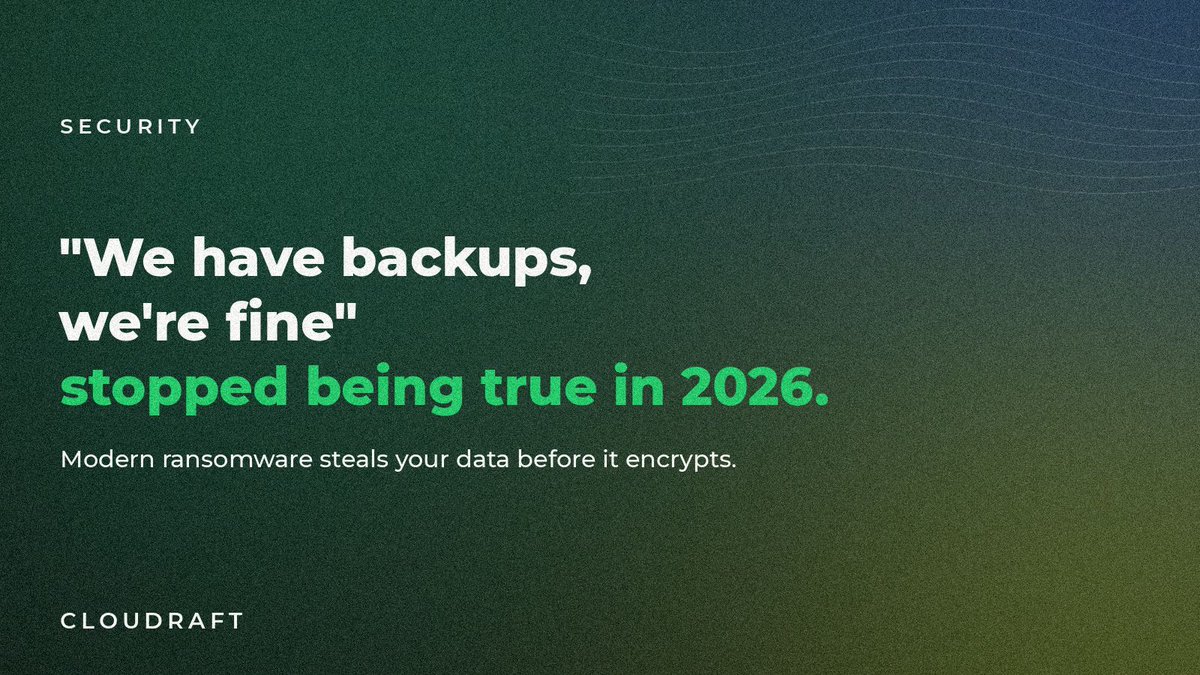
"We have backups, we're fine" stopped being true in 2026.
70% of ransomware claims now involve data theft, not just encryption (Coalition, 2026). Perfect backups restore your systems. They do nothing about the copy the attacker already walked out with.
The fix has two halves: stop the theft, and survive the encryption.
Where a double-extortion attack breaks, stage by stage:
1. Access → MFA + least privilege
2. Lateral movement → segmentation
3. Exfiltration → egress monitoring
4. Encryption → immutable, air-gapped backups