@NintendoEurope When I saw the first announcement I nostalgia hit like a train. The next day I bought the switch 2. All the games I tried so far are amazing. Can’t wait for the release of ocarina…my one and only favorite game ever!
UnitedHealth Group: Is the turnaround starting to take shape?
UnitedHealth Group just reported its third-quarter results, and there are some encouraging signs.
Revenue reached $112.7 billion, while adjusted earnings per share increased from $2.92 to $4.69 compared with the same quarter last year. The company also raised its full-year 2026 adjusted EPS outlook to at least $20.50.
One of the most important metrics to watch is the medical care ratio. It declined from 89.9% to 88.4%, meaning a smaller proportion of insurance premiums went toward medical costs.
However, favorable reserve development also contributed to the improvement, so I wouldn't attribute the entire change to better underlying operations. Revenue also declined slightly year over year.
What interests me most is what management is doing to improve the business beyond these quarterly numbers.
The company is simplifying operations, using AI to improve administrative efficiency and working to reduce unnecessary complexity in healthcare. Management also expects to implement all previously announced prior authorization reforms by year-end, targeting a 30% reduction in total prior authorizations.
Looking ahead, management expects 2027 to bring meaningful progress and remains focused on its long-term earnings growth target of 13% to 16%. These are encouraging ambitions, but the real test will be whether the company can deliver them.
There are still significant challenges, including elevated medical costs, regulatory pressure and profitability issues in parts of the business. Management itself describes 2026 as a trough year for Medicaid margins.
For me, the key question is whether UnitedHealth can turn its operational improvements into sustainable earnings growth over the coming years.
What do you think? Is UnitedHealth beginning to turn the corner, or is it still too early to tell?
$UNH
Could AI Be in the Early Stages of Another Major Technology Shift?
I found this comparison quite interesting.
Personal computers reached roughly 3% household adoption in the US around 1983. Paid home internet reached a similar level around 1995, and smartphones around 2006.
According to the chart, paid consumer AI is reaching a comparable threshold in 2026.
Of course, these technologies are different, and reaching 3% adoption doesn't guarantee that history will repeat itself. But I think the comparison raises an interesting question: what happens when a technology moves beyond early adopters and becomes part of everyday life?
Think about how much personal computers, the internet and smartphones have changed the way we live and work. AI could follow a similar path, although we still don't know how quickly adoption will grow or which companies will benefit the most.
As a long-term investor, I'm less interested in predicting which AI stock will rise the most next month. I want to understand which businesses can turn this technology into sustainable revenue, strong cash flows and lasting competitive advantages.
One thing I've learned is that a great technology doesn't automatically make every company involved a great investment. The business, its competitive position and the price we pay still matter.
I believe AI is worth following closely. But rather than chasing the excitement, I'd rather focus on identifying quality businesses that can benefit from its adoption over the next decade.
That's where I see the real investment question.
$NVDA | $META | $GOOG | $AMZN
The Market Is Usually Looking Ahead
One of the most common mistakes investors make is assuming that markets react to events when they happen. In reality, markets are constantly trying to anticipate what happens next.
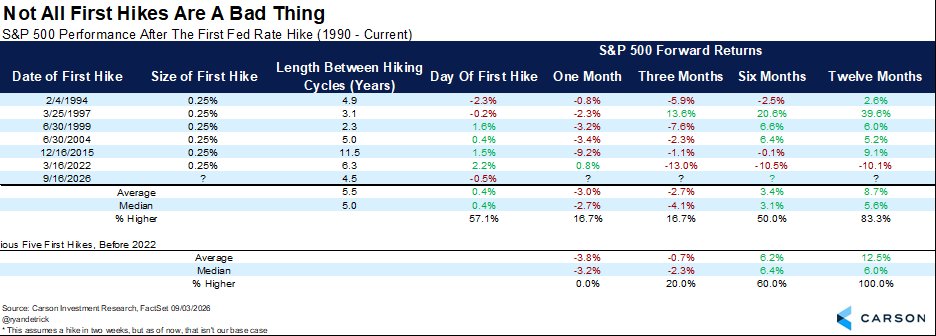
Take interest rates as an example. When the Federal Reserve announces its first rate hike, many investors treat it as a major turning point. Headlines appear, analysts debate the implications, and some investors rush to reposition their portfolios.
But by the time that first hike actually arrives, the market has often spent months discussing it, forecasting it, and pricing in expectations.
When a widely anticipated event finally happens, the market's attention often moves almost immediately to the next question.
Investors stop asking, "Will rates rise?" and start asking, "How many more hikes are coming? How long will rates stay elevated? What does this mean for earnings and economic growth?"
The market is not simply reacting to today's news. It is constantly trying to price what investors believe comes next. That's why stock prices can sometimes rise on bad news and fall on good news. What matters is how reality compares with what investors were already expecting.
Trying to trade every headline can become an endless game of chasing information that millions of other market participants are already analyzing.
Instead, I prefer to focus on understanding the businesses I own, estimating what they may be worth years from now, and giving those businesses time to execute.
The future will never be perfectly predictable. But you don't need to predict every headline to be a successful long-term investor.
Sometimes, the most useful thing to remember is that while everyone is discussing today's news, the market is already thinking about tomorrow.
$NVDA | $META | $AMZN | $PLTR
Higher Interest Rates Mean Stocks Will Go Down... Or Maybe Not?
I was analyzing some historical market data recently and found something that I think many investors would find surprising.
We're often told that higher interest rates are bad for stocks and lower interest rates are good for stocks. It sounds reasonable, and it's one of those ideas that gets repeated so often that many people simply accept it as fact. But when I looked at the numbers by decade, the relationship wasn't nearly as straightforward as I expected.
The 1980s delivered annualized S&P 500 returns of 17.55%, even though the average 10-year Treasury yield was 10.59%. The 1990s did even better, producing annualized returns of 18.21% while the average Treasury yield was 6.67%.
Meanwhile, the 2000s became the worst decade for the S&P 500, with annualized returns of -0.95%, despite average Treasury yields being lower than they were in the 1970s, 1980s, and 1990s.
This doesn't mean interest rates don't matter. They do. But it does remind us that they are only one piece of a much larger puzzle.
Long-term stock market returns are influenced by many factors, including corporate earnings growth, innovation, productivity, starting valuations, economic conditions, and investor psychology. Focusing on interest rates alone can cause us to miss the bigger picture.
The market is rarely as simple as "rates up, stocks down" or "rates down, stocks up." History shows that the relationship is far more complex, which is one reason why I try to avoid making investment decisions based on a single macroeconomic variable.
As long-term investors, our focus should be on owning great businesses, understanding what they're worth, and giving them enough time to compound. The future will always be uncertain, but over time it is the underlying value created by businesses that ultimately drives returns.
History has a habit of reminding us that the most popular narratives are not always the most accurate.
What surprised you most about this data?
$NVDA | $META | $AMZN | $MSFT
@mandyarthur@grok Hey @grok is Zelensky ethnically jewish and did he learn to speak Ukrainian as an adult in his late 30's? Yes or no for each. Be concise. Answer the questions directly with no qualifiers.
Is the S&P 500 Really Overvalued?
Many investors look at the S&P 500 near all-time highs and reach the same conclusion: the market must be overvalued. It's an understandable reaction. After all, how can stocks keep climbing when they've already risen so much?
The problem is that price alone tells us very little. A market can become expensive as prices rise, but it can also become more valuable if the businesses behind those prices are growing even faster. Looking only at the index level without considering the underlying earnings is like judging a company solely by its stock price without looking at its financial statements.
That's why I found this chart interesting. It shows that Wall Street's earnings estimates have historically been much closer to reality than many investors assume. Analysts are far from perfect, especially during recessions and major economic shocks, but over longer periods they have generally done a reasonable job forecasting the direction of corporate earnings.
More importantly, earnings have continued to grow, and analysts expect that growth to continue in the years ahead. In other words, today's market is not being driven purely by optimism or speculation. The companies that make up the S&P 500 are generating significantly more revenue, profits, and cash flow than they were just a few years ago, and expectations remain positive going forward.
Of course, this doesn't mean stocks can't become expensive, nor does it mean corrections won't happen. Markets will always experience periods of fear, uncertainty, and volatility. Short-term price movements are influenced by countless factors, from interest rates and economic data to geopolitics and investor sentiment.
However, the argument that the S&P 500 is overvalued simply because it is trading near an all-time high is often too simplistic. A market can reach record highs while the businesses within it are also producing record earnings. In that case, higher prices may simply reflect higher business value.
This is one of the reasons I spend far more time following earnings, cash flow, and business fundamentals than trying to predict where the market will be next month. Over the long run, stock prices tend to follow the growth of the underlying businesses, even if the path is rarely smooth.
The question that matters most is not whether the S&P 500 is at an all-time high today. The question is whether the companies that make up the index will be earning more money five or ten years from now than they are today. For long-term investors, that is what ultimately drives returns.
$NVDA | $META | $AMZN
What Happens When You Improve by 1% Every Day?
Most people overestimate what they can achieve in a month and underestimate what they can achieve in a few years.
I came across a video recently about the idea of becoming just 1% better every day. At first, 1% sounds insignificant. Almost not worth thinking about. But that's not how compounding works.
If you improve by 1% each day for a year, the math looks like this:
1.01^365 = 37.78
In other words, you don't end up 365% better. You end up nearly 38 times better than where you started.
The same principle applies to investing.
Most investors focus on finding the next big winner. But long-term wealth is often built through small, consistent actions repeated over many years: saving regularly, staying invested, controlling emotions, and continuing to learn.
Compounding doesn't just work with money, it works with knowledge, habits, discipline, and decision-making.
The challenge is that the results are invisible at first. The reward comes much later, after the small improvements have had time to compound.
$NVDA | $PLTR
A quick portfolio update.
Our portfolio is getting close to a new all-time high again.
Earlier this week, I added fresh capital to the account. For now, that cash will remain on the sidelines until attractive opportunities appear. I already have several companies on my watchlist, so I'm simply waiting for prices to reach levels that offer a more favorable risk/reward profile.
Year to date, the portfolio is up 11.35%, compared to 12.3% for the S&P 500. So we're currently less than 1% behind the index. But short-term performance is only one part of the picture.
Since I started investing on eToro on 5 July 2022, our portfolio is up 518.79%, compared with 114.97% for the S&P 500.
Looking at the portfolio today, I also see an interesting setup. Based on my valuation work, both Nvidia and Meta, our two largest positions, are currently trading below my estimates of intrinsic value. Amazon also appears undervalued, while Palantir is getting much closer to what I consider fair value.
Of course, being undervalued doesn't tell us when the market will recognise it.
It could happen next month, next year, or take much longer. Nobody knows.
What I do believe is that, over time, stock prices tend to follow the underlying economics and intrinsic value of the businesses they represent. My job is not to predict exactly when that happens. It's to own great businesses at attractive prices and have the patience to wait.
There will always be periods when we outperform the market and periods when we lag it. I don't believe the answer is to constantly change the strategy based on which one is happening today.
The focus remains the same: own high-quality businesses, stay disciplined, protect capital, and take advantage of attractive opportunities when they appear.
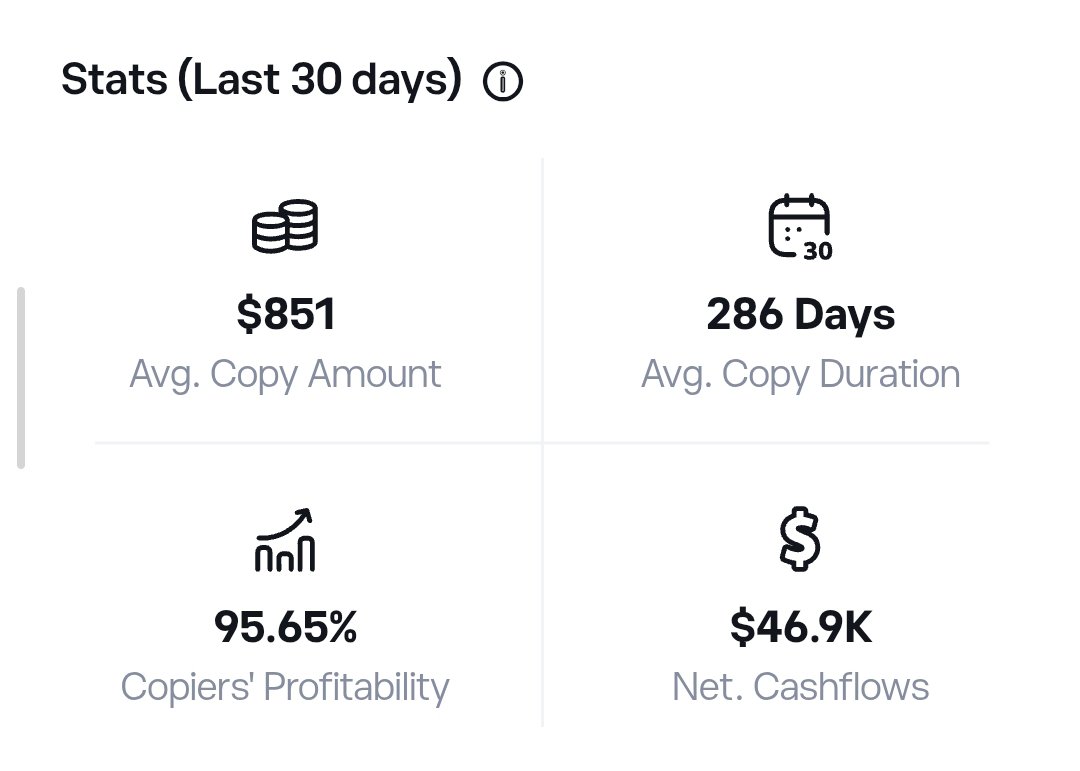
On the copier side, I'm pleased to see that 95.65% of copiers are currently profitable. Average copy duration remains close to 10 months, while net inflows over the last 30 days reached $46.9K.
Patience doesn't always feel productive in the moment. But sometimes, the best investment decision is simply waiting for the right pitch.
$NVDA | $PLTR | $AMZN | $META
A quick update as we head into September.
I’m very happy with how the portfolio performed in August, finishing the month up 9.15%. It was a strong result, especially considering that August and September have historically been among the weaker periods of the year for the S&P 500.
That’s also a good reminder of why I don’t put too much weight on seasonal patterns. They’re interesting to study and certainly worth being aware of, but I don’t see them as a reason to change a long-term investment strategy.
For me, the important question isn’t whether September has historically been a difficult month. It’s whether the businesses I own are continuing to grow their earnings, generate cash and strengthen their competitive advantages.
A great business doesn’t suddenly become a bad investment because the calendar says September.
So I’ll continue doing what I’ve always done: focus on quality, valuation and long-term compounding rather than trying to predict what the market will do over the next few weeks.
Another month begins. The strategy stays the same.
$NVDA | $PLTR | $GOOG | $AMZN
U.S. company Satyress is developing threehalves, a centaur-style robot designed for dangerous environments such as wildfires, rubble searches, toxic areas and confined spaces. The system combines a humanoid upper body with a quadruped mobility platform. #USA#Robotics#UGV#AI
Persia welcomed 4,000 Muslims with open arms.
A century later, the original people were almost erased.
Now it’s Iran.
History doesn’t care about your good intentions.