Another Islamic parallel with Roman law: the child belongs to the marital bed. Both systems presume the husband to be the legal father even if the woman is suspected of infidelity. The Roman maxim appears in the Prophetic hadith: الولد للفراش.
Another unique Maliki W, along with allowing wives to divorce for abuse:
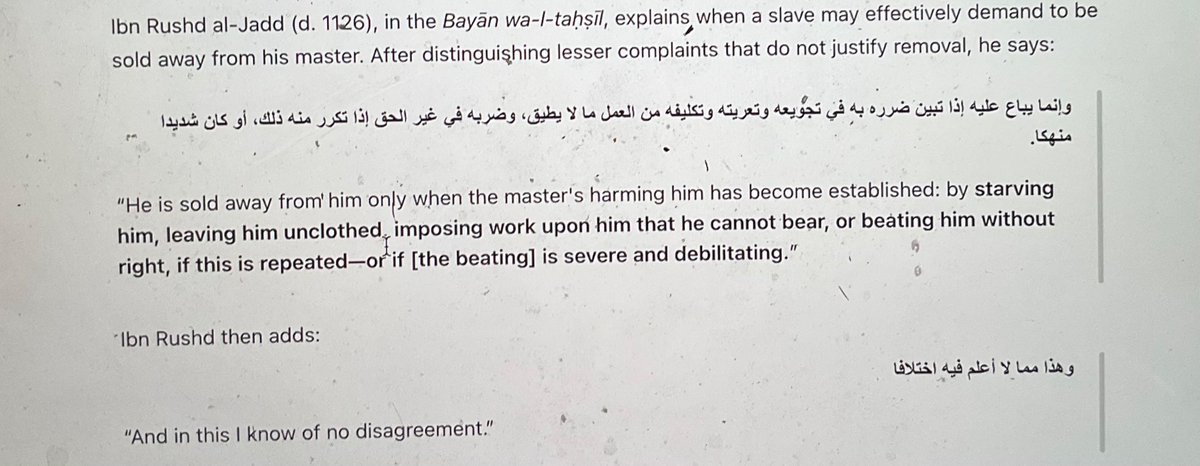
Just like under Imperial Roman law, slaves can petition to be judicially sold for cruelty, starvation, or overwork.
@rookerbets@triglav_@ZouhairsMurid Yeah but those historical reports aren’t even consistent. They’re weighed against an authentic hadith, not the other way around. Aisha’s own narration contradicts them and they’re already inauthentic to begin with. There’s so much against them and nothing in their favor.
@rookerbets@ZouhairsMurid Let me guess, they’re still alive? Modern revisionists can’t rewrite history, you’re not being sincere. Btw Shias have authentic reports placing her age at 6–10 too.
@rookerbets@triglav_@ZouhairsMurid A bit biased to accept contradictory and inauthentic historical reports to argue she was older while rejecting authentic reports from Aisha herself
@rookerbets@ZouhairsMurid Yes, you’re right. If a hadith’s matn isn’t sound, the hadith isn’t authentic. But the reports about Aisha’s age are sound in both isnad and matn. She was 6 at marriage and 9 at consummation (maybe 10 at the latest). That’s a fact but you’re free to be wrong.
See i read this and condemn and hate Ghazali more. Where in the Quran and Sunnah is this? Mulla Sadra (shia philosopher) had written lines along these lines too. Ibn Taymiyyah and Ibn al Qayyim didnt hold such views.
During the era of the Salaf, the first two Abbasid caliphs, the brothers al-Abbas al-Saffah and Abu Ja’far al-Mansur, great-grandsons of Ibn Abbas, the Prophet’s cousin, accepted monogamy clauses from their wives, Umm Salama and Umm Musa. No man from the Salaf as-Saliheen objected to their anti-polygamy clauses.
@3arbi_neuille@Almajhul103 This is the majority position of the Hanbali school, how is that cherry-picking? There’s even historical precedent for it from the time of the salaf.
During the era of the Salaf, the first two Abbasid caliphs, the brothers al-Abbas al-Saffah and Abu Ja’far al-Mansur, great-grandsons of Ibn Abbas, the Prophet’s cousin, accepted monogamy clauses from their wives, Umm Salama and Umm Musa. No man from the Salaf as-Saliheen objected to their anti-polygamy clauses.
Many Muslim scholars advised against polygamy and making your wife jealous. The great Salafi scholars Shaykh al-Islam Ibn Taymiyyah and his student Ibn al-Qayyim treated women’s emotional wellbeing as a central concern. They understood that jealousy was natural, warned husbands against betrayal, and recognized the devastating harm it could inflict on women and families.
@omar_dddg This isn’t a real quote. No one among the salaf ever said this. But even if they did, so what? He divorced her. Gonna cry? Stop projecting your third world cultural values onto Islam. Divorce is normal and better than staying in an abusive, unhappy marriage like some ethnic muzis
I checked several editions and this report isn't in any of them. It's made up and contradicts Islamic principles. Your wife doesn't become “haram” just because another man saw her. The outrage is performative too. Ethnic Muslims are just projecting. You can divorce for any reason
@_Abdullah_Saleh Modern Salafi scholars like Ibn Uthaymeen opposed child marriage and Saudi Arabia eventually criminalized the practice. Islam doesn’t necessitate child marriage. Classical scholars also recommended marrying one wife, and Shaykh Albani advised against polygamy.
Shajar al-Durr: from slave to Queen of the Muslims and founder of the Mamluk Sultanate.
Even a sultan was not immune from the consequences of polygamy. When Izz al-Din Aybak, Egypt’s final Ayyubid sultan, sought another wife, Shajar al-Durr had him killed. She became one of the most powerful women in history, the first woman to sit on Egypt’s throne since Cleopatra more than 13 centuries earlier, Egypt’s last Ayyubid ruler, and the first female Mamluk sultan. Her Mamluk dynasty later produced Baybars, halted the Mongol horde, ended the Crusader states, and ruled the society in which Shaykh al-Islam Ibn Taymiyyah lived and taught.
During the time of the Prophet Muhammad ﷺ, many poor, homeless Companions resided on the raised platform of the Prophet's Mosque, known as Ashaab al-Suffah. These are particularly the companions that stays with the prophet 24/7 to learn the religion from him.
When night fell, Rich Companions from Medina would step forward to take guests home from the mosque to feed them dinner. While a typical household host might invite one, two, or three guests, Sa’d ibn ‘Ubadah was known to take as many as 80 Companions at once to his home to feed them everyday.
Every single day, without fail, he sent a large bowl of food, typically cooked meat or thareed (a rich dish of bread soaked in meat broth), directly to the home of the Prophet ﷺ and his family. It was said in Medina that a bowl from Sa’d’s house followed the Prophet ﷺ wherever he visited.
On one occasion, the Prophet Muhammad ﷺ visited Sa’d ibn ‘Ubadah at his home. Sa’d warmly welcomed him and presented him with dates, sesame, butter, and milk. After partaking in the meal, the Prophet ﷺ turned to Sa’d and made a profound, famous supplication of blessing (du'a):
May the righteous eat your food, may the angels send down their blessings upon you, and may those observing the fast break their fast in your house."
(Musnad Ahmad)
Despite his tremendous fortune, Sa’d was remarkably humble about his riches. He used to supplicate to Allah:
"O Allah! Grant me glory. O Allah! There is no glory without a deed, and there is no deed without property. O Allah! A little is not enough for me, nor am I fit for a little."
The Prophet ﷺ also made supplications for Allah to shower mercy and continued abundance upon Sa’d, his family, and his progeny. Through these prayers and his relentless generosity, Sa’d ibn ‘Ubadah’s wealth remained blessed, and he went down in Islamic history as one of the most richest and generous figures of early Islam.
@ly957194227756@scribeofmedinah@shadarazon@D1mashqi I’m done entertaining your absurd anti-Western prejudice. That’s an eyewitness account and Karmi never denied the murder of Ottoman child princes. The Ottomans themselves issued decrees sanctioning fratricide, which Karmi praised. This isn’t up for debate.
A Refutation of the Modern-Day Street Daʿwah Culture: How Can You Call Others to Islām When Your Own Character Drives Them Away?
Shaykh Abdurrahman Al-Umaysan حفظه الله
@ly957194227756@scribeofmedinah@shadarazon@D1mashqi When have I ever claimed to be Hanbali? Karmi isn’t a gotcha either. The Ottomans deserve some praise, they were Muslims after all. But he (with qualifications) and other Ottoman scholars defended sultans murdering their younger brothers. Today they’d be called “palace scholars.”
The princes of the Ottomans were worse than cattle to the Ottomans. Fratricide was embedded in Ottoman customary law, and sultans regularly sought fatwas from their Maturidi Shaykh al-Islams to justify it. Karmi was defending a tradition that had existed for centuries before him.
@scribeofmedinah@ly957194227756@shadarazon@D1mashqi They were Maturidis, not homosexuals. Their innovations in the religion of God are far worse than any alleged homosexuality. That deserves our attention, as do their massacres of Europeans.