I asked my AI agent to audit my Kubernetes namespace security using this prompt:
Analyze the security posture of my namespace. Identify risks, explain them, and suggest fixes.
It found:
- No NetworkPolicies
- Public API server open to 0.0.0.0/0
- Pods using nginx:latest
- Default service account
- No IAM roles (IRSA)
And gave me the exact fixes.
Watch the video 👇👇👇👇
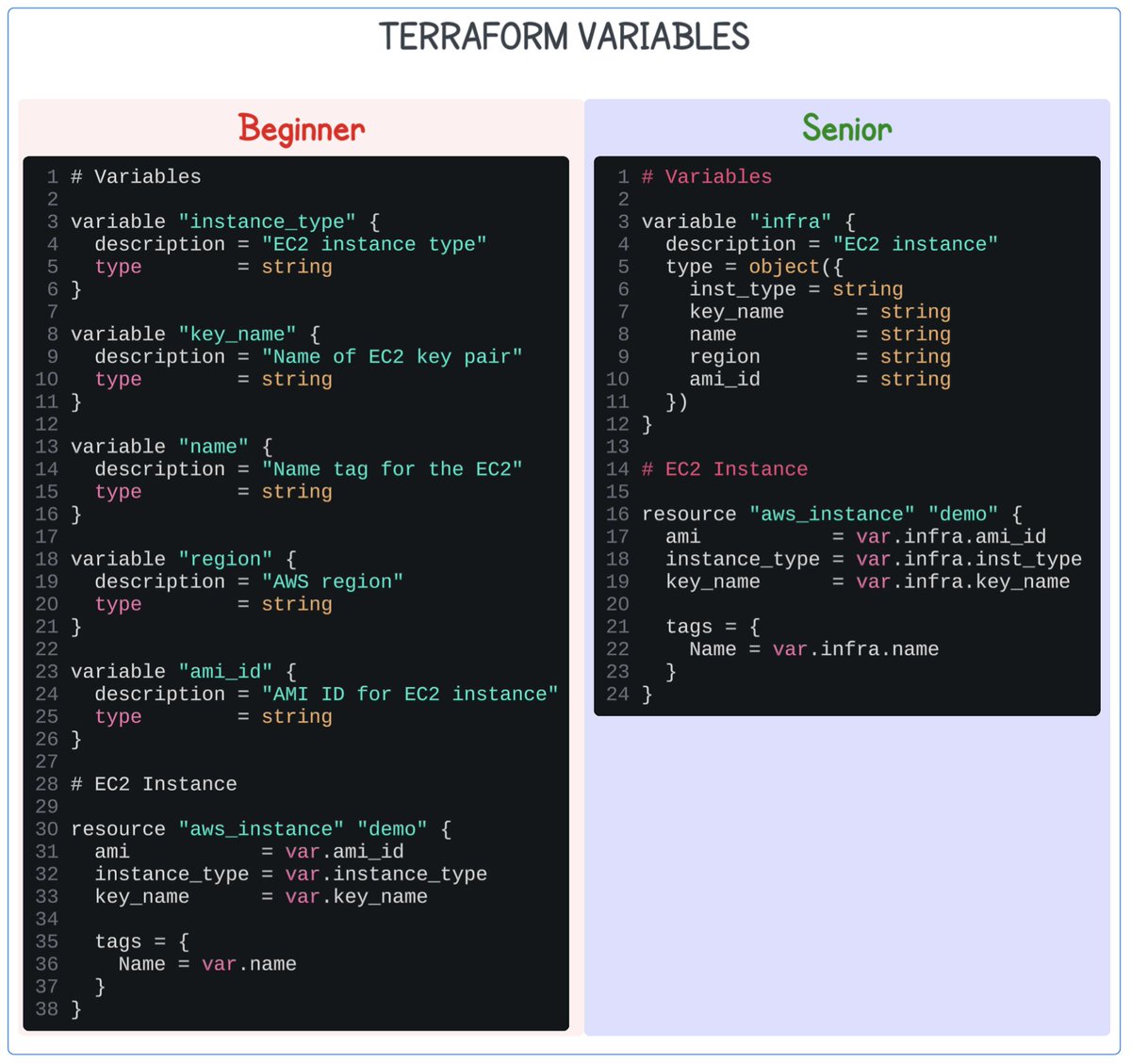
How do you declare your Terraform variables?
There is the traditional way we see in every tutorial:
- One variable for instance_type
- One variable for ami_id
- One variable for key_name
- etc.
It works fine.
But once you join real-world projects, you start seeing another approach:
- Group related variables into one object.
It is cleaner and more professional.
- It keeps related values together.
- It makes the module easier to read.
- It scales better when your infrastructure grows.
Terraform users:
Learn the object data type.
Here is why:
- It keeps related values together
- It makes your variables file cleaner
- It avoids too many separate variables
- It makes your modules easier to reuse
- It scales better when your infrastructure grows
Most engineers miss jobs because they don’t prepare enough for interviews. They spend months building, fixing, and solving real problems. But during the interview, they struggle to explain what they did.
It’s sad when you realize you failed an interview because you could not explain what you did.
Why the upcoming IPOs of OpenAI & Anthropic will be the final nail in the coffin for the global markets.
Everyone wants a piece of the next OpenAI, SpaceX, or Anthropic.
The internet is full of people claiming that if you can somehow get access to these private companies before an IPO, you'll become a millionaire. Maybe they're right. But before putting money into any opportunity, it's worth understanding something most people aren't discussing: AI companies don't necessarily have the same economics as the software companies that dominated the last two decades.
Traditional software is an incredible business. Once you build the product, the cost of serving the next customer is almost zero. Whether you have 1,000 users or 1,000,000 users, the infrastructure costs don't grow at the same pace as revenue. That's why software companies often command premium valuations and generate extraordinary profit margins.
AI changes that equation.
Every new user consumes compute. Every prompt requires GPUs. Every improvement in model capability requires more training, more infrastructure, more power, and more cooling. Unlike traditional SaaS products, the cost of serving customers doesn't disappear. In many cases, success itself creates additional infrastructure requirements.
This is why I think many retail investors are looking at AI companies through the wrong lens. They see software and assume software economics. In reality, frontier AI companies increasingly resemble a combination of software business, cloud provider, infrastructure company, and energy consumer.
That distinction matters because valuation ultimately comes down to cash flows and profitability. A company can grow revenue at an incredible pace and still struggle to justify an extreme valuation if the cost of sustaining that growth continues to rise alongside it.
History gives us plenty of examples. The internet changed the world, but thousands of internet companies disappeared. Cloud computing transformed enterprise software, but not every cloud company became Amazon. Revolutionary technology and successful investments are related, but they are not the same thing.
The biggest risk today isn't that AI fails. AI is already proving useful across industries. The bigger risk is that investors convince themselves that every company associated with AI deserves a trillion-dollar valuation. When expectations become disconnected from business fundamentals, markets eventually correct that mismatch.
As engineers, we're trained to think about constraints. We ask where systems break, what resources are limited, and what assumptions may not hold at scale. I think investors should approach AI with the same mindset.
Before investing, ask a few simple questions:
• How much revenue does the company generate today?
• How much does it cost to serve that revenue?
• Does each new customer improve profitability or increase operating costs?
• How much additional capital is required to sustain growth?
The answers to those questions matter far more than headlines, hype, or promises about the future.
I've learned one lesson from both technology and money: great technology doesn't automatically create great investments. Sometimes the technology wins and the investors lose. Knowing the difference is where the real opportunity lies.
How do you declare your Terraform variables?
There is the traditional way we see in every tutorial:
- One variable for instance_type
- One variable for ami_id
- One variable for key_name
- etc.
It works fine.
But once you join real-world projects, you start seeing another approach:
- Group related variables into one object.
It is cleaner and more professional.
- It keeps related values together.
- It makes the module easier to read.
- It scales better when your infrastructure grows.
You are doing well in the interview.
You are even sure that finally, you got it.
Then you hear:
« Could you share your screen? I want you to write a simple script. »
Suddenly, you see the 6-figure salary disappear.
Most engineers miss jobs because they don’t prepare enough for interviews. They spend months building, fixing, and solving real problems. But during the interview, they struggle to explain what they did.
It’s sad when you realize you failed an interview because you could not explain what you did.