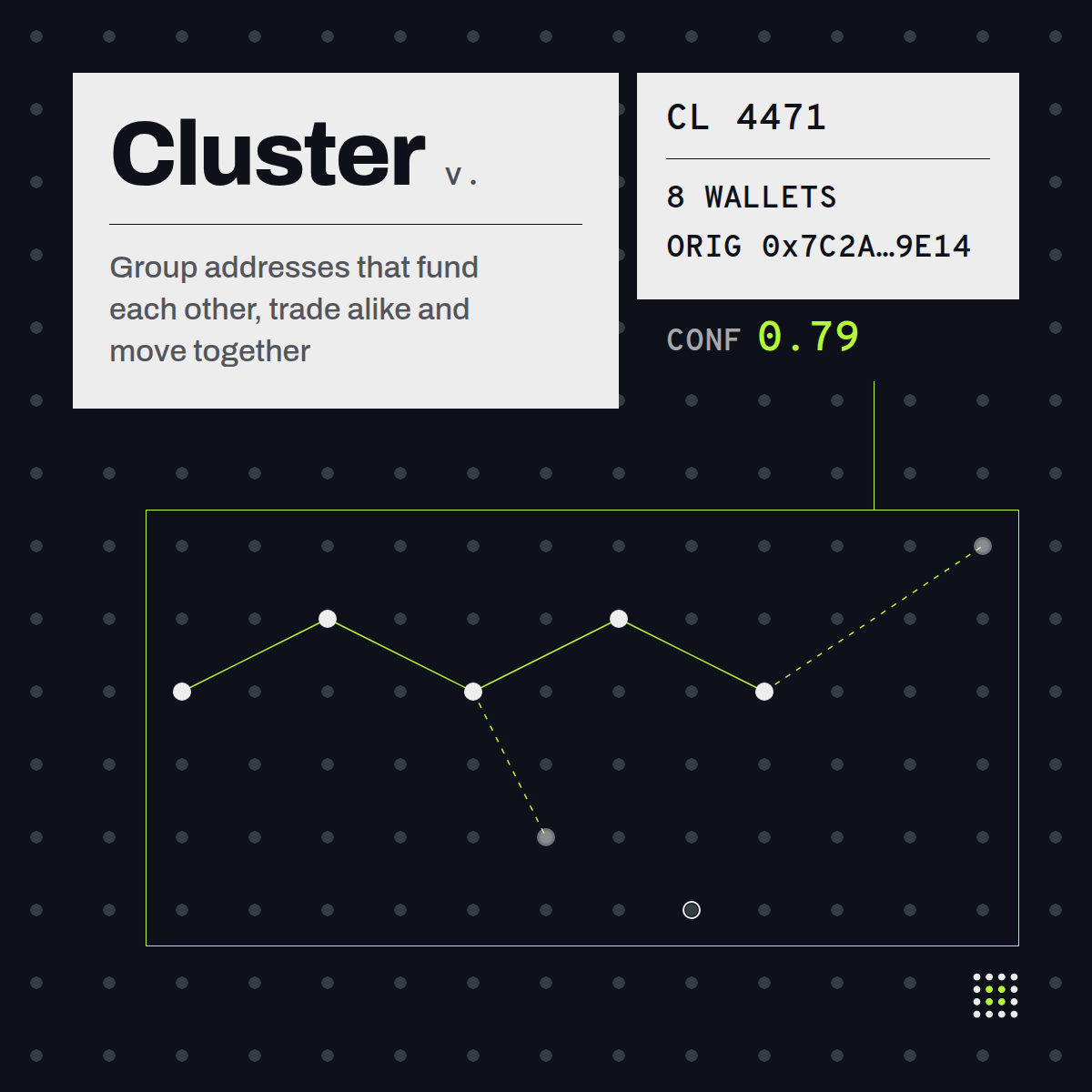
One entity. Hundreds of wallets. One Cluster. We group addresses by behaviour and funding, map how capital really moves, and tell you how confident that link is
@WhaleFactor Curious what the accumulation clusters behind these look like. Single-wallet price targets miss the entity-level picture: are these targets backed by coordinated holding patterns or just hopium? We map the clusters actually accumulating each.
Anyone holding enough to matter, and paying attention, splits it. The position gets cut across twenty, forty, sometimes a few hundred wallets, funded a hop or two apart, quiet for weeks. Per-address analytics read one of them, report a balance, call it a position.
Our correction is flat: cluster, then measure. We group addresses that fund each other, trade alike and move together, then read holdings and flows there. Every link is inference, and we say so.
Put the addresses back together and the behaviour surfaces: capital rotating between venues, distribution into strength, a month of accumulation no single transaction shows. One address at a time, that reads as a wallet receiving 40 ETH on a Tuesday.
@based_elnen Those velocity numbers are address-count growth, not holder consolidation. We'd want to see if the same clusters are rotating between launches or if it's genuinely distributed entry.
@based_elnen watched a cluster with 12 addresses accumulate for 3 weeks while the token stayed flat. the 13th addressed opened and it ran 40% inside an hour
@davidtsocy@base@coinbase@Citi@Citi settling as the bank of record means the fiat leg never leaves their custody stack, which is the part that makes this work for a regulated institution. The stablecoin side is just the transport layer.
@1CrypticPoet@base The part people miss is that the wallet is also how an agent proves it acted autonomously. Without a private key it can't sign, and without signing there's no verifiable trace that the decision was really its own.
Forty wallets. Six weeks. Every buy sized to pass for somebody's paycheck DCA, nothing anywhere near a threshold. That is what competent accumulation looks like from outside, and address-level alerting reports none of it.
Cluster ($CLSTR) resolves the forty into one entity, and at that level a category of event exists with no address-level equivalent:
- accumulation no single position would flag, visible once the forty are added together
- cost basis crossing into profit for the entity as a whole, first time since it started buying
- a year of holding, then a venue this entity has never touched
- selling that runs out of eight side wallets while the one everybody watches sits untouched
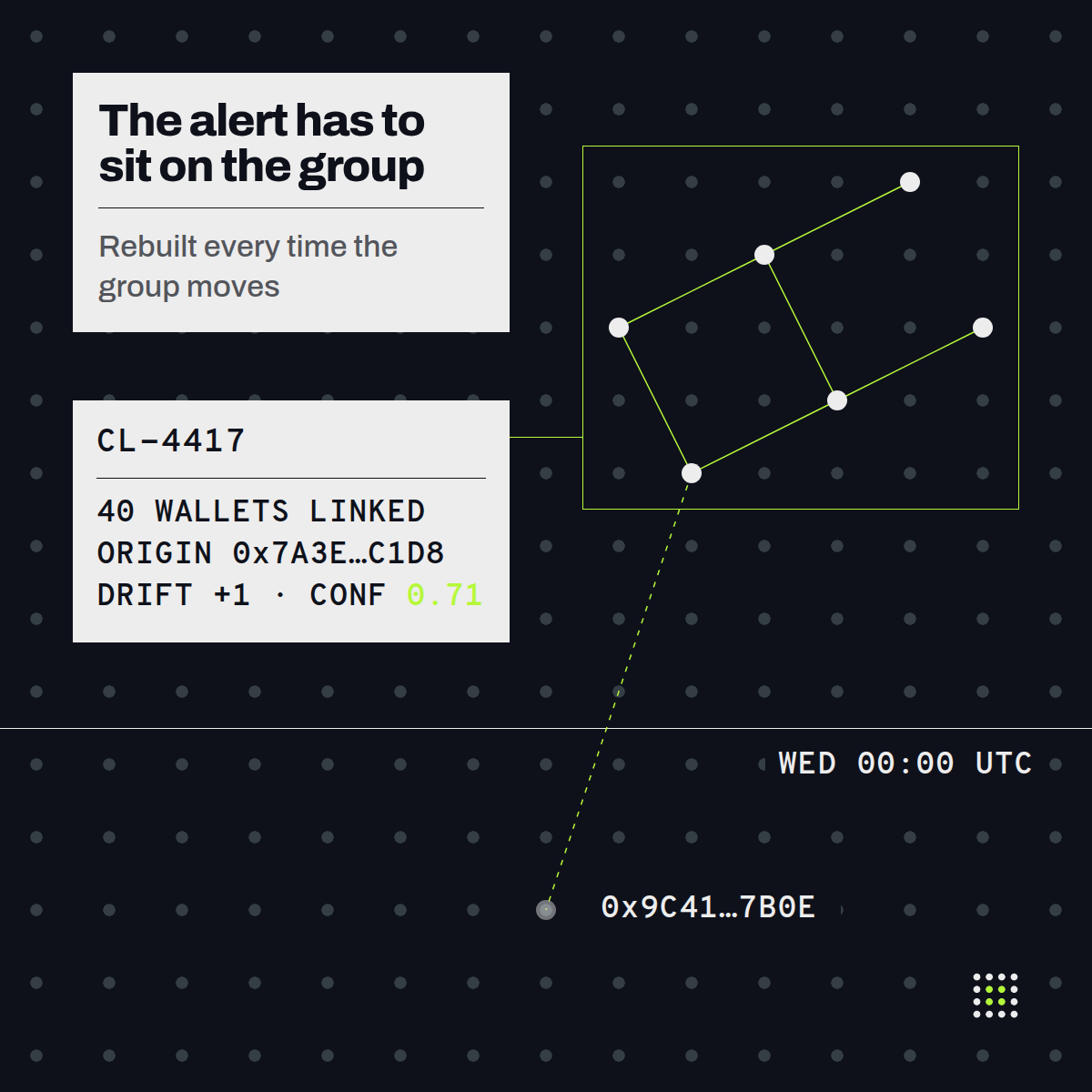
None of these fire on an address, which is why the alert has to sit on the group and get rebuilt every time the group moves. An entity that picks up a wallet on Tuesday is a different alert by Wednesday.