New paper in @theAGU GRL. A simple non-Gaussian extension of linear climate models that reproduces key observed ENSO features: diversity, asymmetry, and extremes, including the curved El Niño–La Niña phase space and the dominance of extreme El Niño events https://t.co/7fgzlfJvyt
I’m a climate scientist. Let me fix this headline.
“Nearly a century ago, scientists showed that burning fossil fuels warms the planet.*
Today, we know human emissions account for over 100% of the warming.**
Yet dark money and disinformation still work to keep Americans addicted to fossil fuels.”***
* in 1937, Guy Callendar published a paper showing that the world had already warmed over the last 50 years due to human emissions what he called “carbonic acid“ – what we now call CO2 – from burning fossil fuels
** If you are wondering, “how could humans be causing more than 100% of the warming?”
— it’s because, according to natural factors, the earth should be cooling right now.
So our emissions are offsetting that cooling AND causing all of the observed warming.
*** For more on the well funded disinformation campaign, read or watch Merchants of Doubt and The Petroleum Papers
Big El Niño? The window is closing. June’s westerly wind bursts may decide everything.
Yes, the ocean looks a lot like early 1997: warm water expanding east across the equatorial Pacific, Kelvin wave warming lighting up the South American coast.
But El Niño is an ocean-atmosphere phenomenon. And the atmosphere is not cooperating.
By late May 1997, a major westerly wind burst was already ripping across the western Pacific, helping tip the system into the strongest El Niño on record.
This year? Nothing of the sort. No sustained WWB so far. If anything, the opposite — a possibility some 2-week weather forecasts were already flagging when NOAA issued NOAA’s May outlook.
That doesn’t mean a big El Niño is off the table. It means caution is still warranted when using 1997 as an analog, because the next few weeks matter a lot.
Surface maps can look similar. Forecast outcomes can still diverge sharply.
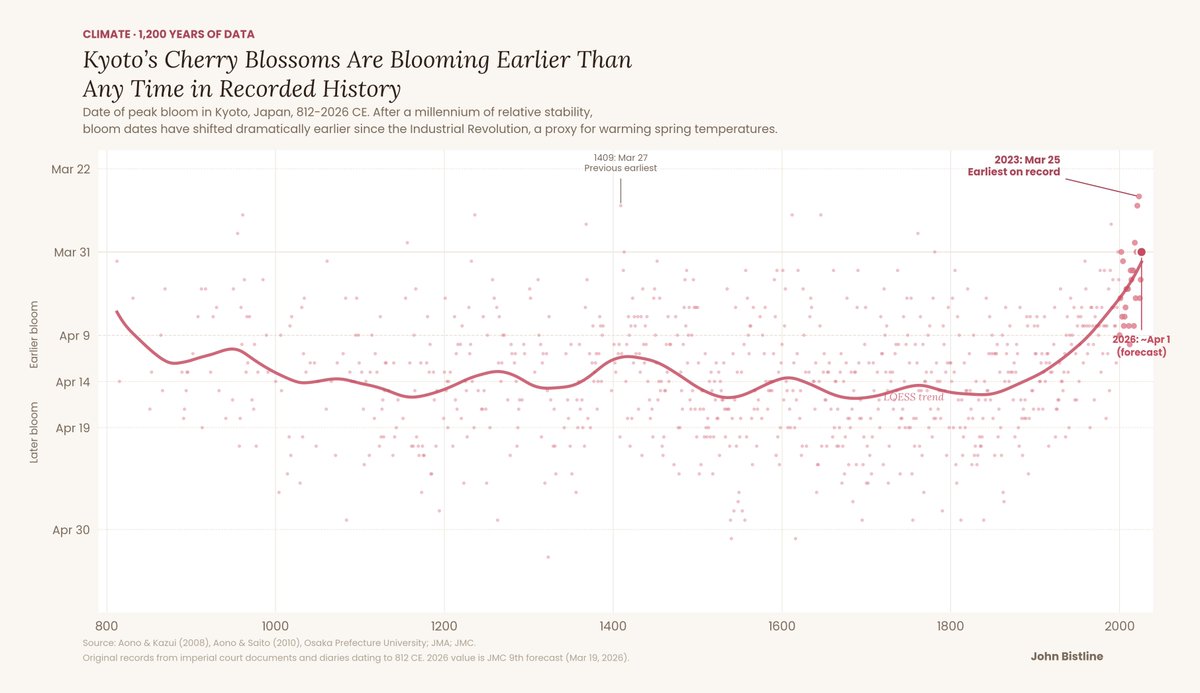
This is my favorite climate change chart. Japanese monks, aristocrats, and emperors kept meticulous records of cherry blossom festivals for 1,200 years and accidentally built the world's longest climate dataset.
Sin datos no hay acción climática https://t.co/VDqoEmWF4x a través de @prensa_educa
Por Cristian Martinez-Villalobos, PhD en Ciencias Atmosféricas y Oceánicas; académico Facultad de Ingeniería y Ciencias UAI, e investigador titular Data Observatory.
Webinars on Marine Heatwaves return! We're thrilled to have Dr. Thibault Guinaldo present:
"When Internal Variability Meets Climate Change: The Story of the 2023 North Atlantic Marine Heatwave."
Join us on December 11, 2025 at 14:00 UTC.
🔗 https://t.co/WfFARspU5u
[Opportunities] Position available: Director of the CLIVAR International Project Office - Deadline for application 30 November 2025
Check more details here:
https://t.co/VULKAYCkdK
Join the Polar Heat Workshop 2026 (Glasgow, Feb 28–Mar 1)!
A joint CLIVAR/CliC/SCAR effort uniting Arctic, Antarctic & global experts to discuss ocean heat dynamics and linkages.
⏰ Deadline: Nov 30, 2025
🔗 https://t.co/nTyn2f3Xbn
Ese pequeño punto azul es una ballena que navega en el intenso tráfico marítimo del Golfo de Ancud, en Chile, y que ha sido rastreada durante una semana.
📢 [TBI Webinar Series] We are pleased to invite you to join the 6th edition of webinar series coordinated by #CLIVAR Tropical Basin Interaction Research Focus.
⏰: November 4, 04:00 UTC
📌: GoTo - Meeting ID 270445813
🔍 You can register by scanning the QR
🌴 Pan-CLIVAR Meeting [Day 3&4] – CLIVAR Symposium!
On 24–25 Sept, the CLIVAR Symposium brought together scientists and stakeholders from 38 countries onsite and online.
Open sessions and side events also strengthened global partnerships and empowered ECRs' connection.
Anthropogenic aerosol forcing is perceived as highly uncertain. Our new paper shows that the uncertainty is in the magnitude while the spatial pattern of the climate response is robust across models.
https://t.co/FWysjFOHve
🔓Now on Peeref: Accelerating increase in the duration of heatwaves under global warming
🔗: https://t.co/VVBq7Ra8BF
👁️Altmetric: 726
@cmartinezvil@ingenieriaUAI@NatureGeosci
I’m recruiting a funded PhD student to join my research group (https://t.co/mRXZCkiMky) @USask in 2026. This position will focus on advancing long-term drought prediction under uncertainty. 🌍💧
Please feel free to share the ad below with anyone who may be interested.
Big El Niños 🌊 usually have big 🌎 teleconnections.
The one in 2023/24 didn’t. Why?
Rainfall anomalies in the tropical Pacific were suppressed due to greater warming in Indian and Atlantic Oceans.
https://t.co/7FQQlJz6p3
Led by Lei Zhang, with @mat_collins@CIRESnews


![WCRP_CLIVAR's tweet photo. 🌴 Pan-CLIVAR Meeting [Day 3&4] – CLIVAR Symposium!
On 24–25 Sept, the CLIVAR Symposium brought together scientists and stakeholders from 38 countries onsite and online.
Open sessions and side events also strengthened global partnerships and empowered ECRs' connection. https://t.co/A2g36NGiJB](https://pbs.twimg.com/media/G1_9e9vakAAV-JH.jpg)
![WCRP_CLIVAR's tweet photo. 🌴 Pan-CLIVAR Meeting [Day 3&4] – CLIVAR Symposium!
On 24–25 Sept, the CLIVAR Symposium brought together scientists and stakeholders from 38 countries onsite and online.
Open sessions and side events also strengthened global partnerships and empowered ECRs' connection. https://t.co/A2g36NGiJB](https://pbs.twimg.com/media/G1_9bJoasAE0xpm.jpg)
![WCRP_CLIVAR's tweet photo. 🌴 Pan-CLIVAR Meeting [Day 3&4] – CLIVAR Symposium!
On 24–25 Sept, the CLIVAR Symposium brought together scientists and stakeholders from 38 countries onsite and online.
Open sessions and side events also strengthened global partnerships and empowered ECRs' connection. https://t.co/A2g36NGiJB](https://pbs.twimg.com/media/G1_9bJmacAATVbc.jpg)



![WCRP_CLIVAR's tweet photo. [Opportunities] Position available: Director of the CLIVAR International Project Office - Deadline for application 30 November 2025
Check more details here:
https://t.co/VULKAYCkdK https://t.co/ZUq2u7oKeu](https://pbs.twimg.com/media/G4edIGDbYAAKUxu.jpg)

![WCRP_CLIVAR's tweet photo. 📢 [TBI Webinar Series] We are pleased to invite you to join the 6th edition of webinar series coordinated by #CLIVAR Tropical Basin Interaction Research Focus.
⏰: November 4, 04:00 UTC
📌: GoTo - Meeting ID 270445813
🔍 You can register by scanning the QR https://t.co/a8Sd8Bl8jA](https://pbs.twimg.com/media/G31LOWeWsAAAL8E.jpg)
![WCRP_CLIVAR's tweet photo. 🌴 Pan-CLIVAR Meeting [Day 3&4] – CLIVAR Symposium!
On 24–25 Sept, the CLIVAR Symposium brought together scientists and stakeholders from 38 countries onsite and online.
Open sessions and side events also strengthened global partnerships and empowered ECRs' connection. https://t.co/A2g36NGiJB](https://pbs.twimg.com/media/G1_9i8cawAAE9gq.jpg)