@NFL_DovKleiman This is the same guy who fell asleep in team meetings last year. And, he got caught watching porn in team meetings. Maybe he should focus on being a pro football player, not worry about his teammates' politics.
Jeff Bezos on America's spending and taxes:
"We don't have a revenue problem in this country. We already have the most progressive tax system in the world. The Top 1% of taxpayers pay 40% of all taxes. The bottom 50% pay just 3%. We have a spending problem."
Elon Musk just defended America better than every politician in Washington combined.
Musk: “After World War 2, the US could have basically taken over the world and any country. Like we got nukes, nobody else got nukes. We don’t even have to lose soldiers. Which country do you want?”
One nation on earth held a weapon nobody else had.
Total dominance. Zero competition. No risk of retaliation.
Every empire in history that held that kind of advantage used it.
Rome. The Mongols. The British. The Ottomans.
They conquered until they collapsed.
America had a bigger advantage than all of them combined.
And it rebuilt the countries it just defeated.
Musk: “The United States actually helped rebuild countries. So it helped rebuild Europe, it helped rebuild Japan. This is very unusual behavior, almost unprecedented.”
Almost unprecedented?
It had never happened before. Not once in 5,000 years of recorded history.
The Marshall Plan wasn’t foreign aid.
It was the most radical act of restraint any superpower ever committed.
America turned its enemies into allies. Turned rubble into economies. Turned surrender into partnership.
Germany went from ashes to the economic engine of Europe in a generation.
Japan went from unconditional surrender to the third largest economy on earth.
Three years after the war, America was flying food into Berlin.
A city in the heart of the nation that just tried to destroy it.
That’s not policy.
That’s a civilization deciding what it is at the exact moment it has the power to be anything.
You’re being told a story right now.
That America is the villain of history.
You hear it everywhere. Media. Universities. Social platforms.
Musk: “There’s always like, well America’s done bad things. Well of course America’s done bad things, but one needs to look at the whole track record.”
Every nation on earth has dark chapters. Every single one.
The difference is what a country does when nobody can stop it.
And when nobody could stop America, it fed its enemies and rebuilt their cities.
Musk: “The history of China suggests that China is not acquisitive. Meaning they’re not going to go out and invade a whole bunch of countries.”
Probably right.
China has historically built walls, not fleets.
But the real question isn’t about borders anymore.
We’re approaching a moment that mirrors 1945 in ways nobody has fully processed yet.
AI is going to give a handful of people a power advantage that makes nuclear monopoly look quaint.
If someone is going to hold that kind of power, who do you want it to be?
The country that conquered when it could? Or the one that rebuilt when it didn’t have to?
Every alliance. Every trade route. Every economy.
Billions lifted out of poverty.
All of it traces back to one act of restraint that had never been done before.
And carries no guarantee of being repeated.
The most powerful thing America ever did wasn’t building the bomb.
It was what it didn’t do after.
The United States capital is in Washington D.C. for one reason almost nobody learns in school.
Congress got run out of Philadelphia by its own army.
In June 1783, just months after the Revolutionary War ended, around four hundred unpaid Continental soldiers marched on the Pennsylvania State House where the Continental Congress was meeting. They surrounded the building, jeered through the windows, jabbed bayonets at the doorway, and demanded their back pay.
Congress turned to Pennsylvania's state government and asked them to call out the militia to disperse the mob.
Pennsylvania refused.
The most powerful legislative body in the new nation realized, in real time, that it had no land of its own, no soldiers of its own, and no protection from the very state that hosted it. So they did the only thing they could do. They fled in the night.
That single humiliation, called the Pennsylvania Mutiny of 1783, is the reason there is a federal district at all. The framers later wrote into the Constitution that the seat of government would never again belong to any one state. It would belong only to itself.
But before that fix arrived, the capital wandered like a refugee.
Including Philadelphia, which served on and off five separate times, the capital of the United States has officially sat in nine different cities.
Baltimore, Maryland. Congress fled there in December 1776 when the British army was closing on Philadelphia and Washington's troops were freezing along the Delaware. They met in a tavern.
Lancaster, Pennsylvania. The capital was here for exactly one day in September 1777 before Congress decided to keep running.
York, Pennsylvania. They settled across the Susquehanna River for nine months. The Articles of Confederation, the country's first constitution, were drafted there. York is the only city outside the original thirteen state capitals that can credibly claim to have hosted the birth of American government.
Princeton, New Jersey. After the soldiers' mutiny, Congress relocated to Nassau Hall on the Princeton College campus, where the building still has a cannonball hole from the war.
Annapolis, Maryland. In December 1783, in the senate chamber of the Maryland State House, George Washington walked in, removed his sword, and resigned his commission as commander in chief of the army. He could have made himself king. Instead, he handed the war back to Congress and went home to farm. King George III, when he heard about it from across the Atlantic, reportedly said that if Washington really did that, he would be the greatest man in the world.
The Treaty of Paris, ending the Revolutionary War, was ratified in that same Annapolis room a few weeks later.
Trenton, New Jersey. Congress met there for a few weeks in late 1784.
New York City. From 1785 to 1790, this was the seat of government. George Washington was inaugurated there on the balcony of Federal Hall on Wall Street in April 1789. The Bill of Rights was drafted there. The first Supreme Court convened there. New Yorkers fully expected to be the permanent capital forever.
Then politics happened.
In June 1790, Thomas Jefferson hosted a private dinner at his rented New York home. Alexander Hamilton attended. James Madison attended. Hamilton needed Southern votes for his plan to have the federal government assume the war debts of the states. Madison and Jefferson, both Virginians, wanted something in return.
They wanted the capital out of the North.
The deal struck over that dinner table is now called the Compromise of 1790. The federal government would absorb state debts. In exchange, the permanent capital would move to a brand new city built on the Potomac River, near Virginia, on land that did not yet exist as a city, on swampy farmland and forest that would have to be carved out of Maryland and Virginia and built from scratch.
While they built it, the capital would temporarily move back to Philadelphia for ten years.
George Washington personally chose the exact site. It included his own neighborhood. Mount Vernon was just down the river.
The boundaries of the new district were laid out as a perfect ten mile by ten mile diamond by Andrew Ellicott and a free Black astronomer named Benjamin Banneker, the son of a former slave, who calculated the survey points using the stars. There is a quiet historical irony in the fact that the city of American government was mapped, in part, by a man whose own grandfather had been kidnapped from Africa.
A French engineer named Pierre Charles L'Enfant designed the streets, the broad avenues, the placement of the Capitol on a hill and the President's House nearly two miles away connected by a long ceremonial road. He was fired within a year for being impossible to work with. His plan was used anyway.
The federal government moved into Washington in November 1800. The Capitol building was unfinished. The White House was unfinished. John Adams, the second president, moved into the unfinished mansion, and his wife Abigail famously hung the laundry to dry in the empty East Room because she had nowhere else to put it.
Then in August 1814, during the War of 1812, a British army marched up from the Chesapeake Bay, fought a brief and embarrassing battle at Bladensburg in which American militia ran for their lives, and walked into Washington unopposed.
They burned the Capitol. They burned the White House. They burned the Treasury. President James Madison fled into Virginia. His wife Dolley refused to leave until she had cut a full length portrait of George Washington out of its frame and rolled it up to save it. That painting still hangs in the East Room today.
When Congress returned to the smoking ruins of the city, a serious motion was put forward to abandon Washington forever and move the capital permanently back to Philadelphia. The vote failed by nine votes. Eighty three to seventy four.
Nine votes. That is how close Washington D.C. came to ending in 1814.
The diamond shape of the original district is also gone now. The Virginia side, which included most of Arlington and part of Alexandria, was given back to Virginia in 1846 because residents there felt ignored by the federal government and wanted to vote in state elections again. That is why the modern map of D.C. has a clean square edge cut out of one side. It was once the rest of the diamond.
During the Civil War, Washington sat on the front line. It was surrounded on three sides by slave territory. Confederate forces came within sight of the unfinished Capitol dome at Fort Stevens in July 1864, the only time in American history a sitting president, Abraham Lincoln, came under direct enemy fire on a battlefield. He stood on a parapet to watch the fight in his stovepipe hat. A Union officer reportedly shouted at him to get down before he was shot. That officer, by some accounts, was a young captain named Oliver Wendell Holmes, who would later sit on the Supreme Court for thirty years.
The Washington Monument, started in 1848, sat as an unfinished stump for over twenty years because the country ran out of money and then had a war. If you stand at the base today and look up, you can still see a faint horizontal line where the marble changes color. The bottom third was quarried before the Civil War. The top two thirds came from a different quarry decades later. It looks like a healed scar on the skyline of the city.
So the next time someone asks why the capital of the United States sits where it does, the answer is not really about geography, or compromise, or Washington's hometown.
The answer is that in 1783, an army of unpaid soldiers chased the United States Congress out of its own building, and a state government shrugged and watched it happen.
Everything after that, the diamond on the Potomac, the burning of the city in 1814, the cannonball hole in Nassau Hall, the resignation in Annapolis, the dinner deal in New York, the missing piece given back to Virginia, the scar on the Washington Monument, all of it traces back to that single summer in Philadelphia when the founders learned the hard way that a government without ground of its own is a government on the run.
They never wanted to run again.
Paul Tudor Jones predicted the 1987 crash, made $100 million, then spent years trying to destroy this footage
you will watch him lose $6 million in one afternoon, sit in his chair and say "total devastation" then make it all back with 100% interest
This documentary will change how you think about risk forever
Bookmark & watch it. Then read the post below - $90 billion from being right just 54% of the time↓
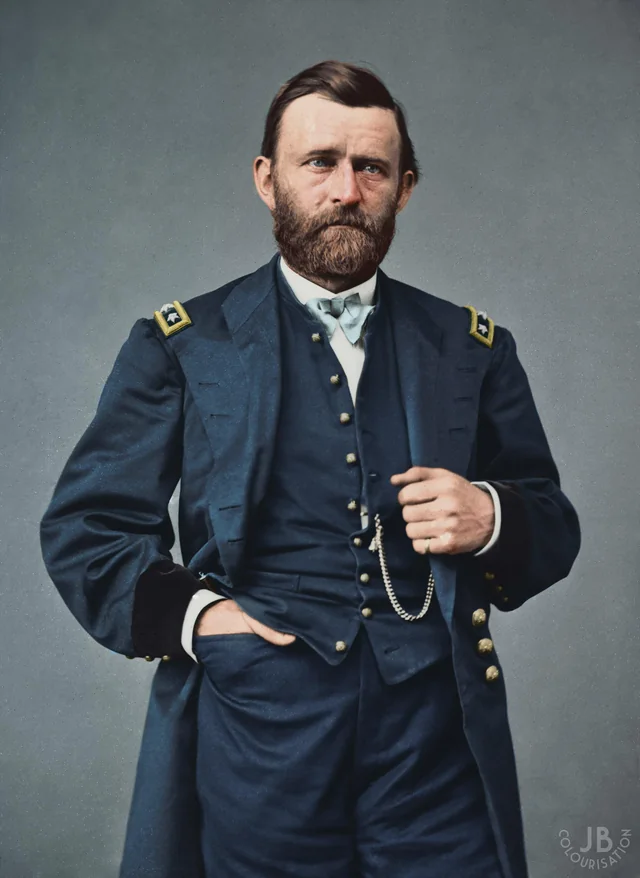
He won the Civil War, broke the Klan, went bankrupt at 62, got terminal throat cancer, and wrote one of the greatest books in American literature in the final year of his life. He finished it 5 days before he died.
Ulysses S. Grant was born 204 years ago today.
His name wasn't even Ulysses S. Grant. He was born Hiram Ulysses Grant in Point Pleasant, Ohio on April 27, 1822. The congressman who nominated him to West Point wrote down the wrong name. Grant kept it. The "S." stands for nothing.
He hated his father's tannery and loved horses. Graduated 21st of 39 at West Point. Fought in the Mexican-American War, then came home convinced it was an unjust war designed to expand slavery. He later said he believed the Civil War was divine punishment for it.
He married Julia Dent in 1848, into a slave-owning Missouri family. His abolitionist father refused to attend the wedding. In 1859, broke and desperate, Grant freed the one enslaved man he'd briefly owned instead of selling him. He could have gotten a year's wages.
In the Civil War he became what no other Union general was: relentless. Vicksburg (July 4, 1863) split the Confederacy in half. Lincoln then gave him every Union army. His Appomattox surrender terms: officers kept sidearms, men kept horses for spring planting, no one prosecuted.
As president (1869 to 1877) he did something no president would do again until LBJ: used federal troops to crush the Ku Klux Klan. He suspended habeas corpus in 9 South Carolina counties, prosecuted Klansmen before predominantly Black juries, and broke the first Klan.
His presidency was also rocked by scandal: Black Friday 1869. Crédit Mobilier. The Whiskey Ring. Belknap. Grant himself never took a dime. He was just disastrously loyal to corrupt friends. The pattern damaged his reputation for a century.
After the White House, he toured the world for 2 years. Dined with Queen Victoria. Met the emperor of Japan. Then in 1884, a Wall Street partner named Ferdinand Ward ran what we'd now call a Ponzi scheme. Grant was wiped out. 62 years old. Penniless.
Weeks later he was diagnosed with terminal throat cancer. Mark Twain offered to publish his memoirs. Grant wrote in agony, sometimes 50 pages a day, racing the disease to leave Julia an inheritance. He finished the manuscript July 18, 1885. He died July 23.
The book made Julia $450,000, about $14M today. It's now considered one of the finest memoirs in the English language. For decades historians ranked Grant a failure. Since 2000 he's jumped 13 spots in the C-SPAN survey, the biggest rise of any president.
Happy birthday, General 🇺🇸
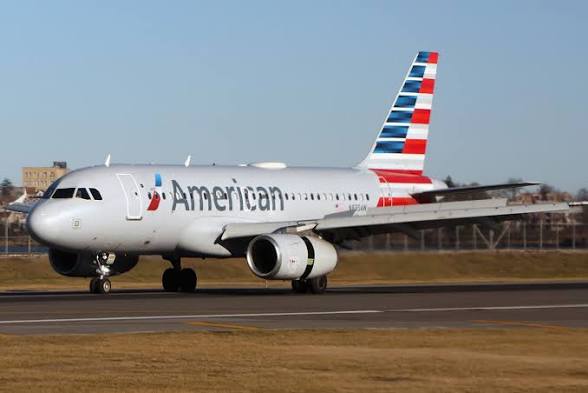
In 1999, David Phillips bought 12,150 cups of chocolate pudding and turned them into 1.25 million free airline miles. Adam Sandler later made a movie about it.
He was a 35-year-old civil engineer at UC Davis when he spotted a Healthy Choice promotion offering 500 frequent flyer miles for every 10 product barcodes mailed in. Double the miles if you sent them in by May 31. Three weeks away.
Phillips ran the math nobody else did. The cheapest qualifying product was Healthy Choice individual pudding cups at Grocery Outlet. 25 cents each. That meant $2.50 of pudding bought 1,000 airline miles. The airlines themselves valued those miles at $20.
He drove a van across California with his mother-in-law, cleaned out 10 different Grocery Outlets around Sacramento, and stacked 12,150 pudding cups from his garage to his living room. When cashiers got suspicious, he told them he was stocking up for Y2K.
There was no way he could peel that many barcodes alone before the deadline.
So he called the Salvation Army and proposed a trade. He'd donate every cup if their volunteers peeled the labels first. They agreed. Phillips kept the barcodes. The Salvation Army fed people with $3,000 worth of pudding. And he claimed an $815 federal tax deduction on the donation.
He mailed the barcodes by May 31 and waited. Two months of silence. His friends told him corporations always renege on these promotions. His own kids asked if he got scammed.
Then a giant package arrived. Paper certificates worth 1,253,000 frequent flyer miles. Lifetime AAdvantage Gold status at American Airlines. $150,000 worth of flights.
The Wall Street Journal put him on the front page in January 2000. The London Times followed a week later. Paul Thomas Anderson read the coverage and built Punch Drunk Love around him in 2002. Phillips paid for his movie ticket with pudding.
Over the next five years he flew his entire family to 43 countries.
Net cost after the tax write-off: $2,325. That's $54 per country.
The flag that Rick Monday rescued 50 years ago today is headed to Cooperstown!
OTD in 1976, Monday, a Cubs outfielder and veteran of the U.S. Marine Corps Reserve, grabbed an American flag from two protesters who had run onto the field at Dodger Stadium and attempted to burn it.
Monday, the longtime Dodgers broadcaster who played 19 years in the Major Leagues, was a two-time All-Star and a World Series champion, has often been asked about the moment.
“If that’s all you’re ever remembered for, that’s not a bad thing at all,” Monday told MLB Network in 2016.
Monday still owns the flag and it will be on loan to the Baseball Hall of Fame this summer as part of America’s 250th birthday celebration. In addition, Monday will be honored on July 25 during induction weekend.
Permanência mediana nos maiores hedge funds multi-manager do mundo:
Point72: 1,8 anos
Balyasny: 1,8 anos
Millennium: 2,3 anos
Citadel: 3,0 anos
A maioria das pessoas que entra num pod shop sai em menos de 2 anos.
Millennium contrata ~160 PMs por ano. Três por semana. E reporta 15-20% de turnover anual como feature do modelo.
As regras são automáticas:
-5% de drawdown: capital cortado pela metade
-7,5%: pod terminado — PM + equipe inteira demitida no mesmo dia
Você pode ser o melhor analista do andar. Pode ter gerado o alpha signal que carregou o book nos últimos 6 meses. Não importa. Quando o PM bate o stop, todo mundo que tá ligado àquele pod sai junto.
"Já vi carreiras sendo arruinadas. Não recebemos grandes bônus e somos tão bons quanto nosso último projeto."
Balyasny gasta US$ 280 mi/ano só em recrutamento. Citadel: US$ 8,6 bi em compensação. Garantias de PM de US$ 10-15 mi são comuns — um PM sênior teria sido atraído com US$ 120 mi+.
Os analistas e pesquisadores não recebem nenhuma dessas garantias. A carreira deles depende inteiramente de qual PM foram designados.
Fonte: Johannes Meyer
This was INCREDIBLE I could watch it a million times! Owen Tippet was floating on ice like a freaking ice god and then dropped it off to Garnet Hathaway! My favorite Hathaway for the record! Man this feels good!! #IgniteTheOrange
During a blowout game, Greg Maddux decided to throw a meatball to Jeff Bagwell for a homer. Why? To set him up for a strikeout when they met again in the playoffs.
Absolute genius he was. The Professor.
BREAKING🚨: Maryland is seriously debating putting tampons in the MEN'S bathrooms at Baltimore Ravens and Orioles stadiums.
Democrat Delegate Ken Kerr, who supports the bill, insisted the tampons must be “appropriately sized.”
Republican Delegate Kathy Szeliga hit back: “What does ‘appropriately sized tampons’ even mean?
Where exactly does a biological male put these?”
This is where your tax dollars and priorities are going, folks. Clown world. 🤡
Bobby Fischer was able to defeat the Soviet school of chess by copying it, and then subverting it through a long term plan. He learned from reading their magazines, studying their games. In the 1960s learning certain openings and structures inside and out was the way to victory. This is something Botvinnik was teaching all the Soviet masters. And they passed this training on. Fischer picked it up in their literature. He didn’t have a Soviet teacher - which is another reason to admire his achievement.
Beyond opening analysis - the USSR masters would focus on consistent endgame play. Fischer became proficient in winning endgames where he had a bishop and his opponent had a knight - he studied this endlessly and became unbeatable in such situations. And he mastered rook endings - which every GM must do.
But his masterstroke to the World Championship was hiding his ideas until 1972. Fischer was so good that he beat everyone to become the challenger to Boris Spassky. But in doing so he played the openings everyone expected him to play. What he had been playing for a decade. The Soviets knew what he would do, prepared for it - but Fischer beat them anyway.
Then he shifted course.
When he played Spassky for the actual World Championship in Iceland, he unleashed new ideas in the Benoni, the Alekhine, the Queen’s Gambit. These were openings he mostly avoided his entire career. He had planned this stuff for years. For one moment in 1972. And he delivered.
It’s an extraordinary achievement. It was a feat of great planning. And Fischer was the GOAT because he put far more distance between himself and every other player than anyone else - including Kasparov and Carlsen - has ever achieved.
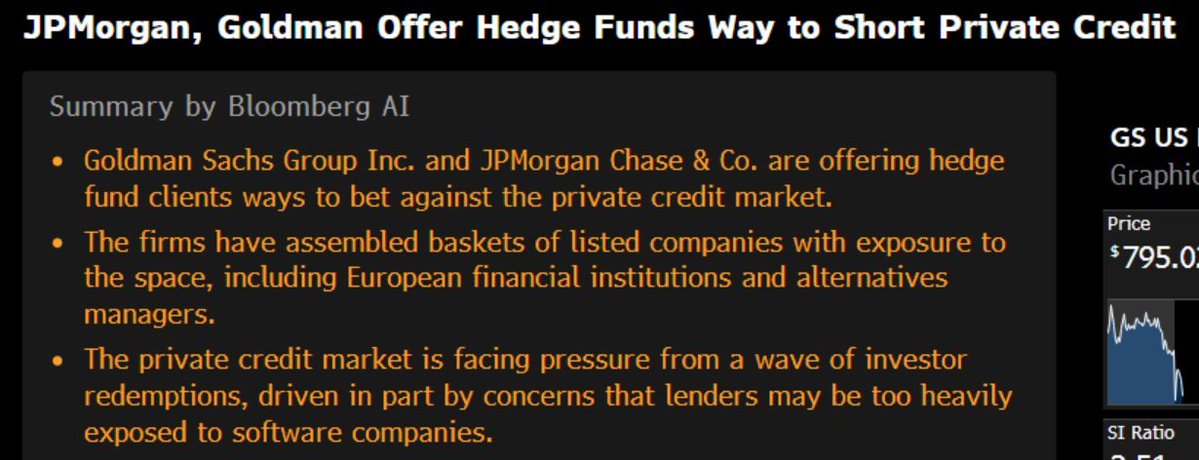
JPMorgan and Goldman Sachs are now offering hedge funds ways to short the $1.8 trillion private credit market.
They've assembled baskets of companies with exposure, alt managers, BDCs, and lenders tied to private credit. This isn't speculation. These are structured products designed to bet against an entire sector.
Private credit defaults hit a record 9.2% in late 2025. Blackstone's $82 billion flagship credit fund saw $6.5 billion in redemption requests in Q1. BlackRock had to cap withdrawals after requests hit 9.3% of its HPS fund. Morgan Stanley and Cliffwater are also gating redemptions.
JPMorgan already started marking down software-related loans in private credit portfolios. When the banks that lend to these funds start cutting the value of the collateral, it forces deleveraging at the worst possible time.
US banks have lent nearly $300 billion to private credit providers. The exposure is not contained.
Goldman's own data shows hedge funds are "aggressively shorting" financial stocks, the most-sold sector of the year. Financials are down 11% on the S&P.
The same banks that helped build the private credit boom are now building the tools to bet against it.
If that sounds familiar, it should.
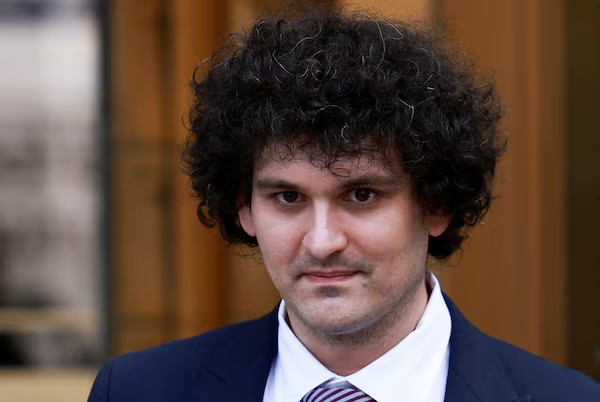
Sam Bankman-Fried had the best venture portfolio in history
What SBF bought vs. what it's worth today:
• Anthropic: $500M → $30.4B (+5,980%)
• Robinhood: ~$546M → $5B (+816%)
• Solana: 60M SOL at ~$8 → $5.3B at $89 (+1,012%)
If he did nothing illegal, he'd be worth $40 billion today
Instead he's now he's inmate #37244-510