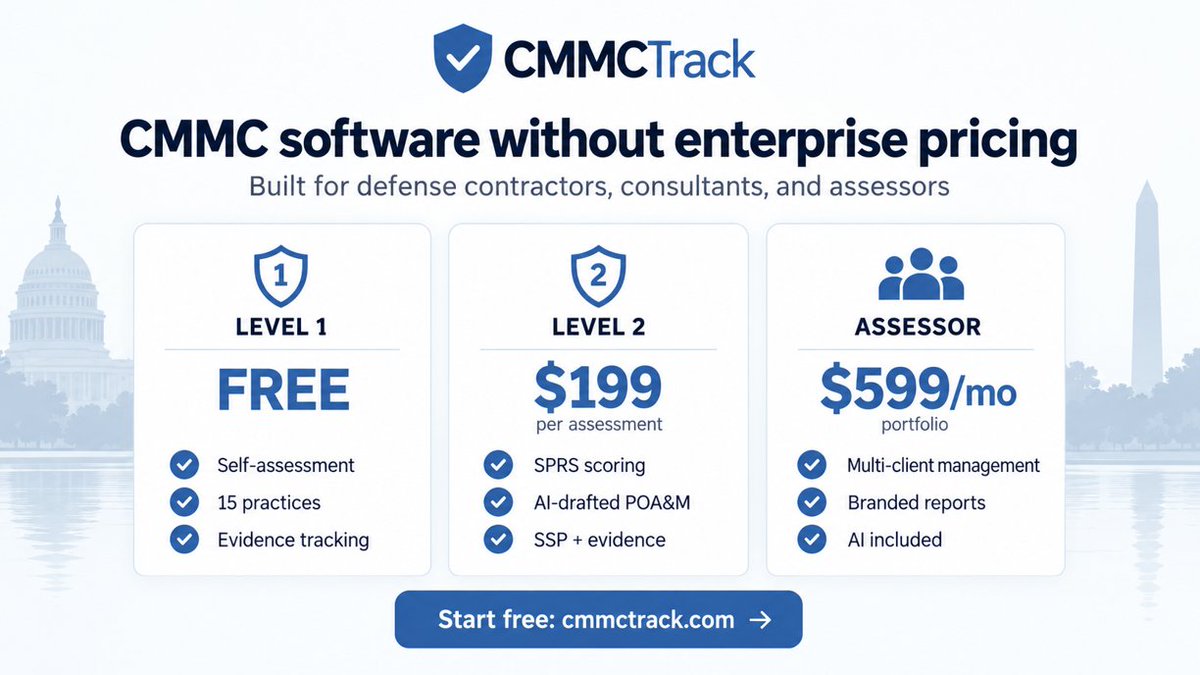
Why pay enterprise prices for CMMC software?
CMMCTrack:
- L1 self-assessment: FREE
- L2 self-assessment: $199 per assessment
- SPRS scoring: Built in
- AI-drafted POA&M: Built in
- SSP + evidence: Built in
- Assessor portfolio: $599/month
Self-assessor? Pay for the assessment, not another subscription.
Consultant or assessor? Manage multiple clients from one portfolio.
https://t.co/gANjcmf61m
@FrontlineTalks The biggest blocker I hear is confidence in the answer. Many subs have security controls in place but cannot map each practice to current evidence or confirm the CUI boundary. When an affirming official must sign, “we probably do that” is not enough.
How does a prime find a qualified subcontractor without asking every company the same CMMC questions?
A public list of who handles CUI would create risk.
An opt-in directory could show capabilities, NAICS codes, service area, and verified CMMC status without exposing CUI holdings.
Your MSP can configure MFA, manage endpoints, and collect logs.
It cannot inherit your CMMC accountability.
The contractor still owns the scope, assessment answers, policies, and evidence behind them.
Outsource the work when it helps. Do not outsource the judgment.
CMMC software should reduce uncertainty, not add another maze.
We improved CMMCTrack’s first-assessment experience with clearer orientation, better resume paths, and more direct next steps.
Less time figuring out the tool. More time working through the assessment.
https://t.co/VSZdkQwJD4
A screenshot can be valid CMMC evidence today and useless six months from now.
Every evidence item should answer:
What practice does it support?
When was it collected?
Who reviewed it?
Is it still current?
Evidence without context becomes another folder someone has to investigate.
Moving CUI into a compliant cloud does not make your company compliant.
The provider may supply inherited controls. You still own configuration, identities, endpoints, policies, and evidence.
A secure platform can reduce the work. It cannot perform your responsibilities for you.
CMMC reform is still being shaped, and one problem is getting overdue attention: inconsistent CUI markings.
@DoW_CIO says listening sessions and RFI responses identified this as a source of friction across the DIB.
You cannot scope what is not identified consistently.
The System Security Plan is where CMMC self-assessment stalls. 110 NIST SP 800-171 practices, each requiring an implementation narrative specific to your environment.
The C3PAO expects to see how each control operates in your network, not a restatement of NIST language.
Vanta and Drata built their product around SOC 2 continuous monitoring. CMMC arrived and they bolted on 110 NIST 800-171 practices as another framework checkbox.
A 30-person defense contractor does not need a $7.5K/yr SOC 2 pipeline.
You need a defensible SPRS score.
The System Security Plan is the one CMMC Level 2 document nobody wants to write.
110 implementation narratives, one per NIST 800-171 practice.
Your IT manager did not sign up to be a technical writer, but the C3PAO expects the SSP coherent, not just present.
Exactly. SPRS is not a “percent complete” score. If a practice does not meet the methodology, the better path is to document the gap, maintain the evidence, and work the POA&M rather than stretch the scoring rules.
Have you seen partial-credit misunderstandings come up often in real assessments?
Only 2 of 110 NIST SP 800-171 practices allow partial credit on the DoD Assessment Methodology. The other 108 are binary. If your SPRS score assumed partial credit where none exists, the number you submitted to DoD overstates your compliance.
A 15-person manufacturer handling CUI faces the same 110 NIST 800-171 practices as a 5,000-person prime.
Same SPRS score, same affirmation, fraction of the budget.
Enterprise GRC tools want $7.5K-$80K/yr for that. The gap is where small DIB contractors get squeezed.
Vanta and Drata were built for SOC 2 sales pipelines, not CMMC self-assessment. A DIB contractor handling CUI doesn't need investor-grade dashboards. You need 110 NIST 800-171 practices answered and a defensible SPRS score. Different problem entirely.
A subcontractor can affect your CMMC scope before either company realizes it.
If they receive FCI or CUI, or connect to systems that handle it, their role needs to be understood.
Map the information flow before signing the agreement, not during the assessment.
Passwords are not the only keys attackers want.
NIST and CISA just finalized guidance for protecting identity and access tokens from forgery, theft, and misuse.
Single sign-on improves usability. Token security determines whether that convenience stays safe.
https://t.co/rVTJ6gPcz1
Your CMMC assessment is already in a spreadsheet.
That should not mean starting over.
CMMCTrack imports Level 1 and Level 2 workbooks into a review screen, shows mapping and scoring differences, and creates an editable draft only after you approve it.
Bring the work with you.
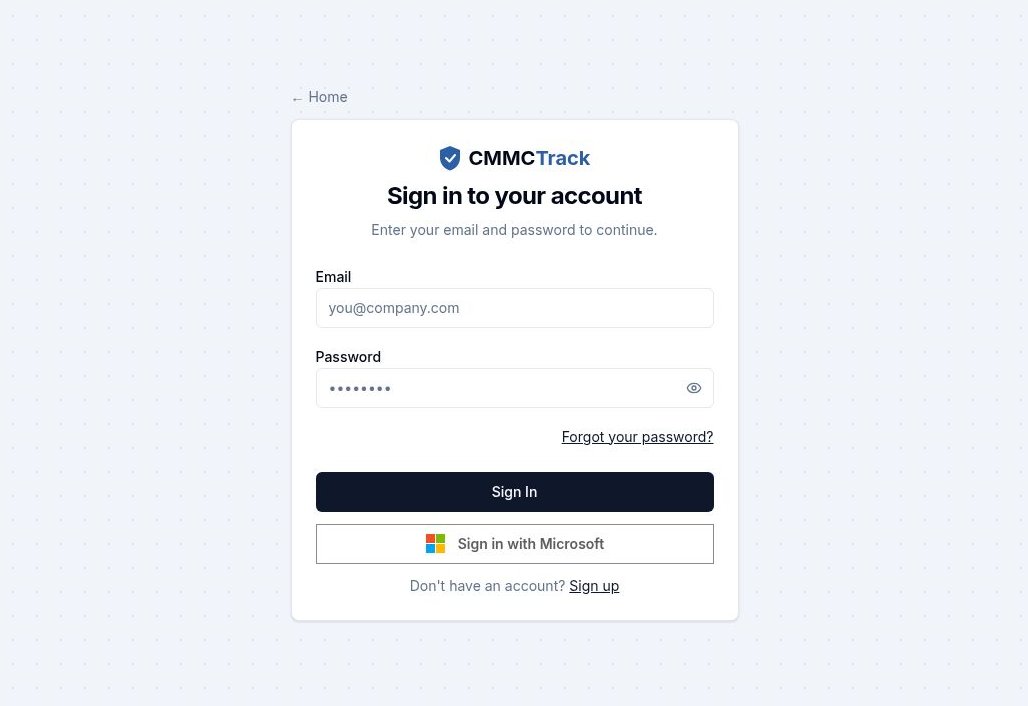
Microsoft sign-in is now live in CMMCTrack.
Contractors, consultants, MSPs, and assessors can use their Microsoft work account to get started, with one less password to manage.
A small button that makes onboarding much easier.
https://t.co/pbPArUUcAh
A CMMC score is a snapshot.
The real story is the work behind it.
Which practices changed?
What evidence was added?
Which gaps remain?
Who owns the next action?
CMMCTrack keeps the assessment, evidence, observations, and remediation work connected.