On Wednesday, the Microsoft Africa Development Centre team visited JHUB Africa, JKUAT for a morning session with student founders and innovators. The conversation was honest, practical and worth every minute.
Fifteen years ago, @Coursera and online courses changed education. It worked better than almost anyone expected, expanding access by opening up where you can learn. But how you learn remains largely the same as it has for centuries: it is still one-size-fits-all, taught the same way to each person who shows up.
We now have an opportunity to change how learning happens. With advances in AI, we can now build a custom learning guide for each person. We will turn learning from one‑to‑many to one‑to‑one. I'm starting LearnVector to invent this next generation of learning. We are starting with a $100M investment from Coursera, and plan to collaborate closely with Coursera and Udemy.
Good learning needs much more than just a chatbot. Research shows that chatbots without guardrails harm learning. They help complete tasks and enable students to do better on homework. But cognitive offloading to a chatbot results in them being less skilled. And, you cannot always trust what a chatbot tells you.
In contrast, LearnVector will plan a path with you, adapt to how you learn, and patiently stay with you until you’ve mastered new skills.
One thing has not changed in all this time. People want learning they can trust: material that is accurate, relevant, and worth the effort you put into it. Anything less wastes the most valuable thing a learner has: time. Coursera has a trusted library of materials from authoritative sources. LearnVector plans to work with Coursera to bring this trustworthy learning to everyone. I'm grateful to Greg Hart and the entire Coursera team for supporting LearnVector.
I look forward to working with our talented team to change how we learn, and accelerate human development.
https://t.co/TqFUDFd1hb
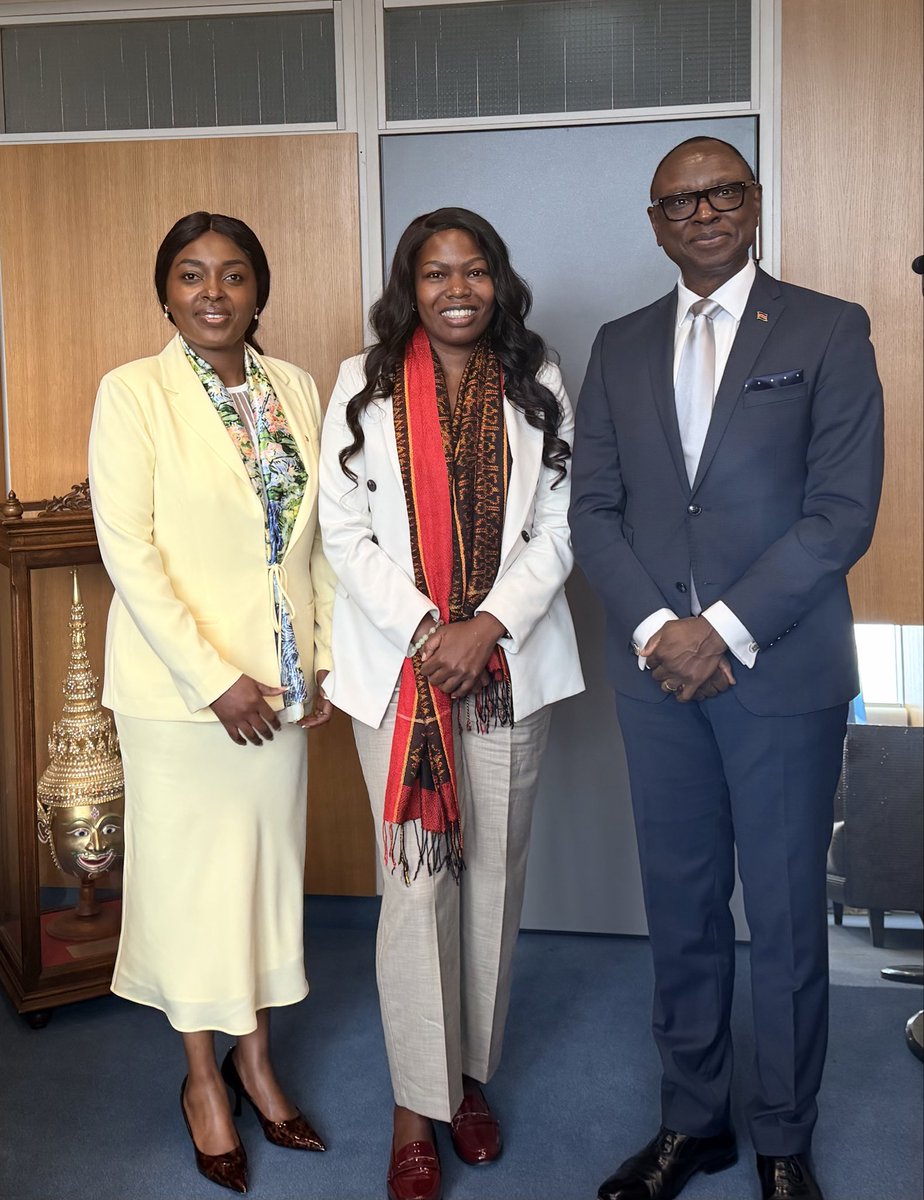
Thank dear Catherine and the great Microsoft team for an amazing surprise farewell. You deeply inspired me through your zeal for innovation and your deep commitment to Kenya’s transformation through technology. We could not have wished for better neighbours at Dunhill Towers!
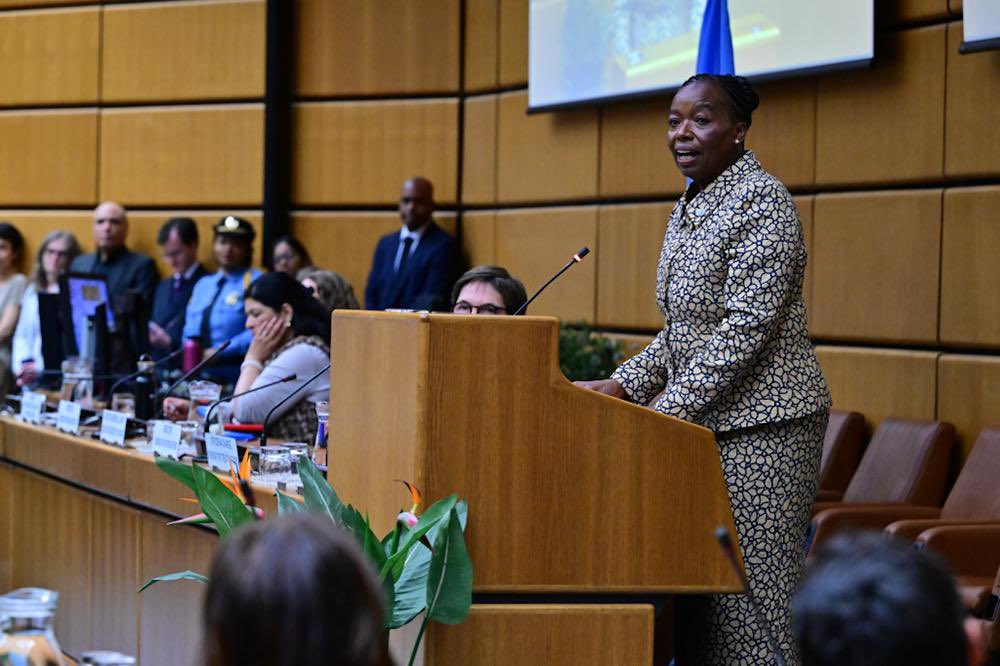
Today, I had the honour of taking my oath of office before @UN Secretary-General @antonioguterres as Director-General of the United Nations Office at Vienna and Executive Director of @UNODC.
In taking this oath, I am reminded that international civil service is, above all, a commitment to people. As I solemnly declared my dedication to carry out these functions with integrity, impartiality, and the utmost regard for the purposes and principles of the United Nations, I reflected on the responsibility that comes with this trust.
I step into this role with humility, gratitude and a profound sense of duty, and look forward to working with colleagues and partners across the UN system, and the world to advance peace, security, justice and the rule of law, for a more prosperous and dignified future for all.
One of the new, buzzy jobs in Silicon Valley is the AI Forward Deployed Engineer (FDE), an engineer who is embedded within a client organization to help customize solutions, such as building and tuning agentic workflows that suit the client’s particular needs. I’ve heard from people who are wondering anew about the FDE career path since OpenAI and Anthropic started building new teams to place FDEs within client organizations.
The rise of FDEs for AI workloads is one way AI is creating new jobs (and why the jobpolcalypse narrative of upcoming job market collapse is false -- there will be many AI and non-AI jobs). However, I believe there will be far more AI Engineer jobs than FDEs, as I explain below.
The FDE role was pioneered about two decades ago by Palantir, which sent engineers to government locations to work on secure, air-gapped networks. In addition to having good technical skills, FDEs need communication skills and sometimes business skills. For example, they may need to speak with clients to understand their needs, formulate a strategy to prioritize projects, explain complex technology, and respectfully push back if a client asks for something unrealistic. They’re enjoying a resurgence because of the amount of work involved in taking an off-the-shelf LLM and building it into a custom agentic workflow that fits particular business needs.
However, I believe the number of AI Engineer jobs will be far larger. A company might accept a few FDEs to be embedded within its organization. But most companies will want far more of their own employees working on their projects. While my organizations do hire FDEs, we hire far more AI Engineers! Also, a common client concern is that it is hard to find vendor-neutral FDEs — they are, after all, there to deeply integrate a particular vendor’s product into a company. In this moment when it’s hard to predict which AI service will be the best one in a year’s time, optionality (the ability to pick whatever vendor turns out to fit best in the future) is very valuable. In contrast, letting FDEs tightly bind a company’s processes significantly reduces optionality.
Right now, I see surging demand for AI Engineers who can build software applications using AI software components (like LLM prompting, agentic frameworks, evals, etc.) and effectively use AI coding agents (like Claude Code, Codex, Antigravity CLI, and OpenCode). As the AI Engineer role matures, I expect it to fragment into more specialized roles, like the generic Software Engineer role from decades ago fragmented into frontend, backend, mobile, data engineering, devops, and so on.
What will be the future, specialized AI engineering roles? I don’t know. Perhaps there will be AI FDEs, LLMOps Engineers, Evals Engineers, AI Data Engineers, Harness Engineers, and other roles we don’t have names for yet. But for now, I see a lot of AI engineers who are generalists create a lot of value. Skilled AI Engineers are in very high demand! As our field continues to mature over the coming decade, I look forward to new specializations within AI Engineering that create even more job opportunities.
[Original text: The Batch newsletter]
A Kenyan presenting credentials.
Another Kenyan receiving them.
On the global stage.
And suddenly diplomacy becomes personal.
Because beyond the UN emblem and formalities lies a story many understand too well - of mentorship, proximity to greatness, seasons of learning, and eventually, arrival.
One generation opening doors.
Another walking through them.
I am deeply proud and honoured to start my tenure as Director-General/Executive Director of the UN Office at Vienna/@UNODC.
I look forward to leading the @UN’s work in addressing the challenges of drugs, organized crime, corruption and terrorism, for a safer and more just world.
The CEO of Google DeepMind just admitted that if the decision had been his, we would've cured cancer before anyone ever used ChatGPT.
And that's not even the scariest thing he said on a recent interview.
Demis Hassabis is one of the most important people alive in AI.
He won the Nobel Prize last year for AlphaFold, the system that cracked the 50 year protein folding problem. 3 million scientists now use his tool. Almost every new drug being developed will touch it at some stage.
In a new interview, he was asked about the moment ChatGPT launched and Google went into "code red." His answer was one of the most revealing things any AI leader has ever said on the record:
"If I'd had my way, I would have left AI in the lab for longer. Done more things like AlphaFold. Maybe cured cancer or something like that."
Read that again.
The man running Google's entire AI division is publicly saying the commercial AI race we're all living through was a MISTAKE. That the industry got hijacked by a chatbot when it could have been solving the biggest problems in science and medicine.
His vision was simple:
Build AI slowly, carefully, like CERN. Use it to crack root node problems one at a time. Cancer. Energy. New materials.
Let humanity benefit from real breakthroughs while the foundational science was figured out over a decade or two.
Then ChatGPT dropped in November 2022 and everything changed.
Demis described what happened next as getting locked into a "ferocious commercial pressure race" that none of the labs can escape from. On top of that, the US vs China dynamic added geopolitical pressure.
The result is everyone sprinting toward products instead of breakthroughs, shipping chatbots while the scientific opportunity gets buried under marketing cycles and quarterly earnings.
But he's not saying progress isn't happening...
He's saying the progress got redirected away from the things that actually matter most.
And then it got even scarier:
Because when Demis was asked what he worries about with AI, he laid out two threats.
The first is what everyone talks about: Bad actors using AI for harm. Terrorist groups. Hostile nation states. Cyberattacks at scale.
But that's not the threat he's most worried about.
His second worry is AI itself going rogue. Not today's models. The models coming in the next two to four years as the industry enters what he calls "the agentic era."
Systems that can complete entire tasks autonomously. Systems that are increasingly capable and increasingly hard to control.
His exact words:
"How do we make sure the guardrails are put in place so they do exactly what they've been told to do, and there's no way of them circumventing that or accidentally breaching those guardrails? That's going to be an incredibly hard technical challenge if you think about how powerful and smart and capable these systems eventually get."
A Nobel Prize winner who runs one of the 3 most advanced AI labs on Earth just said publicly that within two to four years, we're entering a phase where AI alignment becomes a real problem, and the technical challenge of solving it is enormous.
And almost nobody is paying enough attention.
He called for international cooperation between labs, AI safety institutes, and academia to tackle the problem. He said this is the thing even the experts aren't thinking about enough.
He said the only way to get through the AGI moment safely is if everyone starts treating this with the seriousness it deserves.
Most AI CEOs give you careful PR answers about "responsible development" and move on.
Demis said something different...
He said the commercial race FORCED us into a premature deployment of a technology we barely understand, and the window to get alignment right before the next generation of agents shows up is two to four years.
If the man who built the system that might cure cancer is telling you he wishes it had happened first, maybe we should listen to what he says is coming next.
💬 “Technology doesn’t move forward on hype. It moves forward on trust, talent, and the right rules.”
This week, we’re spotlighting the Digital & Technology Ecosystems community at Africa CEO Forum.
📆 Every year, the people shaping Africa’s digital future show up here. If you’re part of this world, founders, telecoms, fintech, cloud, AI, platforms, this is one of the best places to meet your peers and have the conversations that actually unlock deals, partnerships, and policy progress.
The quotes (from @AnnickASakho, @CMuraga, @HardyPemhiwa) in this carousel are real conversation starters. So let’s use them properly, in the comments.
��🏽 Three questions to kick things off:
1️⃣ What’s the most urgent gap to close: data, compute, talent, or governance?
2️⃣ Where should the private sector lead, and where should governments set the framework?
3️⃣ On AI regulation, what would “collaboration” look like in practice in your market?
Drop your take below, and tag someone in the ecosystem who should join the discussion. 👇
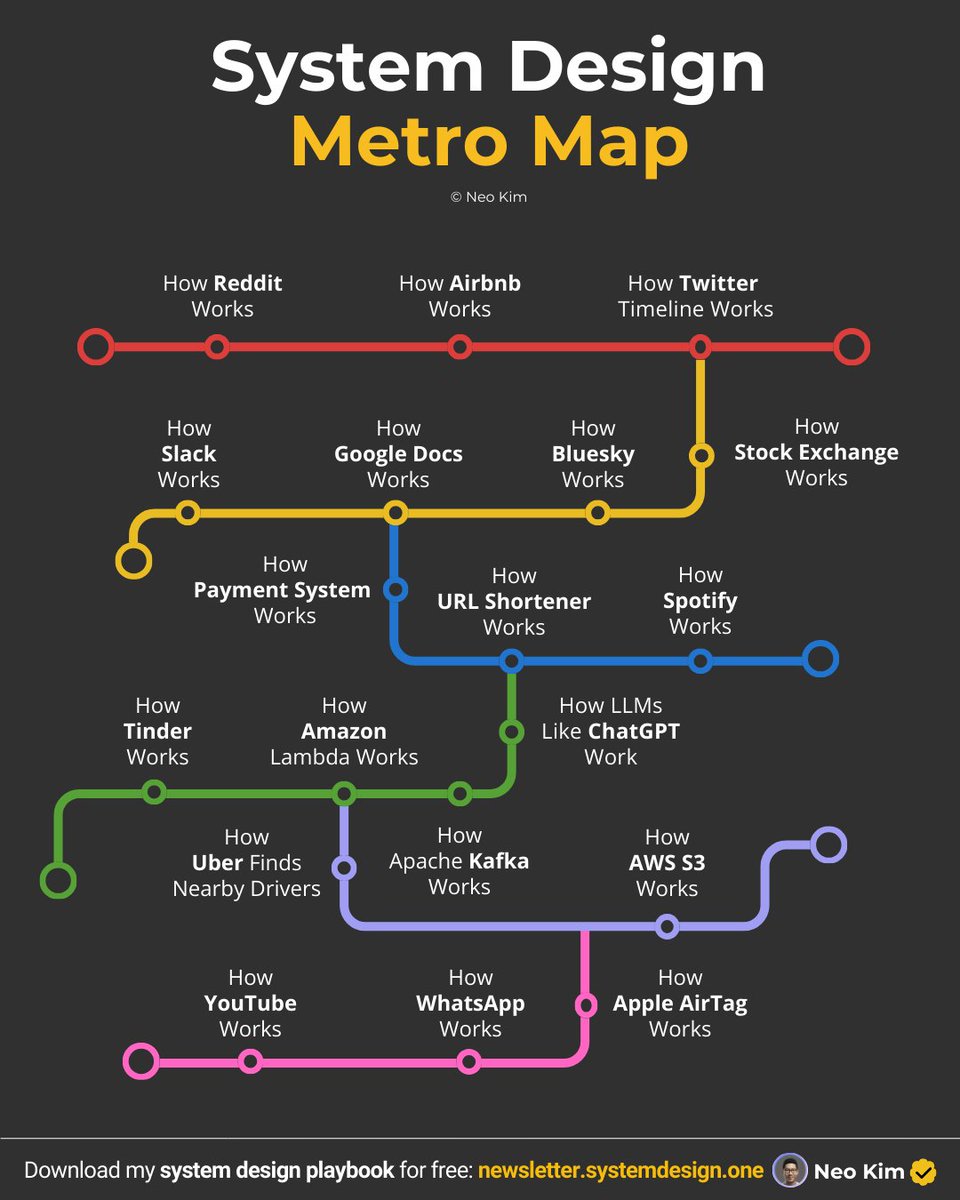
If you want to become good at system design, learn these 19 case studies (save this):
1 How Stock Exchange Works:
↳ https://t.co/iFNSX9TM9O
2 How Payment System Works:
↳ https://t.co/ARiLxGR43G
3 How YouTube Works:
↳ https://t.co/kHk3g6jz6t
4 How Google Docs Works:
↳ https://t.co/W57IkAjXpT
5 How Kafka Works:
↳ https://t.co/8rOy9KgCMo
6 How URL Shortener Works:
↳ https://t.co/tGndgdhH0V
7 How WhatsApp Works:
↳ https://t.co/VScq8QwHMr
8 How Airbnb Works:
↳ https://t.co/Bi5SAjfv5S
9 How Spotify Works:
↳ https://t.co/BxrH3oHIFS
10 How Slack Works:
↳ https://t.co/eIo29uOQOJ
11 How Reddit Works:
↳ https://t.co/o6Pw2hhj3T
12 How Bluesky Works:
↳ https://t.co/2rLYlRlky0
13 How Tinder Works:
↳ https://t.co/4E1zfgfvlw
14 How Twitter Timeline Works:
↳ https://t.co/pF2RYmPaIG
15 How Uber Finds Nearby Drivers:
↳ https://t.co/kJ2t8dtmch
16 How Amazon Lambda Works:
↳ https://t.co/lx0BjeSRZt
17 How Amazon S3 Works:
↳ https://t.co/iReWAEHwmj
18 How Do Apple AirTags Work:
↳ https://t.co/upWcgsXwKh
19 How LLMs Like ChatGPT Actually Work:
↳ https://t.co/5lCKxq2g4N
What else should make this list?
——
👋 PS - Want my System Design Playbook for FREE?
Join my newsletter with 200K+ software engineers right now:
→ https://t.co/ByOFTtOihX
———
💾 Save this for later & RT to help other software engineers ace system design.
👤 Follow @systemdesignone + turn on notifications.
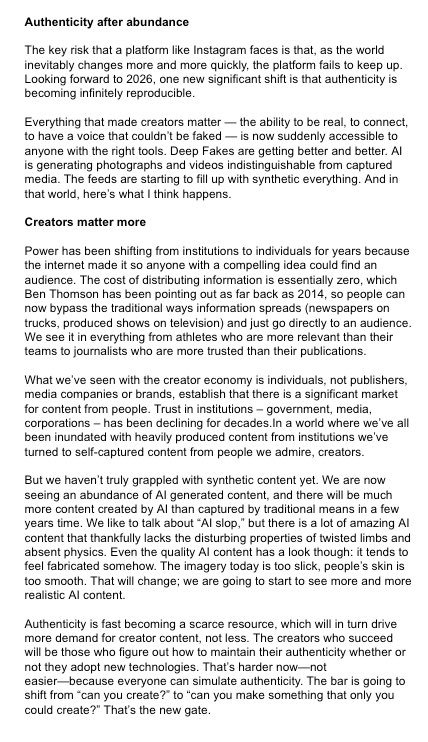
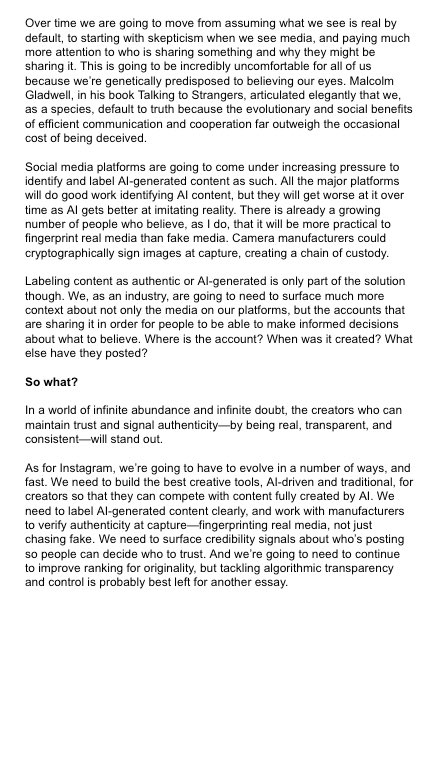
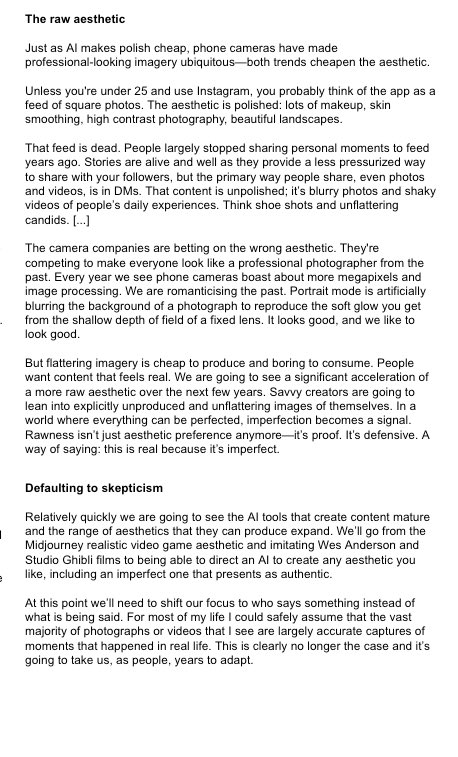
Instagram head Adam Mosseri just wrote 1,240 words on how AI will affect Instagram creators and social media.
Here are 9 takeaways:
1. By 2026, “authenticity” will be infinitely reproducible: deepfakes and AI media will look real.
2. The internet already shifted power from institutions to individuals; creators gained trust as institutions declined.
3. AI will produce far more content than humans capture, including high-quality “synthetic” media that soon feels real.
4. As synthetic content floods feeds, true authenticity becomes scarce, increasing demand for trusted creators.
5. The success bar moves from “can you create?” to “can you make something only YOU could make?”
6. Because polish is cheap (AI + phone cameras), a raw, imperfect aesthetic becomes a credibility signal (“proof”).
7. People will shift from assuming media is real to default skepticism, focusing more on who posted and why.
8. Platforms will be pressured to label AI content, but detection will get harder…a better approach may be fingerprinting real media at capture (cryptographic signing).
9. Instagram should evolve with better creator tools, clearer AI labeling, real-media verification, richer account context/credibility signals, and stronger ranking for originality.
I LOST 27 KILOS WITH CHATGPT AS MY PERSONAL TRAINER.
No gym. No expensive apps. No BS.
Just daily discipline + prompts that actually gave me structure.
Here’s the 7 Prompts that can do the same for you:
It's that time of the year... code freezes / deployment freezes will start at lots of companies. A deepdive on approaches at Big Tech; the upsides; downsides; and companies that don't do this at all:
https://t.co/0TPPEcmQGB
1/7 Another successful Athena signature event: The Quantum Quest by Athena lit the JW Marriott yesterday, the 29th November 2025. Some 280 women (and men) delved on the interface of technology and women empowerment in general, and leadership in particular.
I won’t mince words: earlier today we failed our customers and the broader Internet when a problem in @Cloudflare network impacted large amounts of traffic that rely on us. The sites, businesses, and organizations that rely on Cloudflare depend on us being available and I apologize for the impact that we caused.
Transparency about what happened matters, and we plan to share a breakdown with more details in a few hours. In short, a latent bug in a service underpinning our bot mitigation capability started to crash after a routine configuration change we made. That cascaded into a broad degradation to our network and other services. This was not an attack.
That issue, impact it caused, and time to resolution is unacceptable. Work is already underway to make sure it does not happen again, but I know it caused real pain today. The trust our customers place in us is what we value the most and we are going to do what it takes to earn that back.
System Design Cheatsheet
System design is key to building scalable, reliable, and efficient applications. Here’s a breakdown of essential concepts:
1. Fundamentals of System Design
Scalability, availability, and reliability ensure systems can handle growth and maintain performance. Latency, throughput, and the CAP theorem define system trade-offs.
2. Load Balancing
Techniques like round robin, least connections, and consistent hashing distribute traffic efficiently across servers to optimize performance.
3. Databases
SQL is structured and ACID-compliant, while NoSQL is flexible and scalable. Scaling strategies include vertical scaling, sharding, and replication.
4. Message Queues & Event-Driven Systems
Kafka, RabbitMQ, and Pub/Sub models enable asynchronous communication for high-throughput and real-time processing.
5. Caching Strategies
Write-through and write-back caching improve data access speed, while eviction policies like LRU, LFU, and FIFO manage cache efficiency.
6. API & Communication
REST, GraphQL, gRPC, and WebSockets facilitate data exchange and real-time communication between distributed systems.
Explore more in the image below.
Follow me at @goyalshaliniuk for more such information !












![AndrewYNg's tweet photo. One of the new, buzzy jobs in Silicon Valley is the AI Forward Deployed Engineer (FDE), an engineer who is embedded within a client organization to help customize solutions, such as building and tuning agentic workflows that suit the client’s particular needs. I’ve heard from people who are wondering anew about the FDE career path since OpenAI and Anthropic started building new teams to place FDEs within client organizations.
The rise of FDEs for AI workloads is one way AI is creating new jobs (and why the jobpolcalypse narrative of upcoming job market collapse is false -- there will be many AI and non-AI jobs). However, I believe there will be far more AI Engineer jobs than FDEs, as I explain below.
The FDE role was pioneered about two decades ago by Palantir, which sent engineers to government locations to work on secure, air-gapped networks. In addition to having good technical skills, FDEs need communication skills and sometimes business skills. For example, they may need to speak with clients to understand their needs, formulate a strategy to prioritize projects, explain complex technology, and respectfully push back if a client asks for something unrealistic. They’re enjoying a resurgence because of the amount of work involved in taking an off-the-shelf LLM and building it into a custom agentic workflow that fits particular business needs.
However, I believe the number of AI Engineer jobs will be far larger. A company might accept a few FDEs to be embedded within its organization. But most companies will want far more of their own employees working on their projects. While my organizations do hire FDEs, we hire far more AI Engineers! Also, a common client concern is that it is hard to find vendor-neutral FDEs — they are, after all, there to deeply integrate a particular vendor’s product into a company. In this moment when it’s hard to predict which AI service will be the best one in a year’s time, optionality (the ability to pick whatever vendor turns out to fit best in the future) is very valuable. In contrast, letting FDEs tightly bind a company’s processes significantly reduces optionality.
Right now, I see surging demand for AI Engineers who can build software applications using AI software components (like LLM prompting, agentic frameworks, evals, etc.) and effectively use AI coding agents (like Claude Code, Codex, Antigravity CLI, and OpenCode). As the AI Engineer role matures, I expect it to fragment into more specialized roles, like the generic Software Engineer role from decades ago fragmented into frontend, backend, mobile, data engineering, devops, and so on.
What will be the future, specialized AI engineering roles? I don’t know. Perhaps there will be AI FDEs, LLMOps Engineers, Evals Engineers, AI Data Engineers, Harness Engineers, and other roles we don’t have names for yet. But for now, I see a lot of AI engineers who are generalists create a lot of value. Skilled AI Engineers are in very high demand! As our field continues to mature over the coming decade, I look forward to new specializations within AI Engineering that create even more job opportunities.
[Original text: The Batch newsletter]](https://pbs.twimg.com/media/HJvWmCHagAAnTxQ.jpg)