Lol
“Impossible to fake energy” is not the case for BTC. It is the case for a furnace.
Yes, proof of work expends energy. That proves energy was spent. It does not prove utility, scalability, commercial value, or that the system functions as digital cash.
You can burn electricity honestly and still produce something useless.
The economic question is not “was energy consumed?” The question is “what service was delivered for that energy?”
BTC delivers a speculative ticker, limited throughput, high-friction settlement, and excuses. Calling that “based on energy” does not make it sound money. It makes it an expensive heat lamp with a cult attached.
I do not think people properly considered what would happen when ETFs were introduced into BTC.
They imagined institutional adoption.
What they actually created was a more elegant speculative machine.
An ETF can be harmless, even useful, when the underlying asset has an independent economic use. If an ETF buys natural gas, oil, wheat, or copper, it may distort the market at the margin. It may amplify flows. It may create temporary mispricing. But the underlying commodity still has an economic anchor.
Natural gas is burned.
Oil is refined.
Wheat is eaten.
Copper is wired into civilisation.
The ETF can speculate upon the commodity, but it does not create the commodity’s reason for existing.
Eventually physical demand, storage cost, production cost, substitution, inventory, transport, and industrial consumption impose discipline. Reality enters the room, somewhat late perhaps, but still carrying the accounts.
BTC is different.
BTC does not have an underlying commercial use sufficient to anchor its price. It cannot function as money at scale. It does not process ordinary economic life. It does not settle global commerce. It is not a productive input. It is not consumed. It is not transformed. It does not become energy, food, housing, machinery, or industrial output.
So when an ETF buys BTC, it is not wrapping an asset whose price ultimately rests upon use.
It is wrapping the speculation itself.
That is the fatal distinction.
The ETF does not deepen economic utility. It deepens exposure to an asset whose principal demand comes from the expectation of future buyers.
And once that is understood, the structure becomes rather less impressive.
In commodities, the ETF sits atop an economy.
In BTC, the ETF sits atop a narrative.
That matters because when the price rises, ETF inflows appear to validate the story. The faithful call it adoption. The market calls it demand. Promoters call it inevitability.
But it is not adoption in the commercial sense.
It is merely more capital entering the wager.
Then the cycle reverses.
When performance turns negative and remains negative, ETF holders redeem. Redemptions require exposure to be reduced. The structure that once created buying pressure becomes selling pressure. The machine that once inflated the market begins deflating it.
With commodities, the fall eventually meets industrial demand.
With BTC, the fall meets slogans.
That is not much of a bid.
This is where the mistake was made. People treated ETF approval as proof that BTC had become institutional money. In reality, it became an institutionalised speculative instrument without the underlying monetary function necessary to support the valuation.
A thing that cannot be used as money does not become money because Wall Street packages it more neatly.
A bubble inside an ETF is still a bubble.
It merely wears a better suit.
So welcome to the death cycle.
ETF inflows lift the price.
The higher price attracts more speculative capital.
The speculative capital mistakes price for value.
Then performance turns.
Redemptions begin.
Selling pressure rises.
The price falls.
The falling price weakens the narrative.
The weakened narrative accelerates redemptions.
And because there is no underlying commercial utility to catch the asset, the entire structure begins feeding upon itself.
That is not institutional adoption.
That is a liquidation mechanism waiting for disappointment.
As with railways, internet firms, mortgage finance, and other technologies caught inside speculative manias, the collapse of the overcapitalised financial wrapper does not imply the death of the underlying technology. It implies reallocation. A BTC stress regime would likely destroy speculative collateral narratives while redirecting surviving capital toward scalable transaction processing, auditability, data integrity, micropayments, and enterprise service provision.
At this point, the BSV community is the only one with a realistic view of crypto.
Every other community is delusional, including BCH. They all think having Grayscale backing, WEF backing, institutional backing, and BlackRock backing is a good thing for crypto.
Rugpull nation.
Then why are you talking about BTC?
BTC is a centralized system controlled by a small cadre aligned with government and plutocratic interests from the top.
BTC's not distributed in any meaningful sense. A system can only remain decentralized when the protocol is set in stone, so the rules of the game cannot be manipulated.
For years people have been arguing about digital ownership while carefully avoiding the one question that actually matters.
Can a digital object be property?
Not a licence. Not a subscription. Not a permission granted by a corporation. Not a token that points to something stored somewhere else.
Property.
Something that can be possessed by one person and transferred to another.
Every so-called NFT system has failed this test. Ethereum fails it. BTC fails it. Solana fails it. Every digital collectable platform on earth fails it.
They move records of ownership while leaving the underlying asset infinitely reproducible.
The token moves.
The file remains.
The receipt changes hands.
The asset does not.
That is not property. It is bookkeeping.
The fundamental characteristic of property is exclusion. If I own a gold coin and hand it to you, I no longer possess it. If I own a book and sell it, it leaves my shelf and arrives on yours.
Property requires transfer.
Digital systems have never achieved this because digital information is naturally copied. Every computer system, every network, every database, every file system was built upon replication.
What I have been building attacks that assumption directly.
Not a better token.
Not a better NFT.
Not a better marketplace.
A system intended to create actual digital property.
BSV isn’t just “another crypto” — it’s the ONLY chain built to keep your money sovereign AND your data private at scale.
Massive blocks = low fees, real utility, and no need for surveillance-layer hacks.
Own your wealth.
Control your data.
Everything else is compromise!! 💯
The IPv6 Forum's Call
Why the formal call for IPv6-only transition matters for the architecture being assembled
By MrBen
In May 2026, Professor Latif Ladid, founder and President of the IPv6 Forum, published a position paper titled "Call for IPv6-Only and Blockchain on Agentic AI." It is a formal call from the global authority on IPv6 standards for worldwide transition to IPv6-only networks, and it names BSV blockchain as the trust and economy layer for the Internet of Agents.
This paper deserves attention not because BSV is named, which those who know Ladid's work will not find surprising, but because the IPv6 Forum is making a formal institutional call at a specific moment. That moment is the same moment the rest of this sequence has been documenting. The architecture is reaching the point where formal calls to action are being issued by the standards-setting bodies.
The IPv6 Forum and what it does.
The IPv6 Forum is the international body that has been advocating for IPv6 adoption since 1999. It works with governments, standards bodies, network operators, and equipment vendors to coordinate the global transition from IPv4 to IPv6. Ladid has led the forum throughout its existence and is one of the senior figures in global networking infrastructure.
When the IPv6 Forum issues a formal call for action, it is not commentary. It is policy direction from the body that coordinates IPv6 deployment globally. The forum's calls have historically preceded national IPv6 mandates, enterprise deployment programmes, and standards body decisions.
Ladid's current call is for a worldwide full transition to IPv6-only for enterprise and government networks. The paper notes that the big countries are now crossing 60 percent IPv6 penetration, with six countries above 70 percent. France at 86 percent, China at 77 percent, Germany at 76 percent, Belgium at 72 percent, India at 70 percent. Dual-stack deployment is described as a temporary compromise that creates ongoing expense and operational complexity. IPv6-only is described as the production-ready vision for AI, 6G, Blockchain, peer-to-peer IoT, and enterprise verticals.
Why IPv6-only matters for Agentic AI.
The paper makes a specific architectural argument about why IPv6-only is required for Agentic AI at scale.
Ladid forecasts approximately 900 billion AI agents by the end of the decade. Every agent needs a globally routable address. IPv4 cannot provide that. Network address translation, which is how IPv4 currently handles the address shortage, breaks the end-to-end connectivity that direct agent-to-agent communication requires.
With IPv6, every agent, sensor, container, and device can have a unique globally routable address. Agents can discover each other directly. They can establish peer-to-peer connections without traversing centralised gateways. Service discovery becomes capability-based rather than location-based. An agent can query the network for an agent that can analyse financial risk in Spanish and receive the IPv6 address of a qualified peer.
Without IPv6-only, the machine economy that the agent commerce literature describes cannot operate at scale. The networking layer is the constraint.
https://t.co/TJIk1c0B6n
1 of 3
Later this year, you are going to find that things start appearing.
Some will be under my name.
Some, perhaps, will not.
That is not the important part. Names are useful things, in the same way labels on poison bottles are useful: they help the inattentive avoid consequences. But the work is what matters. The ideas are what matter. The systems are what matter.
And the systems are coming.
For years, people have been told a very comfortable story. They were told that certain things were impossible. They were told that scale had limits. They were told that innovation had to crawl politely through the corridors of approved opinion, bowing before gatekeepers, academics, regulators, bankers, exchanges, committees, and all the other upholstered furniture of institutional fear.
They were told that Bitcoin could not do what it was designed to do.
They were told that micropayments would not work.
They were told that massive scale was fantasy.
They were told that the old intermediaries were permanent.
They were told that the world required friction, delay, permission, settlement layers, custodians, trusted third parties, compliance theatre, and all the greasy little tollbooths of modern finance.
They were told this by people whose livelihoods depend on the lie.
And, naturally, they believed it.
People usually believe the story that asks the least of them. It is easier to believe that the future is impossible than to admit one has spent years worshipping a ceiling built by cowards.
But ceilings are funny things. They look like the sky to men who have never seen a hammer.
Everything you believed was impossible is about to be tested.
The limits you thought existed are about to be rewritten.
The things you thought could not be created are about to be built.
Not discussed.
Not theorised.
Not placed on a panel beside some professionally vacant creature nodding gravely about “the future of innovation.”
Built.
The world does not change because a committee approves a white paper, or because a bank produces a glossy report, or because a politician learns three technical words and misuses all of them before lunch.
The world changes when someone builds something that makes the old excuses look ridiculous.
That is what is coming.
A great many people have spent a great many years mistaking obstruction for victory. They thought they could delay the work long enough for the story to die. They thought ridicule would replace mathematics. They thought litigation would replace invention. They thought social consensus would replace engineering.
It was a charming theory.
It was also wrong.
Because the work continued.
Quietly, stubbornly, sometimes invisibly, but always forward.
And now the shape of it will begin to appear.
Later this year, people will start to understand that the limits they were sold were not laws of nature. They were sales brochures for the existing order. They were bedtime stories told by intermediaries to keep the livestock calm.
The world is not waiting for permission.
Bitcoin is not going away.
The digital cash system is not a slogan. It is not a fashion accessory for exchanges. It is not a casino chip for men with podcasts and no technical competence. It is infrastructure. It is machinery. It is an economic weapon against unnecessary friction.
And machinery, once properly built, has a vulgar habit of working whether fashionable people approve of it or not.
So enjoy the old story while it lasts.
Enjoy the sneers, the comfortable impossibilities, the little rituals of dismissal, the theatrical certainty of men who have confused temporary control with permanent reality.
Because the next story is already being written.
Some of it will have my name on it.
Some of it may not.
But all of it will point in the same direction.
The limits are moving.
The ceiling is cracking.
And the world they told you could not exist is about to introduce itself.
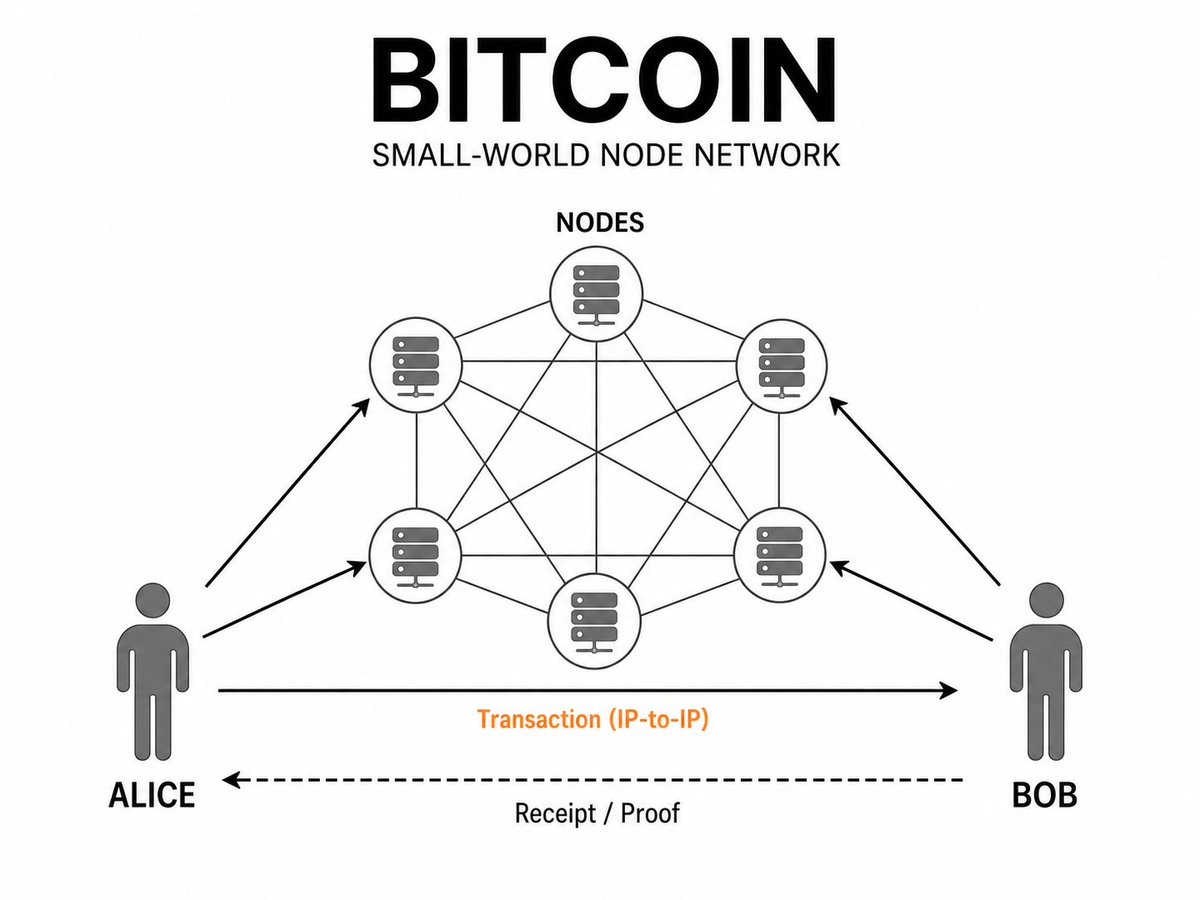
This is how Bitcoin is really designed.
Alice sends to Bob. Alice also sends to nodes. Bob sends to nodes. Bob returns a separate proof — a receipt — showing that he has sent. The nodes are not decorative little saints sitting in a chapel of theory; they are densely interconnected economic actors, passing information through a web so robust that failure becomes not a drama but an edge case.
Notice what is not being said.
Alice is not a node.
Bob is not a node.
A spectator with software is not a node merely because he enjoys the costume.
The nodes are the competitive parties that build, validate, propagate, and settle. Alice and Bob are peers. That is peer-to-peer: not a mystical commune of hobbyists, but a direct exchange between parties, with the network serving as the machinery of settlement.
The elegance is that trust is not required. Trust is the tax paid by badly designed systems. In Bitcoin, Alice does not need to trust Bob to behave nobly. Bob does not need to trust Alice to remain honest. The system is constructed so that proof, propagation, economic interest, and record replace sentiment.
And if someone reneges, the parties with an actual interest in the transaction still act. They propagate. They evidence. They settle. They do not need sermons on virtue, because incentives have already done what sermons pretend to do.
That is the architecture: direct exchange, proof returned, nodes interconnected, incentives aligned, failure reduced, trust displaced by evidence.
Bitcoin was not designed as a theatre for slogans.
It was designed to work.