"Yarışlar, en çok acı çekebilenler tarafından kazanılır." -Eddy Merckx
Çok az spor branşı bedeni ve zihni bu denli limitlerine yaklaştırır. Hatta o sınırları aşar. Mathieu van der Poel’un bugün Paris'teki etap zaferinin ardından şu tükenmiş ve acı çeken hali bisikletin varoluşsal kodu gibi. Bir acı çekme ve irade sanatı...
Bugün aralarda Odissey den bahsedecektiniz kaçırdım mı yoksa
Bir eleştiride bu destanı Akdeniz in sıcak atmosferinden alıp kuzeyin gri soğuk atmosferine hapsetmisler diye okudum ama filmi daha izlemedim değer mi izlemeye iyi yayınlar kolay gelsin
@canereler
Kolay gelsin iyi yayınlar sarper beye selamlar Norveç Atletizm de Ingebrigtsen kardeşlerden sonra Bisiklette de kardeş sporcuları( ki bu sefer ikiz ) bizlere sunuyor.Darisi başımıza ama tayt giyeni pişman ederiz biz Şikayet edende Sosyal demokrat milletvekili
@berkemceylan
@canereler Size iyi yayınlar
Eski dünya kupaların dan bahsedince Hele Johan Cruyff tan evet çok sigara içerdi.Bir de şu aklımda kalmış hangi Dünya kupasında bilmiyorum Ya Hollanda Ya Danimarka galiba futbolcu eşlerini de kaldıkları kampa goturmuslerdi ilginç gelmişti bize.
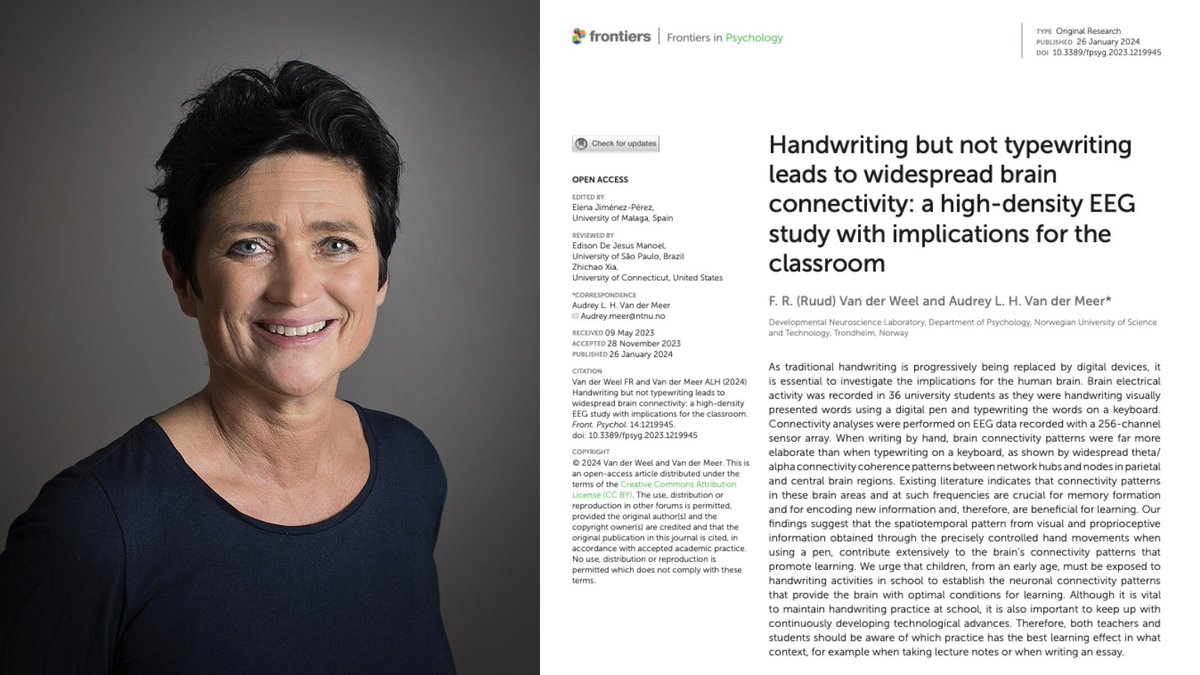
A Norwegian neuroscientist spent 20 years proving that the act of writing by hand changes the human brain in ways typing physically cannot, and almost nobody outside her field has read the paper.
Her name is Audrey van der Meer.
She runs a brain research lab in Trondheim, and the paper that closed the argument was published in 2024 in a journal called Frontiers in Psychology. The finding is brutal enough that it should have changed every classroom on Earth.
The experiment was simple. She recruited 36 university students and put each one in a cap with 256 sensors pressed against their scalp to record brain activity. Words flashed on a screen one at a time.
Sometimes the students wrote the word by hand on a touchscreen using a digital pen, and sometimes they typed the same word on a keyboard. Every neural response was recorded for the full five seconds the word stayed on screen.
Then her team looked at the part of the data most researchers had ignored for years, which is how different parts of the brain were communicating with each other during the task.
When the students wrote by hand, the brain lit up everywhere at once.
The regions responsible for memory, sensory integration, and the encoding of new information were all firing together in a coordinated pattern that spread across the entire cortex. The whole network was awake and connected.
When the same students typed the same word, that pattern collapsed almost completely.
Most of the brain went quiet, and the connections between regions that had been alive seconds earlier were nowhere to be found on the EEG.
Same word, same brain, same person, and two completely different neurological events.
The reason turned out to be something nobody had really paid attention to before her work. Writing by hand is not one motion but a sequence of thousands of tiny micro-movements coordinated with your eyes in real time, where each letter is a different shape that requires the brain to solve a slightly different spatial problem.
Your fingers, wrist, vision, and the parts of your brain that track position in space are all working together to produce one letter, then the next, then the next.
Typing throws all of that away. Every key on a keyboard requires the exact same finger motion regardless of which letter you are pressing, which means the brain has almost nothing to integrate and almost no problem to solve.
Van der Meer said it plainly in her interviews.
Pressing the same key with the same finger over and over does not stimulate the brain in any meaningful way, and she pointed out something that should scare every parent who handed their kid an iPad.
Children who learn to read and write on tablets often cannot tell letters like b and d apart, because they have never physically felt with their bodies what it takes to actually produce those letters on a page.
A decade before her, two researchers at Princeton ran the same fight using a completely different method and ended up at the same answer. Pam Mueller and Daniel Oppenheimer tested 327 students across three experiments, where half took notes on laptops with the internet disabled and half took notes by hand, before testing everyone on what they actually understood from the lectures they had watched.
The handwriting group won by a wide margin on every question that required real understanding rather than surface recall.
The reason was hiding in the transcripts of what the two groups had actually written down.
The laptop students typed almost word for word, capturing more total content but processing almost none of it as they went, while the handwriting students physically could not write fast enough to transcribe a lecture in real time, which forced them to listen carefully, decide what actually mattered, and put it in their own words on the page.
That single act of choosing what to keep was the learning itself, and the keyboard had quietly skipped the choosing and skipped the learning along with it.
Two studies. Two countries. Same answer.
Handwriting makes the brain work. Typing lets it coast.
Every note you have ever typed instead of written went into your brain through a thinner pipe. Every meeting, every book highlight, every idea you captured on your phone instead of on paper was processed at half depth.
You did not forget those things because your memory is bad. You forgot them because typing never woke the part of the brain that would have made them stick.
The fix is the thing your grandmother already knew.
Pick up a pen. Write the thing down. The slower road is the faster one.
Eskişehir'in taraftarları İspanya'nın ABD'ye uslerini kullanma izni vermediği için teşekkür amacıyla tribünlerde "paquito el Chocolatero" şarkısını seslendirdi...
İspanya ve Türkiye arasındaki bu dostluk ve sevgi gösterisi müthiş...
#Spain
@sarpergunsal Sarper bey Çanakkale ye gelin İstanbul insanı boğuyor Arada işimiz olur da gitmek zorunda kalırsak daha giderken dönüş planı yapıyoruz.Ayrica karavancilar hepsi değil ama bir kısmı konakladiklari yerleri güzel kullanmiyorlar
@berkemceylan Dekman oynarken iki gruba ayr��ldık bahçede kırda veya metruk evlerde iki çete birbirini hayali silahlarla avlarlardi bunlar çoğu zaman bir ağaç parçası olurdu daha uzunlar tüfek hatırlarım bir dakmen oyununda esir aldığımız bir arkadaşı ayaklarından ağaca asmiştik
@canereler kolay gelsin haddim olmayarak küçük bir düzeltme:
Frodo nun gittiği dağ Hüküm dağı idi Mordor daki
O göz de Sauro nün gözü idi.
Sarper beye selamlar