Oblivia Coalmine, in a quite remarkable new video, explains why we should be divesting our pensions from fossil fuel, right now!
https://t.co/m1n0qmHOwz
This is the 'Volkswagen 2015' moment for the #COP28 Presidency. Caught red handed, the COP Presidency has no other option but to now unequivocally step up the transparency, responsibility and accountability with which they lead the process. [1/2]
https://t.co/mOpmYDfTaL
Scotland is aiming to be the world's first rewilded country. It's looking to rewild 30% of the country by 2030.
We have the solutions. Replenishing and protecting nature is one of them. #ActOnClimate#climate#biodiversity#GreenNewDeal
So far we are up to
"giving rhetoric and optimism and greenwash" for dealing with an existential risk currently set to bring about mass death.
"Greenwashing is a polite term - it's lying." @KevinClimate#ClimateEmergency
“That's home. That's us. On it everyone you love, everyone you know, every human being who ever was...the pale blue dot, the only home we've ever known" Carl Sagan
We have the solutions. Protect people & the planet.
#ActOnClimate#climate#climatecrisis#nature
Amazed to hear people still talk of carbon budgets. The budget is spent. The oceans and all land ecosystems would need to absorb 50% of emissions. The oceans are are boiling and the forests are burning. Cooling mitigation is urgent.
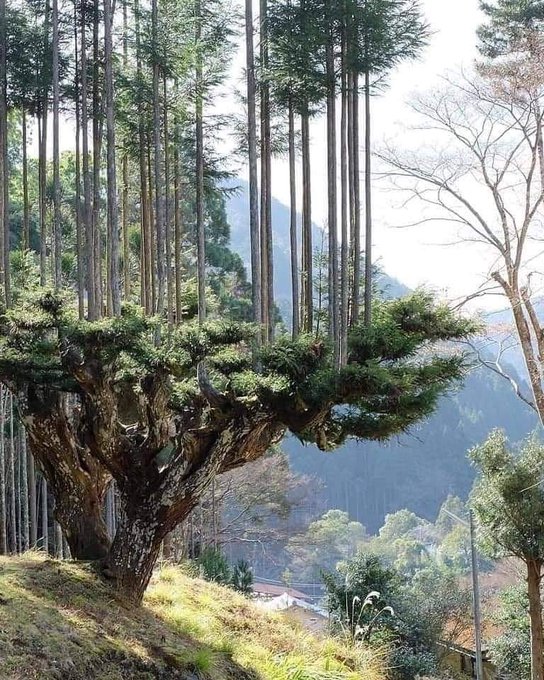
How Japanese have produced wood for 700 years, without cutting down trees.
Daisugi is an ancient Japanese forestry technique developed in the 14th century originally used by people living in the Kitayama prefecture, because the territory was extremely poor in saplings.
They planted cedars pruned in a special way to produce shoots that eventually would become perfect, straight, knot-free lumbers.
The shoots are gently pruned by hand every two years leaving only the top boughs, allowing them to grow straight. Harvesting takes 20 years and old 'tree stock' can grow up to a hundred shoots at a time.
There was actually another reason why the technique was developed: fashion. In the 14th century, a linear, stylized form of architecture known as sukiya-zukuri (数寄屋造り) became popular, and every prominent samurai or nobleman wanted a house built in this way.
There were simply not enough raw materials available to keep up with demand, so daisugi was developed to produce more wood in a shorter time.
The wood produced with this technique has also impressive qualities: it's 140% more flexible than standard cedar and 200% denser and stronger. And, it's extremely durable.