🚨 Early Alpha drops.
🔮 AI x Crypto signals before the noise.
🌍 EN + GR | 🔗 Link in pinned.
Holder of $ZKML $ANYONE $NOX $AUTOS $ZEC $KNDX $GPU $DSYNC $TAO
🚨 Something BIG is happening… 🚨
The door to exclusive #crypto opportunities has just opened. 🔓
Whether you're #Greek or #international, this is YOUR chance to be part of something before the hype begins.🎯
Check out the thread below 👇 and step into the future first. 🔮
GrapheneOS has strong defenses against data extraction. It heavily builds upon the standard security features provided by Android 17 and the most secure hardware available for Android. Currently, only Pixels provide the hardware security features and updates required by GrapheneOS. That's going to change in 2027 thanks to our partnership with Motorola Mobility and progress being made by Qualcomm.
Disk encryption provides strong protection for data. Even the most sophisticated attackers aren't going to be directly breaking it. They either need to exploit the OS while in After First Unlock state or brute force the PIN/password.
Android 16 QPR2 calls for a secure element implementing rate limiting ramping up delays. It's 4 hours after 10 and 41 days after 15. Only 20 attempts are allowed. For usability, It rejects the most recent 5 unique failed attempts early to avoid wasting attempts on repeated errors. GrapheneOS only supports devices implementing the latest generation secure element rate limiting.
https://t.co/NCM7SKeVM6
The secure element on the supported devices also has insider attack resistance. That's implemented by requiring the Owner user to successfully authenticate before the secure element firmware can be updated. A valid signing key and greater version number aren't enough alone. The purpose of this is preventing any government from bypassing the rate limiting by coercing the creation of a firmware update removing the rate limit.
Pixels have used a secure element with an internal timer implementing rate limiting and insider attack resistance since the Pixel 2 launched near the end of 2017. Here's a post about this from back in 2018:
https://t.co/PyRTAml5Cw
The secure element and integration into the OS has become far better since then, but it shows this goes back a long way and isn't a new feature.
GrapheneOS also raises the character limit for passwords from 16 to 128. This enables using high entropy diceware passphrases not depending on the secure element rate limiting.
To make a strong passphrase convenient to use without ruining it with biometric unlock, GrapheneOS adds an optional 2nd factor fingerprint PIN. We reduce the allowed fingerprint attempts from 20 to 5 and failure to enter the correct 2nd factor PIN counts towards it. This enables using 6-8 random diceware words as the main unlock method required in Before First Unlock and fingerprint+PIN using a short PIN for convenience. Using a valid fingerprint prompts to enter the 2nd factor PIN which is needed to complete unlocking the screen and hardware keystore.
GrapheneOS greatly improves the exploit protections for the OS with hardened memory allocators and other features. It heavily uses hardware-based security features including hardware memory tagging (MTE) to protect against exploits. A partial overview of those protections is here:
https://t.co/NH8qDWfnH0
GrapheneOS adds specialized protection against attacks with physical access too. For example, it blocks new USB connections at a software and hardware level by default while locked and disables USB data as soon as there are no active USB connections.
GrapheneOS shipped a locked device auto-reboot timer back in June 2021. It can be set between 10 minutes and 72 hours. We enabled it by default using 72 hours and then lowered it 18 hours. It automatically returns the device to Before First Unlock state due to our memory zeroing as part of tearing down the OS and booting. We got Pixels to add memory zeroing for booting the firmware fastboot mode in April 2024. Apple and Google added a locked device auto-reboot timer in iOS 18.1 and Android 16. For Android, it can be enabled with the Android Advanced Protection Mode. Our implementation is better for multiple reasons but it's a useful feature regardless.
Android uses separate encryption keys for each secondary user and Private Space. GrapheneOS adds support for putting both back into Before First Unlock state without a reboot via end session for secondary users or toggles for either to do it by default. It's still much better for the device to be rebooted to get the main user back at rest, completely clear leftover data from RAM and block secure element updates.
Our duress PIN/password feature is a minor feature fitting into the bigger picture. It wipes the device when it's entered in any OS prompt for the current profile's PIN or password. It will wipe the device when entered into the authentication prompt for changing a sensitive setting or anything else requiring it, not only the lockscreen. It works across every profile including secondary users and Private Spaces, not only the main user.
There are multiple ways to use the duress PIN/password feature including writing it down on a phone case or a paper kept in a wallet. People should carefully consider how to use it in an actual duress situation where there can be physical or legal consequences for wiping the device. GrapheneOS doesn't require it to protect data from being extracted from the device, but it takes recovering it completely off the table even with the PIN/password for each profile on the device.
GrapheneOS doesn't depend on the duress PIN/password to protect user data. It's one of the tools it provides among the major privacy and security improvements it offers as a whole. Our features page provides an overview of what GrapheneOS offers compared to standard Android 17. It covers most of the major features we provide and many of the minor ones but there's also a lot more beyond it. Our release notes are a lot more exhaustive since we make sure to cover everything when it's added, changed or removed.
https://t.co/5BbNpMO7No
https://t.co/sNlMyRHsyL
🚨 BREAKING: The UK has ZERO evidence on Andrew & Tristan Tate.
They have 60 days until September 16 to produce anything real… or the whole extradition dies.
@McBrideLawNYC is going to war on August 5 for their immediate release.
Two innocent men. No evidence. Pure political hit job collapsing in real time.
This is the moment they lose.
MAKE THIS GO VIRAL. 🗣️
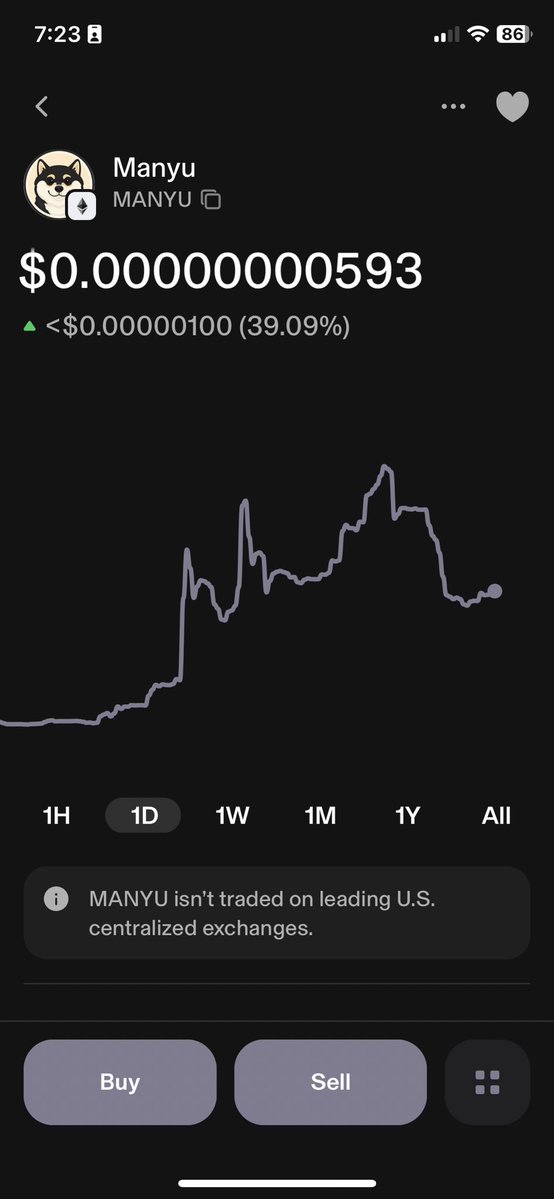
$MANYU performed +80% last 24 hours.
Meme season is back.
Dog season is back.
$MANYU is reminding everyone why strong communities always outperform.
Lets bring this doggo back to ATH. 🐕🔥
@RealManyu
🚨 A traveller who gave US border agents his GrapheneOS duress PIN [wiping his phone] rather than unlock his phone, is now charged with intentionally destroying its contents.
Homeland Security had flagged him to Customs and Border Protection (CBP) and the FBI's Atlanta office over alleged terrorism before he landed.
CBP can copy a device into a central database without a warrant, on suspicion of a crime alone.
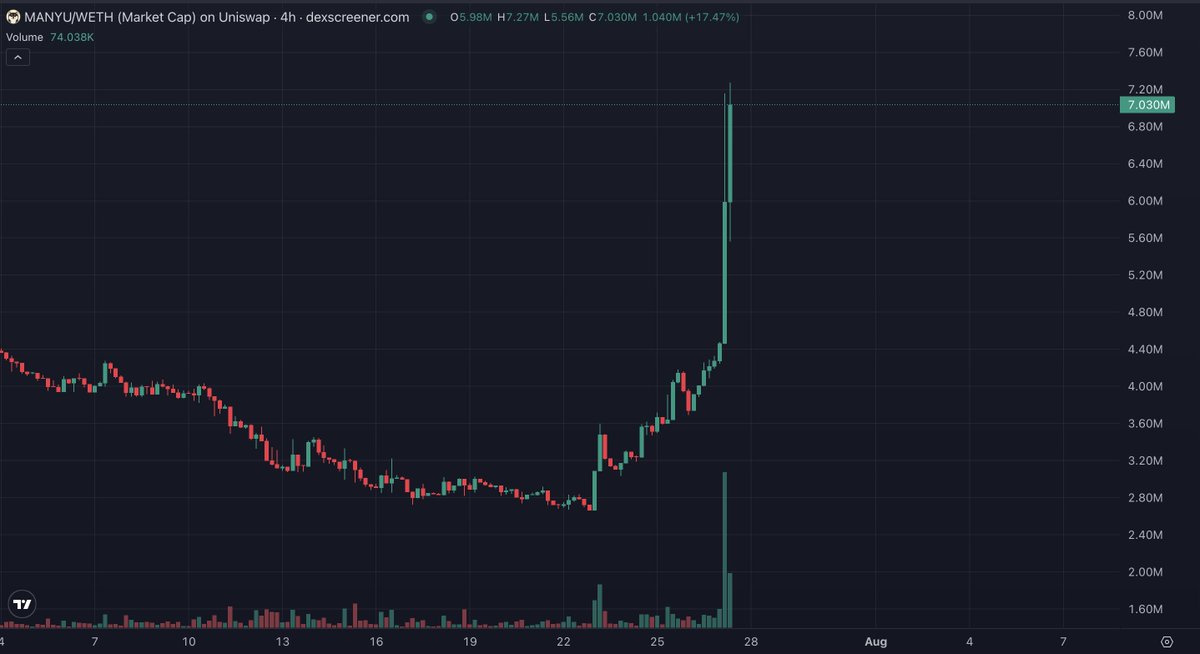
🔥 Went to bed last night with $Manyu at $6.74m mc, trading volumes building and beautiful green candles forming on the chart.
This morning I woke up with a beautiful $Manyu chart and perfectly executed retrace to $6.37m mc ahead of the next leg up.
#crypto#memes https://t.co/tHFzrKiwEI @lookonchain@cryptojezuz
Federal agents in Atlanta stopped a guy at the airport, forced him to unlock his phone, and it self-wiped using GrapheneOS's built-in duress feature
The DOJ is now charging him with destroying evidence
Never forget that it was Elon Musk who gave Andrew Tate his platform back.
After Tate had been charged in Romania, Musk doubled down by significantly promoting Tate's account, inviting him to Spaces to spread his propaganda & misinformation, without a single care for the alleged victims of r*pe and trafficking and the fact the case was ongoing.
$NOX staking dashboard update.
Staking is now one operation. Choose your amount and your lock and the multiplier is shown before you sign: flexible up to 2.5x at 365 days, times your ZeroStatePass boost.
> No separate tabs, no guessing your reward <
Every position shows its own multiplier and weighted stake and you can claim from one place. Every position shows its own multiplier and weighted stake, and you can claim from one place.
New: revoke by @RevokeCash set the staking contract's allowance back to zero in one click when you are done, so no standing approval is ever left behind. Approvals now default to the exact amount, never unlimited.
It runs on your machine, talks only to the RPC and wallet you choose, and holds no keys. No telemetry, no fallback RPC.
Run it: npx @nonos/nox-dashboard
Hosted: https://t.co/hOUyaoHnsr
npm: https://t.co/2EwybjYAwD
Source: https://t.co/y11nGTBwuH
Your keys. Your RPC. No trace.
@Zcash is one of the best privacy technology anyone has actually shipped and it has a problem its own developers have written down:
it does not survive a quantum computer.
Every shielded transaction is proven with Halo2 over the Pallas and Vesta curves. In a lot of ways that was the right call. No trusted setup and no ceremony you have to trust nobody cheated on but the security sits on the discrete logarithm problem and discrete log is precisely what Shor algorithm solves. When a real quantum computer arrives, shielded notes become forgeable and the privacy of past spends stops holding.
#Zcash knows this and the #Ironwood proposal already commits the protocol to post-quantum note commitments and it leaves one piece open on purpose: the proof system itself. Tachyon's prover is still built on curves. That slot is empty.
We are filling it, with our own stack.
zKølang is a language we wrote. You write an ordinary program and it compiles to a transparent STARK: FRI and hashes, no curves anywhere, no trusted setup, post-quantum because there is nothing based on discrete log left to attack. It is no_std and compiles for bare metal, because it is not meant for a datacenter.
It runs inside NØNOS as well, the kernel we built and we do not ask anyone to trust that the compiler is correct. We prove it. 230 host proofs and 74 theorems in Lean with no gaps, showing the language does what it says.
We took the real Orchard action, the exact statement a Zcash shielded transaction proves,
and replaced every part that depends on discrete log. The Sinsemilla Merkle tree becomes a Poseidon tree over Goldilocks. The Pedersen value commitment becomes a balance checked inside the circuit. Curve-based spend authorization becomes knowledge of a hash preimage. What used to rest on the hardness of a curve now rests on the collision resistance of a hash and a hash is the one thing a quantum computer leaves alone.
Where this actually is: a proof of concept aimed at a ZIP, not a shipped product and we are working on it but the direction is exact and the slot is open. Post-quantum privacy, on the chain that invented shielded money, written in a language we built, running on a kernel we built.
Well here it is leaked footage of a Human Hybrid …. Half human-half pig …
Our government officials continue to hide this and fund it…
If you know Spanish it is disturbing what they are talking about..
🚨#BREAKING: Andrew Tate's ex girlfriend, who he allegedly abused with a belt in a viral video, speaks out and DEFENDS him:
'He's a great guy. It was nothing but a s*x play. Consensual. That I wanted. It was not abuse."
"I don't like seeing injustice of him being called a woman beater."
There is spyware that can take over your phone without you clicking anything at all.
It is called Pegasus. Once inside, it can read your messages, listen to your calls, track your location, and switch on your camera and microphone.
A leaked list of more than 50,000 phone numbers, investigated by 17 news organizations, included journalists, lawyers, activists, and politicians around the world.


![IntCyberDigest's tweet photo. 🚨 A traveller who gave US border agents his GrapheneOS duress PIN [wiping his phone] rather than unlock his phone, is now charged with intentionally destroying its contents.
Homeland Security had flagged him to Customs and Border Protection (CBP) and the FBI's Atlanta office over alleged terrorism before he landed.
CBP can copy a device into a central database without a warrant, on suspicion of a crime alone.](https://pbs.twimg.com/media/HOPYerYWsAATr-A.jpg)





![IntCyberDigest's tweet photo. 🚨 A traveller who gave US border agents his GrapheneOS duress PIN [wiping his phone] rather than unlock his phone, is now charged with intentionally destroying its contents.
Homeland Security had flagged him to Customs and Border Protection (CBP) and the FBI's Atlanta office over alleged terrorism before he landed.
CBP can copy a device into a central database without a warrant, on suspicion of a crime alone.](https://pbs.twimg.com/media/HOPYfJkWwAA0G4B.jpg)