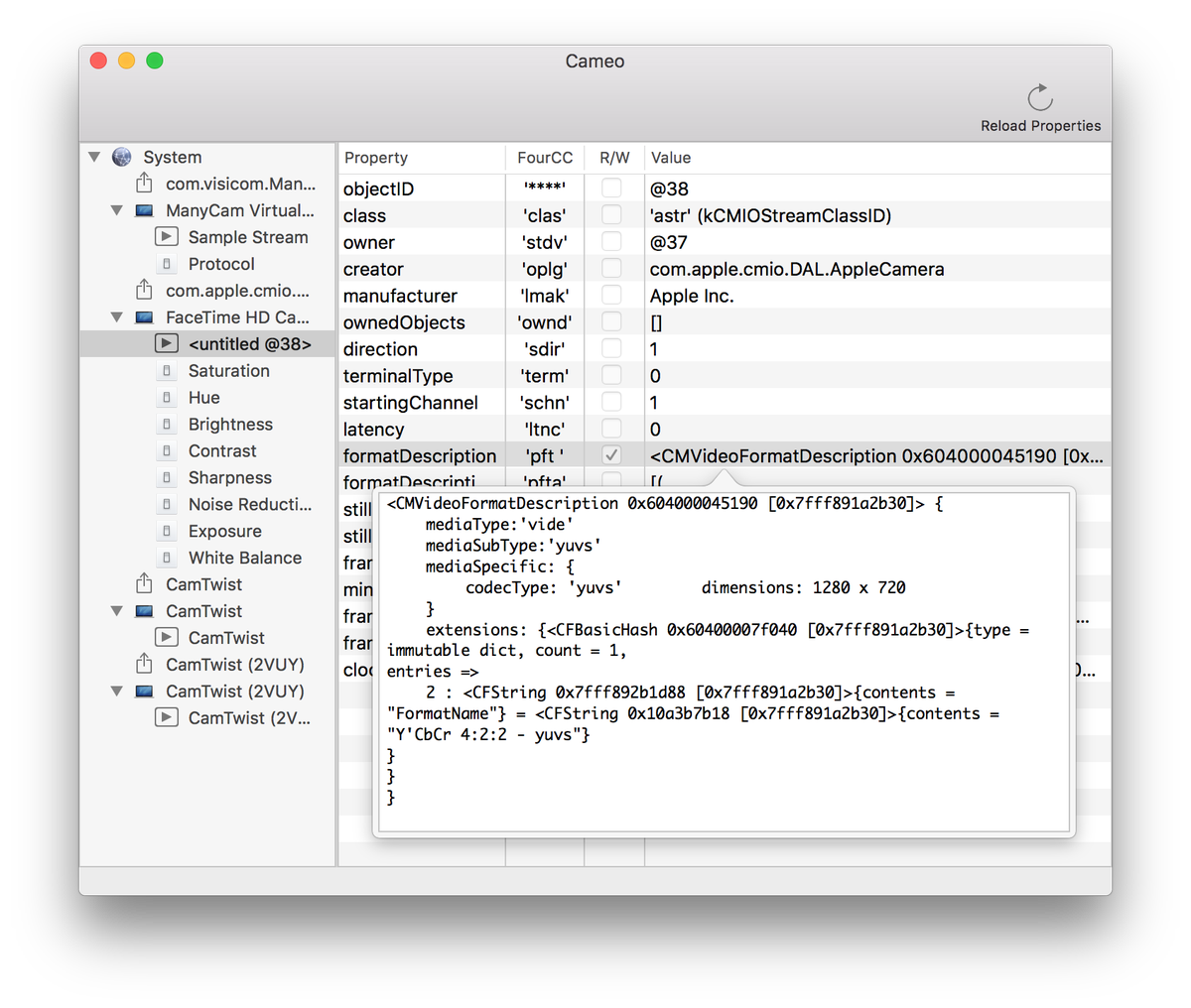
better late than never: I've moved the CoreMediaIO Swift wrapper from Cameo to its own repository (CMIOKit), so if you are tired of juggling with unsafe pointers be sure to check it out! https://t.co/KJlMHfWIku
@tang1013 well there are a number of things that can go wrong, to me the hardest was to get the timestamps right, but it might be something else in your case
I've developed a HALLab alternative called Audit, so if you are working with low-level CoreAudio stuff, you may find it useful: https://t.co/o5KDSzGYGC
(Resemblance to Cameo is not a coincidence 🙃)
Riddle of the day: who knows what the 'donz' and 'evis' FourCharCodes stand for in the CoreAudio realm? They appear to be boolean control subclasses on the built-in mic and built-in speaker respectively, but I haven't found any reference in the system framework headers. Game on!
I've started to modernize this Apple sample code -- https://t.co/joxovdV5Ic -- and I want to convert it into an OSS project under MIT/BSD. Any licensing gotchas I should be aware of?
I'm trying to distribute a Swift-only static library (.a) but I cannot figure out what to put in the modulemap on the other side so that symbols actually get imported. Is this even possible? Or is my approach fundamentally wrong? #SwiftLang
@4brunu@daniel_dunbar@rballard@NeoNacho Well, it sounds feasible but will certainly be slower. I guess implementing both the fast and the slow path should be a good enough solution. WDYT?
@4brunu fortunately, we don't need to be able to compile it, it's sufficient that Sourcery/SourceKit parses it together with the rest of the (compilable) code