@_dvd23_@DJSnM But no regulation against light aircrafts in particular, as long as you have oxygen bottles on board (and provide an IFR flight plan above FL195, but I reckon very few light aircrafts can fly this high)
@_dvd23_@DJSnM Ok, just to clarify a bit :
We are talking about oxygen regulation here. For more than 30min above FL100, the pilot must have oxygen. Above FL130, all passengers on board for any amount of time.
+ airspace above FL195 is class A, so VFR forbidden
@pli_cachete thus knowing they are the second one
Third and final order : from lack of second order reaction, there must be three smudges.
It is interesting to note that this reasoning can be generalized to n philosophers
@pli_cachete First order : if only one smudge, they can instantly deduce it from the fact that they don't see other smudge, and wipe it
Second order : if two smudges, from the point of view of a smudge, the lack of instant reaction of the other smudge can rule out the first order situation,
@astropierre On est clairement sur du MEMS
A vue de nez, les traces sombres ressemblent plutôt a des indentations qu'a des dépôts de conducteurs. Des canneaux pour de la micro fluidique ?
La zone en bas a une tête de chambre de combustion avec tuyere
Propulseur pour nanosat ?
@MedCrisis Hi !
I have a good friend with a leg longer than the other, she has to wear compensated shoes in order to be able to walk painlessly.
I didn't know leg lengthening existed. Would it be able to correct this kind of issue ?
How common is the procedure ?
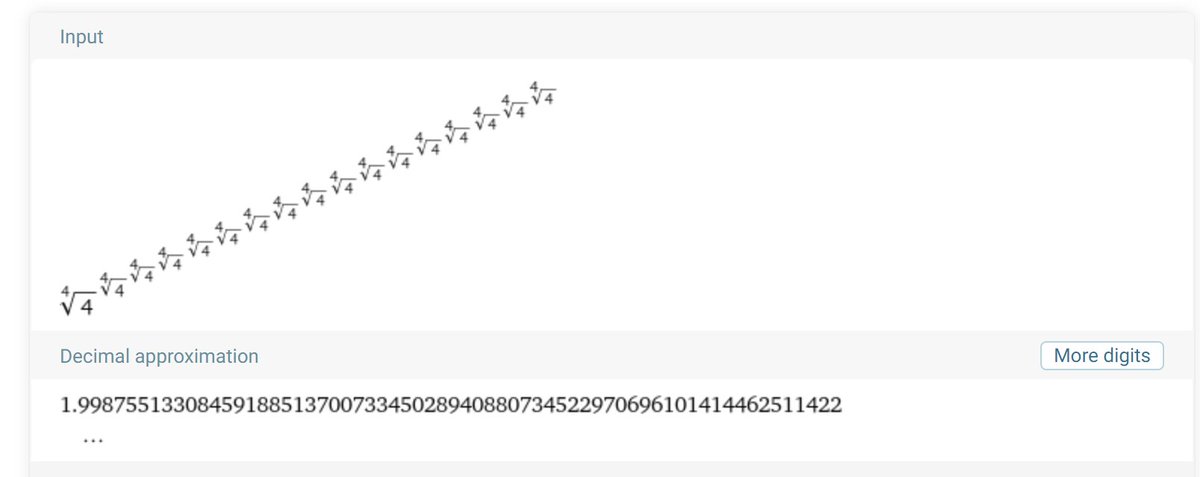
@ThomasCabaret84 Du coup (Hypothèse), la solution générale marche pour y entre 0 et exp(1), et n'a pas de solution pour y>exp(1) / l'expression diverge pour x > e^(1/e) ~= 1.44
De la a montrer ça proprement par contre...
@ThomasCabaret84 Effectivement, je l'ai remarqué après coup, je me sent pas très brillant sur ce coup là. Mais ça commence a faire un peu plus de sens pour moi !
Merci beaucoup du tweet d'origine, c'est une fonction sympa à tritouiller !
@ThomasCabaret84 Ok, en jouant un petit peu avec le résultat général ça s'éclaire. Déjà. 4^(1/4) = sqrt(2). Ca aurait du me sauter aux yeux, mais nan ^^" Mais ça explique mes résulats numériques pour 2 et 4
@ThomasCabaret84 Ok alors j'ai du mal à comprendre le truc. Cas 2 : x^x^x^x^... = 2, on remplace, x^2 = 2, x = sqrt(2). Wolfram alpha à l'air de numériquement être d'accord.
Cas 4, même principe : x = 4^(1/4). Cas général, f(x) = y => x = y^(1/y)
Par contre numériquement ça marche pas du tout
@GendyGentil @RoullierY@HuntDog3@Gendarmerie_026 Pourtant j'ai passé mon code en 2017, les guides indiquaient bien que le passage de ligne blanche pour depasser un vélo était ok ??? (Mais on m'a effectivement pas mentionné d'exceptions pour les véhicules motorisés même lent)
And I mean, + 2 culture for breathtaking tiles adjacent to a forest and + 2 science for breathtaking tiles adjacent to a mountain is an AWESOME bonus both in the early and late game.
Teddy. A progressive who drove hard for racial equality, supported women's suffrage, negotiated an end to the Russo-Japanese war, secretly forced the Kaiser to abandon annexation of Venezuela & the Dominican Republic, and was undeniably the most bad ass person to ever hold office
@SnowFake3@AnalysisFact The top limit is 0
The bottom one is 1
If we have n = m, no need for limits, the expression is always 1/2
In that case that sits exactly between the 2, but that's not a general rule
@ScienceClic Ok merci bcp ! Ce qui me perturbait c'est que je pensais pas que la longueur d'onde du rayonnement de Hawking d'un TN si petit était encore si grande.