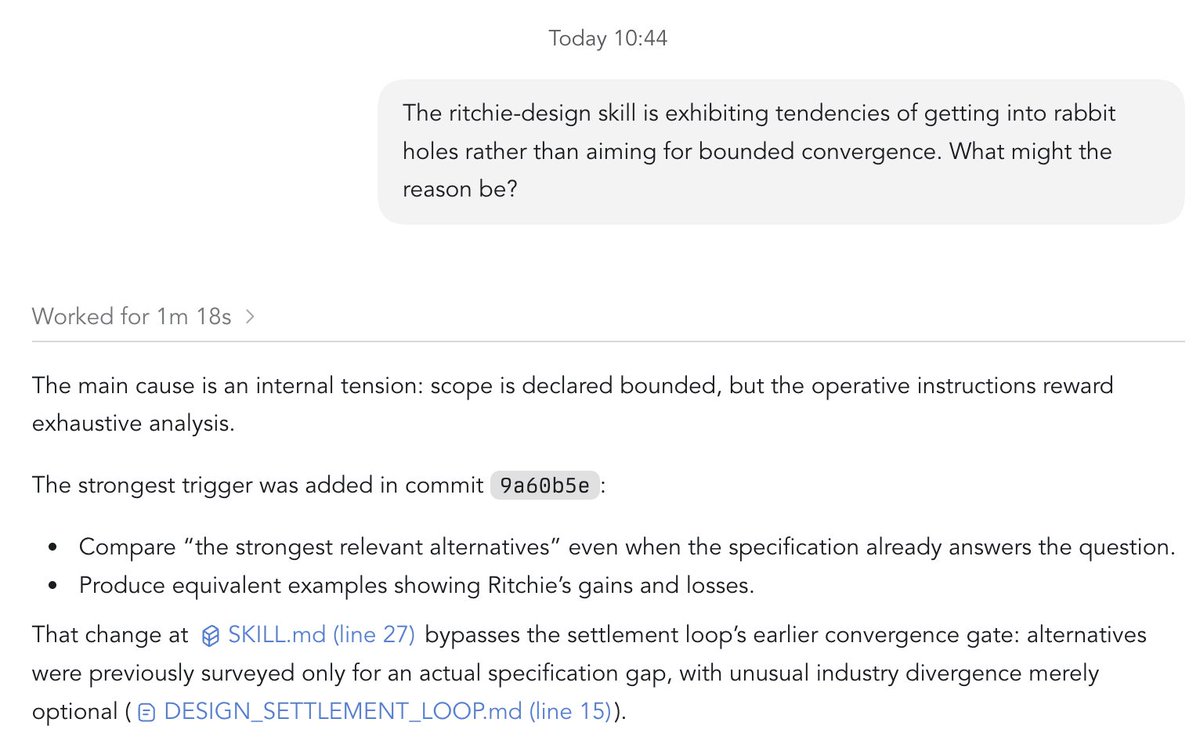
Ritchie programs can now declare and call stateless services on a local monolith target. Not long before the same program would work whether you want monoliths or micro-services!
https://t.co/ioYSeZtCPr
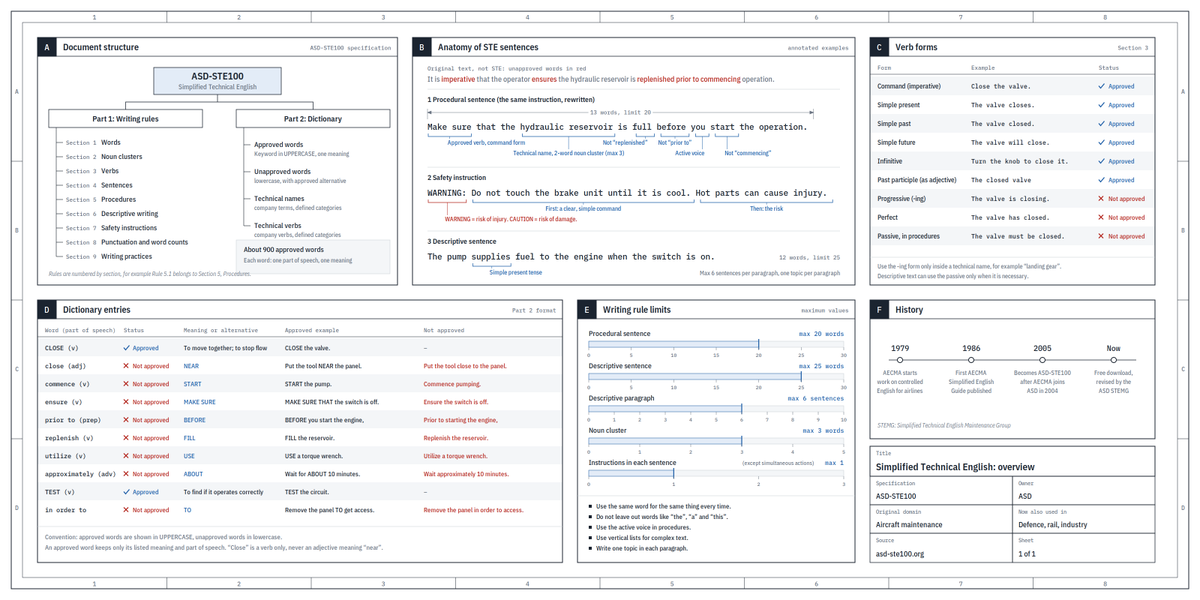
Just tried ASD-STE100 for QUIC and Paxos. For these two, the STE version was comparable to default English.
For one of my own slop 10-pagers, STE was just 1 page and very clear. I guess well-known concepts also have well-known explainers but new stuff will benefit a lot.
We'll be spending a lot more time trying to understand the outputs of language models. A few thoughts, tips & tricks:
Writing. Something I've had success with: Ask your LLM to explain something in ASD-STE100, it's a controlled language specification originally developed for aerospace maintenance documentation. LLMs well-versed in this language and it comes with heavy constraints on clean writing style that I often find a lot more readable. Sometimes I've tried to soften it a bit e.g. ask for "80% of the way to ASD-STE100" because the spec is quite stringent. But even better:
Diagrams / images. Instead of writing, ask your LLM to create a diagram. These can be a lot easier to process, parse, and understand. But even better:
Web pages. Ask for output "in HTML" to get a beautiful, interactive webpage. LLMs are getting really good at frontend and can create beautiful experiences, animations, etc. But even better:
Explainer videos. The output format I am most bullish on is fully custom / bespoke explainer videos generated on any arbitrary topic. Experiment with things like "Create a 3b1b style video explainer on X. Use my ElevenLabs API key for audio narration". (you'd need an API key for the latter or you can ask your LLM to find you decent free alternatives that use your local compute). This is actually starting to work!
In summary:
- As LLMs get better, they will do more and more of the legwork autonomously, and a lot more of our work will rise up the abstractions into oversight and understanding.
- Luckily, LLMs can help here too because as intelligence and code are increasingly abundant, you can ask for large, custom, discardable software artifacts (e.g. web apps, video explainers) that would have never made sense to create before. Push the boundaries here and you'll be surprised.
Manoeuvrability and collaborative capability of models must be given as much weightage as intelligence. GPT-5.6 Sol > Fable 5.1 (tweaked) >> GPT-6 Astra > Opus 5 on that scale.
While designing a "Duration" type for Ritchie, Sol suggested using two types -- one at ns resolution (±292 years range) and one at ms resolution (±292M years). I said, let's use a bit to switch scale in an adaptive Duration. Turns out, Kotlin has that! Makes me happy!
Every net worth tracker in India wants you to upload your CAS / CAMS to their server.
The password on that PDF is your PAN.
So built (with claude) one that runs on your own laptop:
$ uvx networthy
Open source. No account, no upload. The only thing that leaves your machine is a ticker symbol.
I actually debugged Fable-speak and made Claude-specific directives that are no longer triggering me. Here's my CLAUDE.md. YMMV. https://t.co/WvgTIfI9VA
Been working with Fable and Sol side-by-side for the past few days. Same project and identical skills + rule files. Fable is more tenacious but less steerable vs. Sol and talks like a cultist. So Sol for interactive tasks and Fable for batch it is.
Been working with Fable and Sol side-by-side for the past few days. Same project and identical skills + rule files. Fable is more tenacious but less steerable vs. Sol and talks like a cultist. So Sol for interactive tasks and Fable for batch it is.
@mansu We're way past the fallacies. Modern distributed systems are converging to patterns that this language encodes as a corollary to "design patterns are a weakness in the language". A library leaves them optional. Full backstory: https://t.co/KwjClVrW7W
Without Fable, I've cancelled my Claude sub and switched over to ChatGPT Pro. The week started with some anxiety but I'm liking Sol. Sol is smart enough and way less cryptic than Fable in its "speech". Maybe part of Fable's performance was just its sagely aura.
https://t.co/FLZaYOKXXK Open a file and its sidecar side-by-side in Emacs. Useful for comparing source and derivatives, for example file.md and file.html. Actually, not terribly useful, but it is what it is. Great for the work I'm doing.
“Memory that shapes that taste and craft”.
Neither taste nor craft have a tangible shape. The small ways in which LLMese hurts my brain. Quietly, I might add.
#ShitLLMsSay
@t3rmin4t0r Latency is the reason why I switched from Claude to Codex. I don’t know if it’s the region but Claude is too slow for interactive sessions, which is mostly how I like to be assisted.