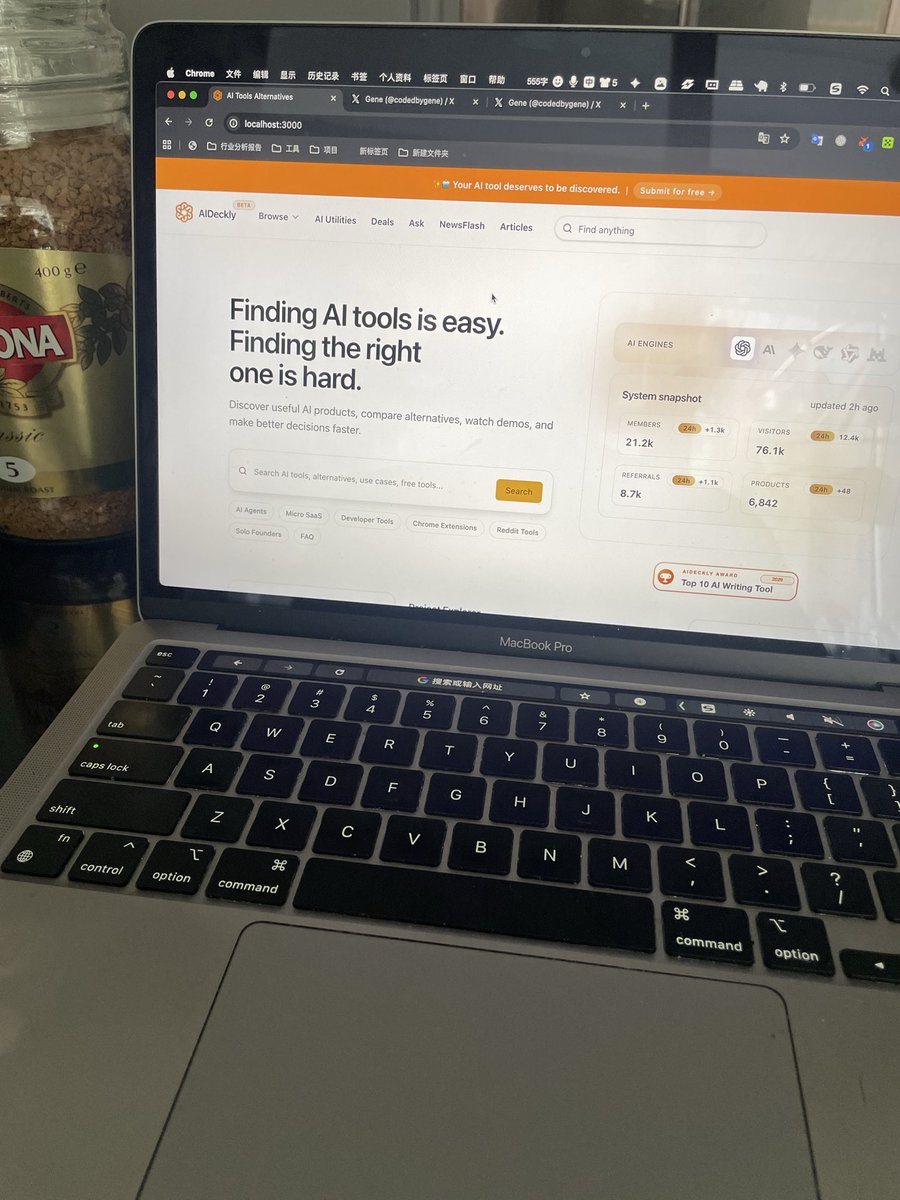
Current status:
🙏 Praying that Trae IDE can successfully migrate my entire OpenSaaS project to Next.js.
The migration is underway...
May the AI gods be with me. 😂
That's exactly the lesson I'm learning.
As a backend engineer, I spent most of my career thinking about APIs, databases, and scalability.
For AIDeckly, crawlability and discoverability might be more important than any of those.
Most likely Next.js, but I'm trying to avoid a full rewrite if possible.
Building AIDeckly taught me an expensive lesson.
My background is backend engineering and system architecture.
I can design distributed systems, databases, APIs, and infrastructure.
But I underestimated frontend architecture.
When I started AIDeckly, I optimized for development speed.
What I didn't fully understand was that AIDeckly isn't a SaaS business.
It's a search business.
And search businesses live or die by:
• SEO
• GEO
• Crawlability
• Indexability
• AI visibility
If your framework fights those goals, that's a serious problem.
For my use case, it's zero tolerance.
The good news:
I realized it now, not two years later.
Sometimes the most expensive mistakes are the ones that teach you what really matters.
@dschewchenko I used to think it was an energy problem.
Now I think it's a context problem.
Building requires holding a large mental model in your head.
Social media constantly interrupts that model.
Anyone else struggling with this?😌
The more time I spend on X, content, and marketing, the less focused I feel on actual product development.
Every time I get back into coding, it takes a while to rebuild the mental context.
Building needs deep focus.
Distribution needs constant attention.
How do you balance the two?
Or is this just part of the game?
@AikidoSecurity As someone who's worked on security-critical systems before, supply chain attacks are one of the most underestimated risks in software today.
Glad to see more tooling focused on early detection.
@higgsfield We're moving from AI tools to AI workflows.
The real value isn't generating a screen or a video.
It's connecting idea → product → distribution in one system.
@AikidoSecurity As AI-assisted development becomes the norm, developers are trusting more third-party tools than ever before.
Security at the device level feels much more critical than it did a few years ago.
@tuanle Posts like this are a good reminder that startup revenue rarely grows in a straight line.
The hard part isn't making money.
It's surviving long enough to find something that works.
@EvanYadegari Interesting.
Most founders focus on acquiring more users.
Sometimes improving the paywall converts better than getting more traffic.
Looks like a useful tool for teams trying to optimize revenue without shipping app updates every time.
Just updated the navigation for AIDeckly.
Current structure:
🔍 Discover Tools
• AI Tools
• Categories
• Alternatives
• Free AI Tools
• Top Launches
• Trending AI Tools
⚡ Decide Faster
• For Your Work
• AI Tool Videos
📚 Research
• Founders
• AI Funding
• AI Tools Status
🛠 AI Utilities
💰 Deals
💬 Ask
⚡ NewsFlash
✍️ Articles
Still simplifying.
The goal isn't to show more tools.
It's to help people find the right tool faster.
Anything missing?
【How AIDeckly Makes Money】 Notes#5
Tool makers won’t submit to a platform just because there is a Submit button.
They submit when they believe the platform can help them get found.
I noticed this while looking at AI tool directories.
Most submission pages only say:
Submit your tool.
But makers are thinking:
Will this bring users?
Will this help SEO?
Will AI search understand my product better?
Will I get feedback?
Will this create long-term visibility?
Or is this just another dead listing page?
The submit button is not the offer.
Discovery is the offer.
That’s why I think AIDeckly needs to give tool makers a real reason to submit.
Not just a listing.
But:
a structured product profile
use cases
alternatives
discussions
founder story
update logs
SEO/GEO-friendly pages
better chances to be found by users and AI search
If makers see AIDeckly as a discovery layer,
submission becomes natural.
Because every builder wants the same thing:
to be found by the right users.
What would make you submit your product to a new platform?
Need some help.
When someone replies to my post, and then I reply to their comment, I can't see my own reply in the thread afterward.
The other person's reply is visible, but my response seems to disappear or doesn't show up for me.
Has anyone experienced this before?
Is it a bug, a visibility issue, or some kind of account restriction?
【How AIDeckly Makes Money】 Notes#4
Most AI products don’t need more launch hype.
They need long-term exposure.
I noticed this after watching a lot of indie AI tools launch.
Launch week looks exciting.
A few tweets.
A Product Hunt page.
Some Reddit posts.
Maybe a newsletter mention.
Then the traffic drops.
Not because the product is bad.
Because discovery disappears.
That’s the gap I think AI tool platforms can help with.
Not just “list your tool once.”
But help developers stay discoverable through:
use case pages
alternatives pages
comparison pages
founder stories
update logs
user discussions
AI Answers
SEO/GEO-friendly profiles
A good tool should not only be visible on launch day.
It should be discoverable when users actually need it.
For developers,
long-term exposure means:
someone can find your tool next week,
next month,
or six months later.
Through Google.
Through ChatGPT.
Through Perplexity.
Through a comparison page.
Through a real user question.
That’s the kind of exposure I want AIDeckly to help create.
Launch brings attention.
Long-term discovery brings users.
What do you think?
Is launch traffic enough for indie AI tools,
or do they need a better discovery layer?
【How AIDeckly Makes Money】 Notes#3
Founder Story might become one of AIDeckly’s strongest growth channels.
Not because stories are cute.
But because founders actually share them.
I noticed something simple:
Most tool pages are about the product.
But Founder Stories are about the person behind it.
That changes the incentive.
A founder is much more likely to share:
why they built it
what problem they saw
how they got first users
what failed
what changed
what they’re learning
That kind of content feels more human than another feature list.
For AIDeckly, this could create a small but powerful loop:
feature a founder
→ founder shares the story
→ their audience discovers AIDeckly
→ more founders want to be featured
→ more tools get submitted
→ the ecosystem grows
It’s not just content.
It’s distribution with emotion.
People may ignore another AI tool listing.
But they often stop for a real builder story.
That’s why I think Founder Story could become an important growth entrance for AIDeckly.
Would you read more founder stories from indie AI builders?