Hi 👋. I'm an experienced full stack product developer looking for a new project, ~4 days a week (remote)
I can build prototypes and experiments, ship production features, plan architecture and lead a tech team
More info at https://t.co/DwHuYyRbh4, and in this thread 🧵
Another major problem, this time in additive combinatorics, has fallen, this time to humans rather than AI, but using methods related to the AI solution to the unit distance conjecture.
"echo": your logged-in tab as an MCP target
An agent can drive any browser tab you're already signed into, without ever holding your password.
1. install the Chrome extension
2. open a tab you're signed into (Jira, GitHub, your CRM, anything)
3. click the echo icon
4. paste the MCP URL into Claude/Cursor/etc
5. agent drives that tab via one tool: `echorun(plan)`
• no copied cookies, no API tokens, no headless browser
• every step = durable workflow receipt
• close the tab = session dead
• MIT, deploy to your own @Cloudflare account
Demo: https://t.co/hCxuRzSDoC
Source: https://t.co/sAS96ehvEj
I think it's the same basic failure mode that lead so many people to cargo cult microservices for their 10,000 MAU products, or to terraform and/or kubernetes their pre-PMF product's architecture. It's fun to make computer go brrr, but it won't make the planes land!
I wonder if underlying these issues is the nature of pluggable/implicit deps. Nextjs, webpack, react, styled components, storybook all brittle together. Glue code doesn't tend to have this problem
It's always been interesting with NPM specifically how engineers can have an urge to update deps all the time. Obviously it's all trade offs but if the code is working and doesn't have critical patches, it will still work fine
Fork your dependencies, trim them to only your use case, never update unless it breaks for your users. I’ve been vocal about this for 10+ years. I’ve always said that updating is way riskier than latent bugs (which can be tracked and CVEs monitored).
If you are updating a dependency, it’s on you to analyze every single commit in the full transitive set of dependencies. If you dont see anything compelling, dont update!
I remember at HashiCorp once in awhile an engineer would try to update a dep or replace a DIY lib with an external one and id always ask “show me the commit we need.” Dont update for the sake of it.
Feeling pretty swell about this mentality with all the supply chain attacks happening.
It's all trade offs of course, but like all trade offs it can be easy to take one side as gospel. I've been there having to apply weird webpack patches to storybook just to fix a bug that needs a newer version of nextjs or whatever
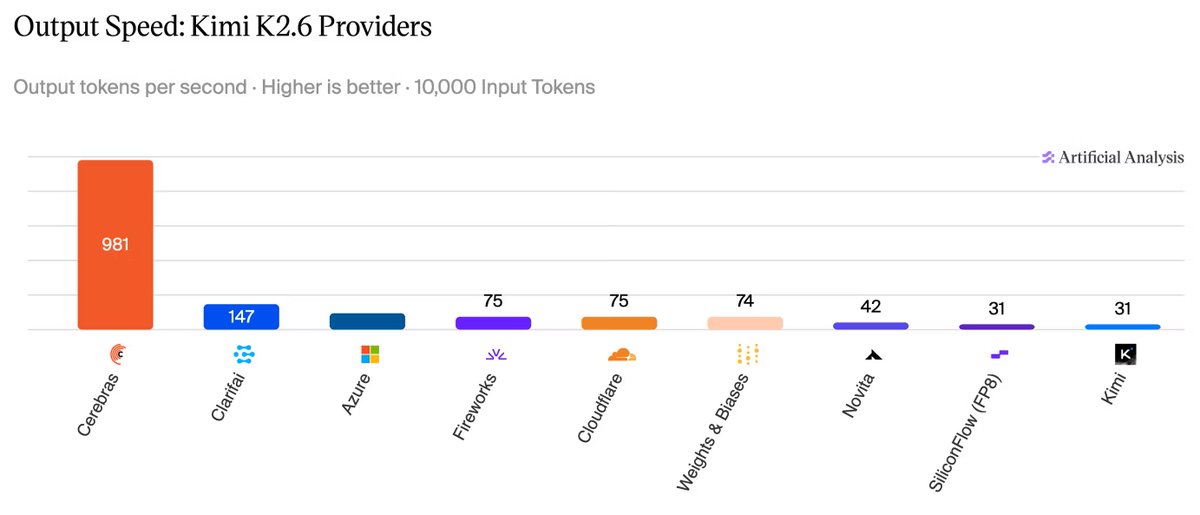
Cerebras is now running Kimi K2.6 – a trillion parameter model – in enterprise trials.
At ~1,000 tokens/s, this is the fastest frontier model performance ever measured by Artificial Analysis @ArtificialAnlys.
This reminds me of a designer I worked with who always wanted to "Jony Ive" the ideal paradigm for each bit of UI. Users were confused, features were late, it all got replaced with UI that the users already understood
Unpopular opinion: I don’t care if most web apps look the same. All I care about is whether it does what it says and does it fast.
Make it fast. Make the UX obvious. Put the right things in the right place and little to no animations.
Unpopular opinion: I don’t care if most web apps look the same. All I care about is whether it does what it says and does it fast.
Make it fast. Make the UX obvious. Put the right things in the right place and little to no animations.
Multiple security vulnerabilities affecting React Server Components and Next.js have been disclosed. We strongly recommend updating your applications immediately.
Cloudflare WAF managed rules already mitigate the disclosed denial-of-service vulnerabilities, and we are investigating additional coverage for several other CVEs.
https://t.co/mT9ujk1H7c
Ok, I've had enough of this.
I'm relieved that I never actually adopted RSC and at this point I'm convinced I never will. I'm now firmly in the camp of "RSC was a bad idea."
The problems weren't made up. But this solution is not good.
En azul: El agua fluye hacia el Atlántico, el Mar del Norte o el Báltico.
En granate: El agua viaja hacia el Mediterráneo, el Mar Negro o el Caspio.
Infografía: Perrin Remonté