A subtle prep mistake:
Optimizing for "FAANG" instead of optimizing for the company you're actually interviewing with.
Pattern distributions differ more than most candidates expect.
One FAANG prep mistake:
Treating every company like they test the same thing.
They don't.
Amazon tends to test much broader pattern coverage.
Google leans harder into binary search variants.
Meta clusters tighter around common patterns.
"FAANG prep" isn't one thing.
#faang
An Amazon Bar Raiser interview mistake:
Treating followup questions like a completely new problem.
Strong candidates adapt the existing reasoning instead of restarting.
#LeetCode#Amazon
Most people prepare for the wrong part of Amazon coding interviews.
The first solution usually isn't the hard part.
The hard part starts after you've solved it.
When the interviewer says:
"Ok… now let's change one constraint."
One of the biggest DSA misconceptions:
"Linked lists are good for insertion."
Only half true.
Linked list insertion is O(1) if you already have the pointer.
Most interview problems?
You don't.
So first you traverse.
Now it's O(n).
Most people measure interview readiness with feelings:
"I think I'm close."
A better signal:
Can you solve unfamiliar problems under interview conditions?
You've solved 250 LeetCode mediums.
Some take 12 minutes.
Then one unfamiliar medium shows up and you freeze for 40.
And suddenly:
"Am I even ready for FAANG?"
Here's the mistake most people make:
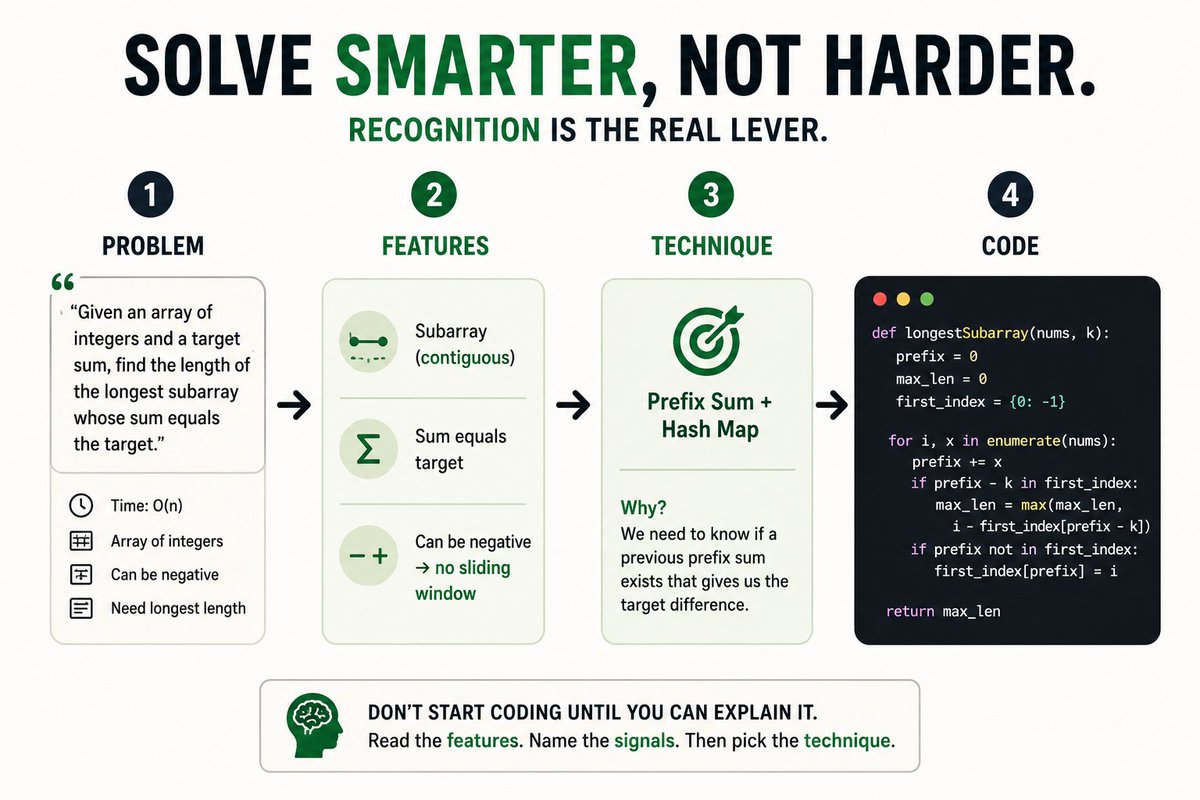
Most candidates don't struggle because they haven't solved enough problems.
They struggle because they haven't trained pattern recognition under interview conditions.
You've solved 200 LeetCode problems.
Then a medium shows up in an interview and you still freeze on:
"What kind of problem even is this?"
At some point, the bottleneck stops being solving more problems.
The bottleneck becomes pattern recognition.
One of the biggest interview mistakes we see:
Candidates can solve the problem, but struggle to explain why the solution is correct.
This thread breaks down a practical way to think about correctness arguments.
You've finished the algorithm in eight minutes.
The interviewer asks:
"Ok, but how do you know this works for every input?"
You start pointing at the code.
Pointing isn't an argument.
And suddenly you realize nobody taught you how to explain algorithm correctness.
Most DSA prep plans fail for the same reason.
You learn to recognize solutions.
But interviews test whether you can generate them from a cold prompt.
That gap is where most people freeze 👇
If walkthroughs make sense until the interview starts, this will help:
https://t.co/lcnoWQxJAD
(trigger lists, hidden-title protocol, pattern recognition system)